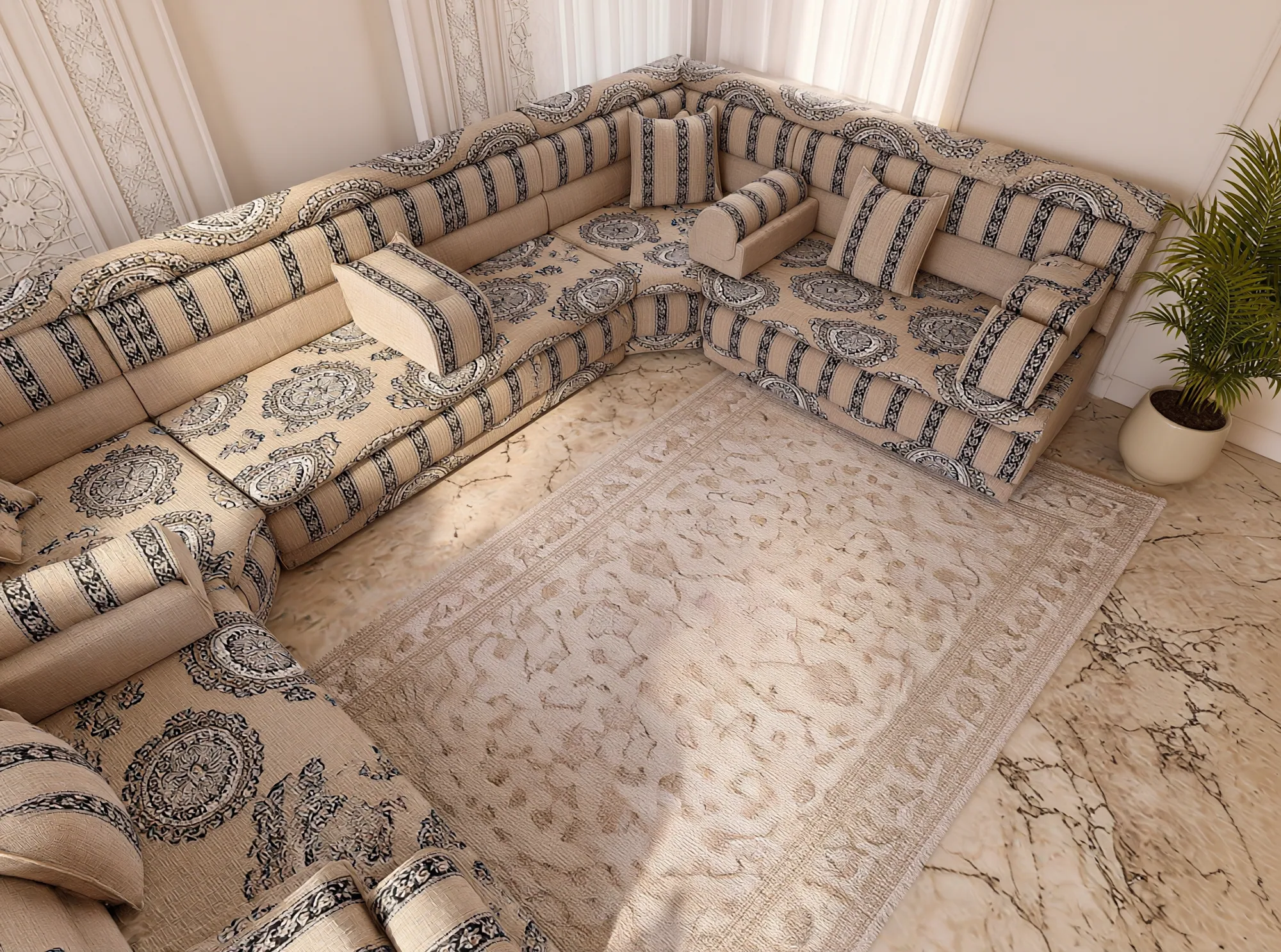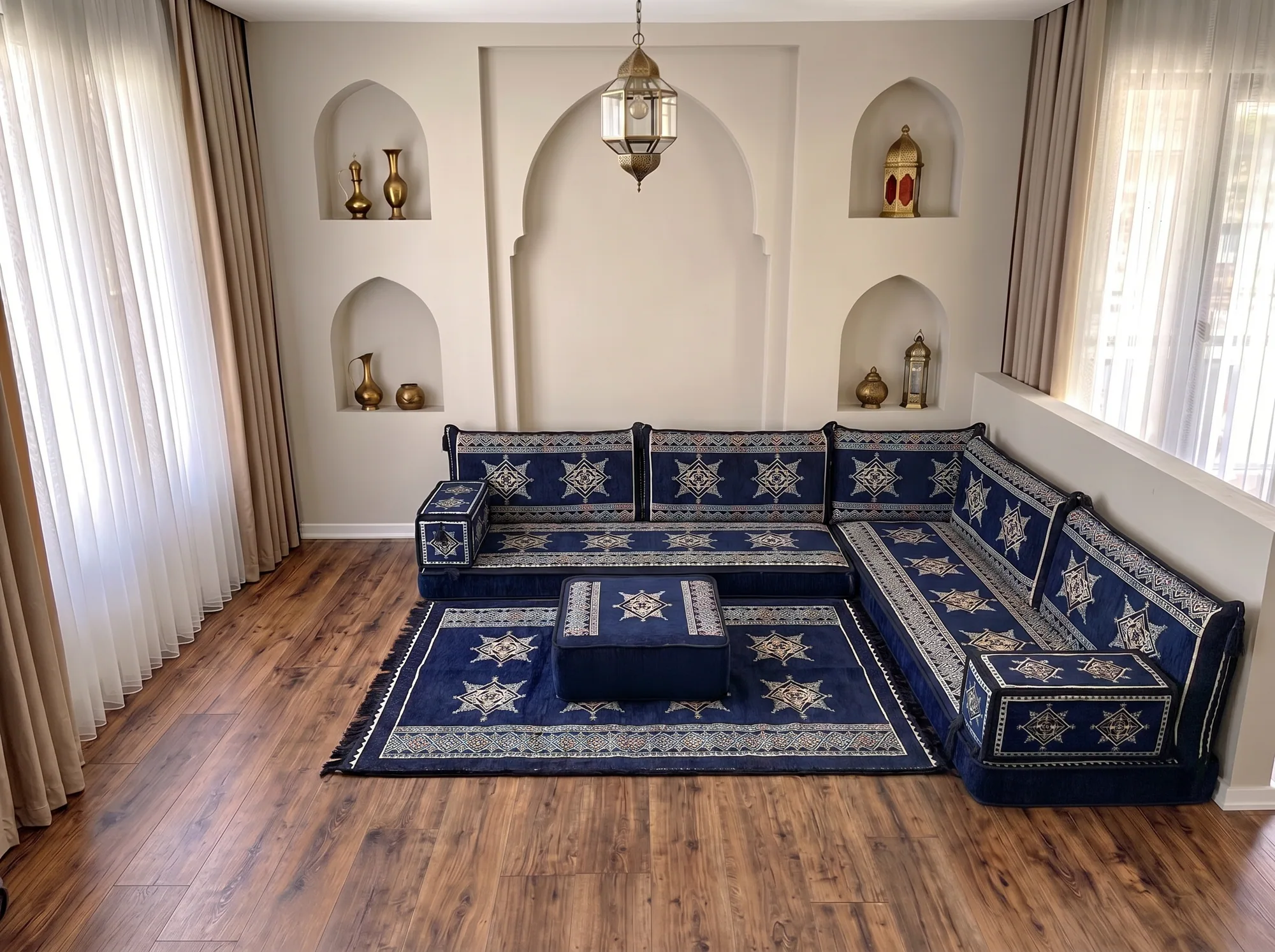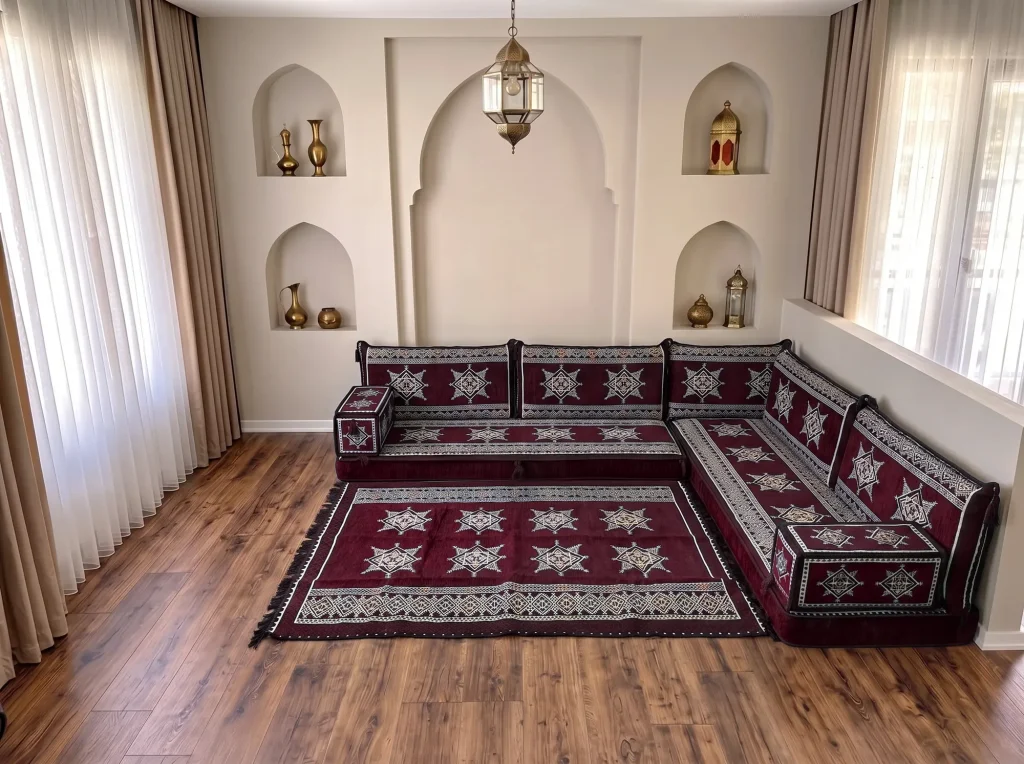
A Yemeni diwan (ديوان يمني) is the large sitting room of a Yemeni house, and the mafraj is the top-floor room with wide, low windows where family and friends gather in the afternoon. Both are furnished with seating around the walls. Sofhu makes Yemeni-style floor sofas in Türkiye to your wall measurements, with 32 kg/m³ foam and free worldwide shipping.
- Arabic
- ديوان يمني (diwan yamani), مفرج (mafraj), مجلس يمني
- Mafraj
- Top-floor social room with low windows on three sides
- Diwan
- The larger sitting room of the same house
- Maqil
- The afternoon gathering held in these rooms
- Filling
- 32 kg/m³ (32 DNS) high-density foam, no springs
- Layouts
- Single run, L-shape or U-shape, cut to the room
- Shipping
- Free worldwide from Türkiye
On this page
- Diwan, mafraj, majlis: three words for Yemeni seating rooms
- What the mafraj looks like
- The afternoon maqil and why the seating is built for hours
- Yemeni furniture abroad: who orders it and for which rooms
- Star motifs, medallions and colour
- What comes in a Sofhu Yemeni set
- Ordering Yemeni seating from Sofhu
People who type “Yemeni diwan” into a search box usually want one of two things. Some want to know what the word means in a Yemeni house. Most want the furniture: the long, cushioned Yemeni seating that lines the walls of the room where the family receives its guests. This page answers both, starting with the rooms and ending with how to order a set for a house in Dearborn, Birmingham or anywhere else.
If you only need the product range, our existing Yemeni majlis from Sofhu page is the place to go.
Diwan, mafraj, majlis: three words for Yemeni seating rooms
The diwan and the mafraj are two rooms of the same house. In the tower houses of old Sana’a, the mafraj is the social room on the top floor. Its wide windows look out over the city, and it is the preferred place to sit with friends and family in the afternoon and early evening. It is often the most ornate room in the building, finished with gypsum plasterwork and inscriptions. The family’s quarters lie on the floors below.
The diwan is a sitting room in the same kind of house, usually the larger one. The plural, dawawin, is the word used for the rooms where group gatherings are held. Majlis yamani is the broad term that most buyers abroad use for the room and for the set in it. The afternoon gathering itself has its own name, the maqil.
So when someone asks for a Yemeni couch or a Yemeni sofa, they mean seating built for these rooms: low, continuous, and made for sitting a long time in company.
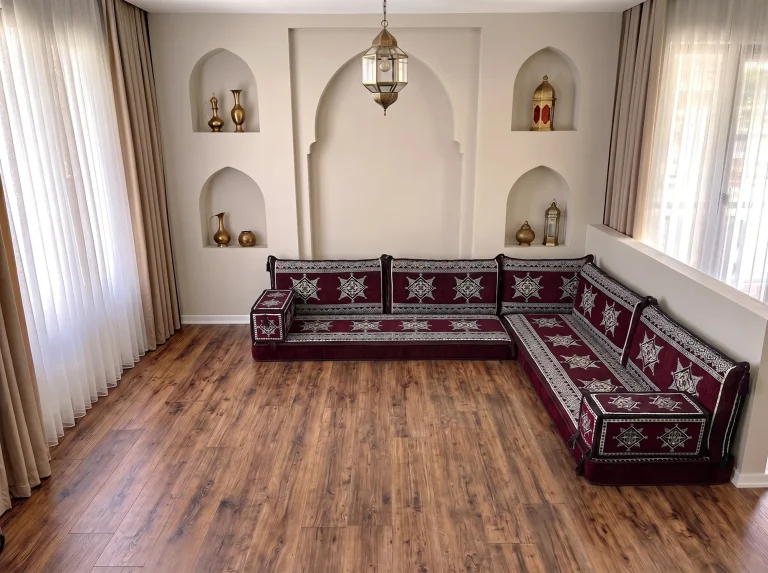
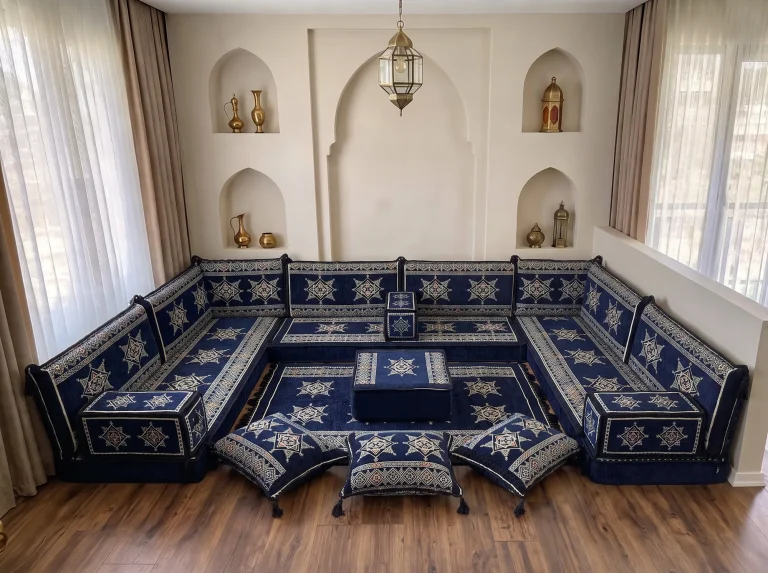
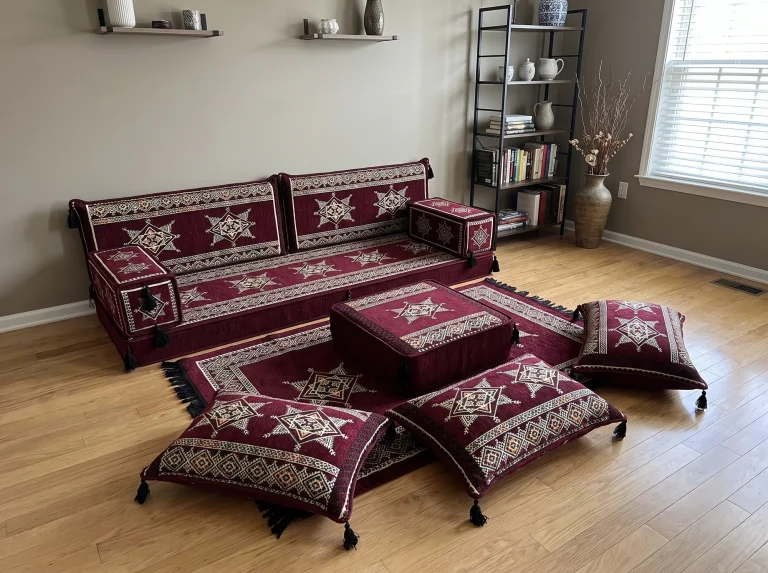
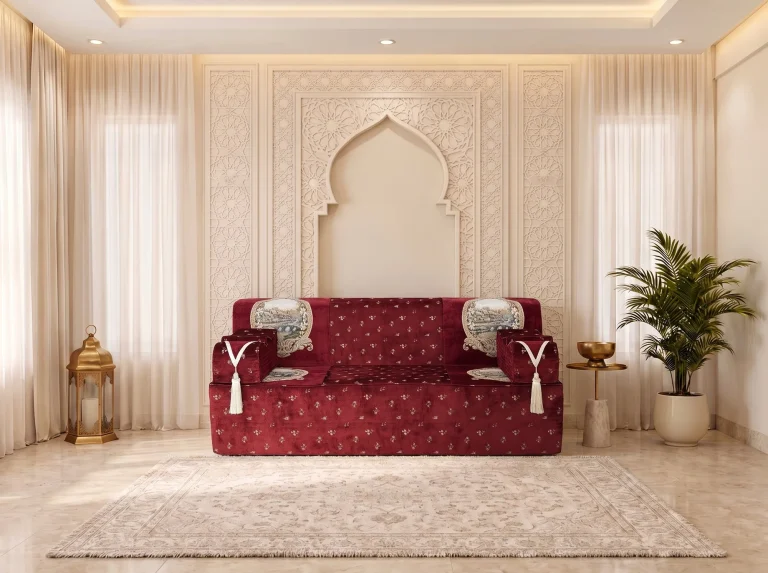
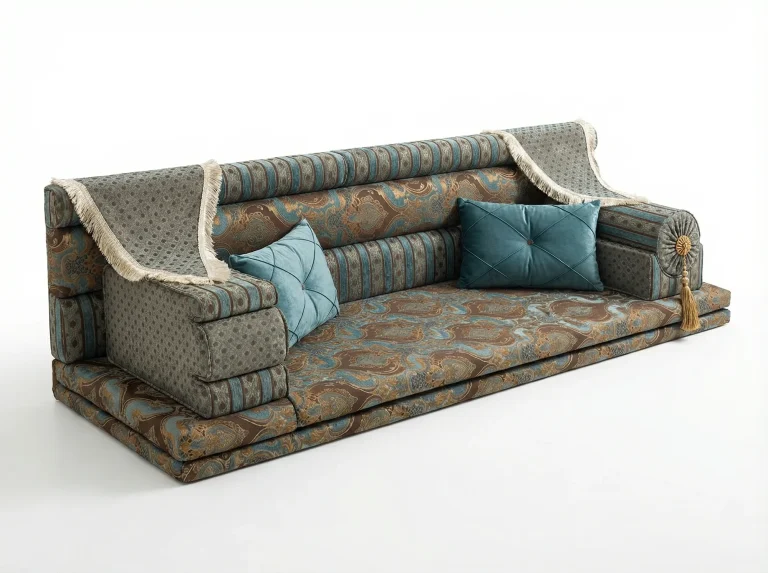
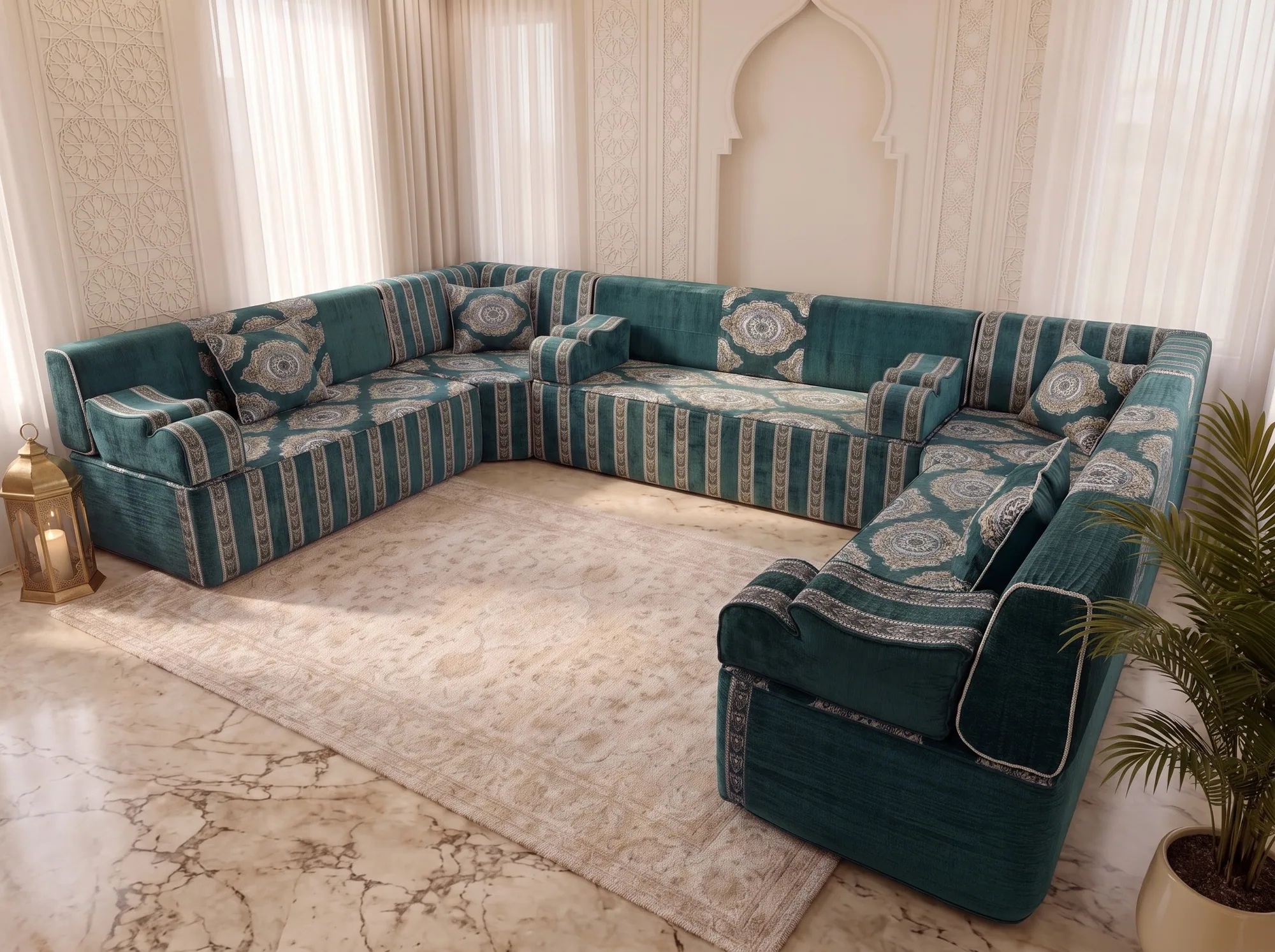
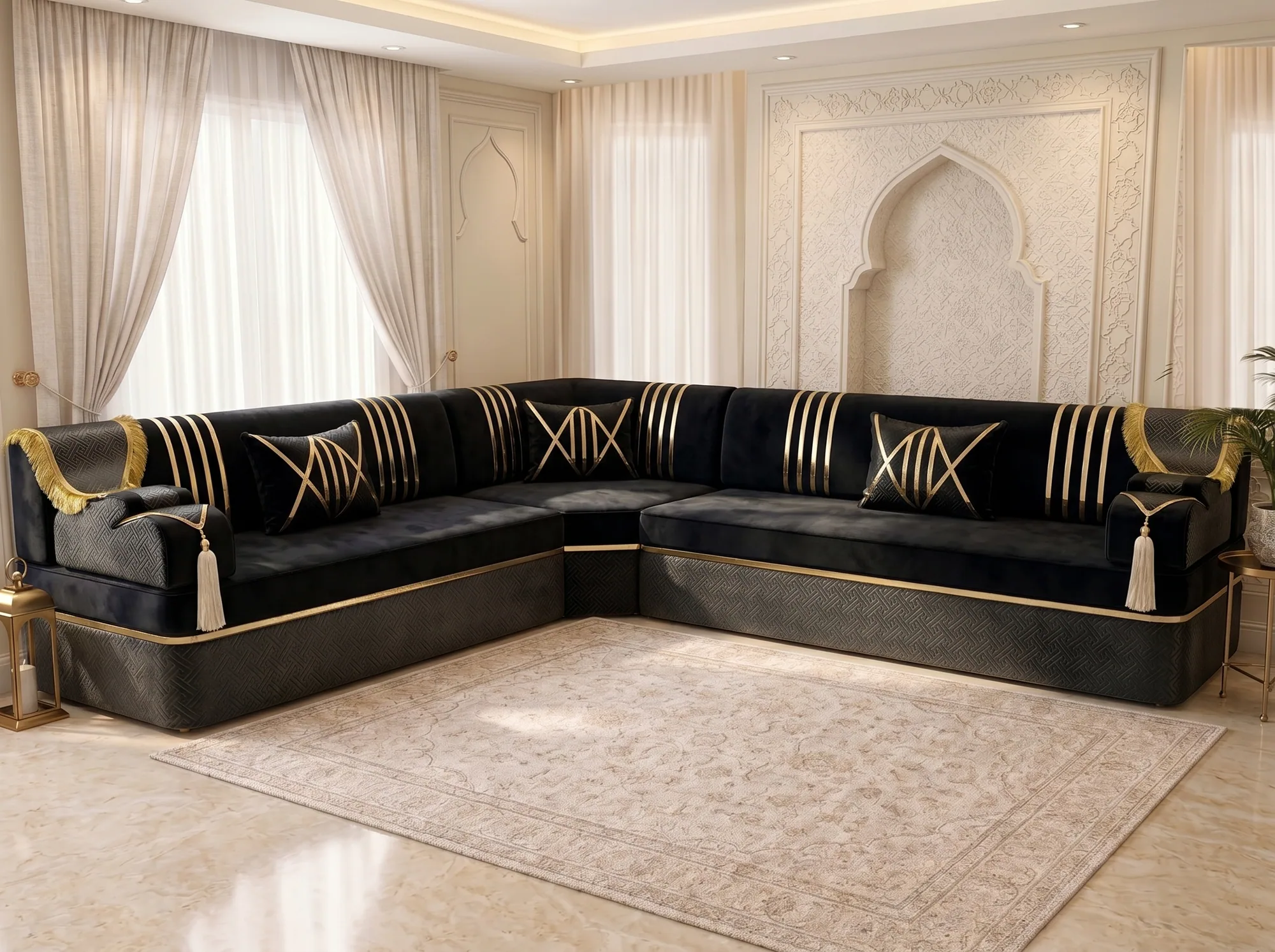
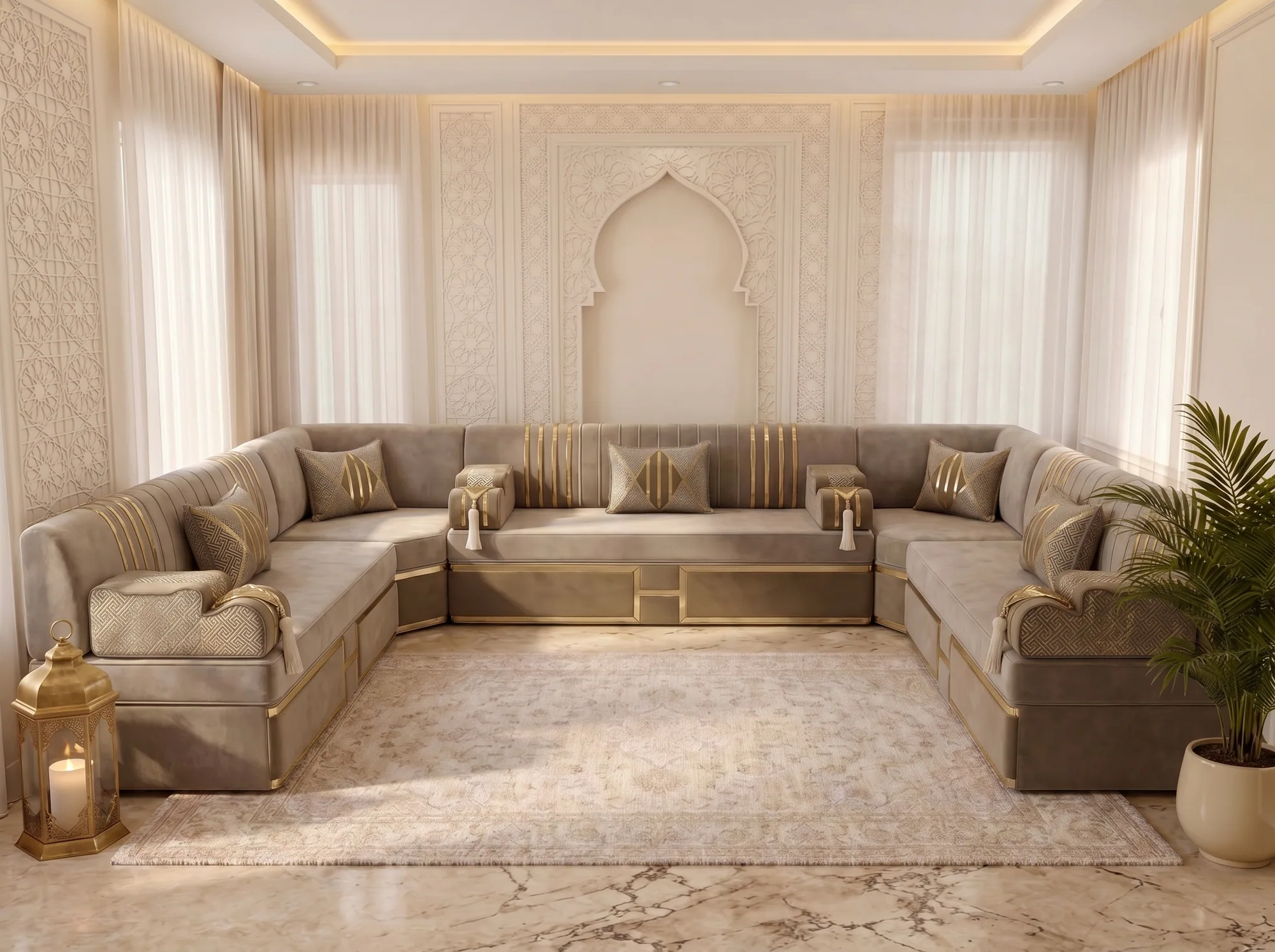
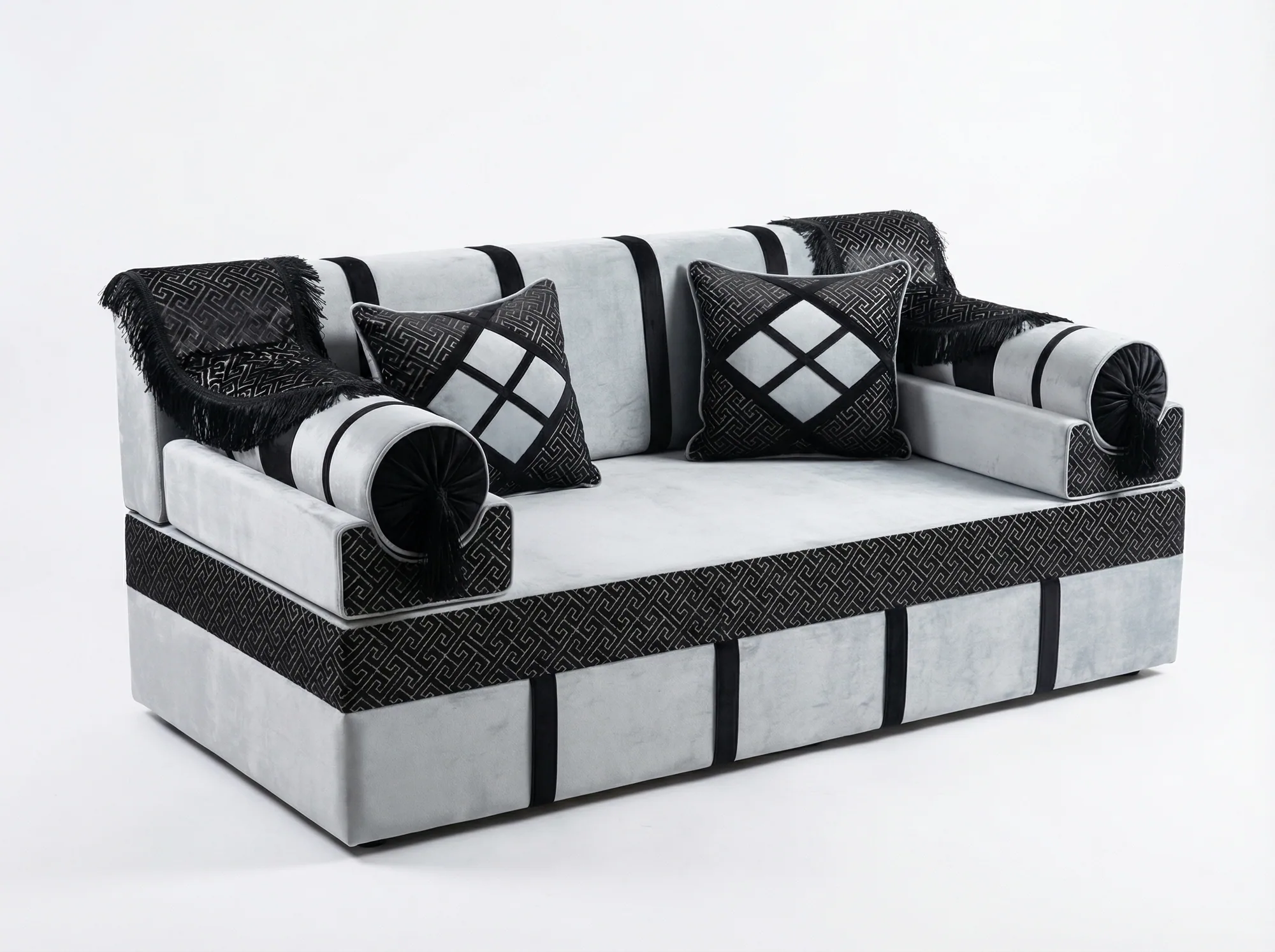
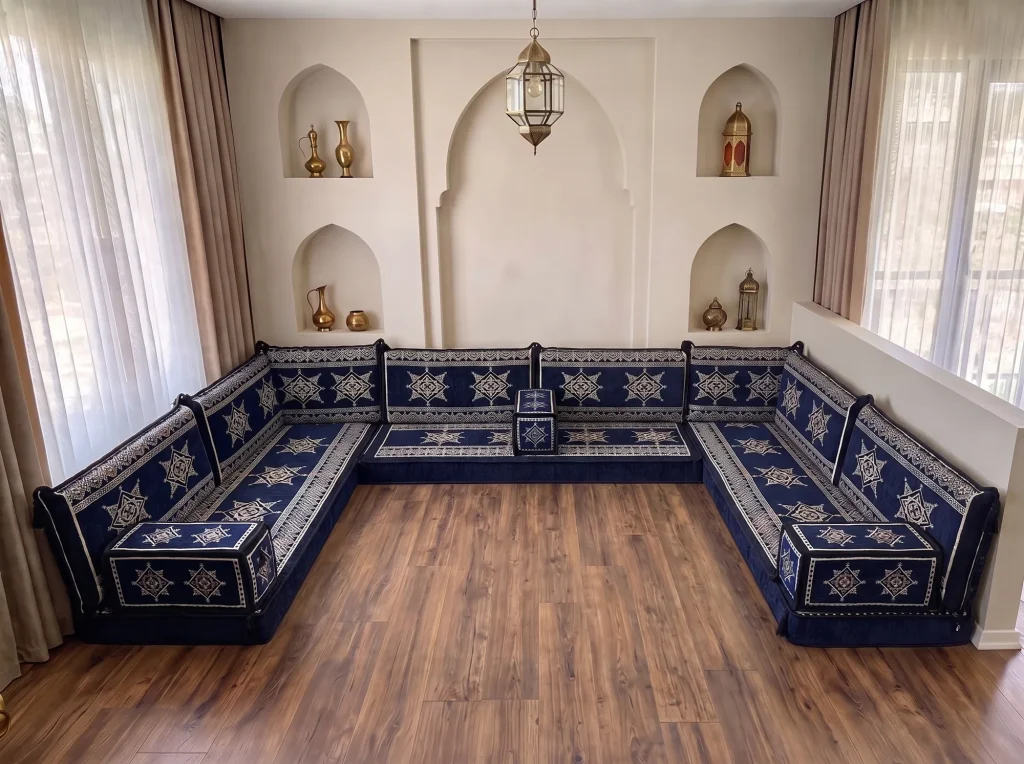
In Sofhu’s range that is the Arabic floor sofa: a seat mattress at floor level with loose back cushions, armrest blocks, an ottoman and floor pillows, like the star-pattern sets on this page. Sofhu also makes the Arabic majlis, raised and fully upholstered seating at sofa height, for families who want the room more formal or easier on the knees.
What the mafraj looks like
The mafraj is designed around a seated person’s line of sight. The windows are set low on three sides, so guests on the floor can look out without standing. Above them are fanlights of coloured glass set in gypsum tracery, which throw patches of colour across the room as the sun moves. Rooftop rooms in Sana’a are described with soft seating running wall to wall and low tables in front.
Two things follow for anyone furnishing such a room today:
- The seating has to stay below the window sills, or it blocks the view the room was built for.
- The room is used for hours at a stretch, so comfort over a long sitting matters more than first impressions.
Written accounts of the mafraj describe its windows and plasterwork in detail and say much less about its cushions. We will not invent a standard that the sources do not give. What we can do is build to the room you have.
The afternoon maqil and why the seating is built for hours
The maqil sets the pace of a Yemeni sitting room. It is the afternoon gathering of friends and family, and it can run on into the early evening. A seat that feels pleasant for twenty minutes and tired after two hours has failed.
This is where foam matters. Sofhu cushions are filled with 32 kg/m³ (32 DNS) polyurethane foam, with no springs inside. Density is the amount of material in the cushion, not how hard it feels. Denser foam generally keeps its height and support longer than light foam, and low-density foam can feel firm when new yet recover less well from being sat on. On a custom order you can ask for a softer or firmer feel. For the detail, see what foam density is best for floor seating.
Armrests are the other half of long-sitting comfort. People lean on one elbow, shift, and lean again. Our guide to how many backrests and armrests a majlis needs helps you count them for your room.
Yemeni furniture abroad: who orders it and for which rooms
Yemeni families living abroad are the readers this page is mainly written for. In the United States that means communities in Michigan, around Dearborn, Hamtramck and Detroit, in New York, in the Bronx, Brooklyn and Lackawanna, and in California’s Central Valley and the Bay Area. In the United Kingdom there are long-established Yemeni communities in Birmingham, Sheffield, South Shields, Liverpool and Cardiff.
The rooms are different from a Sana’a tower house, and the layout has to change with them:
| Room | What usually fits | Watch for |
|---|---|---|
| Front room of a terraced house | L-shape on the two unbroken walls | Radiators and the bay window |
| Basement of a detached house | U-shape on three walls | Support posts, low windows |
| Apartment living room | Single run or short L | Balcony door, sockets |
| Dedicated guest room | Full U-shape | Door swing, wardrobe doors |
A converted basement is the nearest thing many North American homes have to a diwan: a separate room, away from the family’s daily space, large enough for a wedding week or Eid. Our basement majlis ideas post covers it. For measuring any of these rooms, follow how to measure a room for a majlis.
Star motifs, medallions and colour
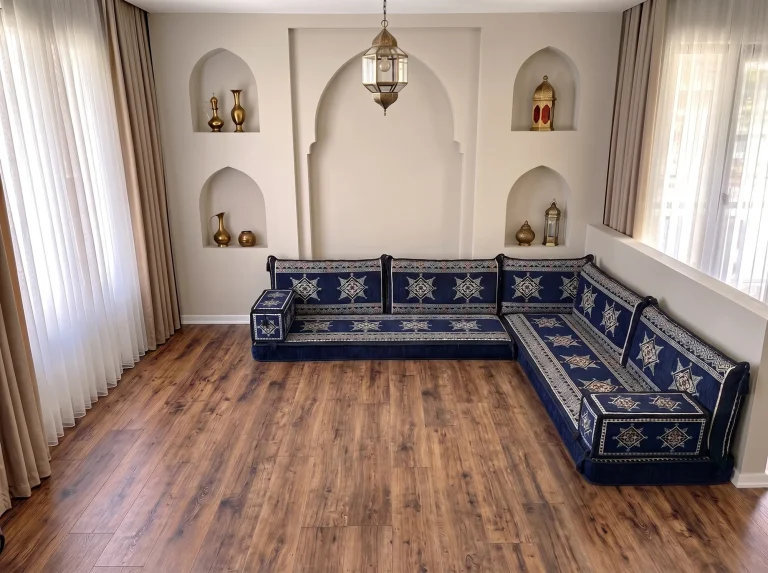
Many of the Yemeni-style floor sofas in Sofhu’s range carry an eight-point star. The burgundy floor sofa at the top of this page has cream stars on the seats and backs, and a matching fringed rug repeats them in two rows. The navy version does the same in blue and cream.
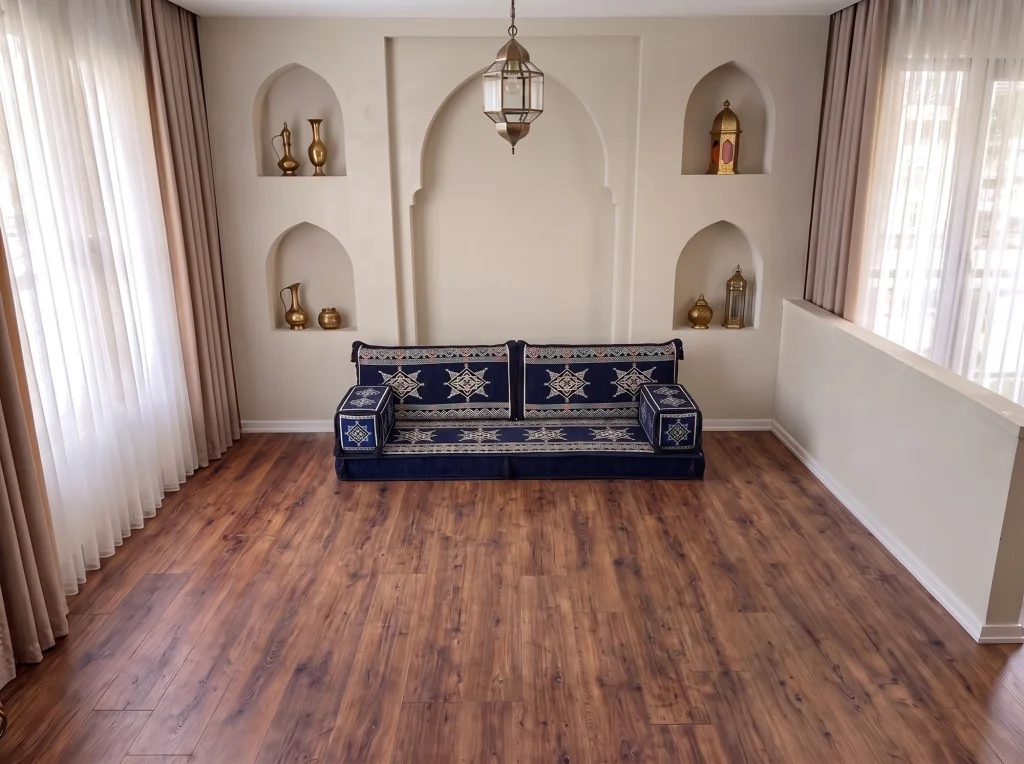
We describe the star as a Sofhu design, not as a documented Yemeni heritage pattern, because we have not found a source that names one. Textile sources link Yemen historically with striped and ikat cloth. If your family remembers a particular fabric, send a photo.
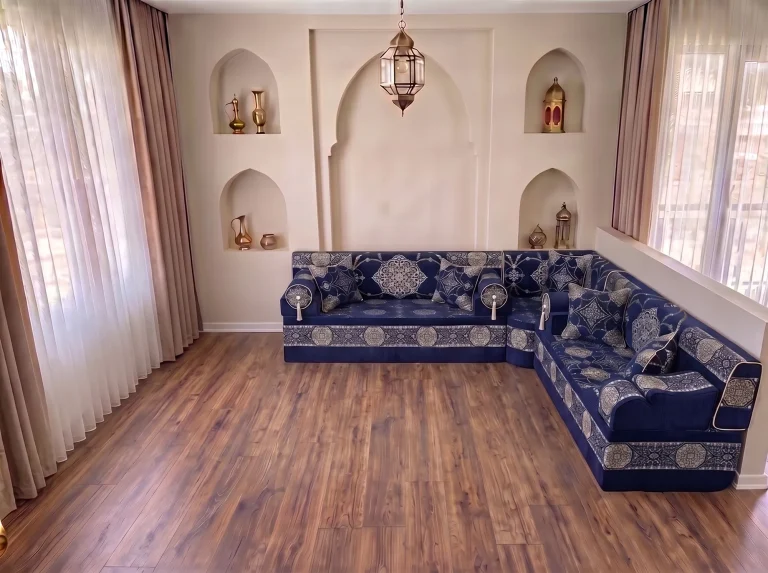
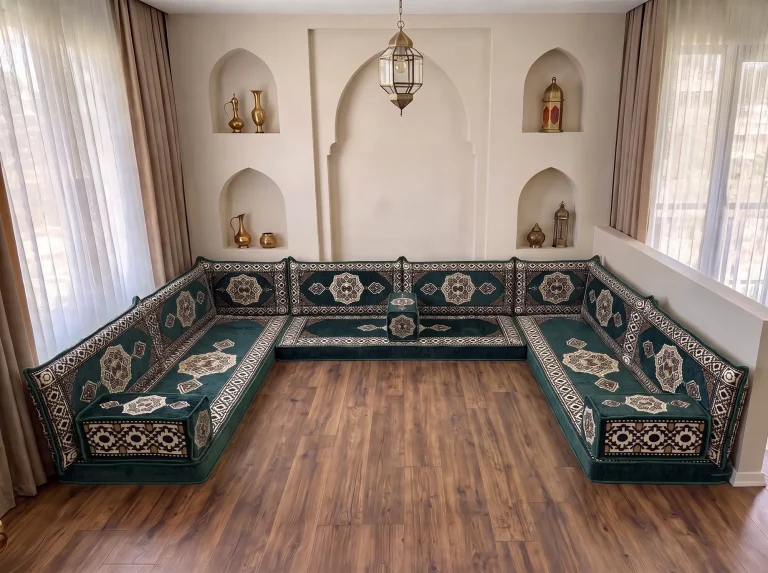
Medallion fabrics are the main alternative. They read as more formal, and in emerald green or navy they suit a room kept for guests.
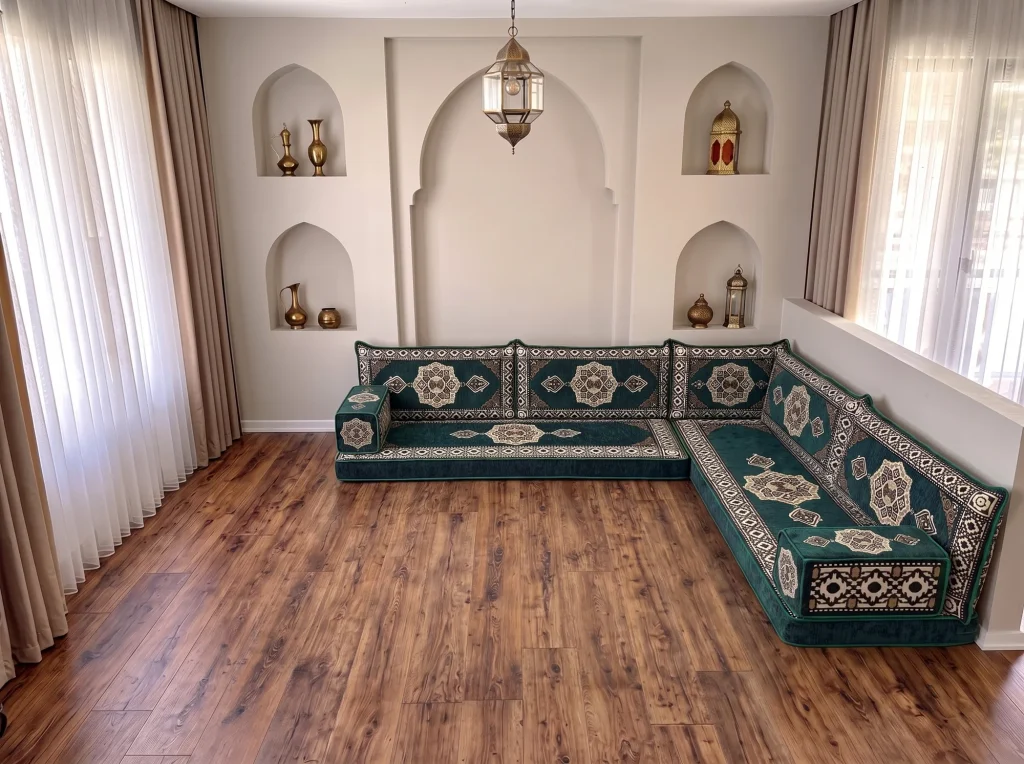
Deep colours are practical as well as traditional in feel: burgundy, navy and green hide the marks of a busy room better than cream. All covers are zippered and can be removed and washed at 30°C. More on the motifs is in majlis patterns and motifs.
What comes in a Sofhu Yemeni set
A Yemeni set is more than the seats. The full-room sets Sofhu makes can include:
- Seat mattresses along each wall
- Backrests and throw pillows
- Armrests
- A matching carpet or kilim
- Curtains
- An ottoman
- Wall decor
You can take the whole room or only the seating. The pieces are modular, so a U can later be split into an L and a single run if you move house. The seating is not freestanding and needs a wall behind the backrests. Seat thickness can be chosen, which is how the same design is made lower for a window wall or higher for a formal diwan.
Related traditions are close cousins. The Saudi majlis of the Asir region shares a wall-painting tradition with northern Yemen, Somali Arabic seating sits just across the Gulf of Aden, and the comparison of Yemeni, Saudi and Moroccan majlis shows how to tell them apart.
Ordering Yemeni seating from Sofhu
Sofhu is a manufacturer, not a reseller. Each set is made to order in Türkiye and shipped free worldwide. We do not keep shops or stock in Michigan, New York or the UK. You send measurements, we design the set with you, and it is delivered to your door. Design can be discussed by video call with our designers.
Send the length of each wall, the positions of doors and windows, a photo of the room and the model you like. You can do that through get a quote or on WhatsApp. Buyers in the United States can also read our page on Yemeni majlises for the USA, and anyone planning a cafe should see Yemeni coffee house seating. The wider range is on the Arabic majlis and majlis sofa set pages.