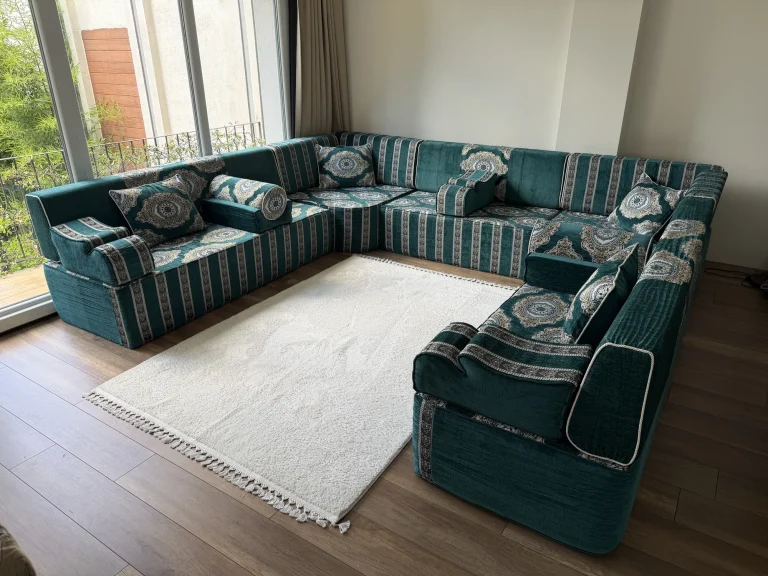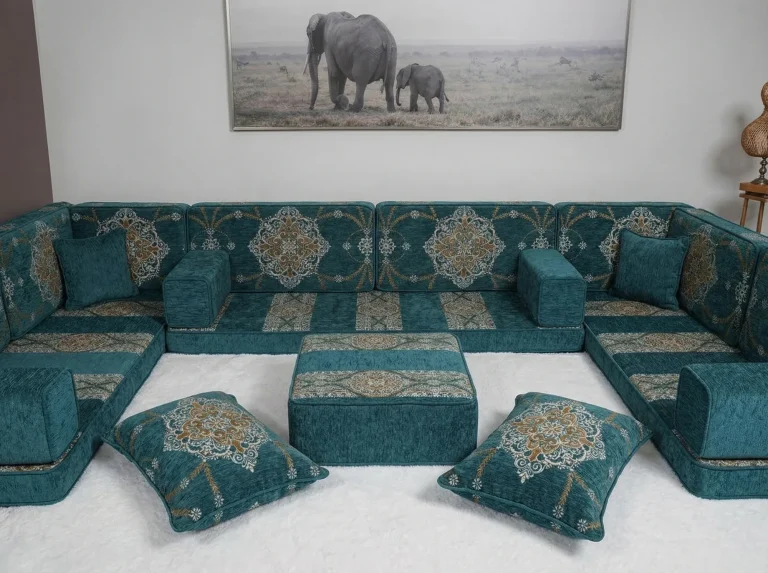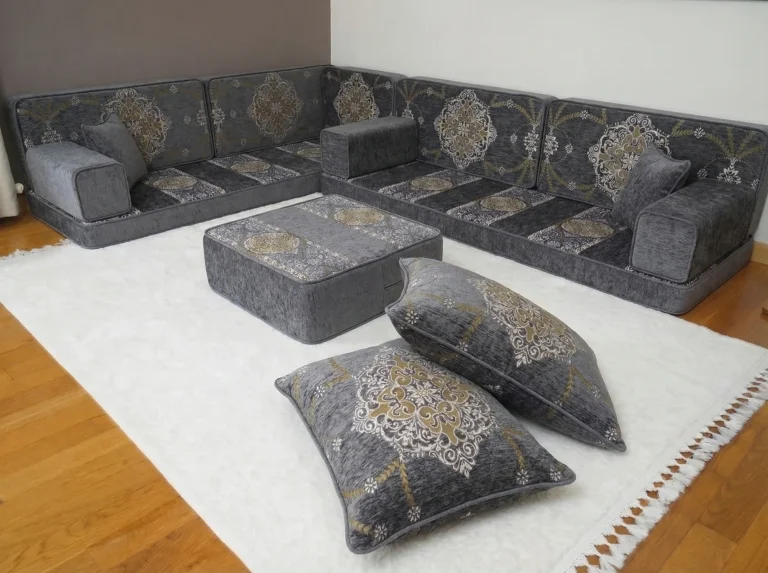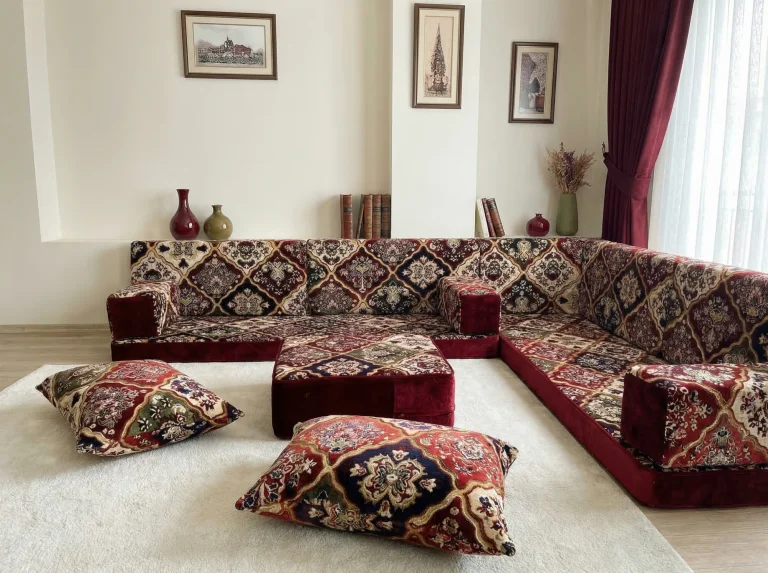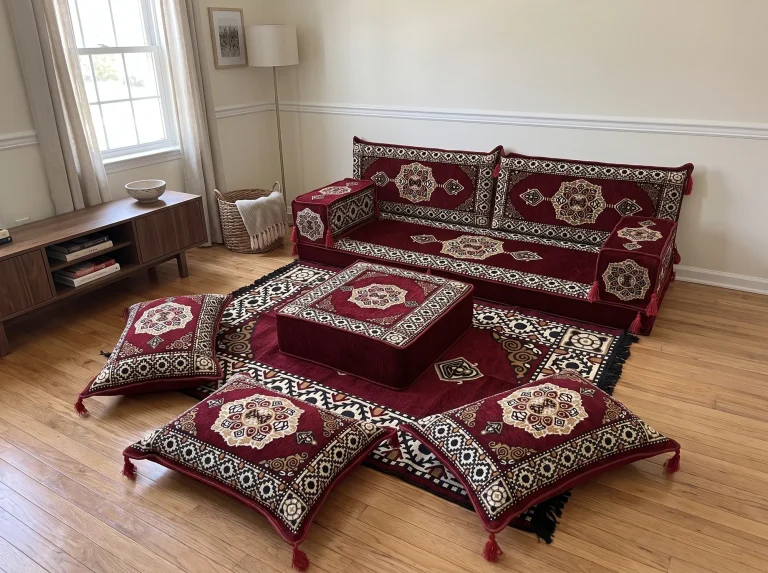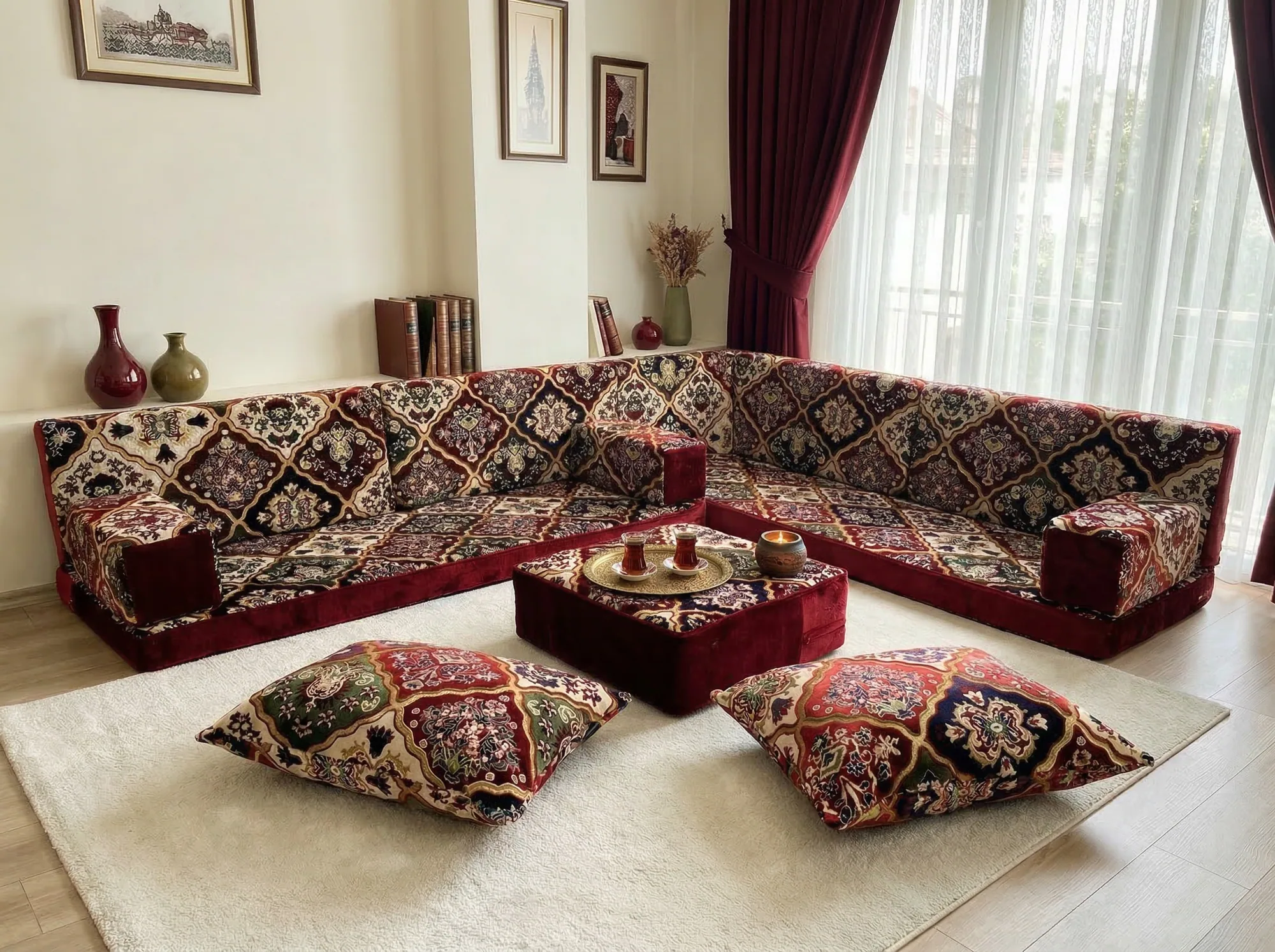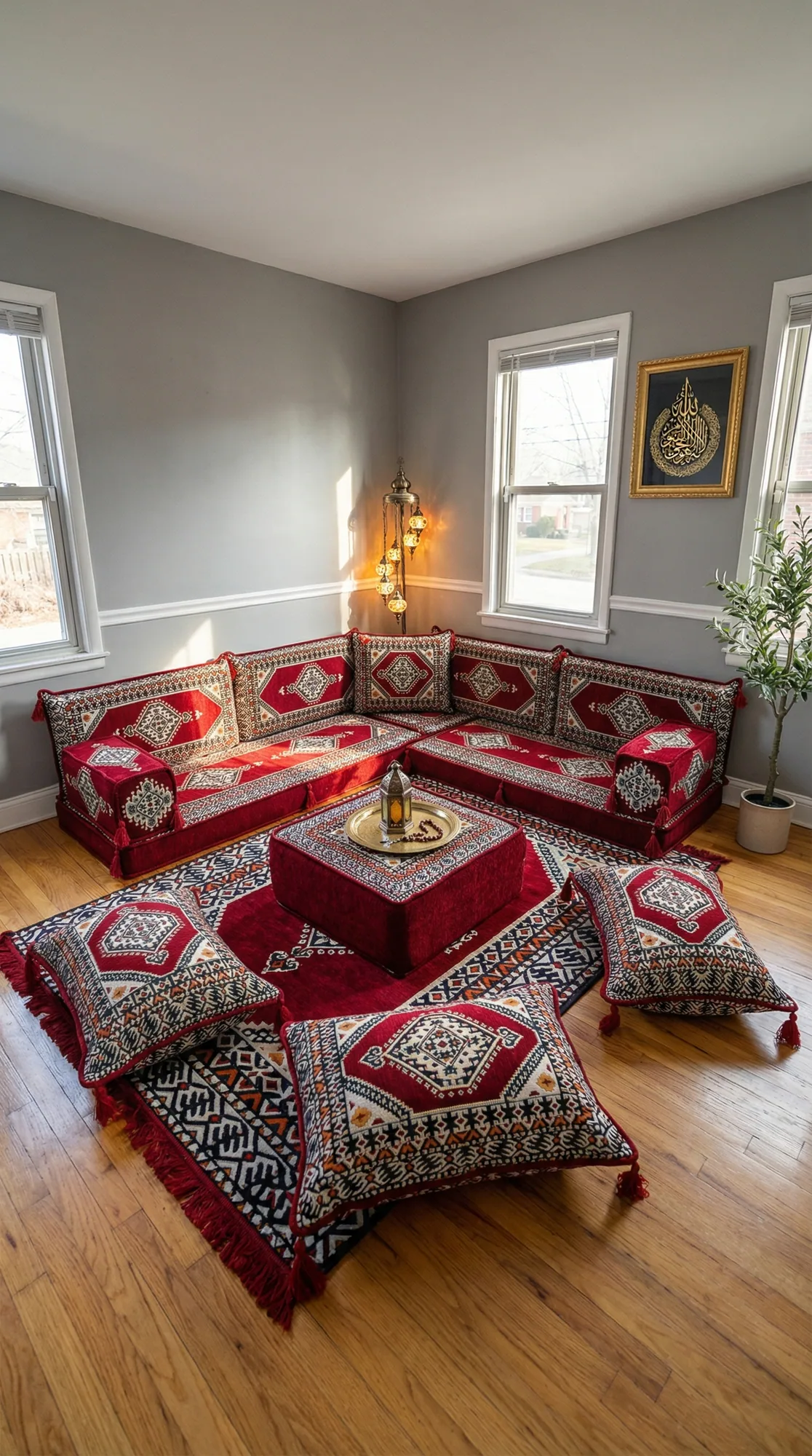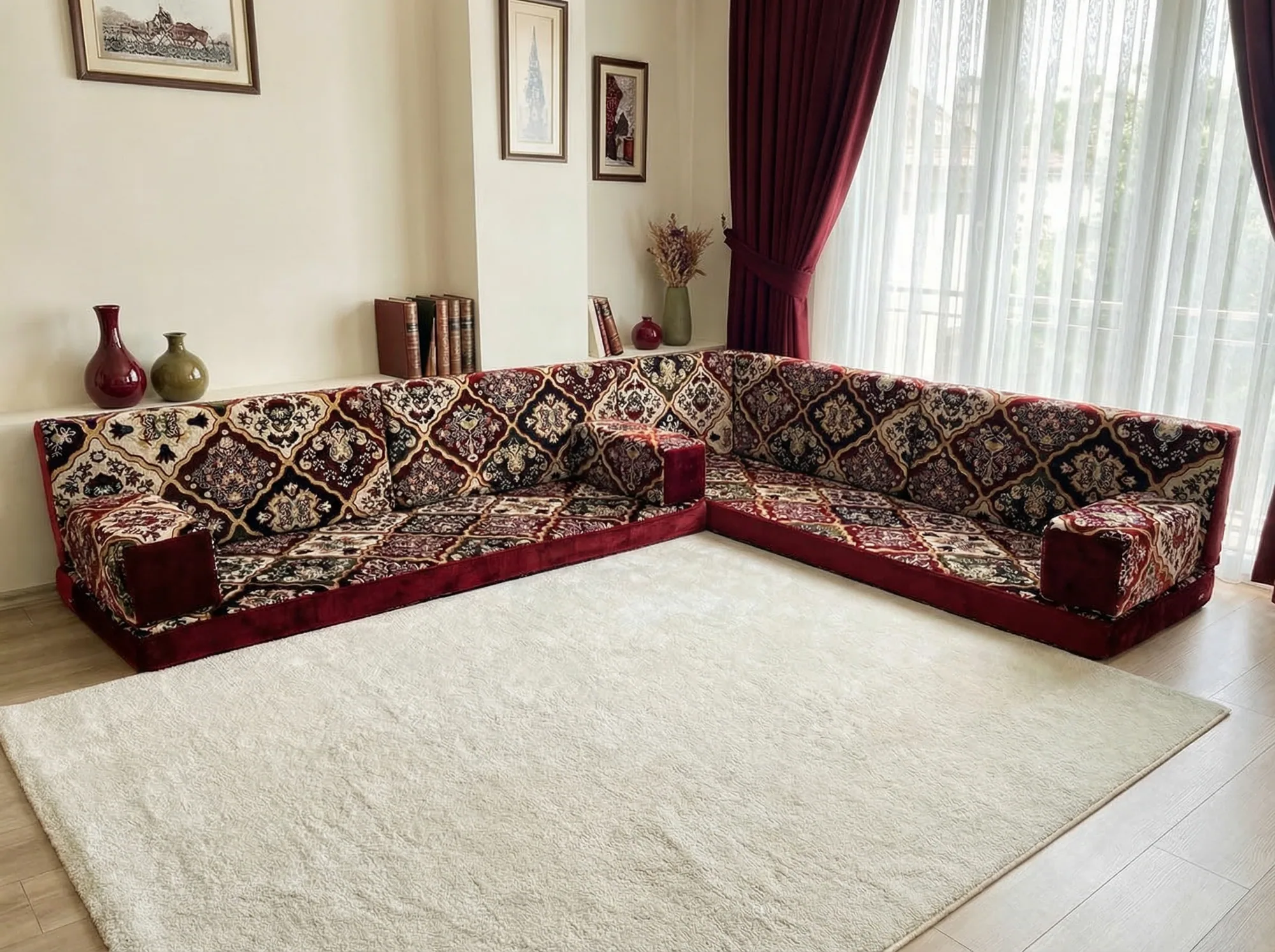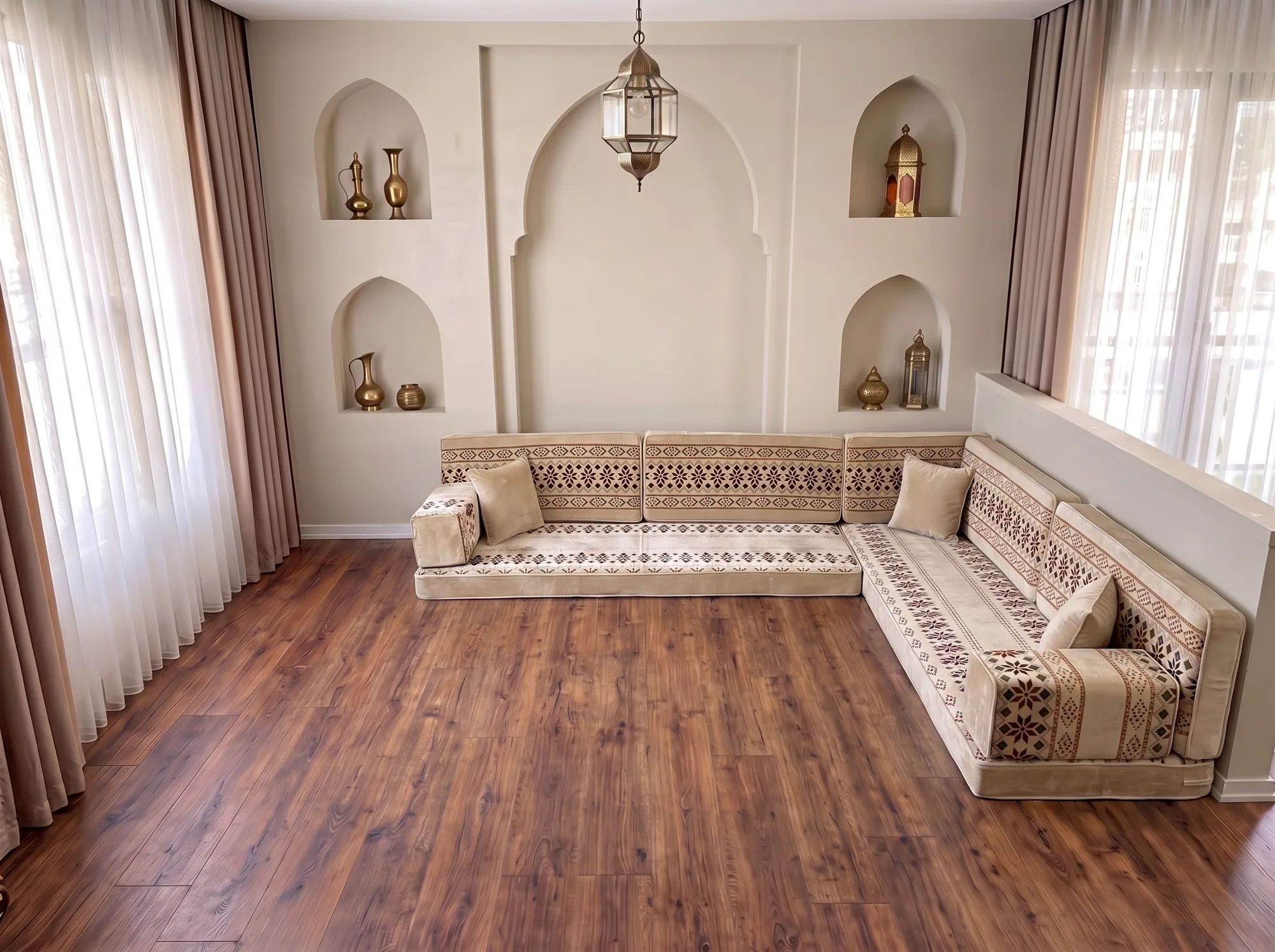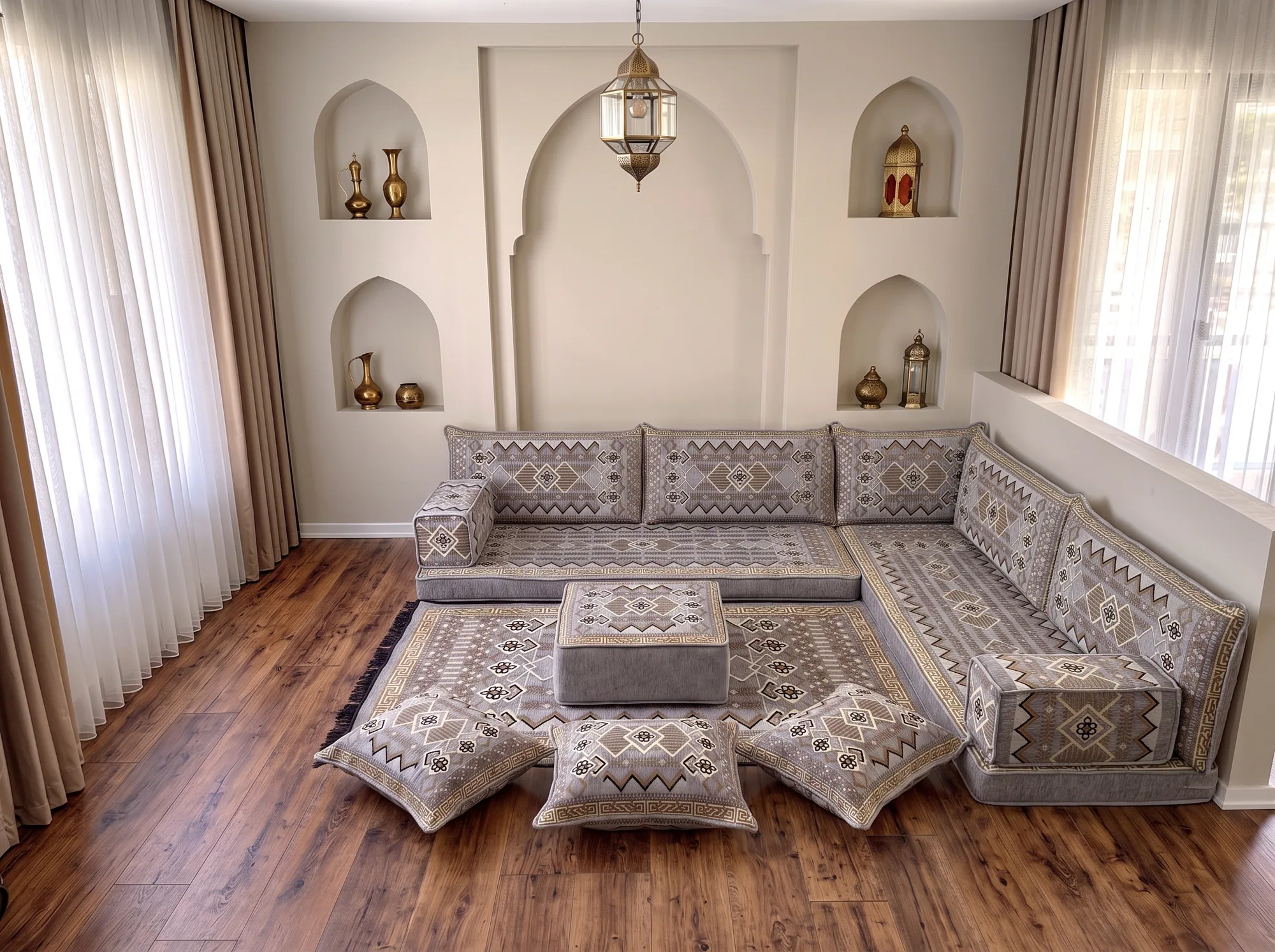
A Middle Eastern sofa is wall-lining seating built from firm seat cushions, backrests and armrests that line the walls of a room. Sofhu makes two kinds: the Arabic floor sofa, a cushion set at floor level, and the Arabic majlis, a raised, fully upholstered set. Both are manufactured in Türkiye to your room measurements and shipped free worldwide.
- Also called
- Arabic sofa, floor sofa, oriental sofa; the raised kind is a majlis
- Seat level
- Floor sofa at floor level; majlis raised on an upholstered base
- Layouts
- Single row, L shape, U shape
- Foam
- 32 kg/m³ (32 DNS) high-density foam
- Covers
- Zippered, removable, washable at 30°C
- Sizing
- Made to your wall measurements
- Made in
- Türkiye
- Shipping
- Free worldwide
On this page
If you have sat in a home where the sofas run along the walls at floor level, with thick cushions to lean on and the middle of the room left open, you have seen a Middle Eastern sofa. You may not have had a name for it. This page gives you the names, shows how the styles differ from one region to the next and explains how to order a set that fits an ordinary living room.
What a Middle Eastern sofa is
A Middle Eastern sofa is modular low seating made of three kinds of cushion. A firm seat cushion lies on the floor or on a low base. A backrest stands between the seat and the wall. Armrests mark the ends of a run and divide one place from the next.
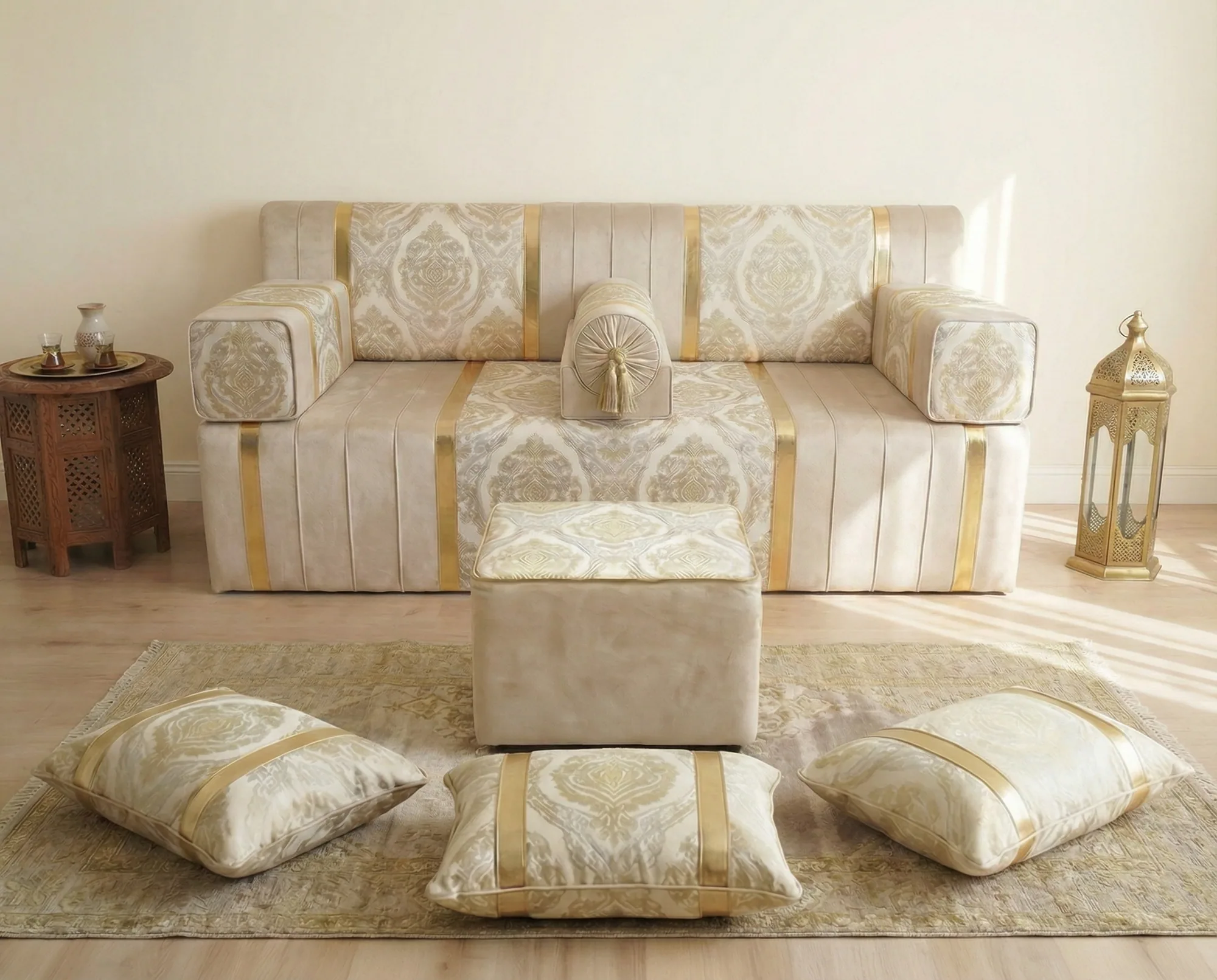
On a floor sofa there is no frame holding the pieces together, so the set is arranged to the room: along one wall, around a corner or around three walls. The ivory and gold floor sofa at the top of this page is the smallest version, a single sofa unit with a pouf and three floor cushions.
Sofhu makes two products under this heading, and most of this page is about the first. The Arabic floor sofa is the low set described above: a seat mattress on or near the floor, loose back cushions and armrest blocks. The Arabic majlis is raised to sofa height on a solid upholstered base, with tall fixed backs and arm bolsters.
Two things set the floor sofa apart from Western furniture. It needs a wall behind it, because the backrests lean rather than stand on their own. And it is sized by the metre of wall rather than sold as a two-seater or three-seater.
The names it goes by
The furniture has a different name in almost every country, which is why English speakers often search for a “Middle Eastern couch” instead.
| Name | Where it is used | What it means |
|---|---|---|
| Majlis | The Gulf, Yemen; understood everywhere | The guest room, and its seating |
| Jalsa | Gulf and Levant shops | The seating set itself |
| Diwan | Yemen, Iraq, Kurdistan, Türkiye | A reception room or a long seat |
| Toshak | Afghanistan | The floor mattress |
Sofhu’s own article on what an Arabic sofa is covers the basics, and the guide to floor seating names by country lists the rest, from sedari to poshti.
Middle Eastern seating styles by region
“Middle Eastern furniture” covers several distinct traditions, and they are not all floor-level.
The Gulf. The majlis is the room for receiving guests. UNESCO, which listed the majlis as a social space in 2015, describes it as typically a large room with carpets on the floor and cushions against the wall. Striped sadu weaving is the textile most associated with it.
Yemen. In the tower houses of Sana’a the social room is the mafraj, on the top floor with wide windows over the city. Seating runs around the whole room. See Yemeni diwan and mafraj seating.
The Levant. The reception room of an old Damascus house has a raised platform lined with a low sofa and cushions, where guests step up after leaving their shoes below. More on the Syrian and Levantine seating page.
North Africa. The Moroccan sedari is the clearest exception to the floor-level rule. It is a wooden banquette that raises the mattress to bench height, set around a central table.
Afghanistan. The toshak is a long, thin floor mattress used for sitting, eating and sleeping, with loose pillows behind it.
Türkiye. The traditional sedir is a raised seat built into the wall under the windows. Today’s version, the şark köşesi, is a corner set of firm cushions in kilim-pattern fabric.
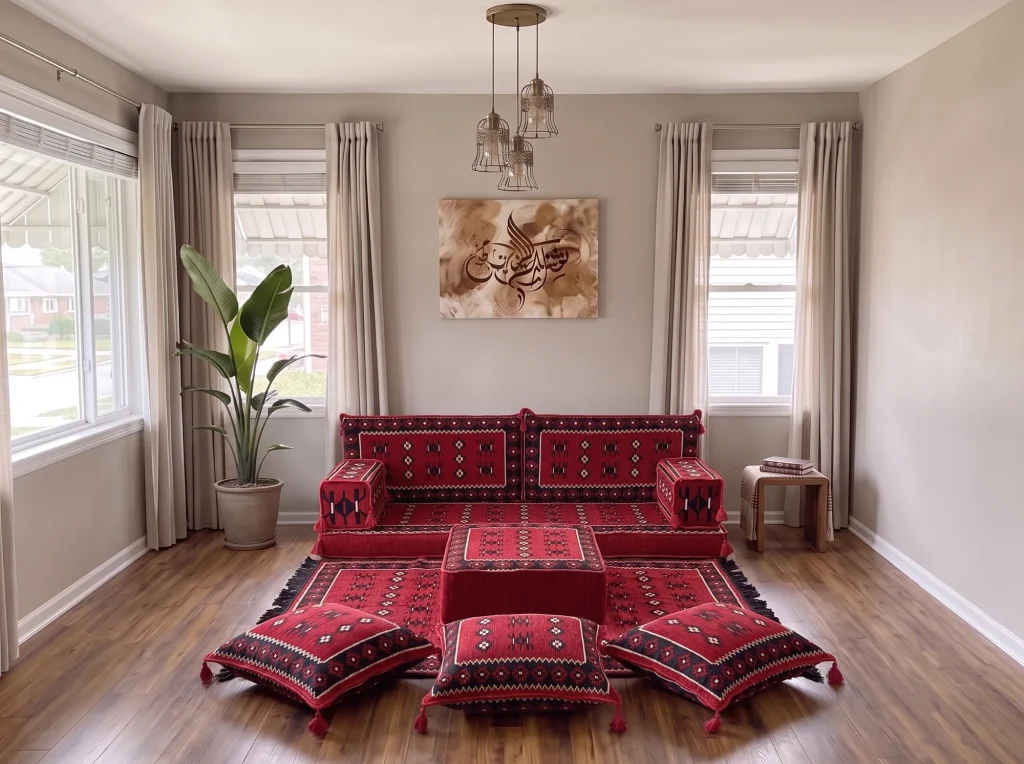
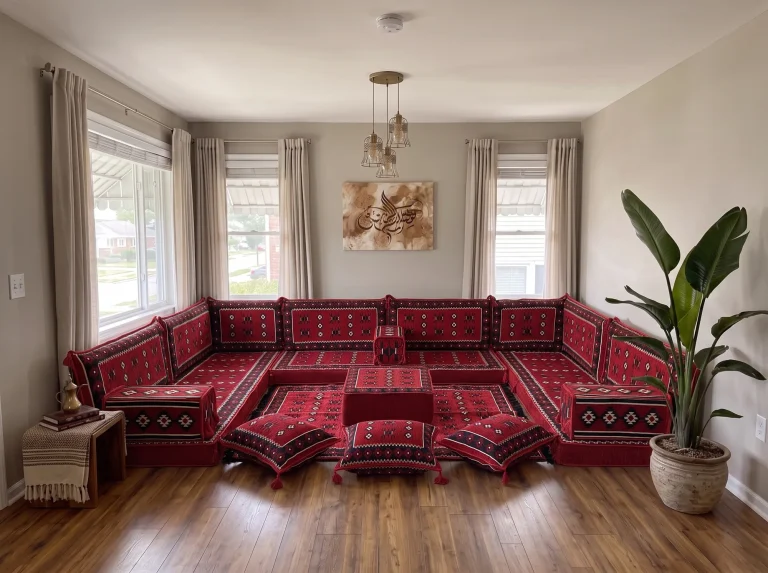
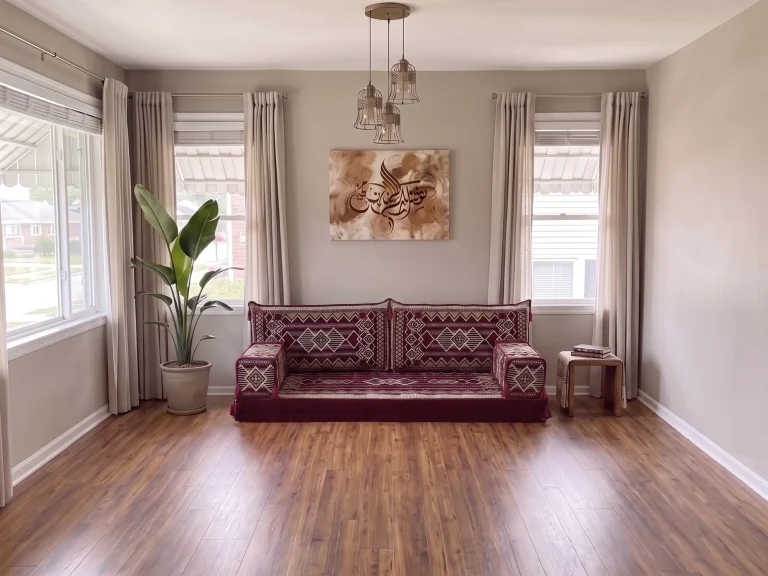
The red floor sofa above uses black and white sadu-style bands. For photographs of older designs, see traditional sofa models from Sofhu, and for the history behind them, the history of the Arabic sofa.
Floor couch or raised couch
Choose by who will sit on it most. A Middle Eastern floor couch is the classic form. It keeps the room open, seats the most people for the wall length and has nothing underneath to scratch a wooden floor. It suits families who already sit on the floor to eat, pray or play with children.
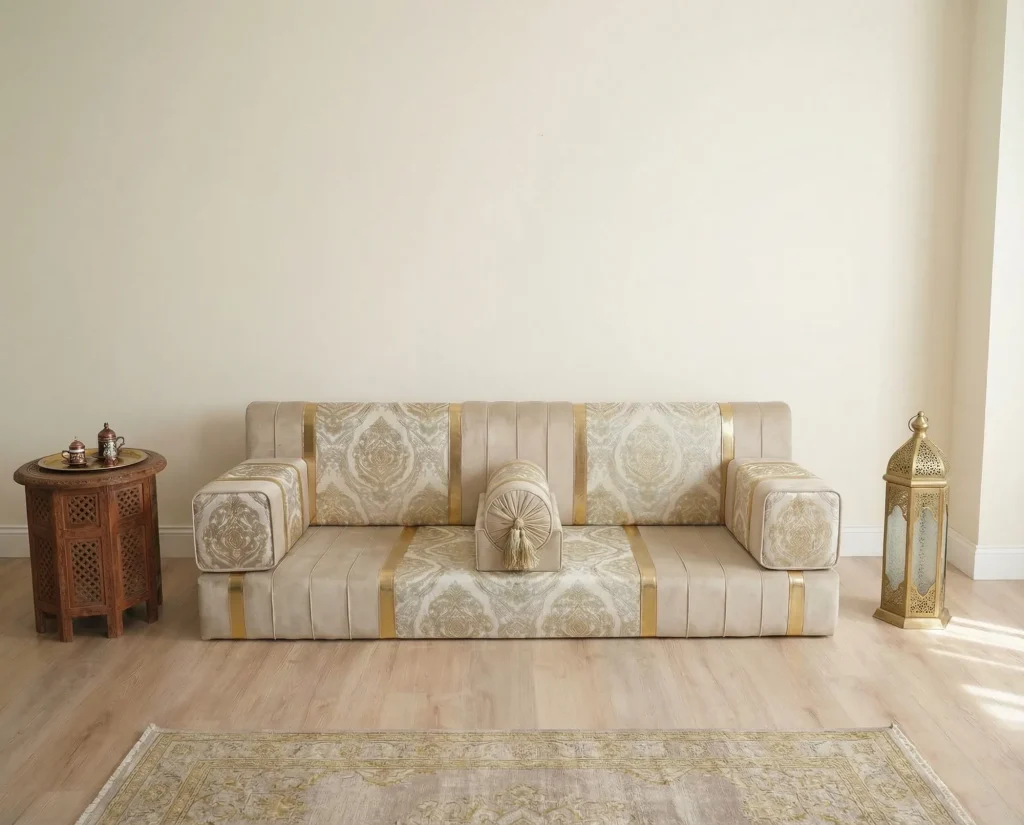
A raised couch suits older relatives and anyone with stiff knees. Sofhu’s Arabic majlis is the raised option: structured, upholstered units at sofa height, usually built as an L or a U for a formal guest room. Sofhu also makes wooden bench-frame sets that lift the cushions off the floor, and a carved-wood Turkish majlis line. Cushion thickness can also be chosen on a floor sofa, which gives a little more height without a frame.
Many homes use both: a floor sofa for most of the room and one raised seat for those who need it. The comparison of a majlis and a sectional sofa sets out the trade-offs for a family deciding between the two.
How a set is made
The quality of Middle Eastern seating is mostly hidden inside the cushion. Sofhu fills its cushions with 32 kg/m³ polyurethane foam and uses no springs. The number is a density: one cubic metre weighs about 32 kg. Denser foam generally keeps its height and support longer than light foam, which matters for a seat that is used every day at floor level.
Each cushion has a zippered cover that comes off for washing at 30°C. Fabrics include velvet, chenille, linen and woven upholstery, and stitching details or embroidery can be specified on custom orders. Sofhu manufactures the sets itself in Türkiye and inspects each one before it is packed. The article behind the craftsmanship follows the process.
Fitting one into a Western living room
A Middle Eastern sofa works in a standard living room if you plan around the walls and the television.
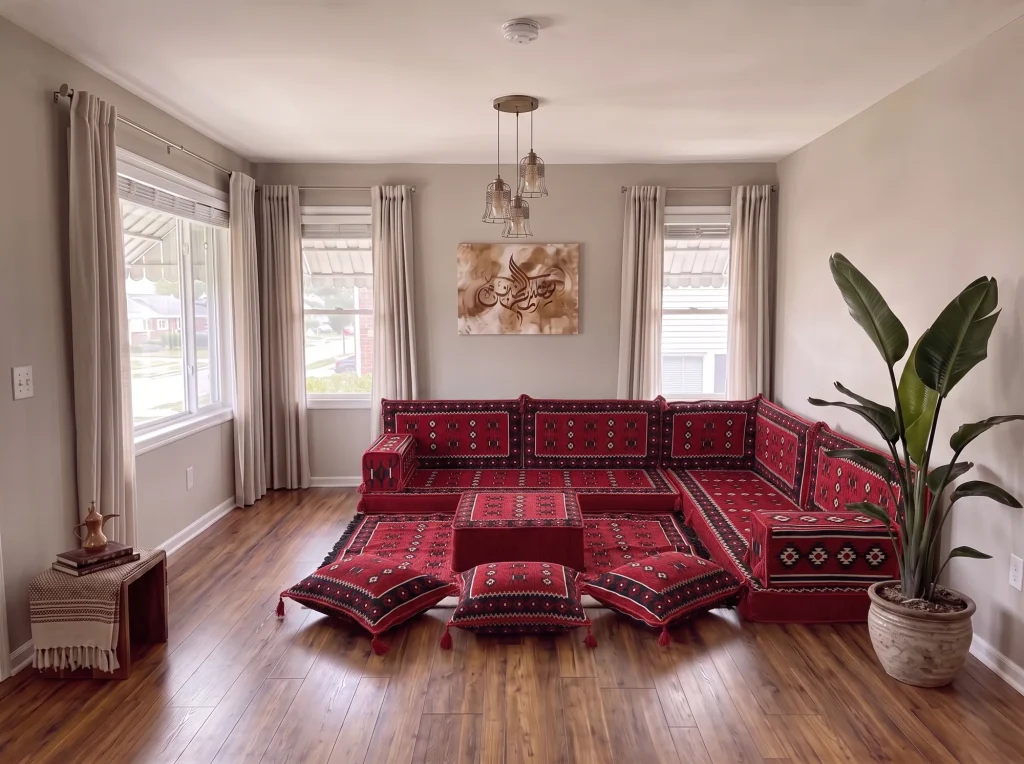
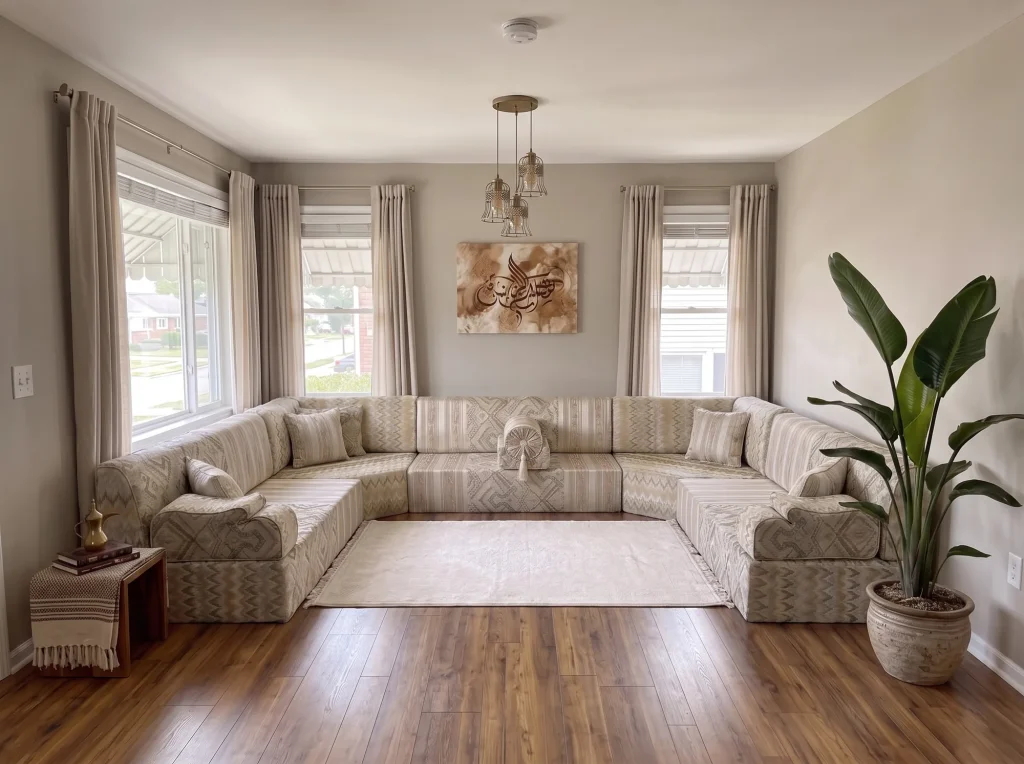
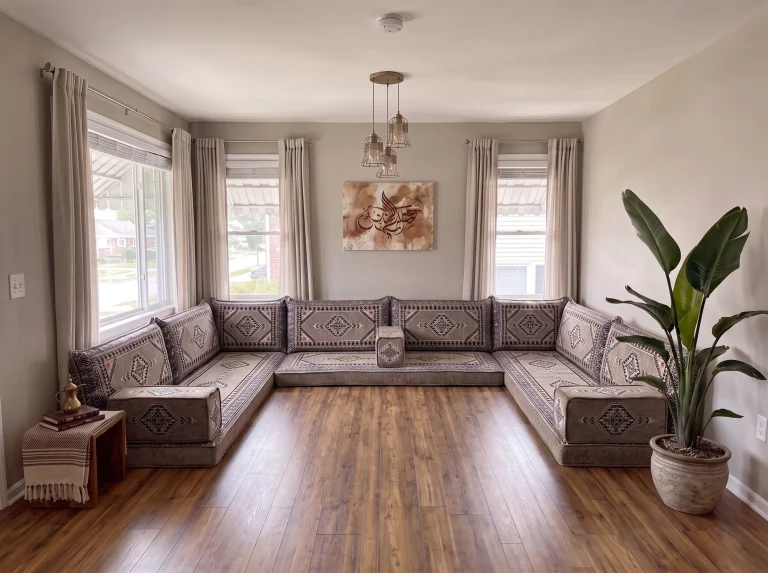
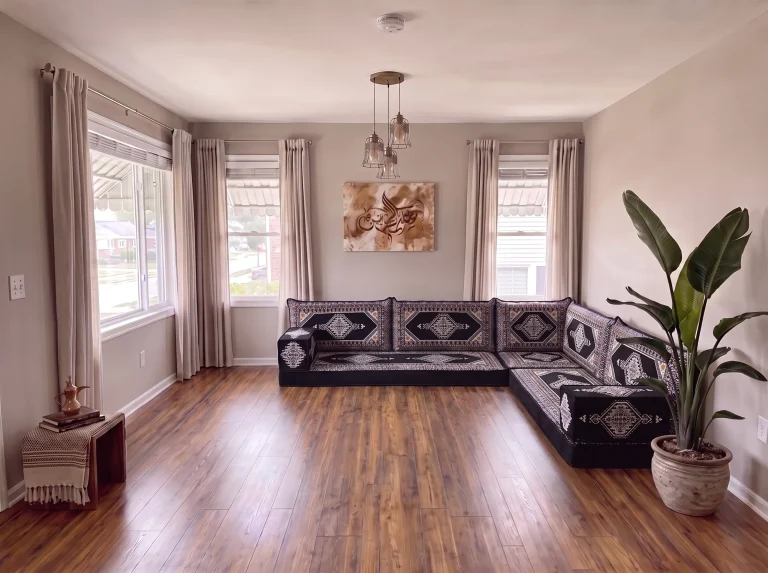
The two rooms above are ordinary grey-walled living rooms. One holds a red floor sofa in an L shape in a corner, the other a beige raised majlis in a U shape around three walls. A few points make this easier:
- Pick the walls first. A floor sofa must lean on something solid. Runs under windows work well if the sill is high enough for the backrest.
- Keep one side open. In a U shape, leave the side nearest the door clear.
- Decide what stays. A television unit or bookcase can keep one wall while the seating takes the others. See mixing a majlis with western furniture.
- Use the centre. A rug and an ottoman give the open floor a purpose and add seats when guests arrive.
- Start small if unsure. A single row can be extended into an L later, since the pieces are modular.
Ordering from the USA, Canada and Europe
Sofhu has no local stores, so “Middle Eastern furniture near me” has one honest answer: the set is built to order and delivered to your door.
- Measure each wall the seating will run along and note doors and windows.
- Send the measurements with a photo of the room through the quote by measurement form or WhatsApp.
- Agree the layout, fabric and price for your room.
- The set is made, vacuum packed and shipped.
Shipping is free worldwide. Import duties or taxes may apply depending on the country, and you can ask about yours before ordering. Existing pages cover several American states, among them New York, California and Michigan. To compare more designs, browse the Sofhu shop or continue to the Arabic sofa sets and oriental sofa sets pages.