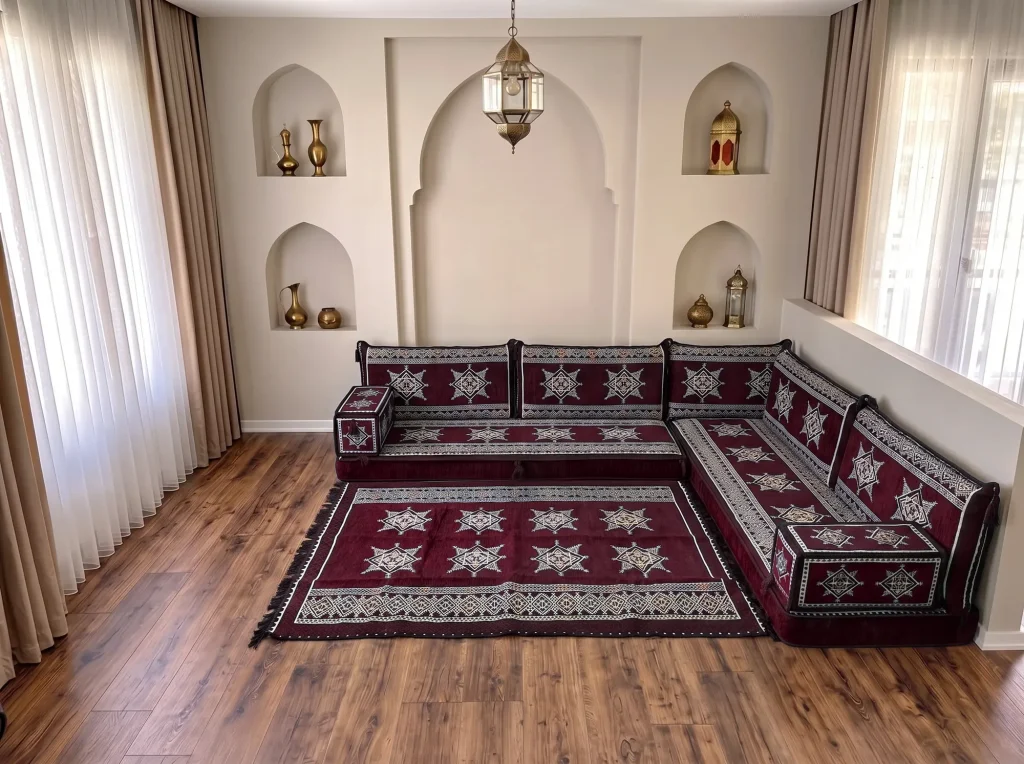
Majlis patterns fall into four families: the eight-point star, a figure from Islamic geometric ornament; Sadu bands, taken from Bedouin tent weaving; arabesque, damask and floral jacquards; and angular kilim geometry. Sofhu makes sets in all four. Choose by scale: large motifs for large rooms, small repeats or plain fabric for small ones.
- Eight-point star
- Two overlapping squares; common in Islamic geometric art
- Sadu
- Bedouin warp-faced weaving in narrow geometric bands
- Sadu colours
- Black, white, brown, beige and red
- Arabesque
- Scrolling plant-based ornament; damask and brocade weaves
- Kilim
- Flat-woven, angular diamonds and triangles
- Scale rule
- Large motif for large rooms, small repeat for small rooms
On this page
Majlis patterns are not random decoration. Almost every Arabic sofa pattern you see belongs to one of four families: the eight-point star, Sadu bands, arabesque and floral weaves, or kilim geometry. Knowing which is which helps in two ways. You can describe what you want when you order, and you can avoid repeating claims about origin that nobody can support. This guide takes the families in turn, then deals with the practical question of scale.
The eight-point star
The eight-point star is a figure from Islamic geometric ornament, made by laying one square over another turned by forty-five degrees. It needs only a compass and a straight edge to draw, and it repeats neatly in rows and grids, which is why it appears on tiles, woodwork, plaster and textiles across the region. In the old houses of Najd in central Saudi Arabia, for example, star and geometric designs were incised into the wall plaster around the guest room.
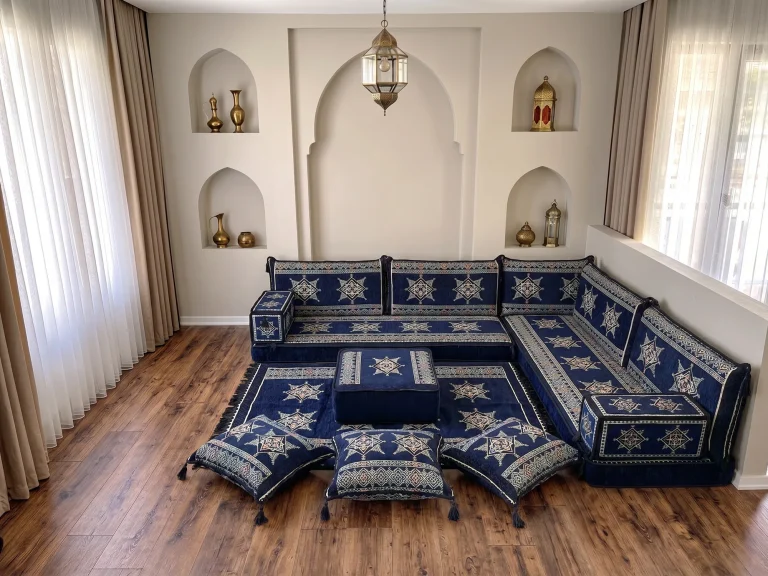
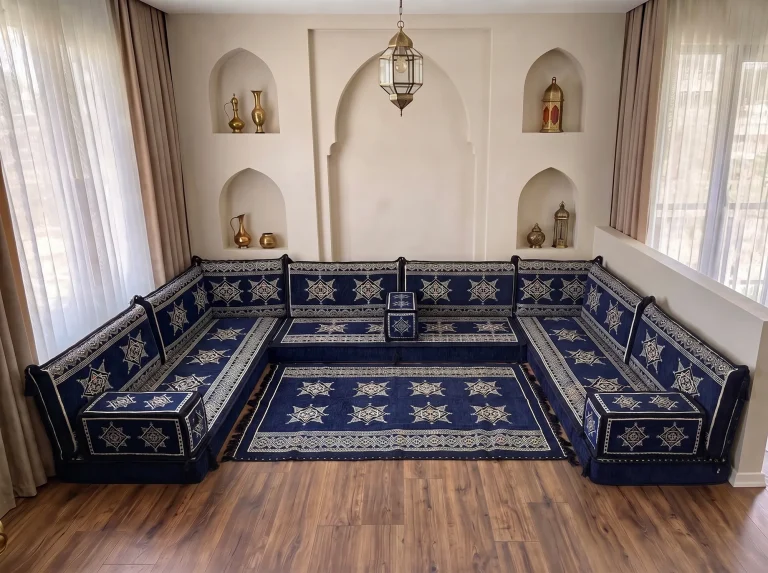
On our fabric the star is usually cream on a deep ground, framed by small geometric borders, and it is used on floor sofa sets.
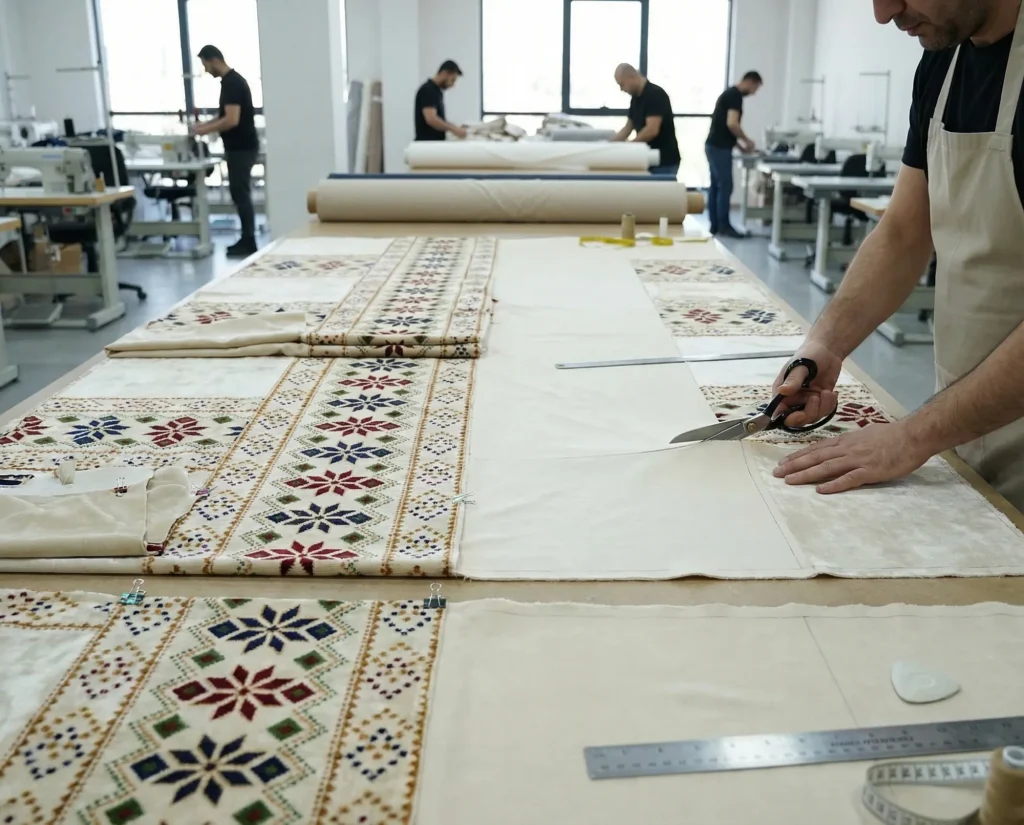
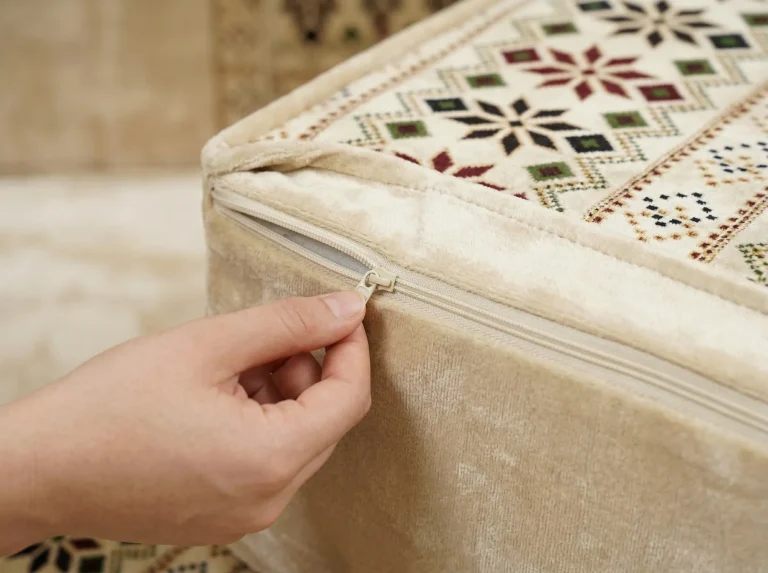
This is star-pattern cloth on our cutting table. Cutting each panel so the stars sit centred on the cushion and line up from one piece to the next takes care. That alignment is the difference between a set that looks ordered and one that looks slightly off, and it is a reason to have patterned sets cut for the room.
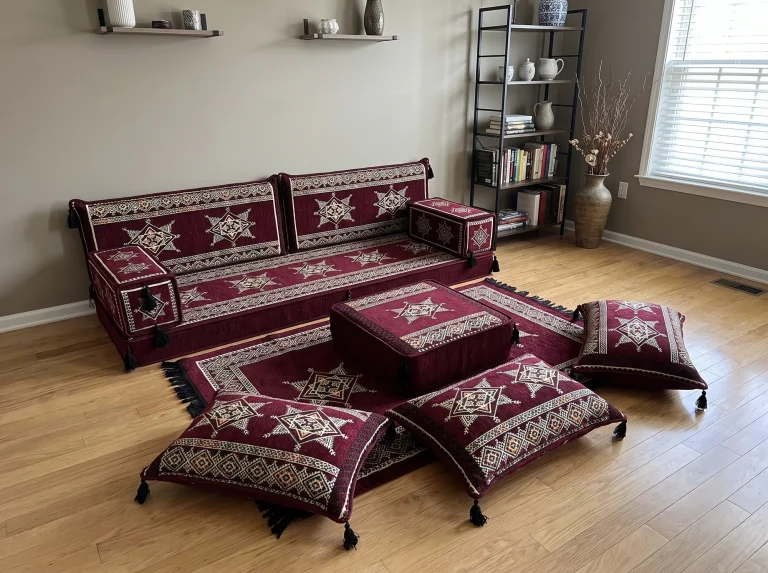
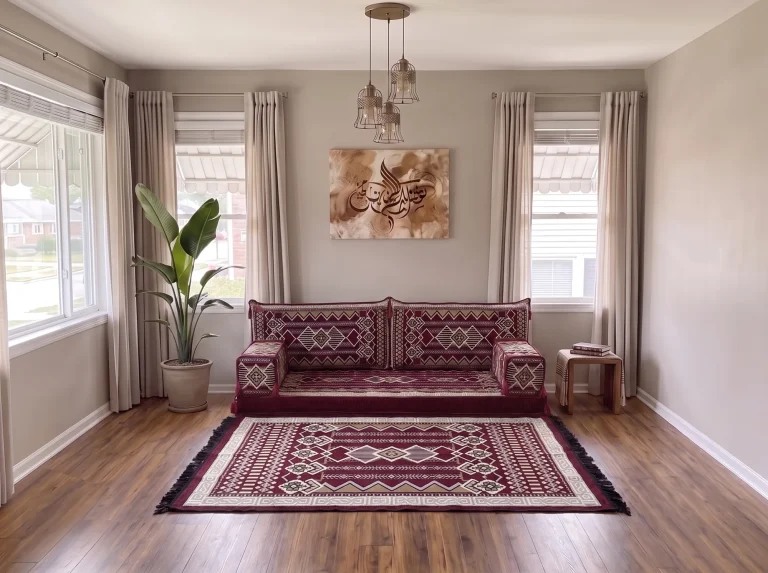
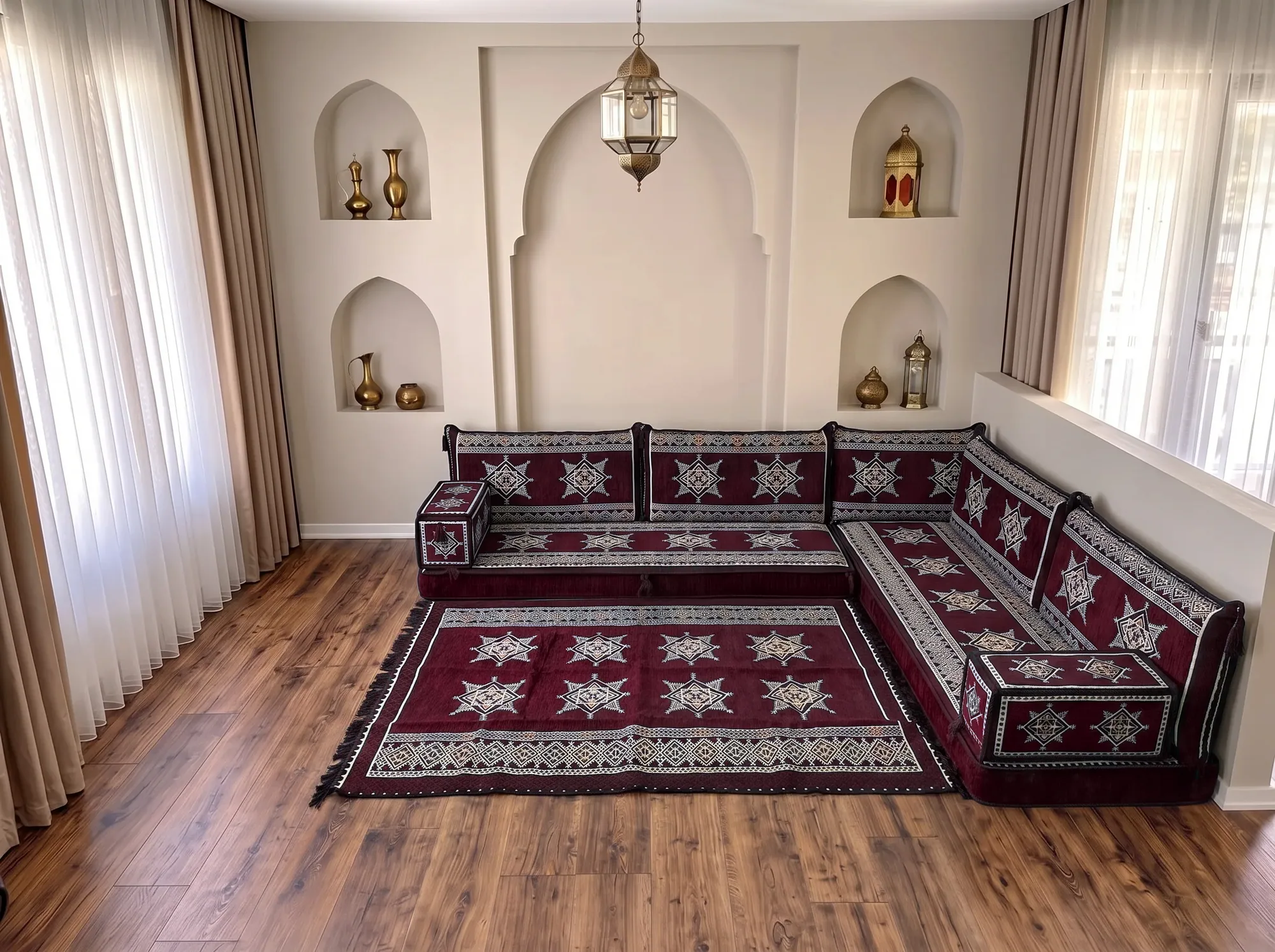
The floor sofa at the top of this page shows the finished result in burgundy, with two rows of stars on the matching rug repeating the motif from the seats.
Is it a Yemeni star pattern?
Many shops, and many of our own customers, call this design the Yemeni star pattern, and it is strongly associated with the full-room sets sold as Yemeni majlis. We have looked for a documented origin and have not found one. What textile historians do record for Yemen is a long reputation for striped and ikat cloth. So we describe the star fabric honestly: it is a Sofhu design that draws on the wider star tradition of Islamic geometry, widely chosen for sets sold as Yemeni majlis, not a proven piece of Yemeni heritage. In our range the star sets are Arabic floor sofas, low cushion sets on the floor, whatever name an older page gives them. The room tradition itself is described on our page about Yemeni diwan and mafraj seating.
Sadu weaving
Sadu is the weaving of Bedouin women, and its stripes are the oldest majlis pattern of all, because the first majlis was a tent. The cloth is warp-faced, woven in wool, goat hair and camel hair, and built up from narrow bands of geometric motifs: triangles, diamonds and small figures. The documented colours are black, white, brown, beige and red. The most prized piece was the long divider between the guest side and the family side of the tent, whose richness showed the standing of the household.
If you are looking for a Sadu pattern meaning, the honest answer is that the motifs record the weaver’s world. Sources describe dunes, stars, desert plants, women’s jewellery and camel brands among them. They are a visual language of daily life more than a code of fixed symbols.
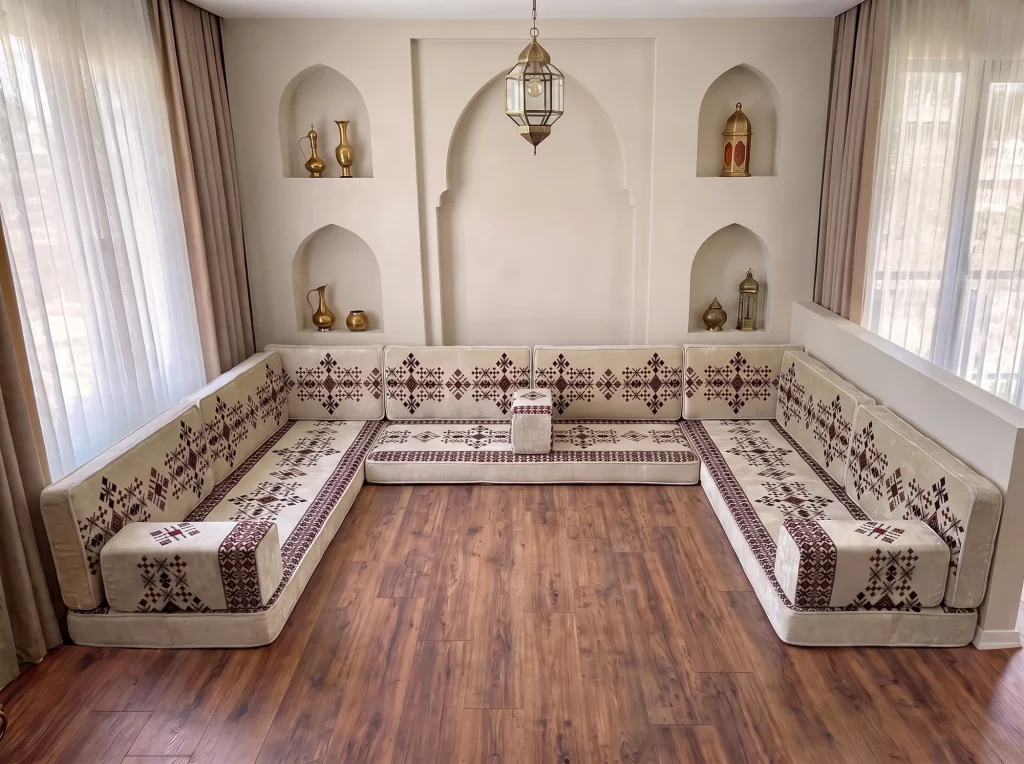
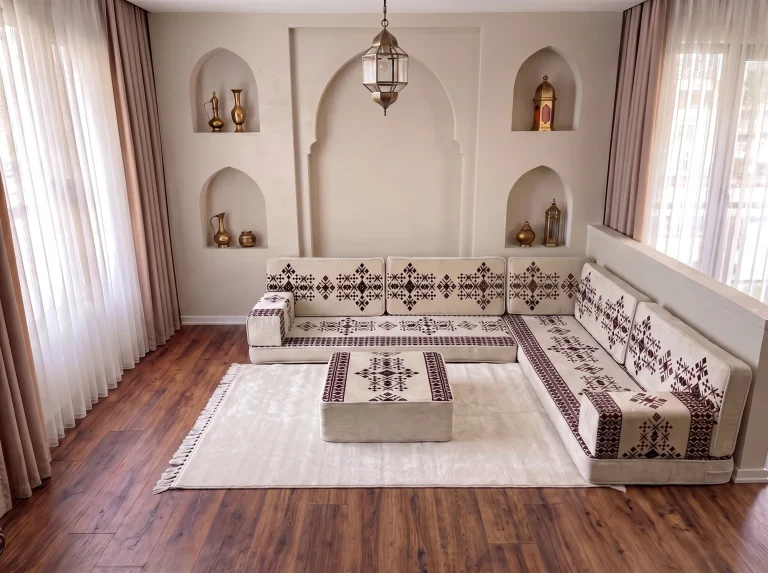
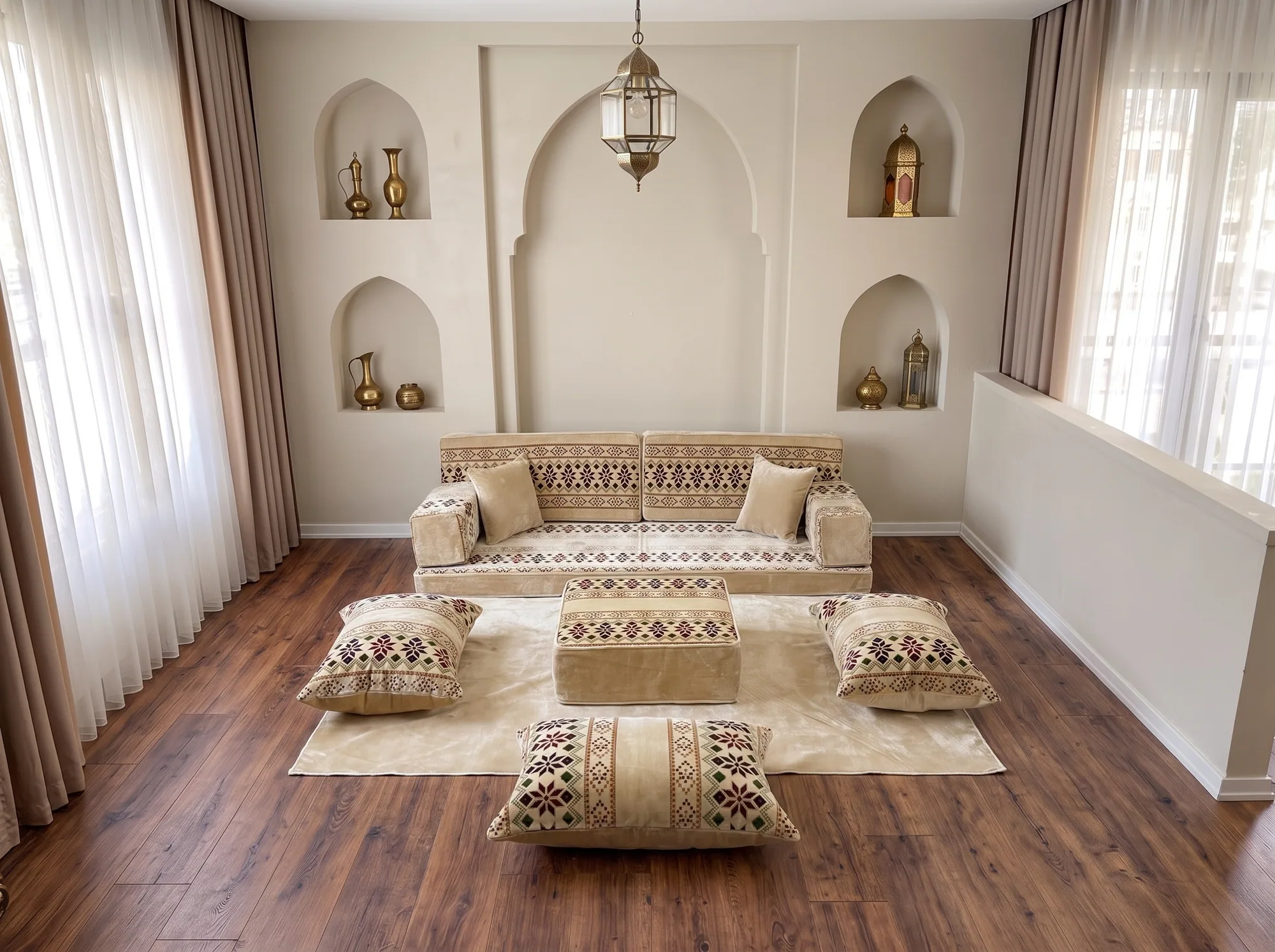
Upholstery fabric with Sadu-style bands is not hand-woven Sadu, and should not be sold as such. It borrows the look: horizontal bands of small geometric figures along the seat edge and across the backs. The cream floor sofa above carries burgundy and black bands along every seat, in a U-shape with the floor left open.
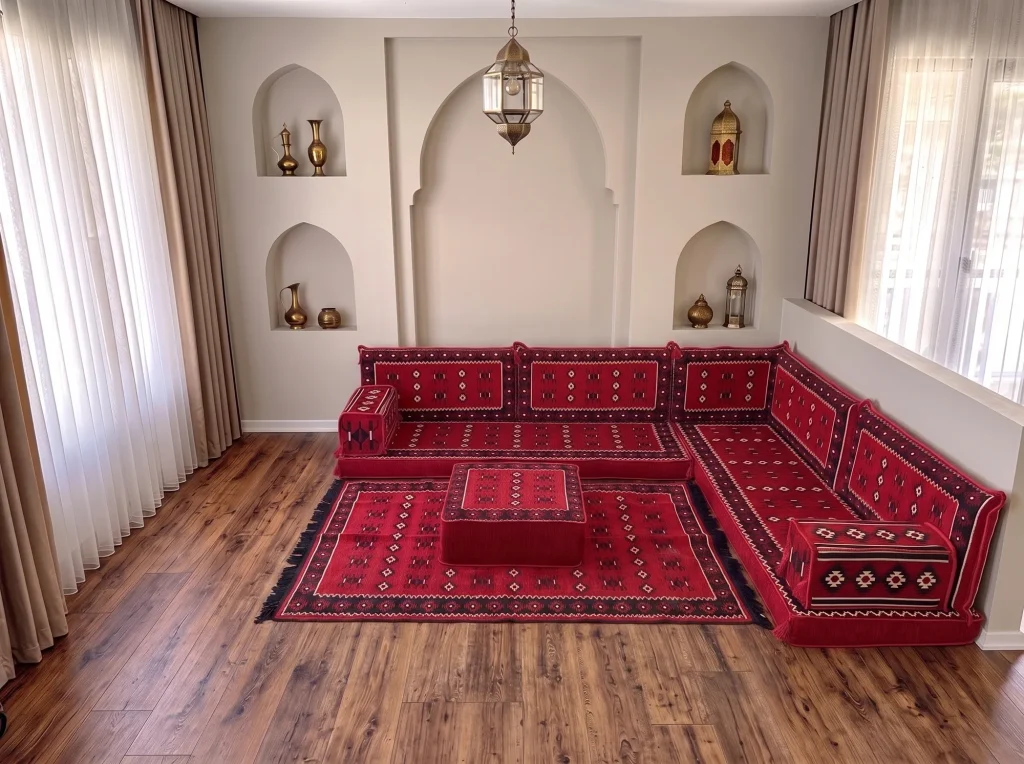
The red and black version is closer to the tent palette and gives a stronger, more festive room. For the tradition behind it, see Bedouin majlis and Sadu weaving.
Arabesque and floral jacquard
Arabesque is the name Europeans gave to the scrolling, interlacing plant ornament of Islamic art: stems, leaves and blossoms that curl and repeat without a clear beginning or end. Museum scholars today tend to call it vegetal ornament, and note that apart from the garden as an image of paradise it carries little fixed symbolism. It is there to be beautiful.
On Arabic fabric patterns this family shows up as damask, brocade and floral jacquard. All three are woven, not printed. The design is built into the cloth on the loom, so it does not rub off. Damask is tone on tone and subtle. Brocade adds a contrasting or metallic thread and is richer. Medallions, a large central ornament repeated on each cushion, belong here too.
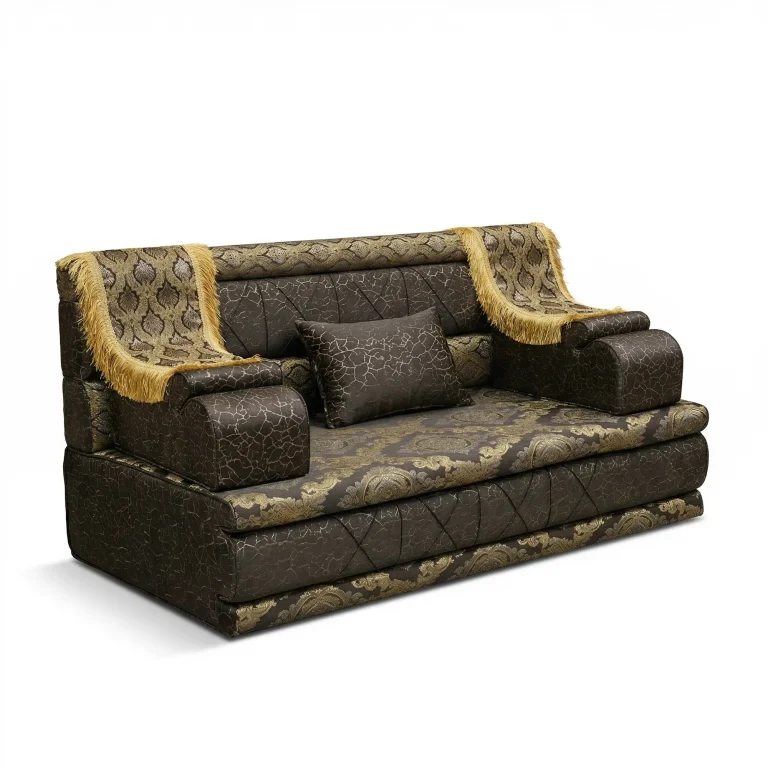
The four families divide loosely between our two products. Damask, brocade and velvet with medallions are the usual dress of the Arabic majlis, the raised, fully upholstered set with tall fixed backs and arm bolsters. Star, Sadu-style and kilim weaves appear mostly on the Arabic floor sofa, the low cushion set that sits on the floor.
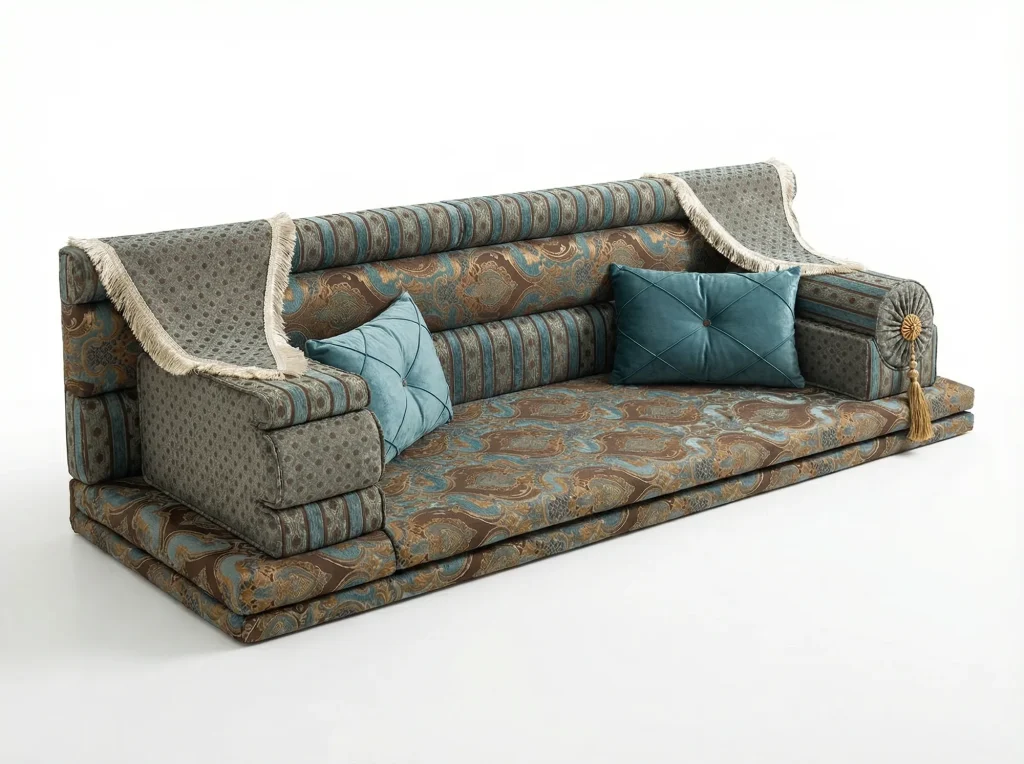
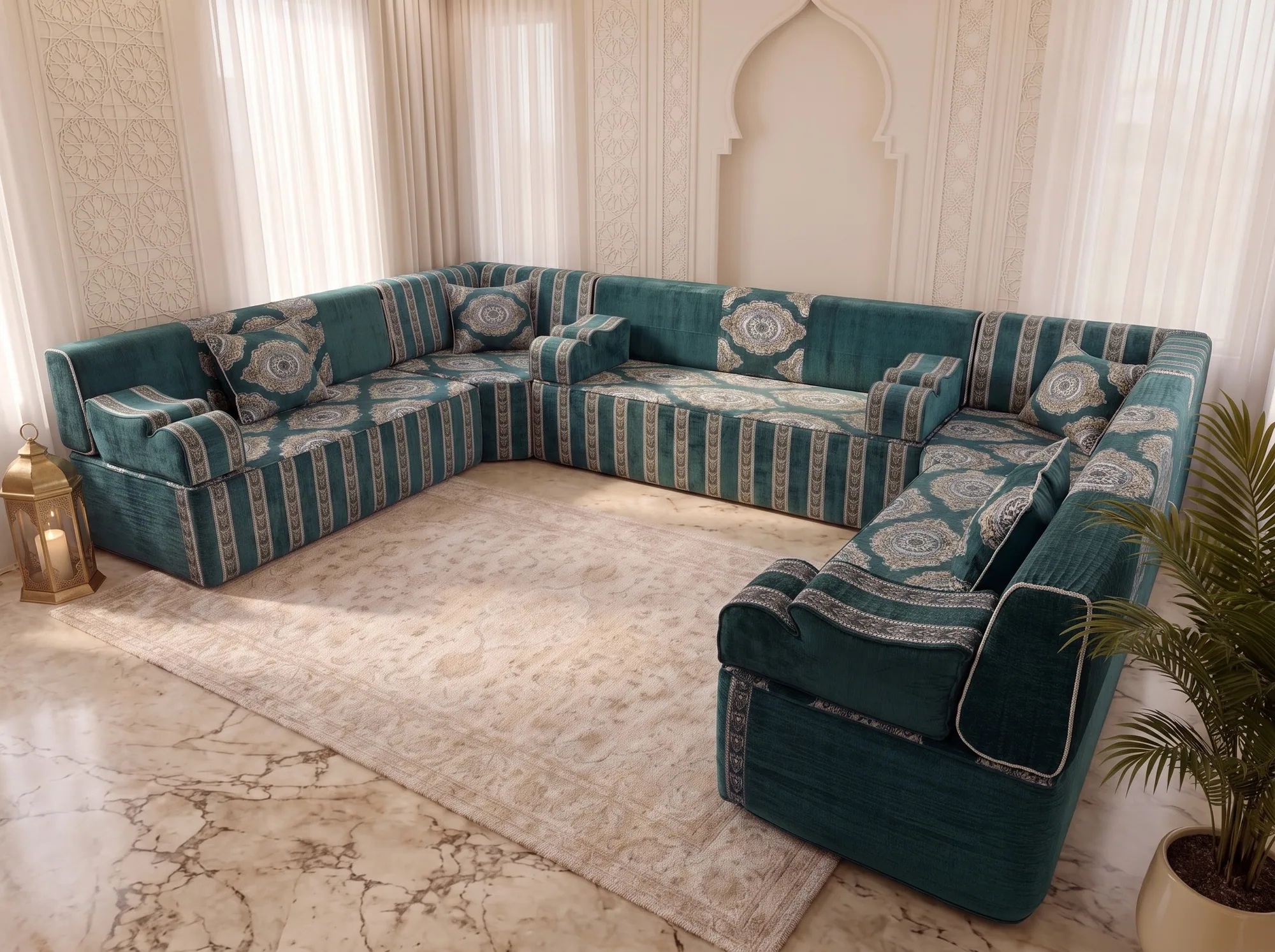
This majlis piece combines three coordinating weaves in the usual manner: an ornamental brocade on the seat and back, a stripe on the bolsters and a small-scale weave on the arm panels, all in teal and brown. It is a good lesson in mixing. The colours are shared, the scales are different, and one pattern clearly leads. Our comparison of velvet, linen and jacquard explains how these weaves wear, and the fabrics page lists the families we use.
Kilim geometry
Kilim patterns are angular because of how a kilim is made. It is a flat weave with no pile, and where two colours meet along a vertical line the weaver leaves a small slit. Long slits weaken the cloth, so weavers favour diagonals and steps. The result is the familiar vocabulary of diamonds, triangles and stepped medallions with sharp outlines.
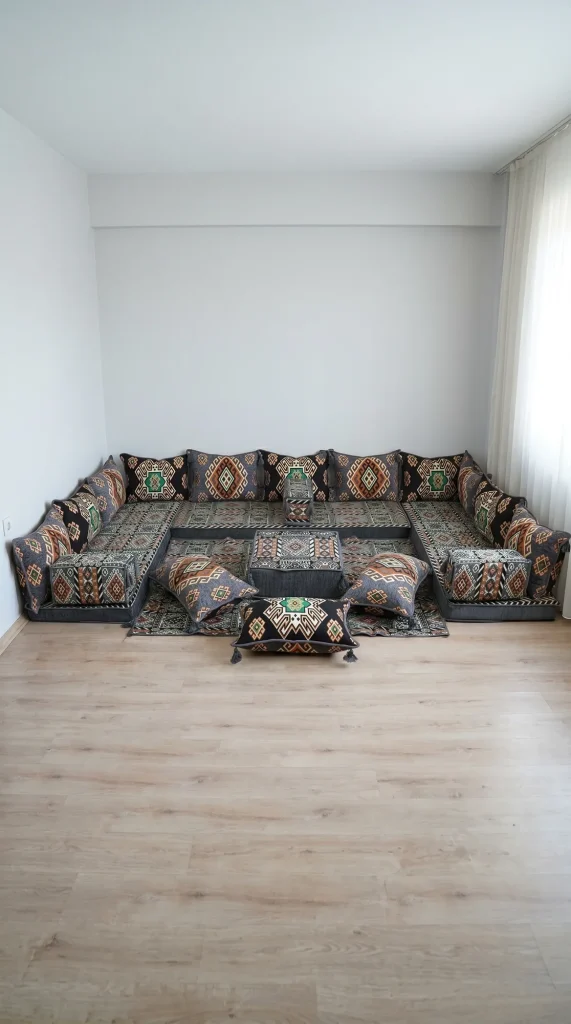
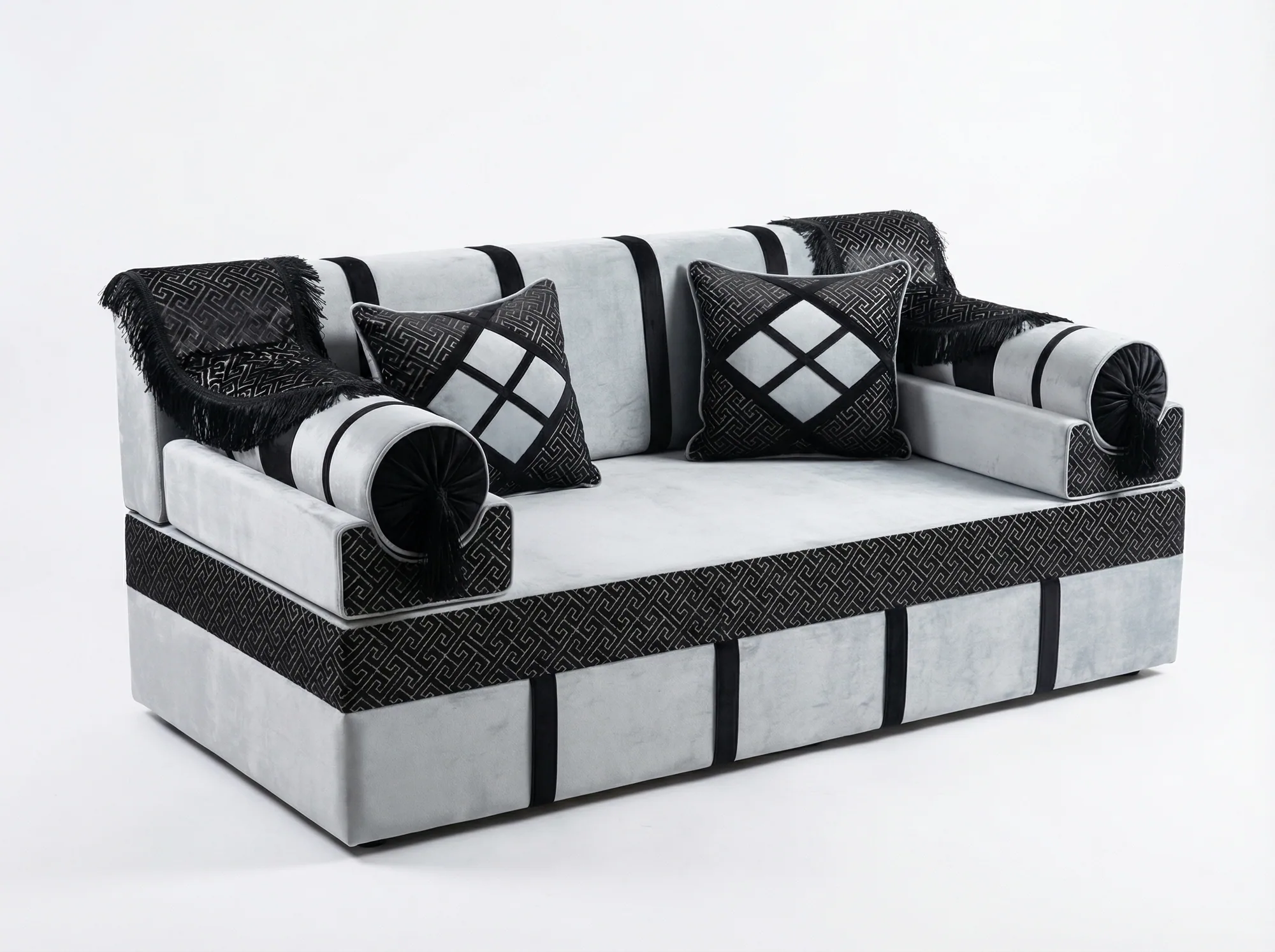
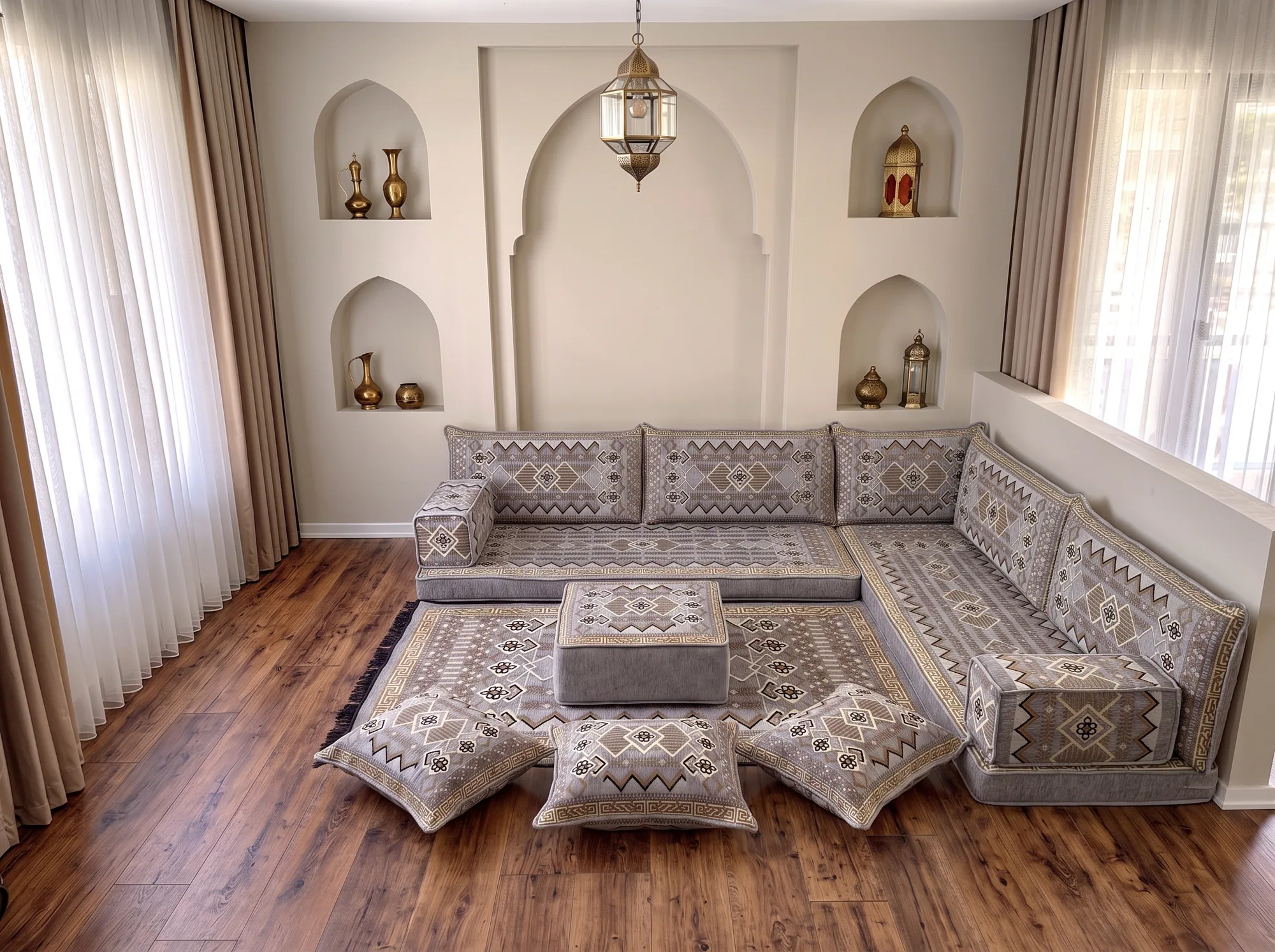
Kilim-pattern upholstery carries that geometry onto seat and back cushions. This grey and black floor sofa, with orange and green motifs, shows how well it suits a plain white room. In Turkish homes the same look defines the corner set known as the şark köşesi, covered on our Turkish sedir page. Kilim patterns hide wear better than any other family, which makes them a sound choice for rooms in daily use. Rugs in the same tradition are shown on our kilim rugs page.
Choosing pattern scale for your room
Scale matters more than motif. A pattern has to be read from where people actually stand and sit.
| Room | Pattern that works | Why |
|---|---|---|
| Small room, single row or L | Small repeat, narrow band, textured plain | Reads clearly at close range |
| Medium living room | One medium motif with plain seats | Pattern without crowding |
| Large guest majlis, U-shape | Large stars or medallions, matching rug | Motifs need distance to be seen whole |
Three further rules save most mistakes.
- Count the rug. A patterned rug is the largest pattern in the room. With a strong rug, choose calmer seats. With a matching rug, as in the star and medallion rooms, keep the walls and curtains plain.
- One leader. Let a single pattern dominate and keep any second pattern smaller and in the same colours.
- Mind the people. Guests cover the seat and half the backrest. Put the motif you care about on the upper back and the armrests, where it stays visible.
Colour and pattern are decided together, so read this alongside how to choose majlis colours.
Ordering a patterned set
Patterned sets gain the most from being made to measure, because the motifs can be centred on each cushion and matched around the corners of an L or a U. Send your wall measurements and a photo of the pattern family you prefer, and say whether you want the matching rug and floor cushions.
Covers are zippered and removable, the filling is 32 kg/m³ high-density foam, and shipping is free worldwide. Close-up photographs of weaves and stitching are in the fabrics and details gallery, and the Arabic majlis guide covers layouts and set contents. When you are ready, get a quote by measurement or message us on WhatsApp.