Qa'da arabi (قعدة عربي) is the Egyptian name for Arabic-style low seating: mattresses along the wall with backrests and armrests, usually as a corner or a U on three walls. Its older relative is the mandara, the historic guest room. Sofhu makes these sets to your wall measurements in Türkiye, with 32 kg/m³ foam and free worldwide shipping.
- Egyptian name
- Qa'da arabi (قعدة عربي), also searched as rokna arabi and galsa arabi
- Historic room
- Mandara, the ground-floor room for receiving visitors
- Historic layout
- A raised dais on three walls, covered with rugs or mattresses
- Sofhu foam
- 32 kg/m³ (32 DNS) high-density foam, no springs
- Layouts
- Single row, L-shape corner or U-shape
- Sizing
- Made to measure from your wall lengths
- Shipping
- Free worldwide from Türkiye
On this page
Qa’da arabi means “Arabic sitting”. When an Egyptian family asks for one, they are asking for low seating in the Arabic manner: long seat mattresses laid along the wall, a backrest behind each sitter and an armrest at the elbow, in place of a sofa on legs. Sofhu builds these sets to your wall measurements and ships them free to your door.
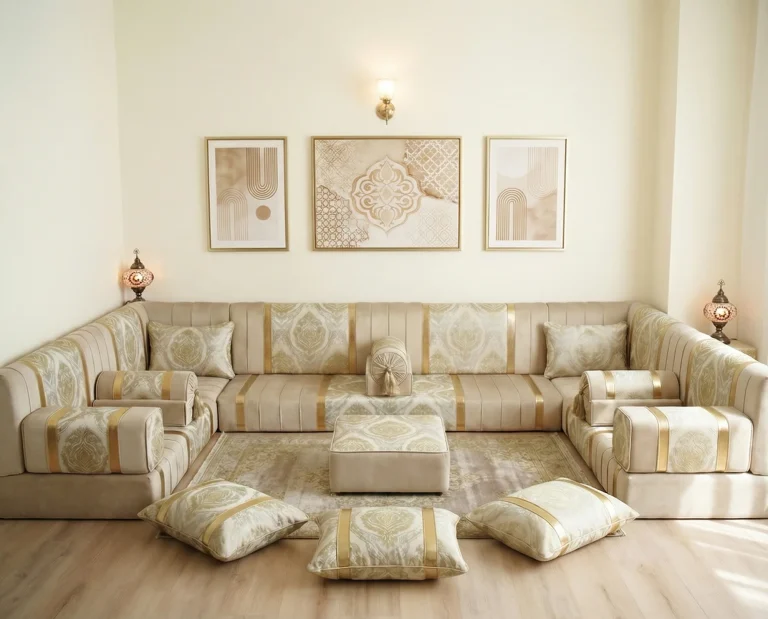
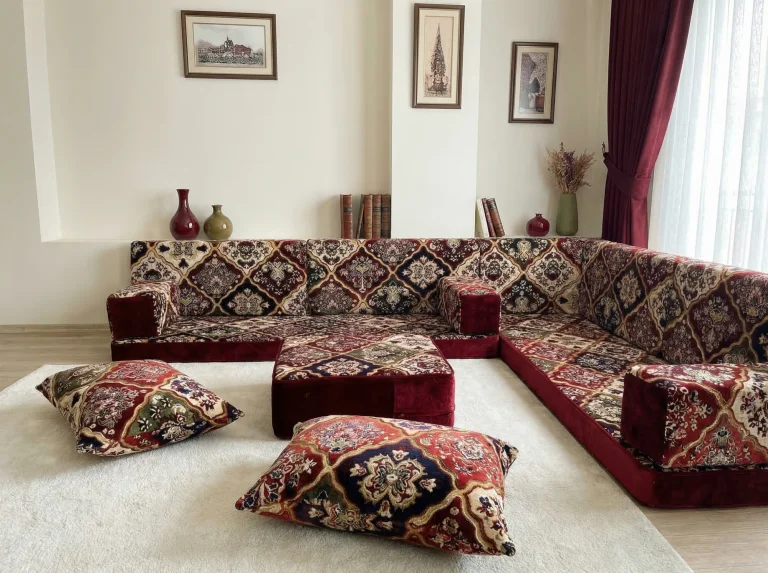
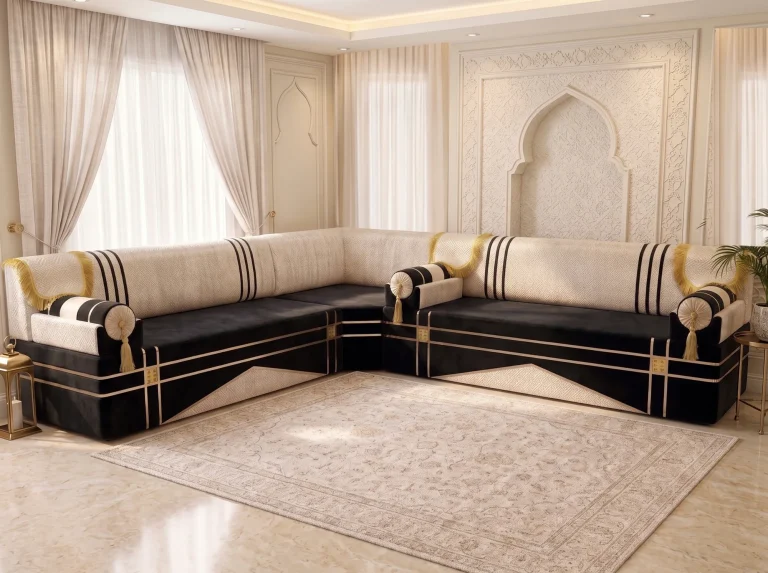
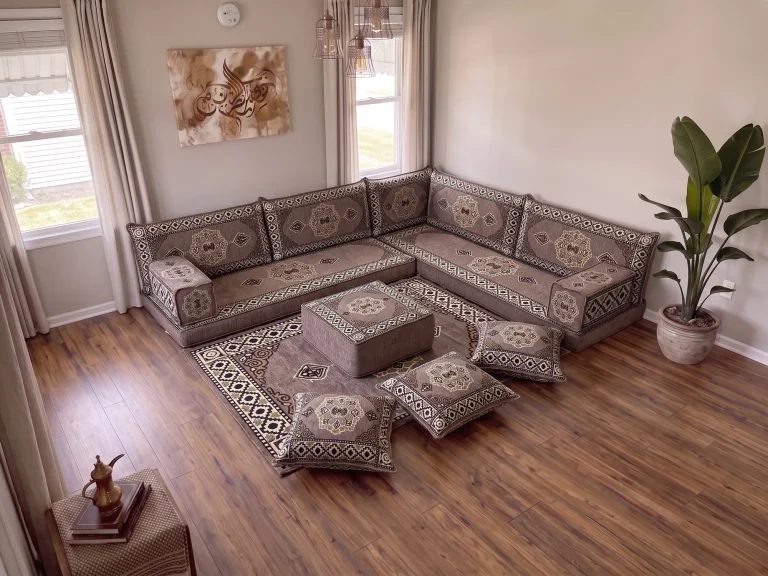
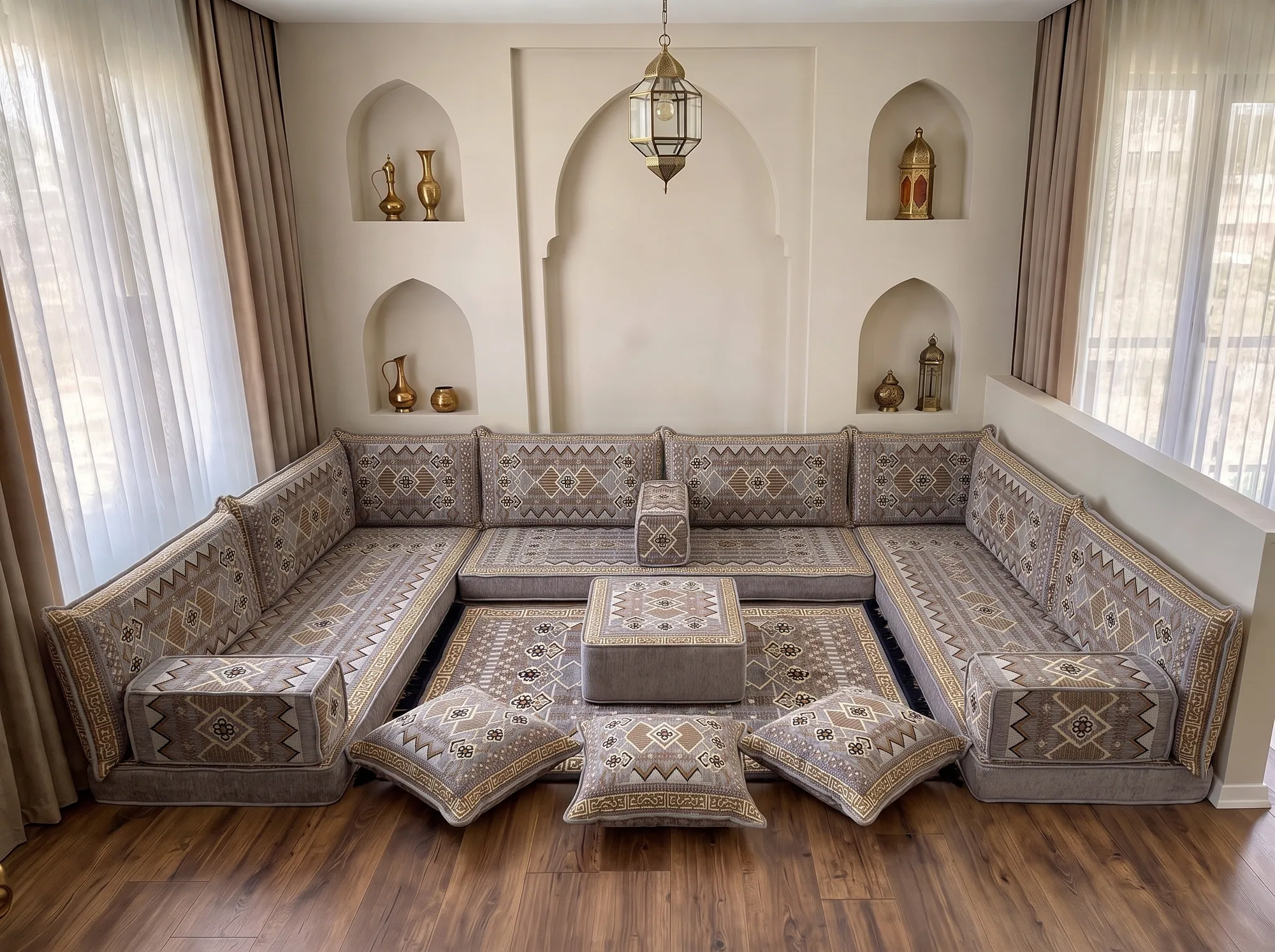
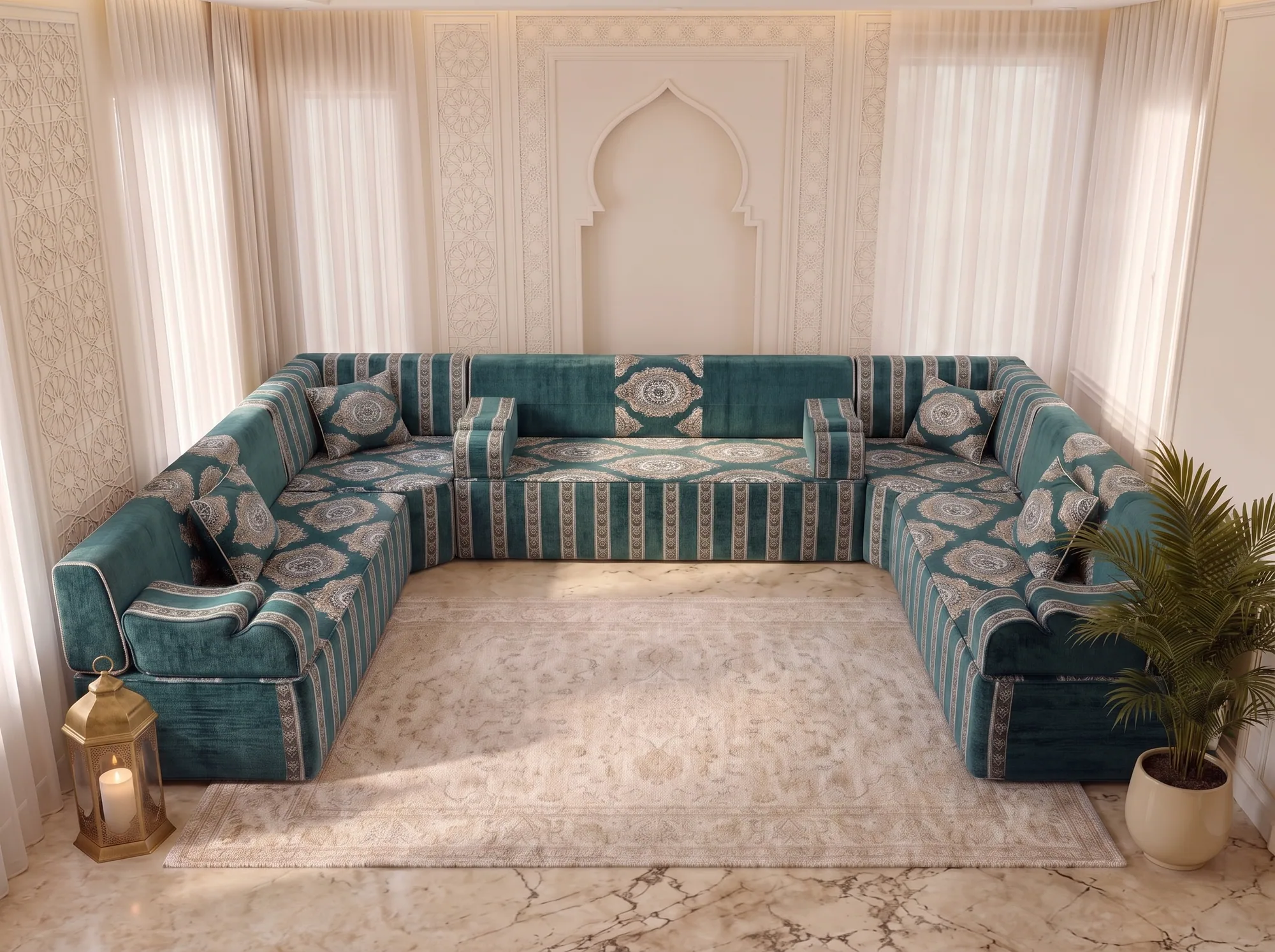
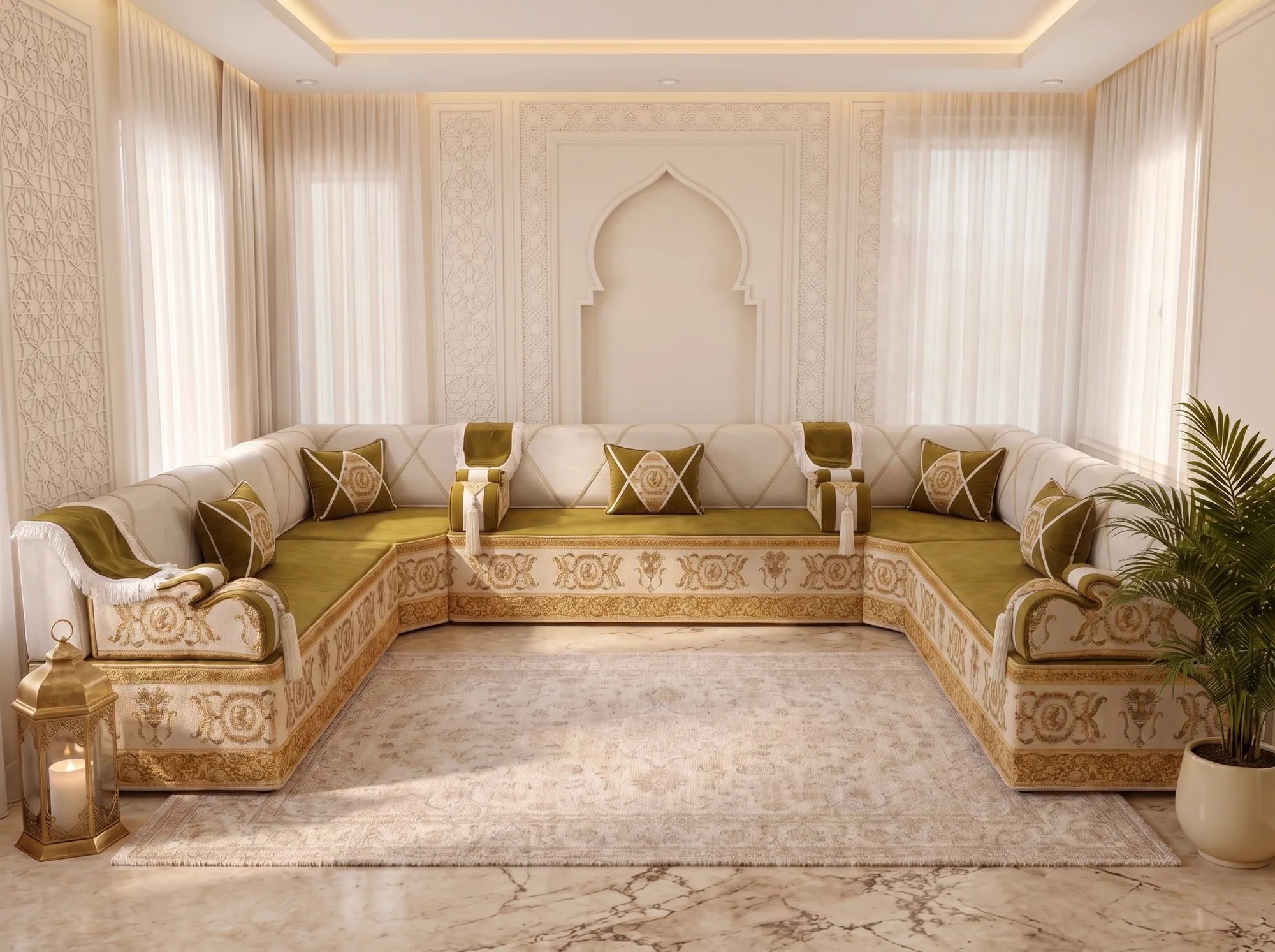
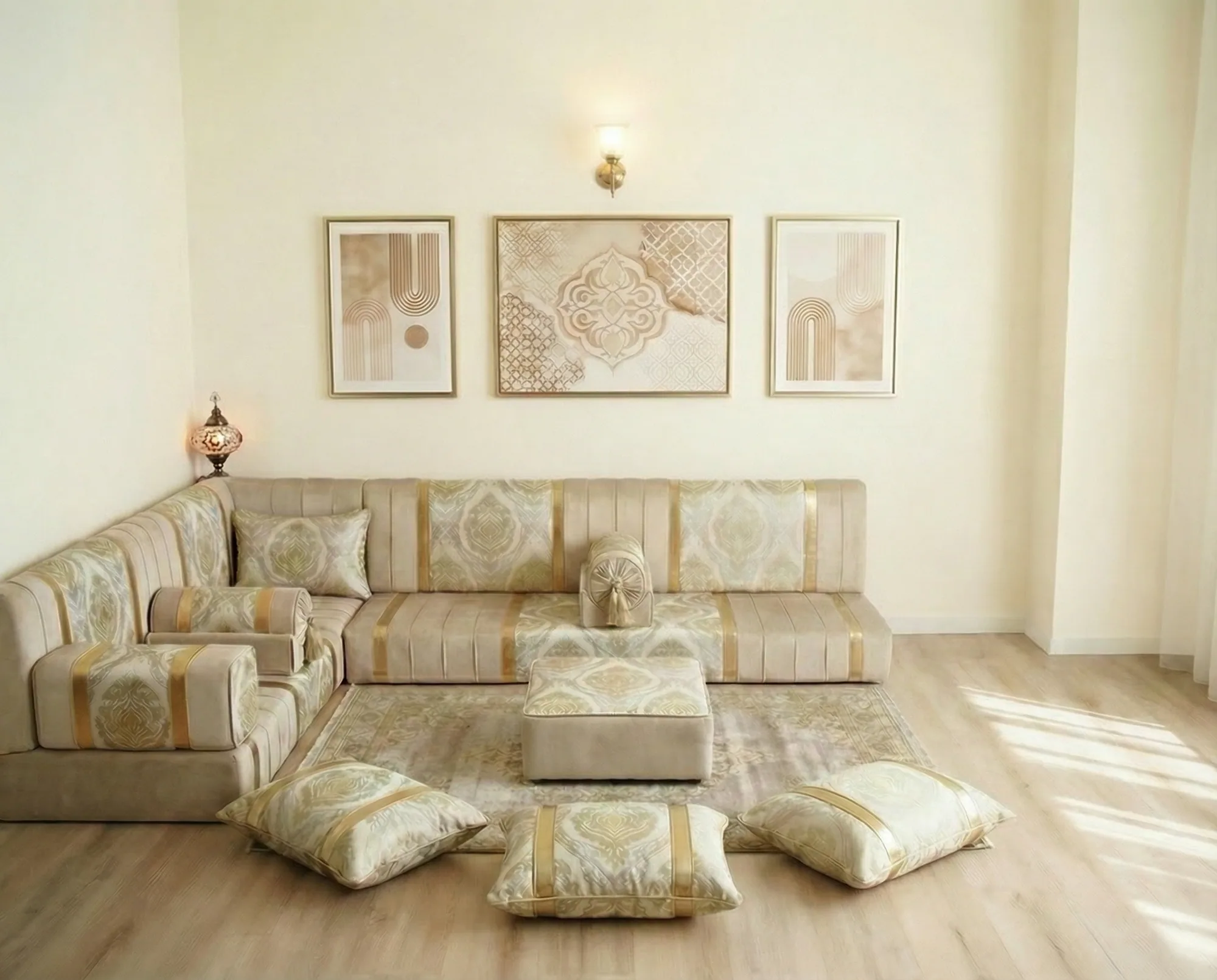
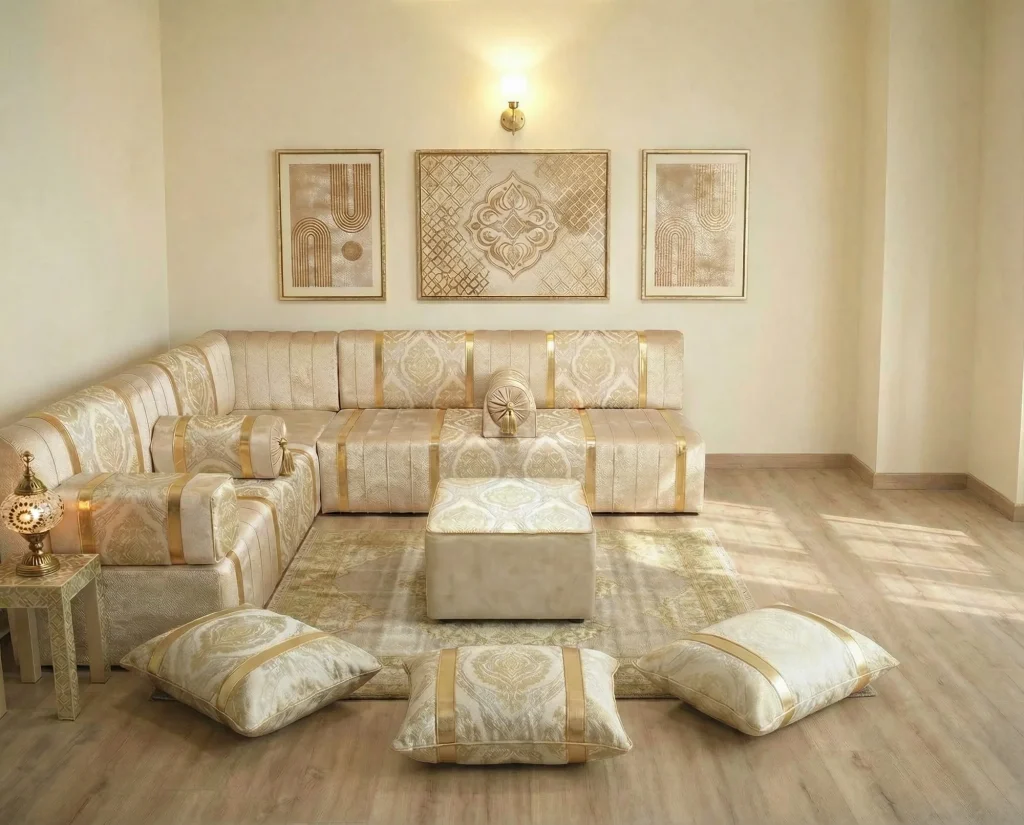
In Sofhu’s range the qa’da arabi corresponds to the Arabic floor sofa: a seat mattress at floor level with loose back cushions, armrest blocks and usually an ottoman, like the ivory and gold corner set at the top of this page. Sofhu also makes the Arabic majlis, a raised, fully upholstered set at sofa height with a solid base and fixed backs. Most photographs here show floor sofas, and a few show a majlis for comparison.
What qa’da arabi means
The phrase names the seating, not a room. Qa’da comes from the verb for sitting down, and arabi marks it off from the European-style salon that many Egyptian flats also have. You will see the same idea searched as قعدات عربي, ركنة عربي (an Arabic corner) and جلسة عربي. In English, people type Egyptian majlis or Egyptian floor seating and mean the same set.
We make no claim about one fixed “Egyptian look”. Homes in Cairo, Alexandria, Upper Egypt and the western desert furnish their sitting corners differently, and you know your own family’s taste better than a furniture maker does. What stays constant is the form: seat, back, armrest, wall. That form is what we build.
If you read Arabic, our page on قعدة عربي بالمقاس covers the same ground in Arabic.
From the mandara to the corner in a flat
The qa’da arabi has an old ancestor in the Egyptian house. The mandara (منظرة, also written mandarah) was the ground-floor room where the householder received male visitors. European readers learned the word from Edward William Lane’s account of Egyptian life, published in 1836.
Descriptions of the mandara from that period give a clear picture. The floor was paved, often with a small fountain basin in the middle. Around three walls ran a raised dais, the liwan, covered with rugs or mattresses on which guests reclined. Recesses in the walls held water jars. In the great houses of Cairo the equivalent hall was the qa’a, where guests sat on the raised sides and the sunken centre was called the durqa’a.
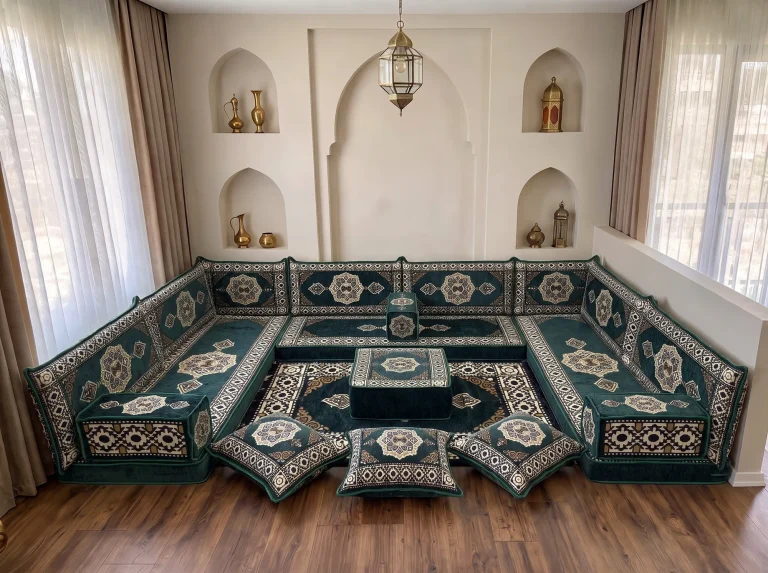
Two things in that description still matter when you plan a set today. First, the layout was a U: seating on three sides, with the middle left open for serving. Second, the cushions were soft furnishings laid on a platform, not furniture with frames and legs. A modern qa’da arabi keeps both ideas.
Further west, in Siwa and the desert oases, the men’s guest room is called the marbu’a, the same word used across the border. We cover that tradition on the Libyan marbouaa page.
Floor level or raised: how a Sofhu set relates
The historic mandara was not strictly floor seating. Guests sat on mattresses, but the mattresses lay on a dais a step above the paved floor. That gives you three honest ways to interpret the tradition.
| Approach | What it is | Suits |
|---|---|---|
| Arabic floor sofa | Foam seat mattresses directly on the floor, loose backrests on the wall | Corners, spare rooms, children, long evenings |
| Arabic majlis | Upholstered units at sofa height on a solid base, with fixed backs | A formal guest room, older guests |
| Wooden bench-frame set | Cushions on a wooden base along the wall | A formal salon, older guests, the feel of the old dais |
Sofhu makes all three. Floor sofas are the ones shown in most photographs on this page. The raised options are the upholstered majlis and the line of wooden bench-frame sets, where cushions sit on a handmade wooden base. If you are unsure which suits your family, the comparison of floor seating and a raised diwan sets out the trade-offs.
Choosing a layout: one wall, a corner or three walls
The layout follows the room, so start with how many walls you can give to the seating.
- One wall (single row). The smallest qa’da arabi. It fits under a window or along the side of a living room that already has a sofa.
- Two walls (L-shape). The classic rokna arabi. A corner piece joins the two runs so the seating reads as one line and nobody sits in a gap.
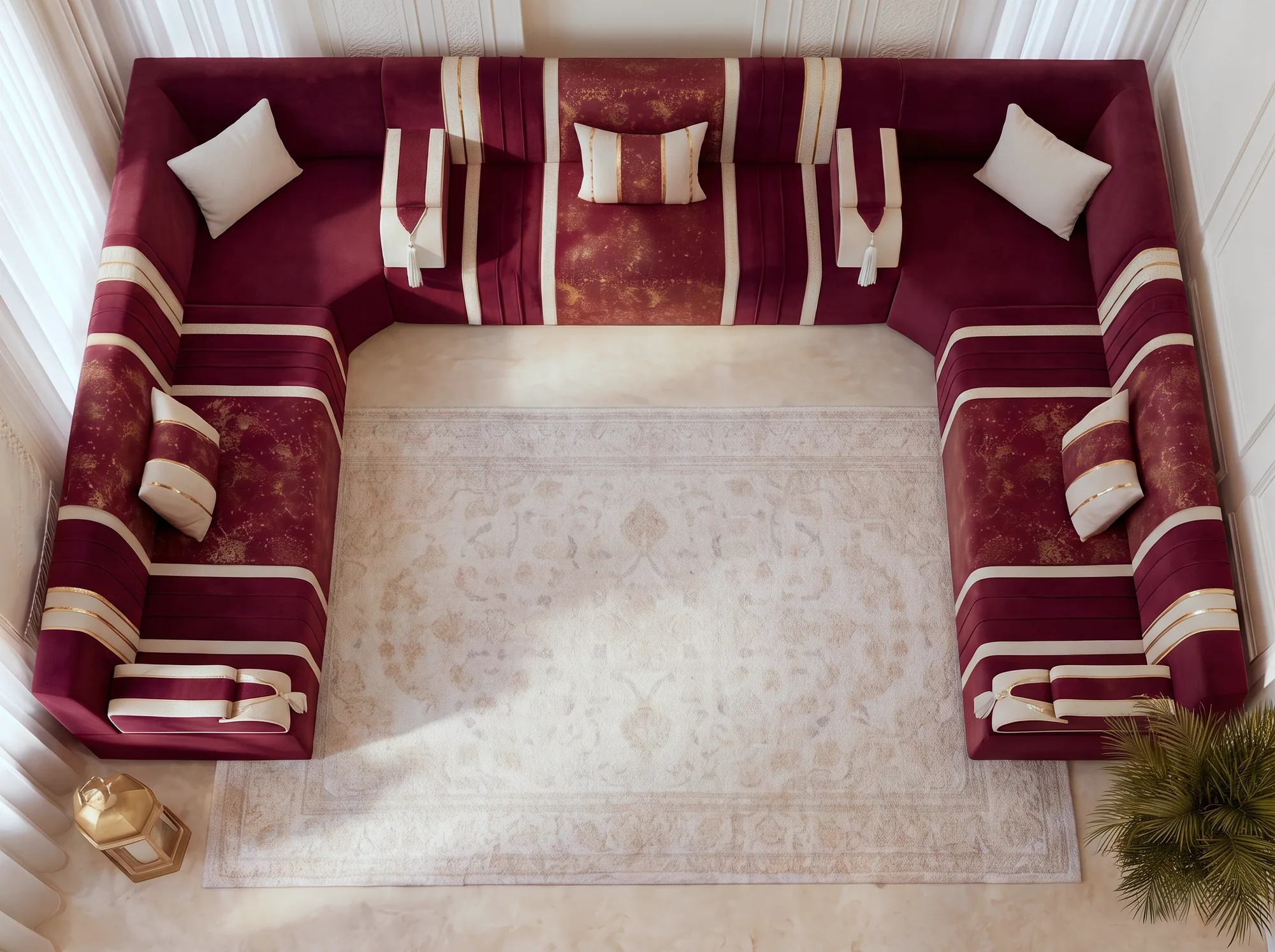
- Three walls (U-shape). The closest to the old mandara. It needs a room of its own, or at least a room where the fourth side stays clear for the door and for serving.
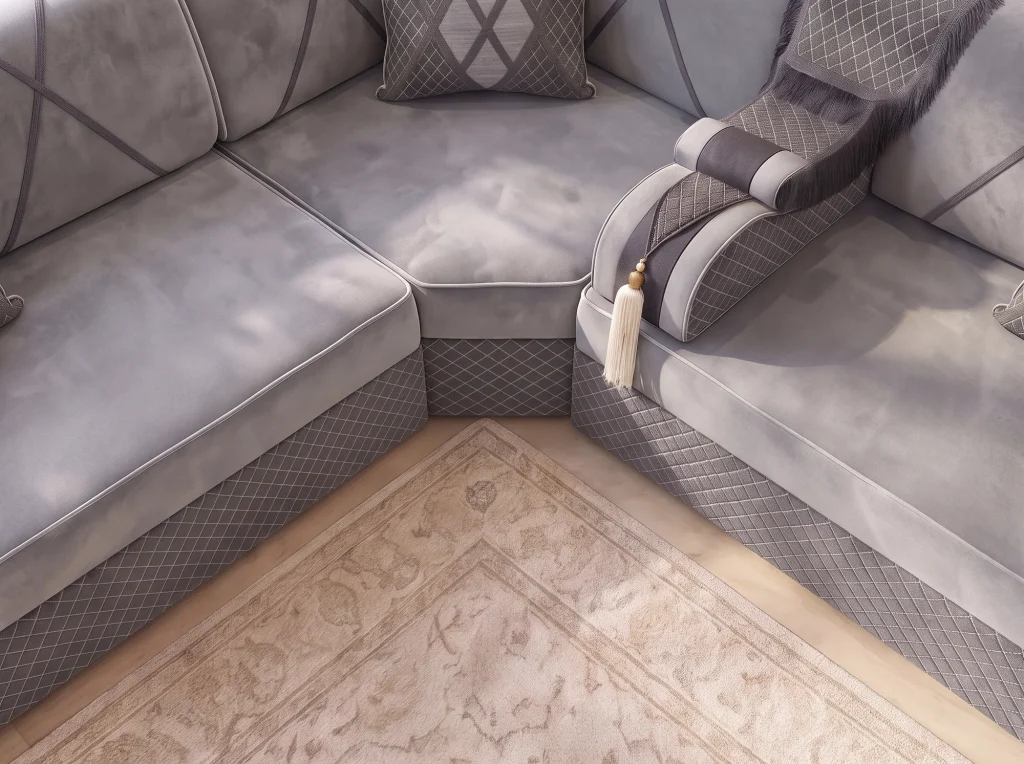
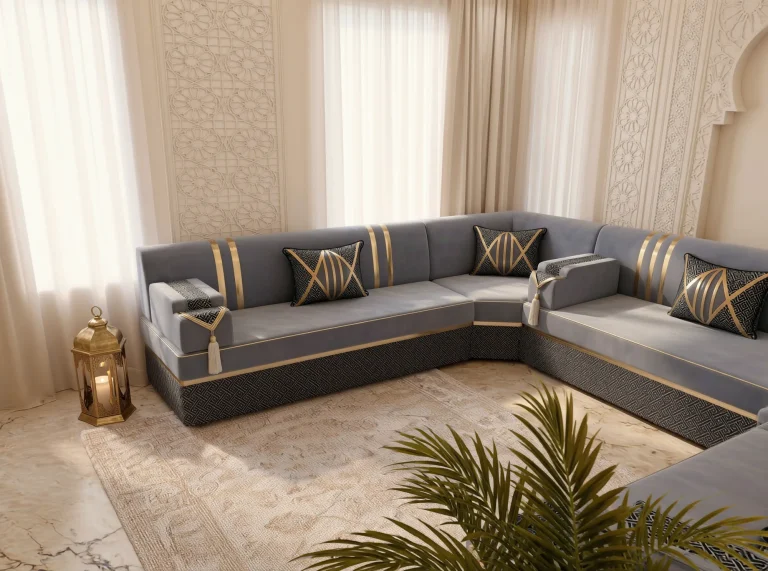
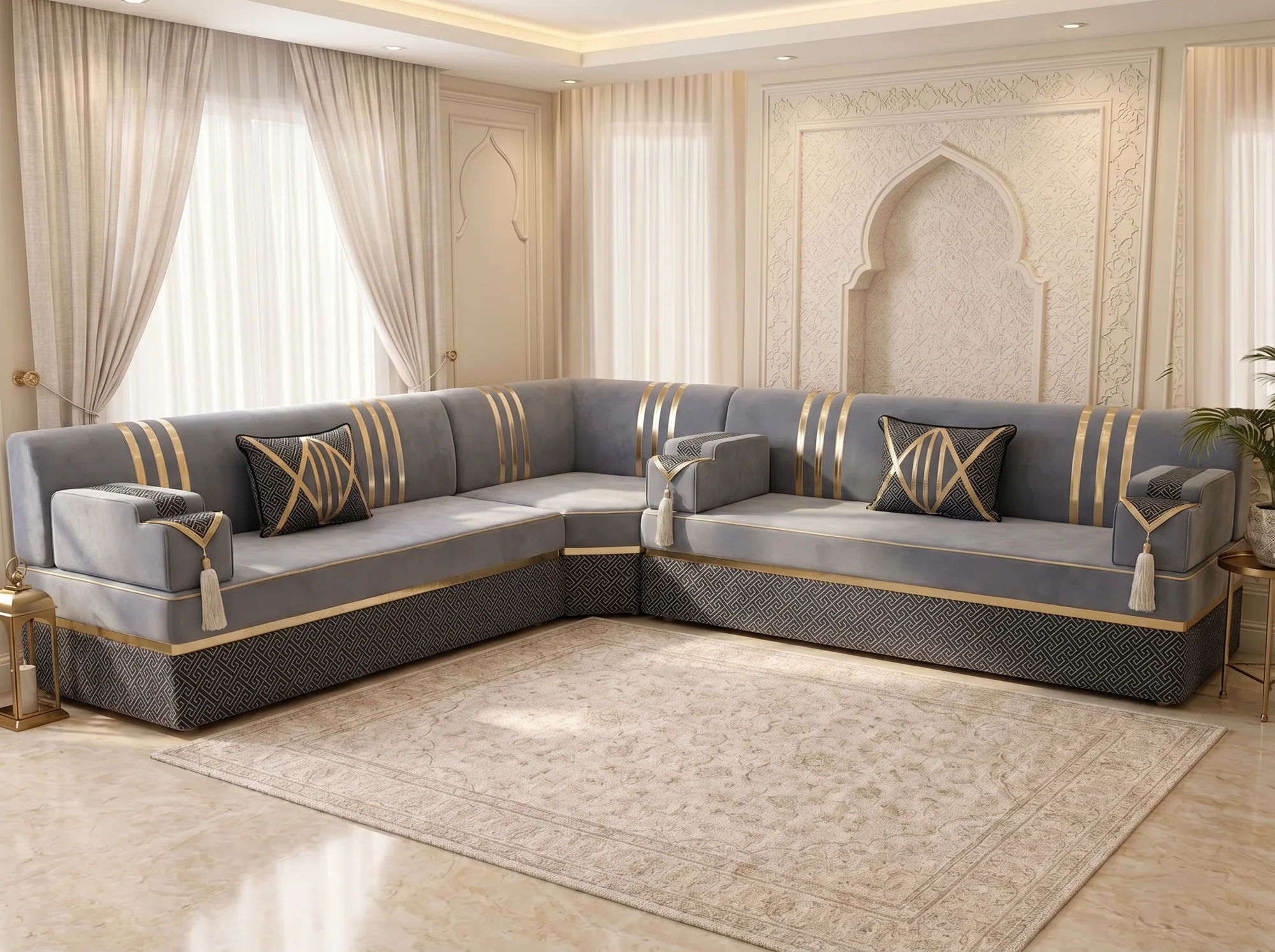
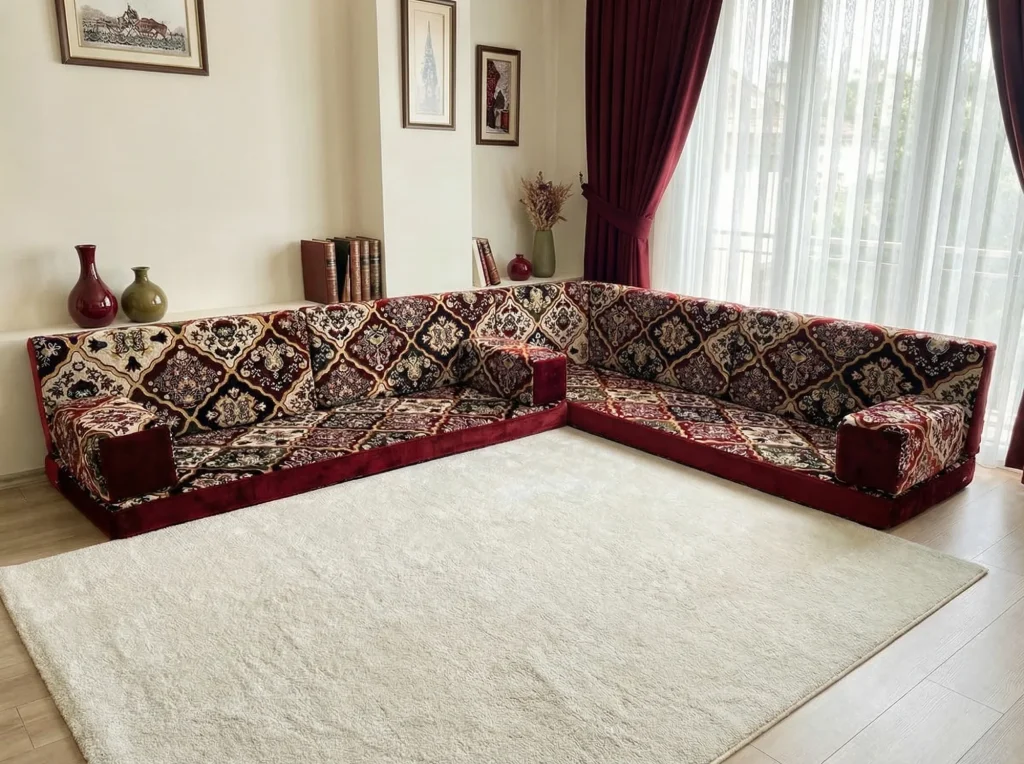
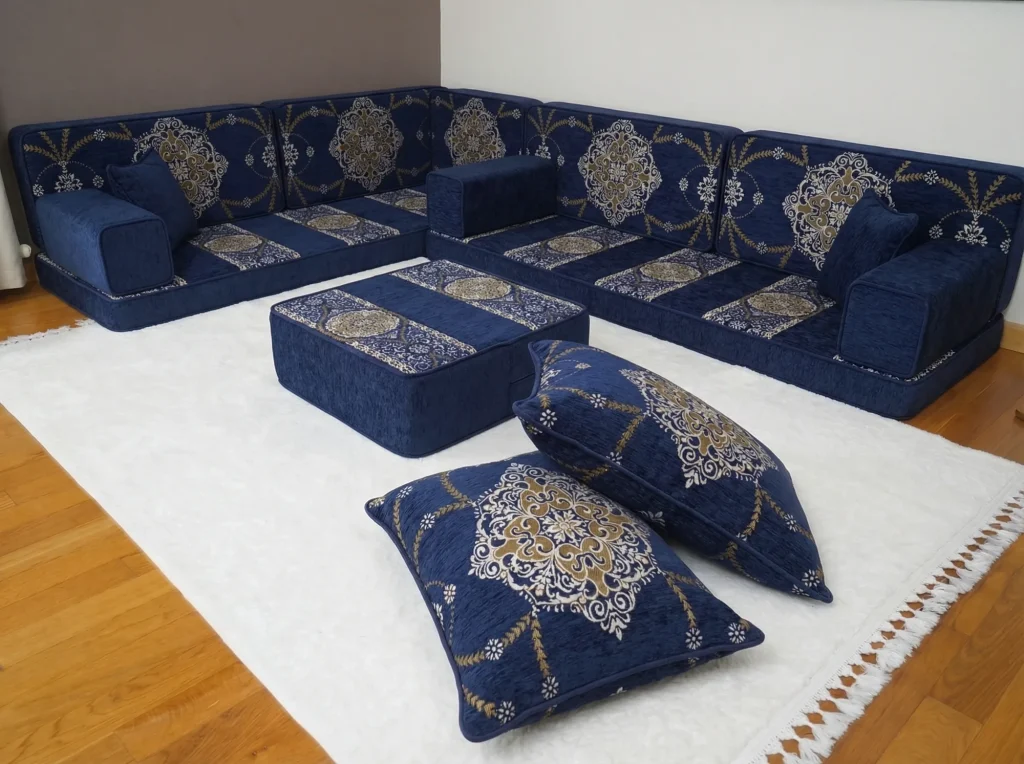
The corner is where a made-to-measure set earns its keep. A ready-made set leaves either a hole in the corner or a mattress that overshoots the wall. When the runs are cut to your wall lengths, a wedge fills the angle and the armrests land where people actually sit. The close view above shows that corner wedge on a raised grey velvet majlis, and the navy and gold floor sofa below turns its corner on the same principle. Our guide to L-shape and U-shape layouts shows how each one is assembled.
Foam and fabric for warm rooms and long evenings
A qa’da arabi is used hard. People sit for hours, children climb on it, and someone always naps on it after lunch. The filling decides how it holds up.
Sofhu cushions are filled with 32 kg/m³ (32 DNS) high-density foam. The number is a density: one cubic metre of the foam weighs about 32 kg. Density tells you how much material is in the cushion, not how hard it feels. Denser foam generally keeps its height and support longer than light budget foam, which can feel firm in the shop and flatten with use. There are no springs inside. On a custom order you can ask for a softer or firmer feel.
For fabric, think about the climate the set will live in:
- Linen-type weaves are the cool choice. Sofhu describes its linen fabrics as porous and refreshing in hot weather, which suits a Cairo summer or a sunny room anywhere.
- Velvet gives the richer, more formal look and is described by Sofhu as durable and easy to clean. It suits air-conditioned rooms and cooler countries.
- Jacquard and woven patterns hide wear and small marks well in a room that sees daily family use.
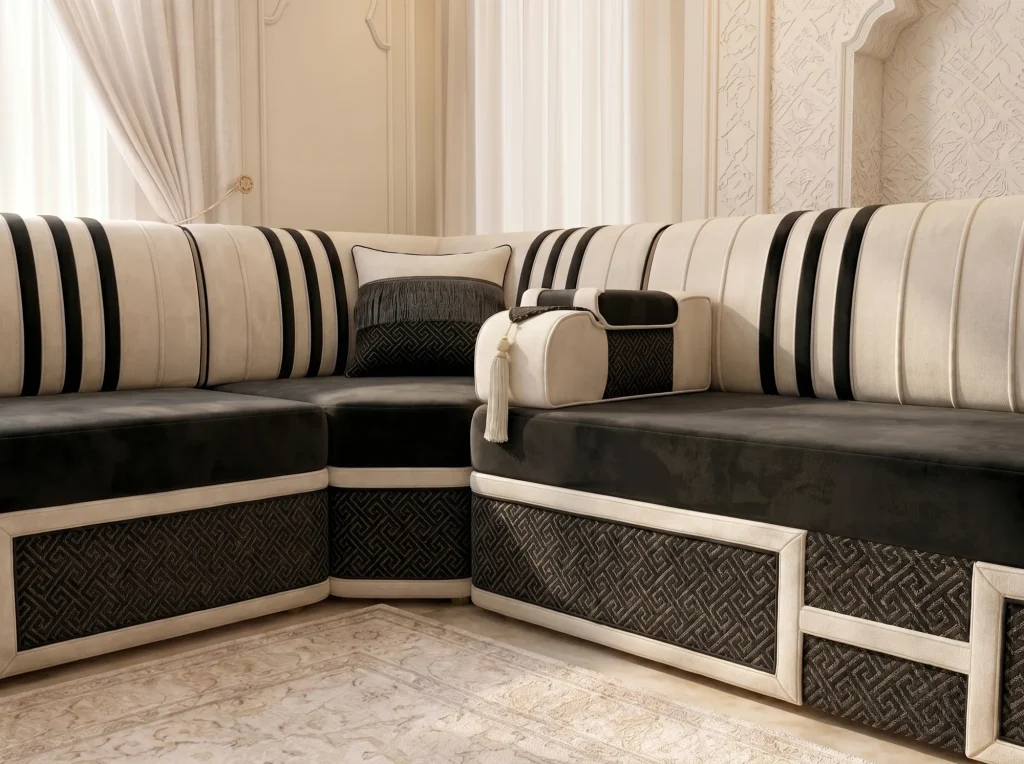
The full range is on the fabrics page, with separate notes on linen floor sofas and velvet floor sofas. All covers are zippered and come off for washing. The close view below is the corner seat of a raised majlis in black velvet.
Measuring and ordering
You do not need a drawing. You need a tape measure and ten minutes.
- Measure each wall the seating will run along, at floor level, corner to corner.
- Note anything that interrupts the wall: a door, a radiator, a socket you need to reach, a low window sill.
- Decide the layout: single row, L or U.
- Choose a colour direction, or send a photo of a set you like.
- Send it all through the quote by measurement form or on WhatsApp.
Sofhu is the manufacturer, so the set is cut for your room and the quote is for that exact set. The step-by-step version, with the mistakes people usually make at corners, is in how to measure a room for a majlis.
Ordering from Egypt or from abroad
Many of the Egyptian families who look for a qa’da arabi live outside Egypt. In the United States the largest Egyptian communities are around New York and northern New Jersey and in the Los Angeles area, with others in Washington, Nashville, Chicago and Houston. There are established communities in Canada, Australia and London as well. In a detached house the Arabic corner can take a spare room or a finished basement; in a city flat it is more likely to be one wall of the living room.
Sofhu has no shops abroad. Every set is built to order in Türkiye and delivered to your address, and shipping is free worldwide. The cushions travel vacuum packed. When they arrive, open the bags carefully without a knife or scissors against the fabric and let the foam recover its shape. Import duty or tax may apply depending on the country, so ask before you order.
For the wider family of low seating, see Arabic floor sofas and the Arabic jalsa hub. For neighbouring traditions, compare the Syrian and Levantine qa’a, and see how the names change from one country to the next in floor seating names by country.