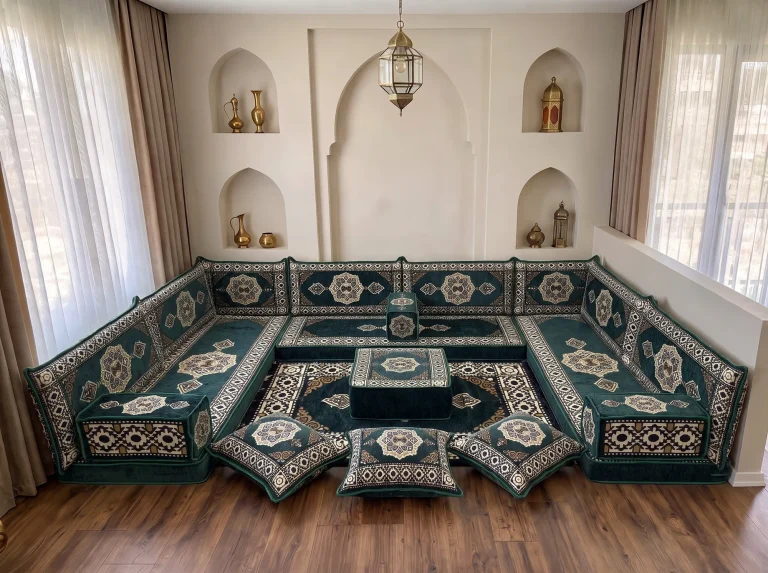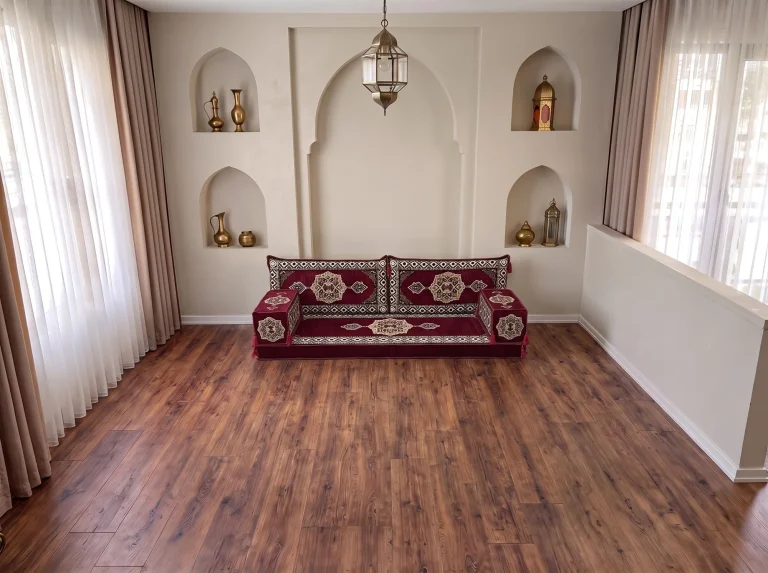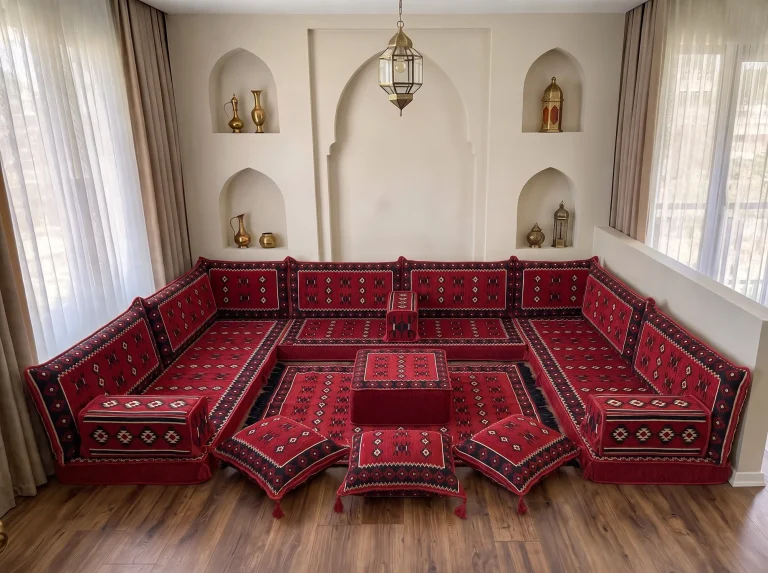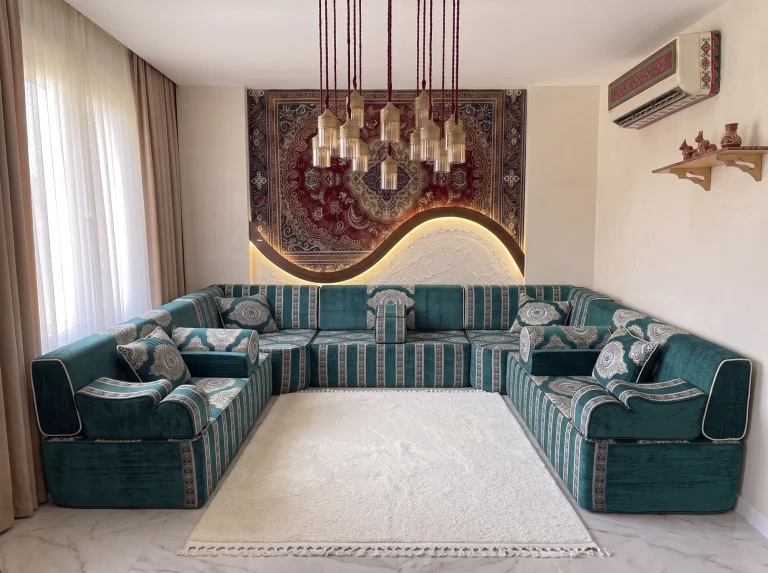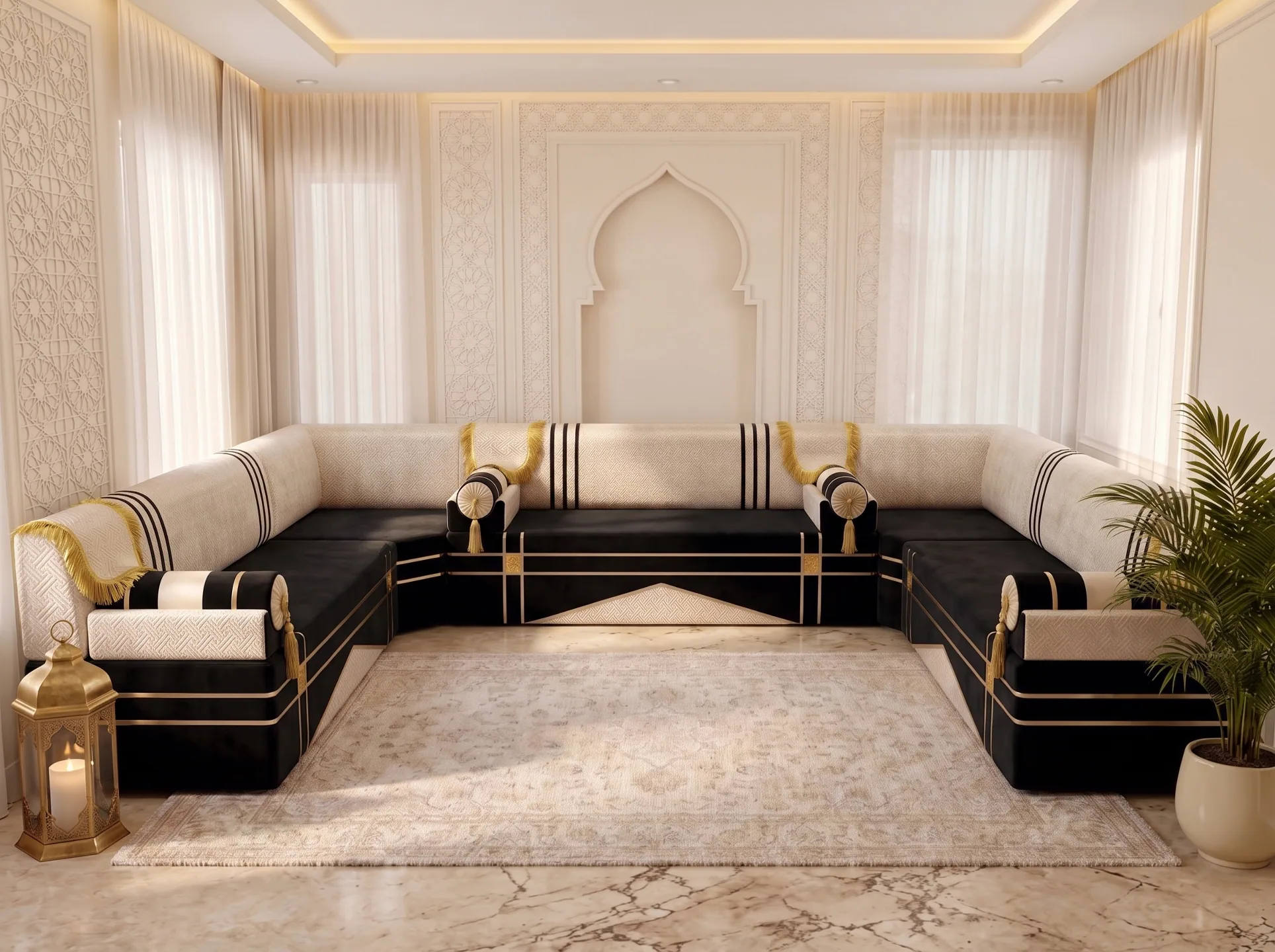
A custom majlis is raised, upholstered Arabic seating built for one room: the unit lengths follow your walls, and you choose the layout, fabric, colour, seat height and foam feel. Sofhu, a manufacturer in Türkiye, makes each set to measure from the wall measurements you send, fills it with 32 kg/m³ foam and ships it free worldwide. Start with a quote by measurement.
- What is customised
- Lengths, layout, fabric, colour, pattern, cushion thickness, foam feel
- Layouts
- Single row, L-shape, U-shape
- Foam
- 32 kg/m³ (32 DNS) high-density foam, softer or firmer on request
- Covers
- Zippered, removable, washable at 30 degrees
- Design help
- Photos, video and video calls with Sofhu's designers
- Made by
- Sofhu, manufacturer in Türkiye
- Shipping
- Free worldwide
On this page
What you can change on a custom majlis
Almost everything. A custom majlis from Sofhu is not a catalogue set with a few colour options. It is cut and sewn for one room, and each decision below is yours.
| Choice | What you decide |
|---|---|
| Size | The length of every seat run, to fit your walls |
| Layout | Single row, L-shape or U-shape |
| Fabric and colour | Velvet, linen, chenille or woven cloth, plain or patterned |
| Seat height | How low or high you sit |
| Foam feel | Softer or firmer, always 32 kg/m³ foam |
| Details | Stitching details, special embroidery, armrests |
| Extras | Loose cushions, ottoman, floor cushions, rug, curtains |
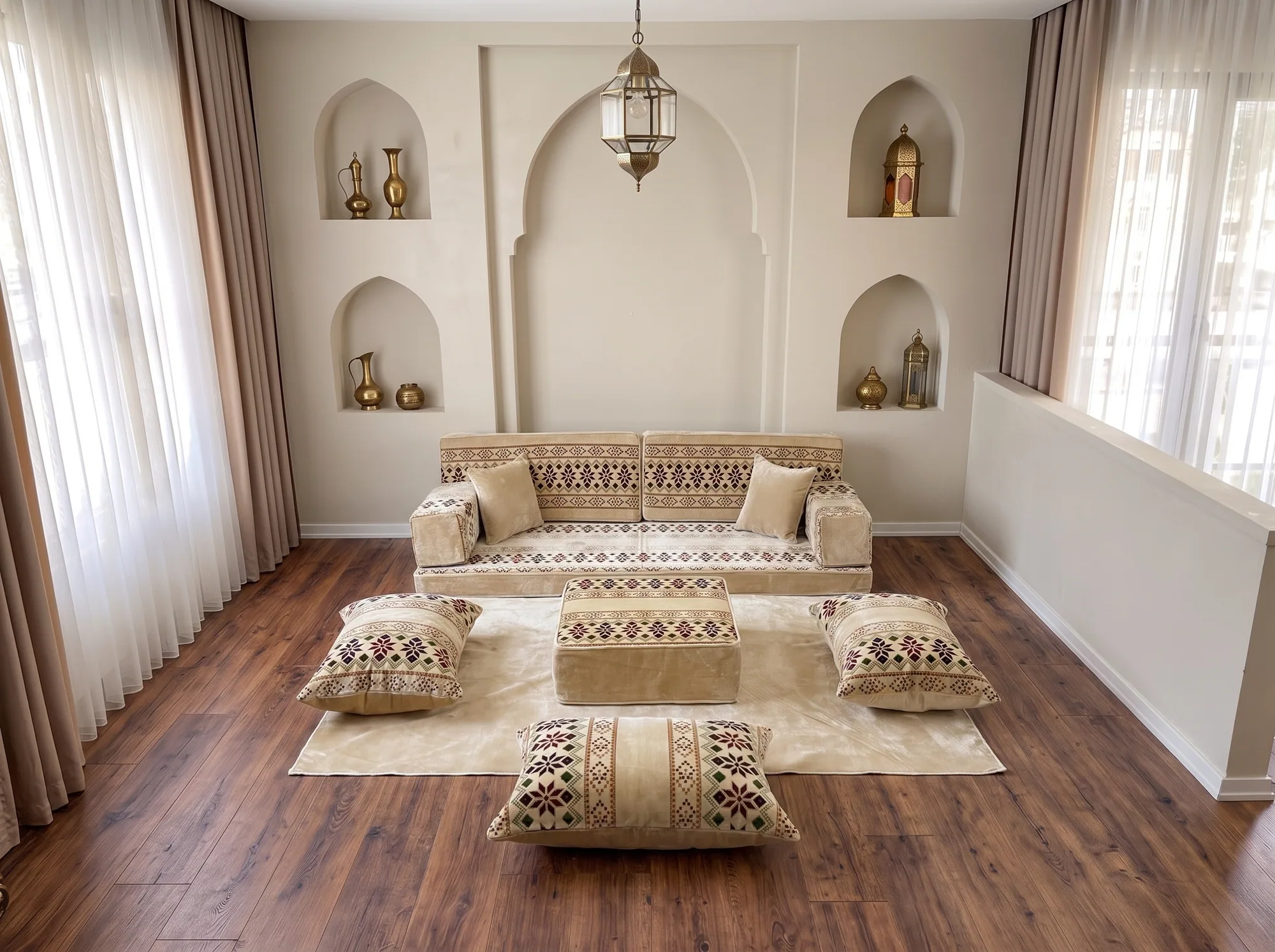
Sofhu makes two kinds of Arabic seating, and both are made to measure. The Arabic majlis is the raised, sofa-height one: a solid upholstered base, tall fixed backs, arm bolsters, piping and trim. The Arabic floor sofa is the low one: a seat mattress near the floor with loose back cushions, an ottoman and floor pillows. This page is mainly about the majlis, but a custom floor sofa is ordered in exactly the same way, and a few appear in the gallery.
Sofhu is the manufacturer, so these are production decisions rather than requests passed on to someone else. The set is made in Türkiye and shipped to you free of charge, wherever you live.
A custom made majlis matters most in three situations: the room has an awkward shape, you have a particular design in mind from home, or a ready-made set in fixed lengths simply will not fill the wall. If you are weighing the two routes, marketplace floor sofa sets against a custom majlis sets out the difference.
What to measure and send
Good measurements are the whole foundation of a made to measure majlis. You do not need a laser or a floor plan. A tape, a pencil and ten minutes are enough.
- Walls. Measure each wall that will carry seating, along the floor, from corner to corner.
- Openings. Mark where each door and window starts and ends on that wall. Note which way doors swing.
- Fixed objects. Radiators, sockets you need to reach, vents, pipes, skirting heaters, built-in shelves.
- Heights. The height of any window sill or ledge that the backrests will sit under.
- A sketch. Draw the room from above, even roughly, and write the numbers on it.
- Photos or video. Stand in the doorway and pan slowly round the room.
Send all of it through the quote by measurement form or on WhatsApp. The full method, with the common mistakes, is in how to measure your room for a majlis.
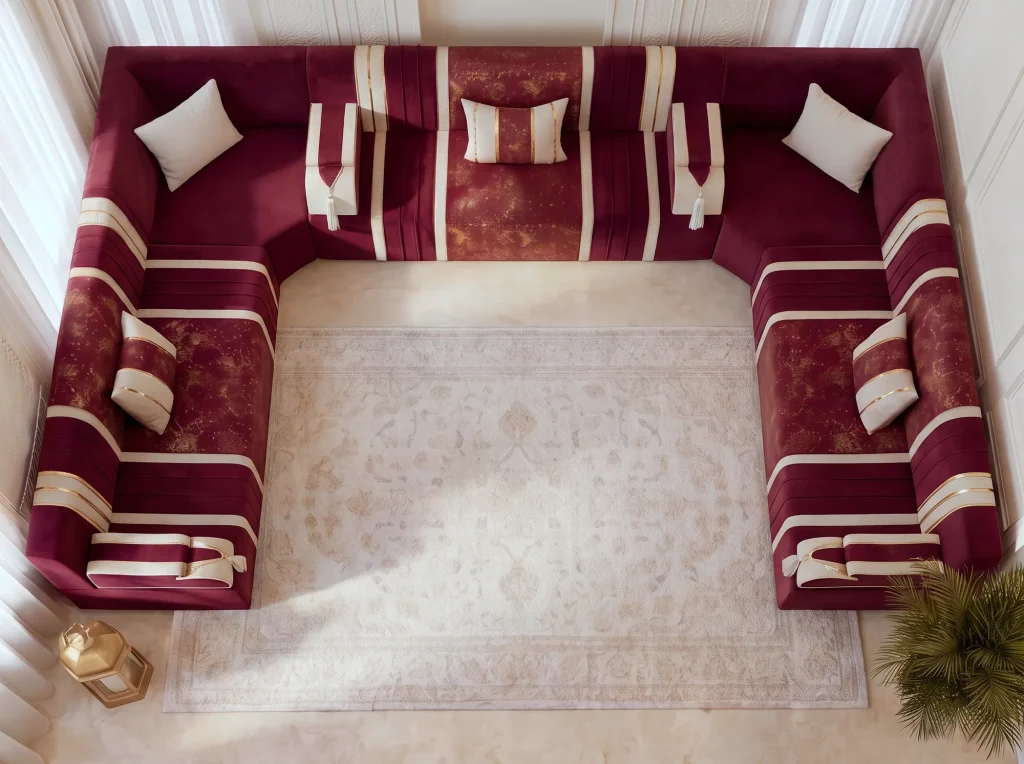
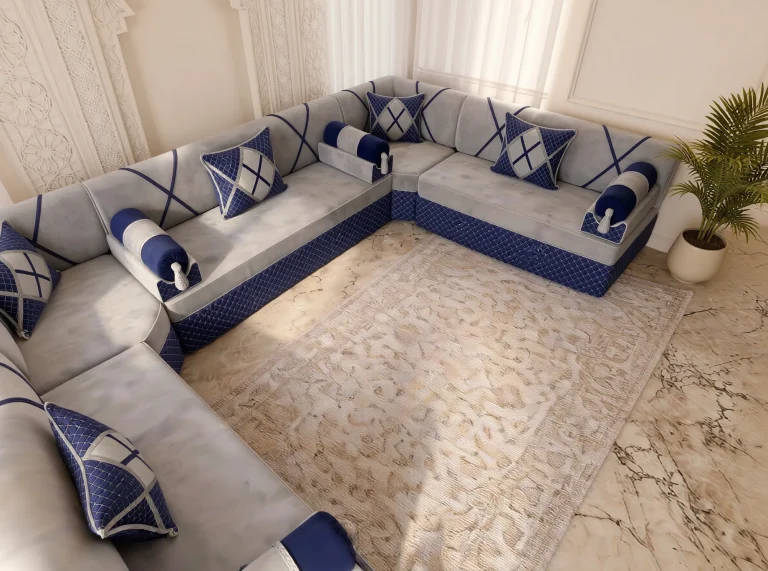
A plan view like the one above is how we think about your room. The seating forms the outline, and the open floor in the middle is as much a part of the design as the cushions. If you are not sure how many guests a layout holds, see how many people a majlis seats.
Awkward rooms: columns, radiators, bay windows and doors
Most rooms are not clean rectangles. These are the problems we see most often and how a custom majlis deals with them.
A column or chimney breast. The run is divided so that one unit ends on one side and the next begins on the other, or a shorter piece is made to sit in front of the projection. Give us the column’s width, its depth and its distance from the corner.
A radiator on the seating wall. Foam should not be pressed against a hot radiator, and a covered radiator heats nothing. The usual answers are to stop the seating short of it, or to choose the other walls for the main run. Tell us whether the radiator is in use.
A bay window. A bay can take its own short pieces along each face, or the seating can run straight across in front of it. Send the length of each face and the angle if you know it. A photo usually settles it.
A low window. The backs stand against the wall. Where the sill is low, the back is planned to sit beneath it so the window still opens and the view is kept.
A door in the middle of a wall. The wall becomes two shorter runs with a clear path between them. Mark the door swing so the nearest armrest does not catch it.
No wall at all. A majlis is designed to line the walls, and the loose back cushions of a floor sofa need a wall or another hard surface to lean on. In an open-plan room that usually means seating only the solid walls. Send photos and we will say what is possible.
For the geometry of corners and how the pieces meet, see L-shape and U-shape majlis layouts.
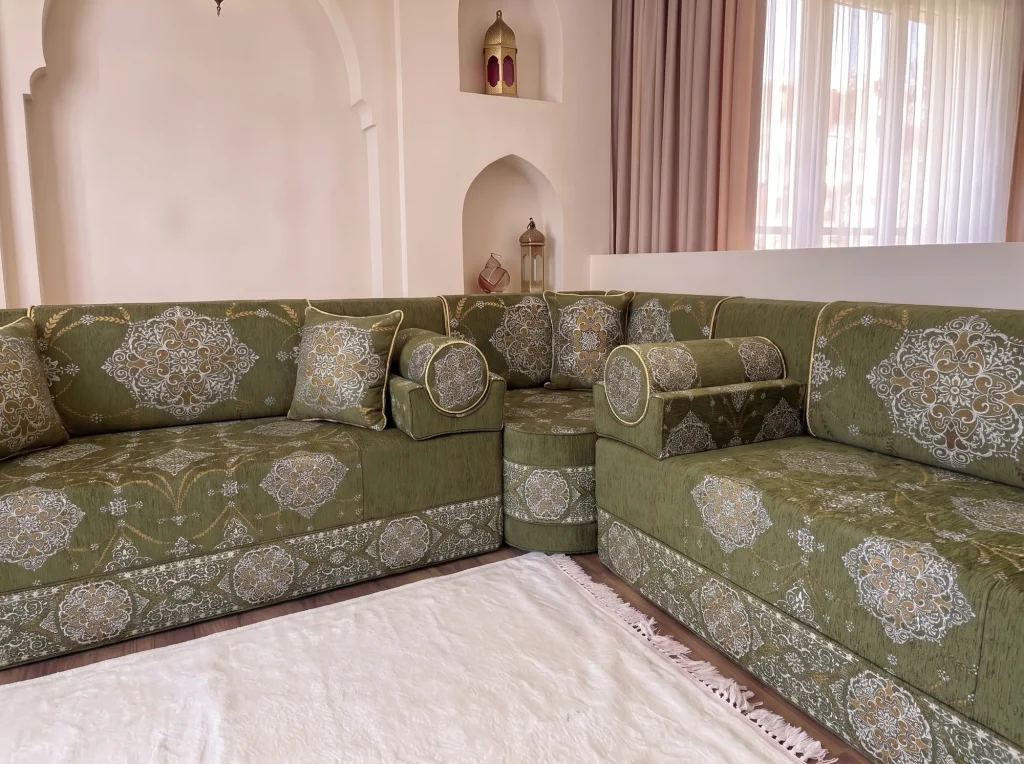
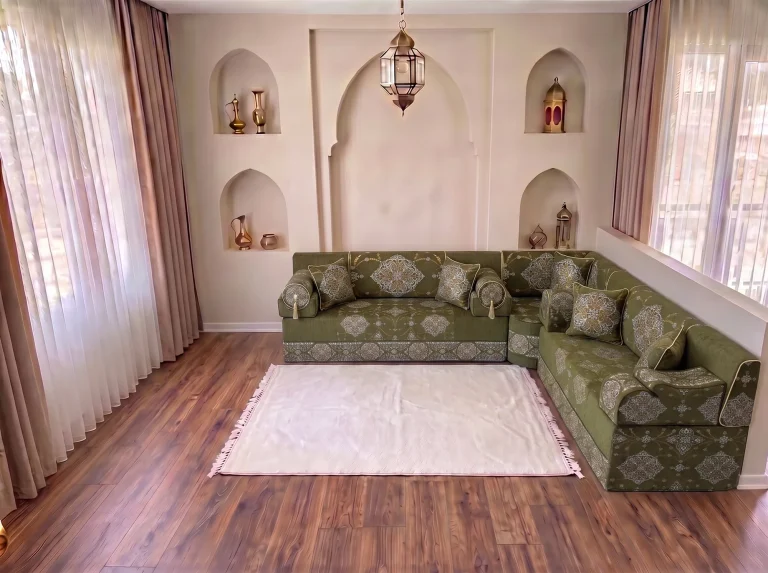
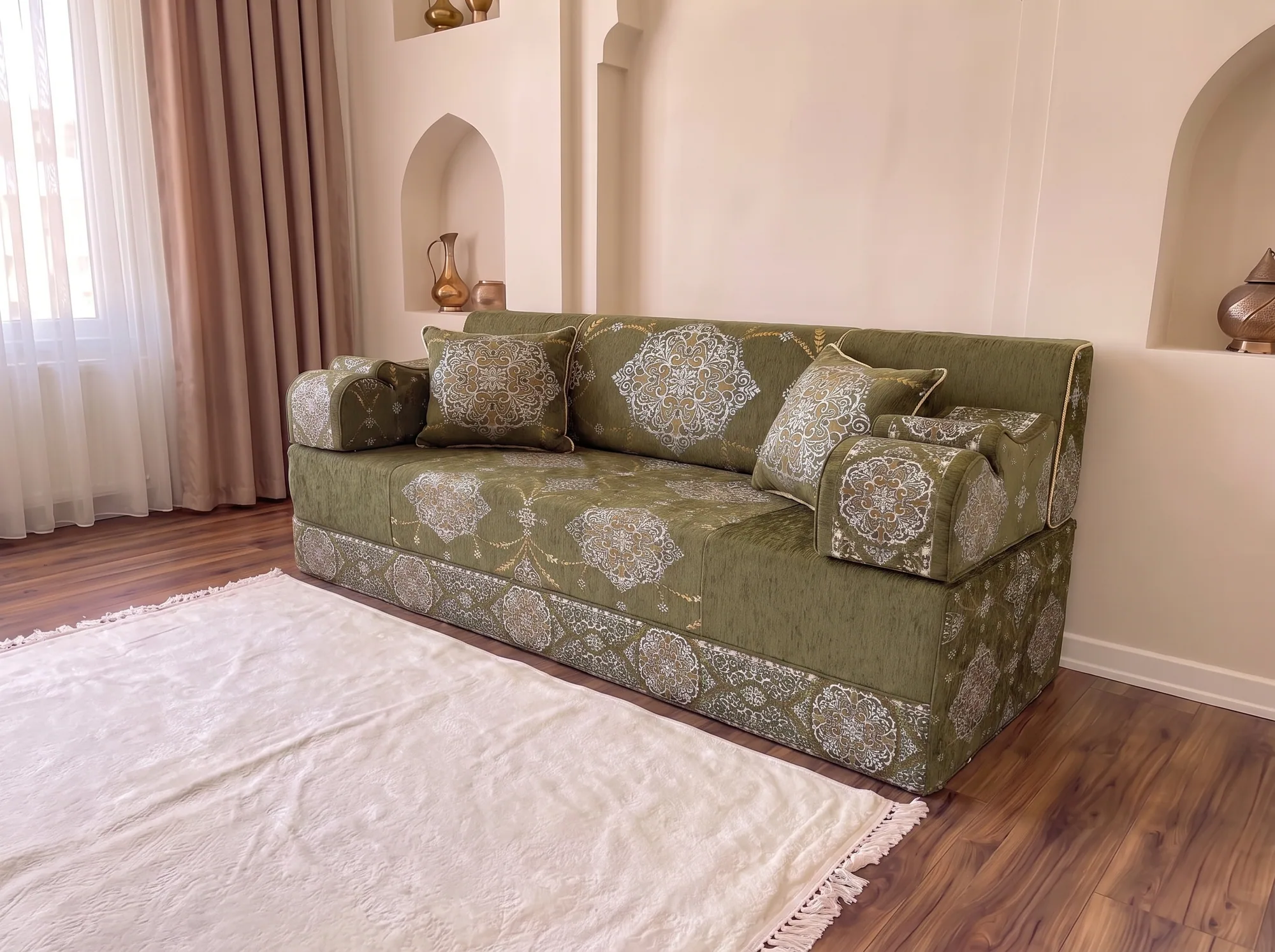
The khaki majlis above shows what a finished corner looks like from sitting height: the base, the seat and the bolster armrest all end exactly where the wall does.
Choosing fabric from a distance
You will choose your fabric without touching it, so the process has to make up for that.
Start with use, not colour. A daily family room with children needs a cover that washes. A formal guest room used on Fridays and at Eid can carry a richer cloth. Sofhu’s covers are zippered and removable, and the company states they can be machine washed at 30 degrees.
Then narrow by type. Velvet gives depth of colour and a formal look. Linen is cooler to sit on in hot climates. Chenille and woven fabrics carry medallions, stripes and geometric patterns well. The fabrics page lists the families Sofhu works with, and velvet, linen and jacquard compared explains how each wears.
Finally, look properly. Ask for photos in daylight and a short video with the cloth moving, because pile and sheen change with the angle. On project orders you can go through the options with one of Sofhu’s designers by video call. Send a photo of your curtains, carpet and wall colour so the suggestions are made for your room and not for a studio.
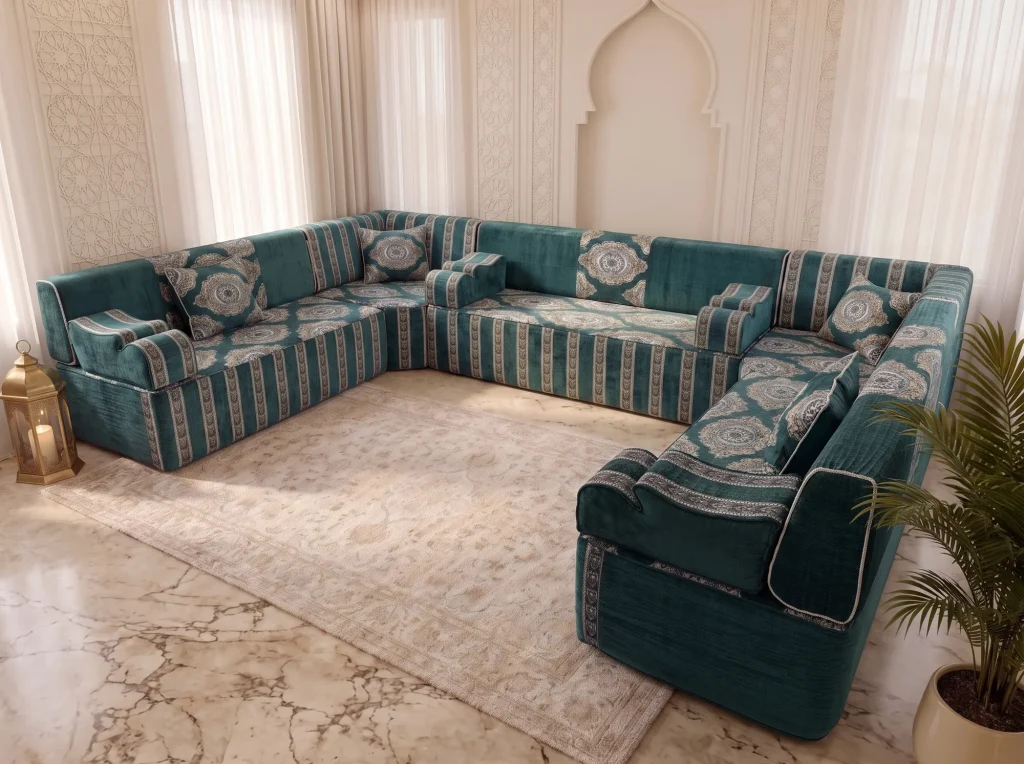
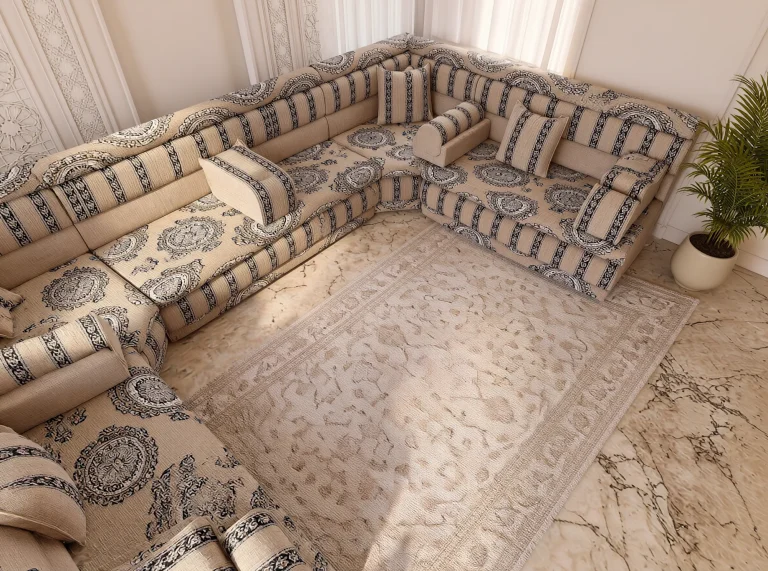
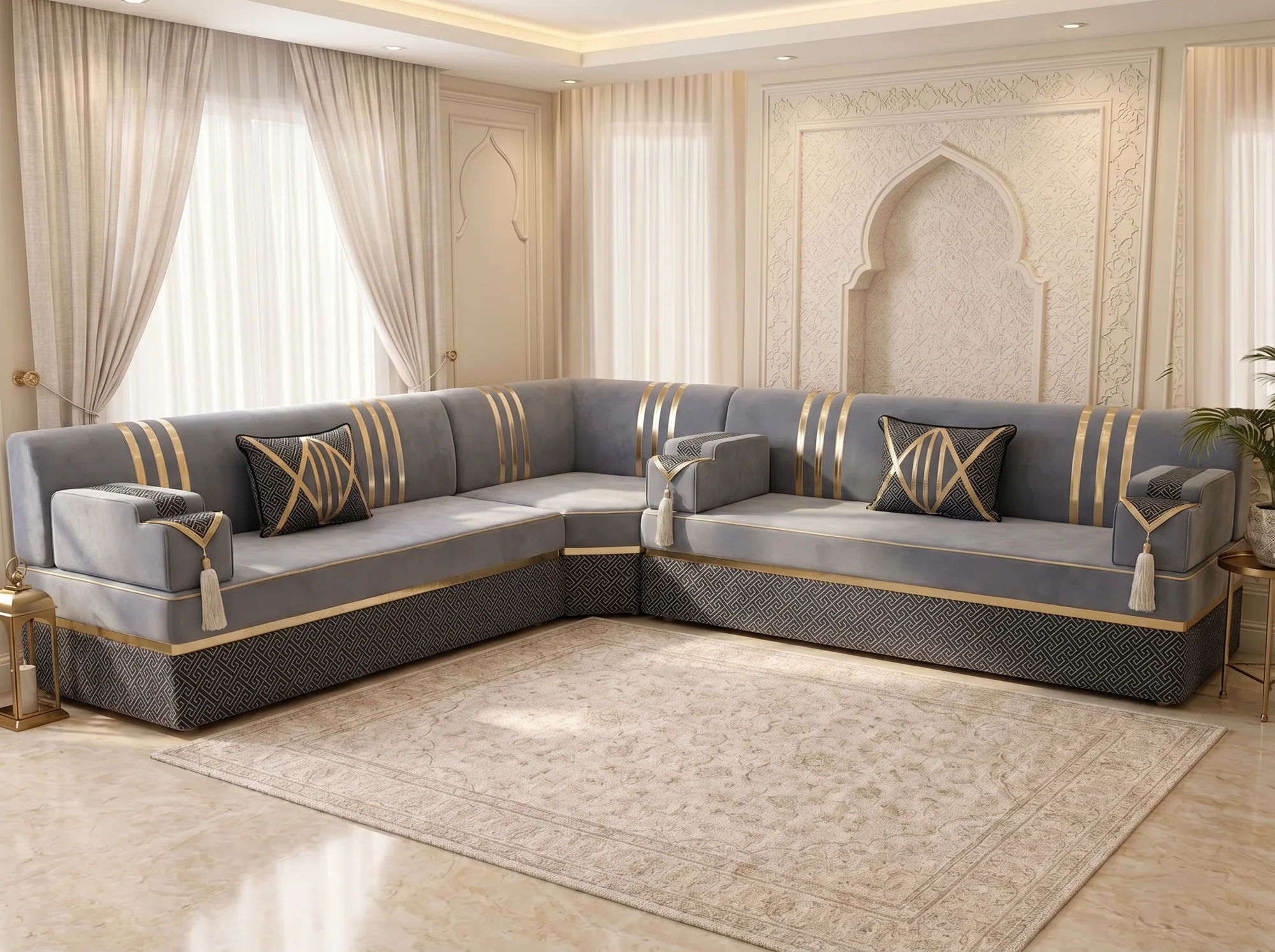
Pattern placement is part of the design. In the set above, the medallions sit centred on the cushions and the stripes carry on from one run to the next, so three runs read as one piece. That alignment is planned once the piece lengths are fixed, which is one more reason the measurements come first.
Foam, thickness and how the seat feels
Every Sofhu cushion uses 32 kg/m³ (32 DNS) high-density foam. Density and firmness are separate things. Density is how much material is in the foam, and denser foam generally holds its height and support for longer. Firmness is how hard it feels when you sit, and the same density can be made softer or firmer.
So there are two choices to make. The first is height, which decides how high you sit and how easy it is to stand up. The second is feel. Sofhu describes its standard cushions as firm, and on custom orders you can ask for a softer or firmer foam. The cushions contain no springs.
We do not print a fixed table of heights here, because the right answer depends on the people in the room. Tell us who sits there most. The majlis seat height guide covers floor-level, mid and raised seating, and Sofhu’s page on sponge and foam quality gives more background.
From measurements to delivery
The order follows the same steps whether you live in Detroit, Birmingham or Doha.
- You send measurements, photos and ideas. Include any design you have seen and liked.
- We propose a layout and fabrics. You see options and ask questions by message or video call.
- You receive a quote for that exact set, with shipping included at no charge.
- You confirm sizes, layout, fabric and details. Check each figure once more against your tape.
- The set is made in Sofhu’s workshops in Türkiye and inspected.
- It is vacuum packed and shipped to your address. Open the sealed bags by hand, without a blade, and let the foam recover.
Import duties or taxes may apply depending on your country. Ask us before you order. For a closer look at each stage, read how to order a custom majlis online and Sofhu’s own account of the making of an Arabic sofa. The factors behind a quote are explained in what affects the price of a custom majlis.
Seeing the footprint before you commit
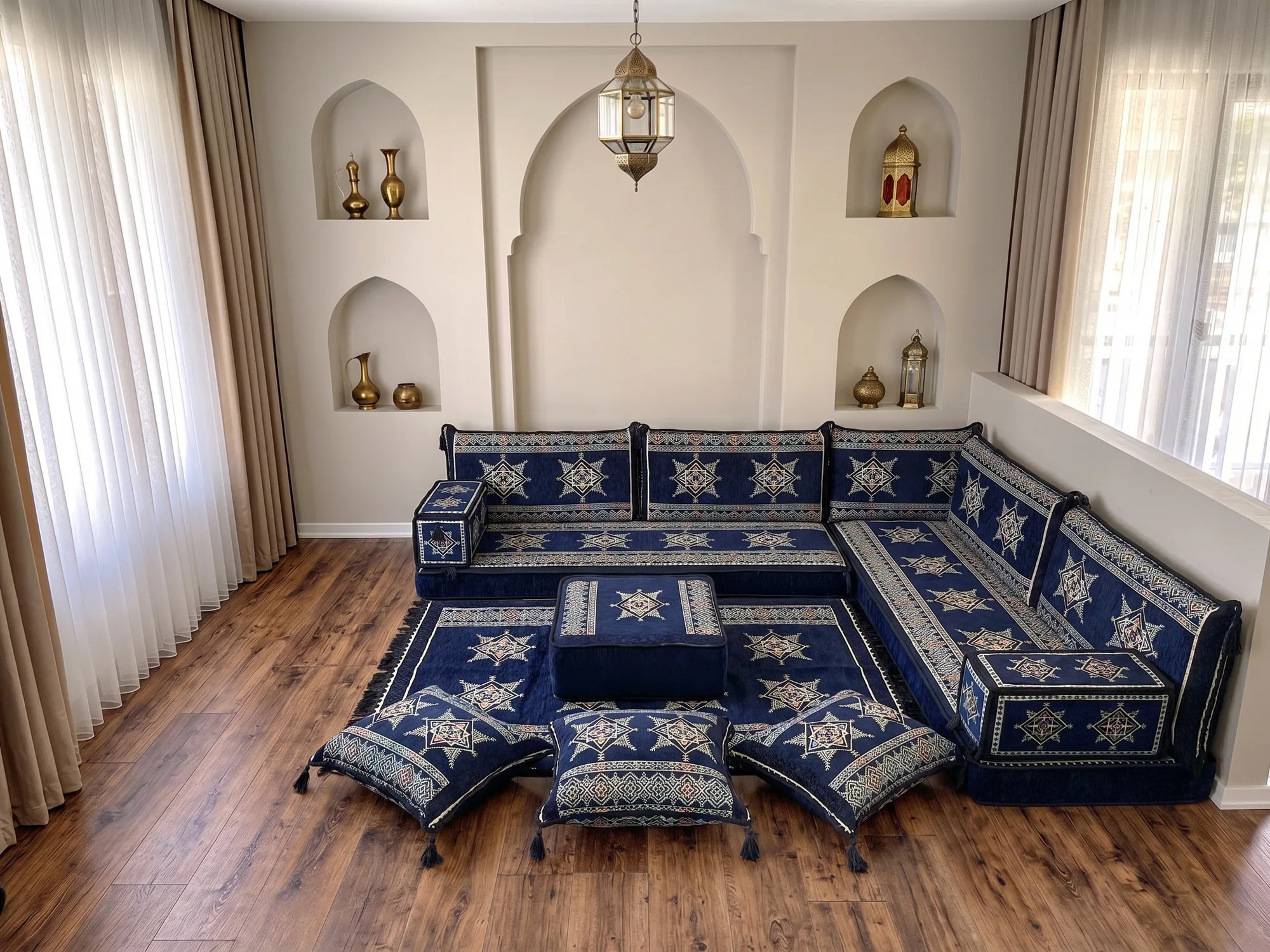
The easiest way to judge a custom majlis design is to look at the seating without the accessories. The photograph below shows a navy U-shaped majlis on a bare floor, with no rug or tables. You can see exactly how much of the room the seating takes and how much stays open.
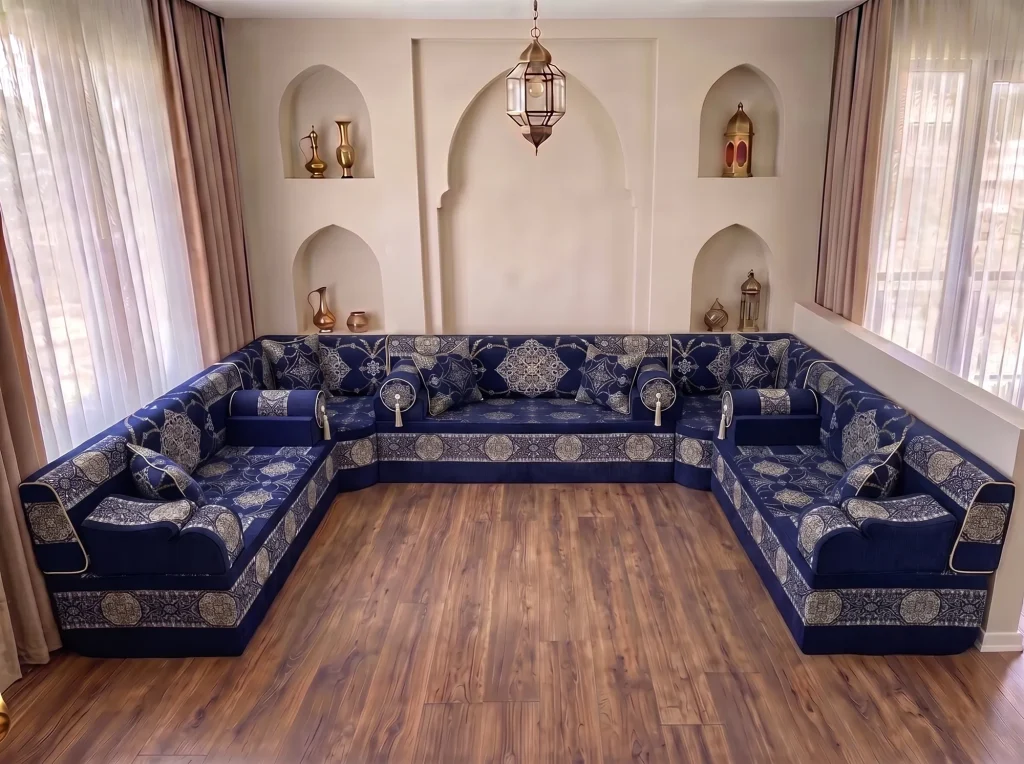
Try the same thing at home before you order. Ask us for the seat depth of your set, mark it on the floor with masking tape along each wall, then walk the room, open the doors and sit where the corner will be. If the taped outline feels right, the finished set will too.
Earlier Sofhu articles on custom-made Arabic sofas for personalised decoration and custom-made Yemeni majlis sets show more of the options. Readers planning a diwaniya in Kuwait should go to Arabic sofas in Kuwait. Arabic speakers can read about تفصيل مجالس. When you are ready, contact us or send your measurements.