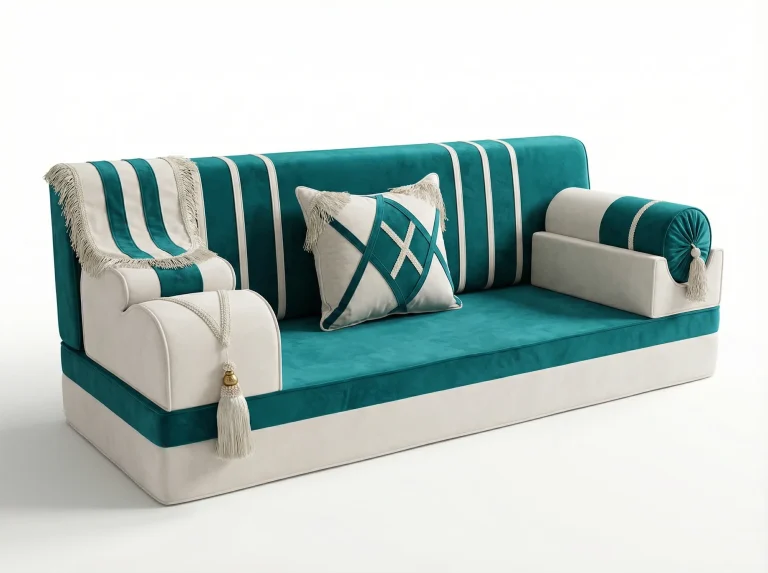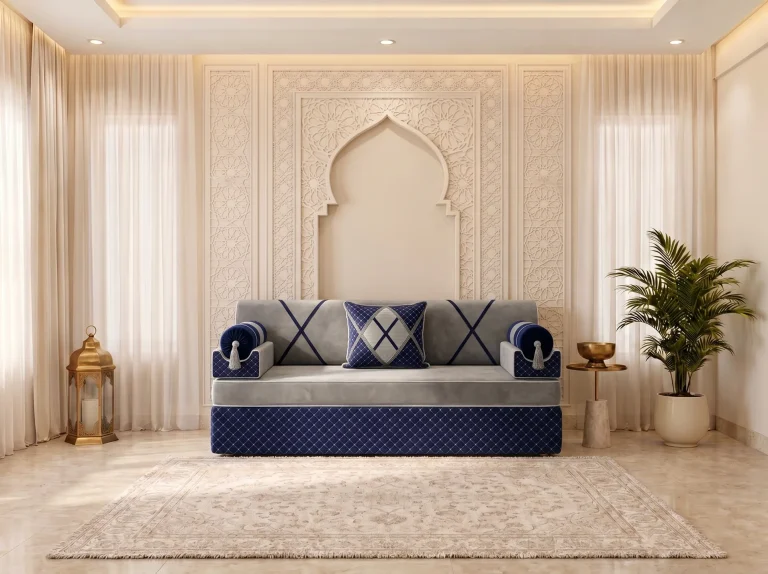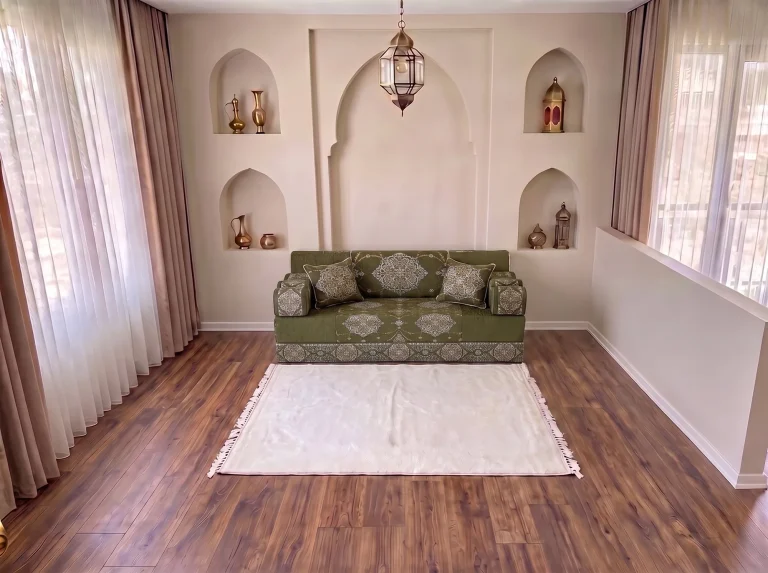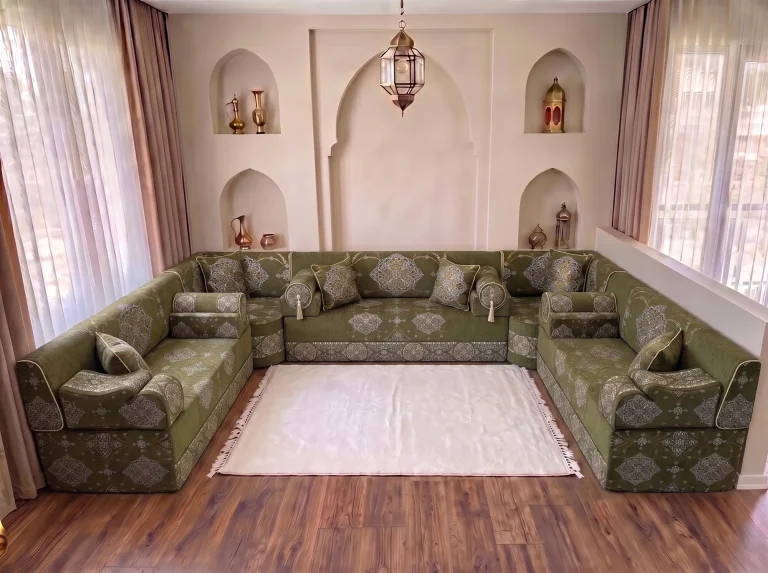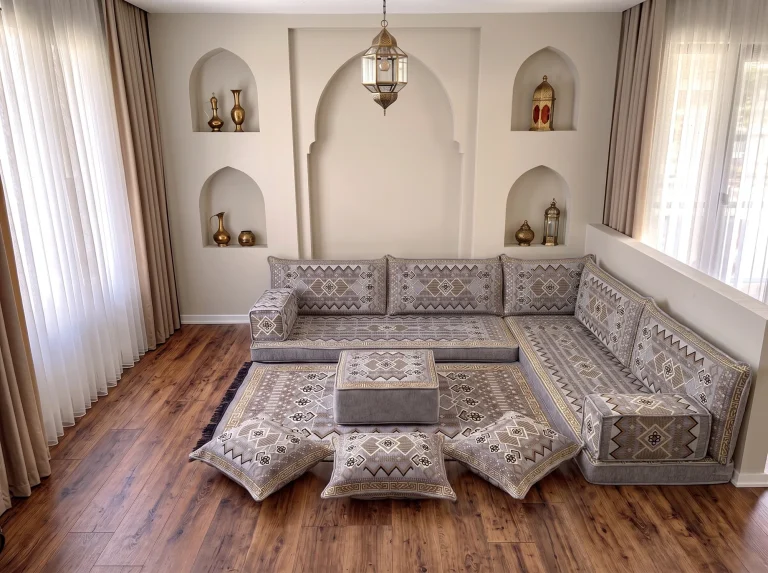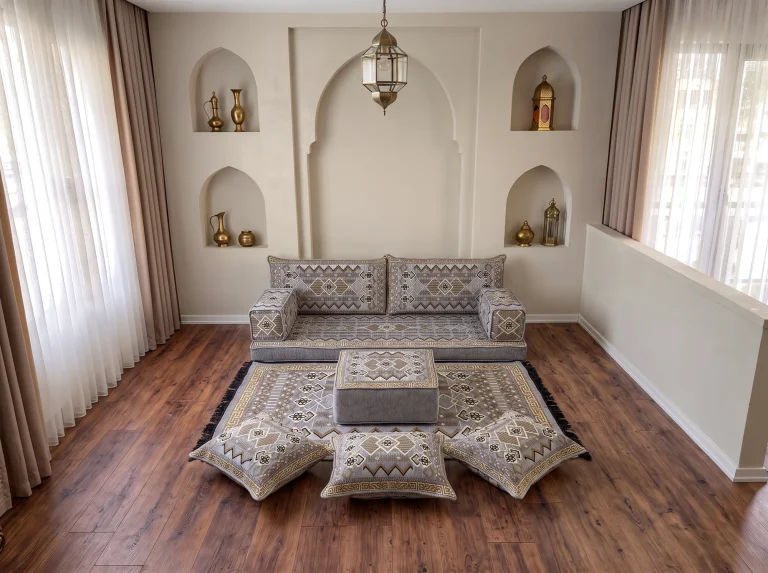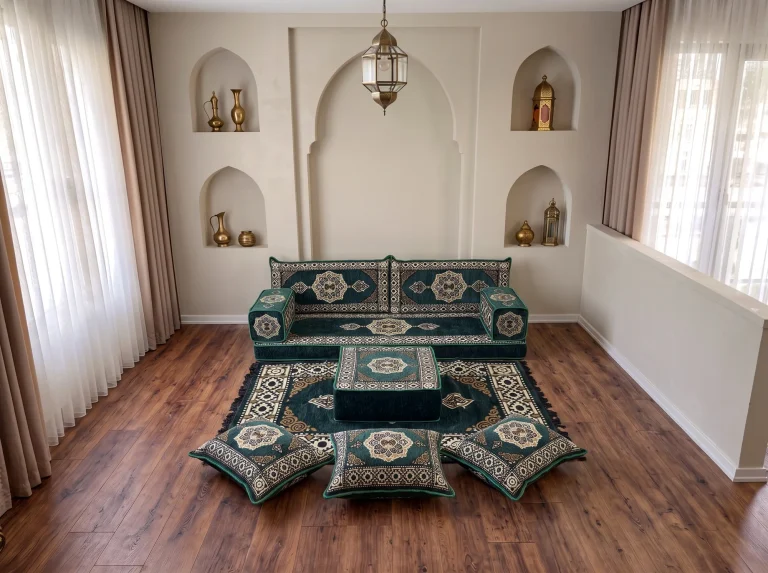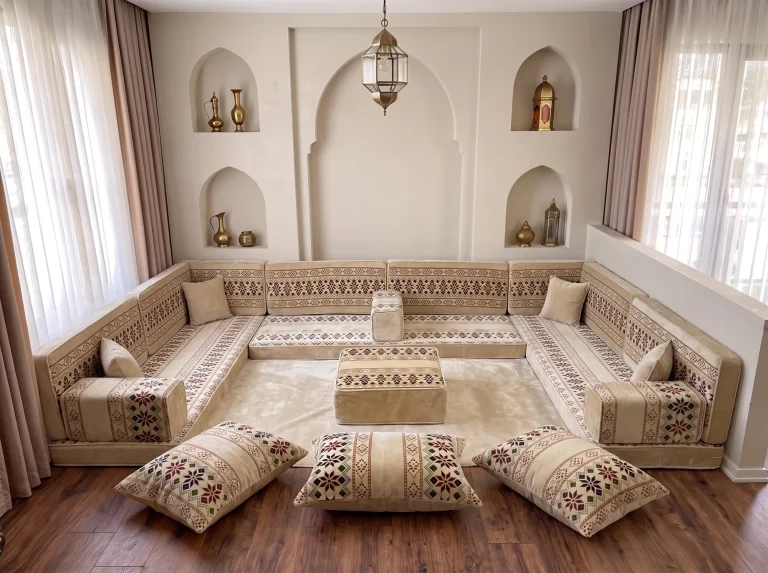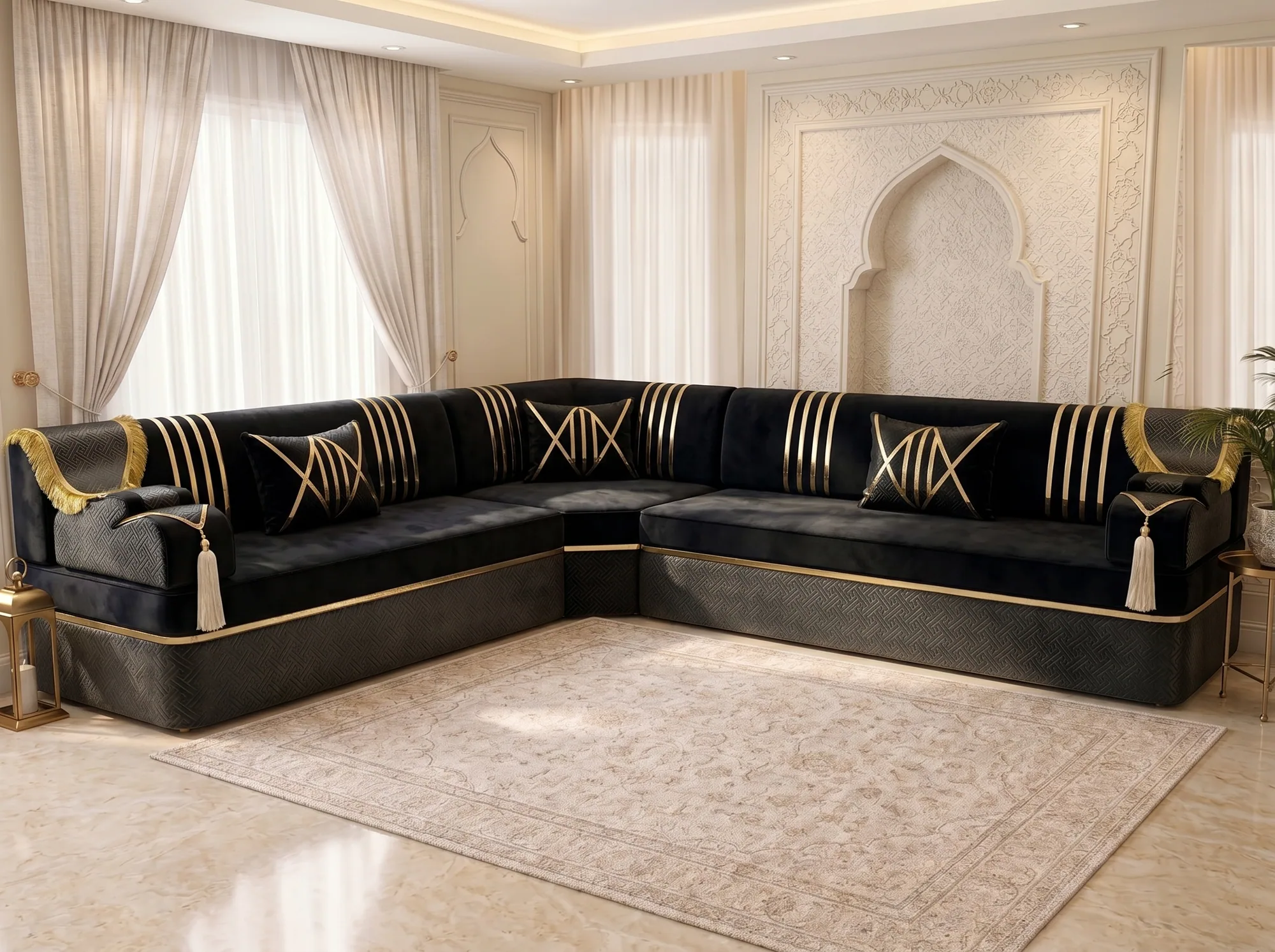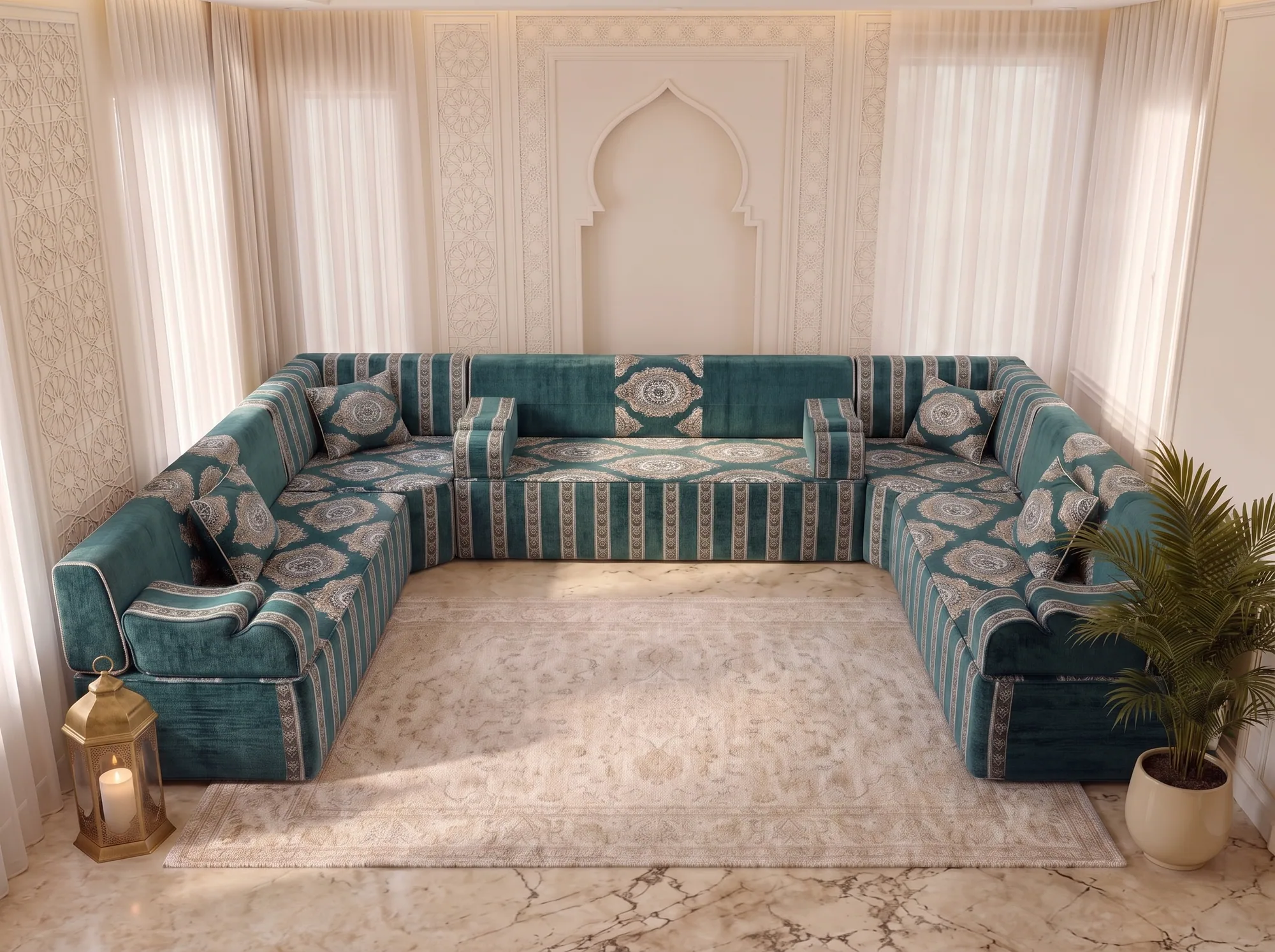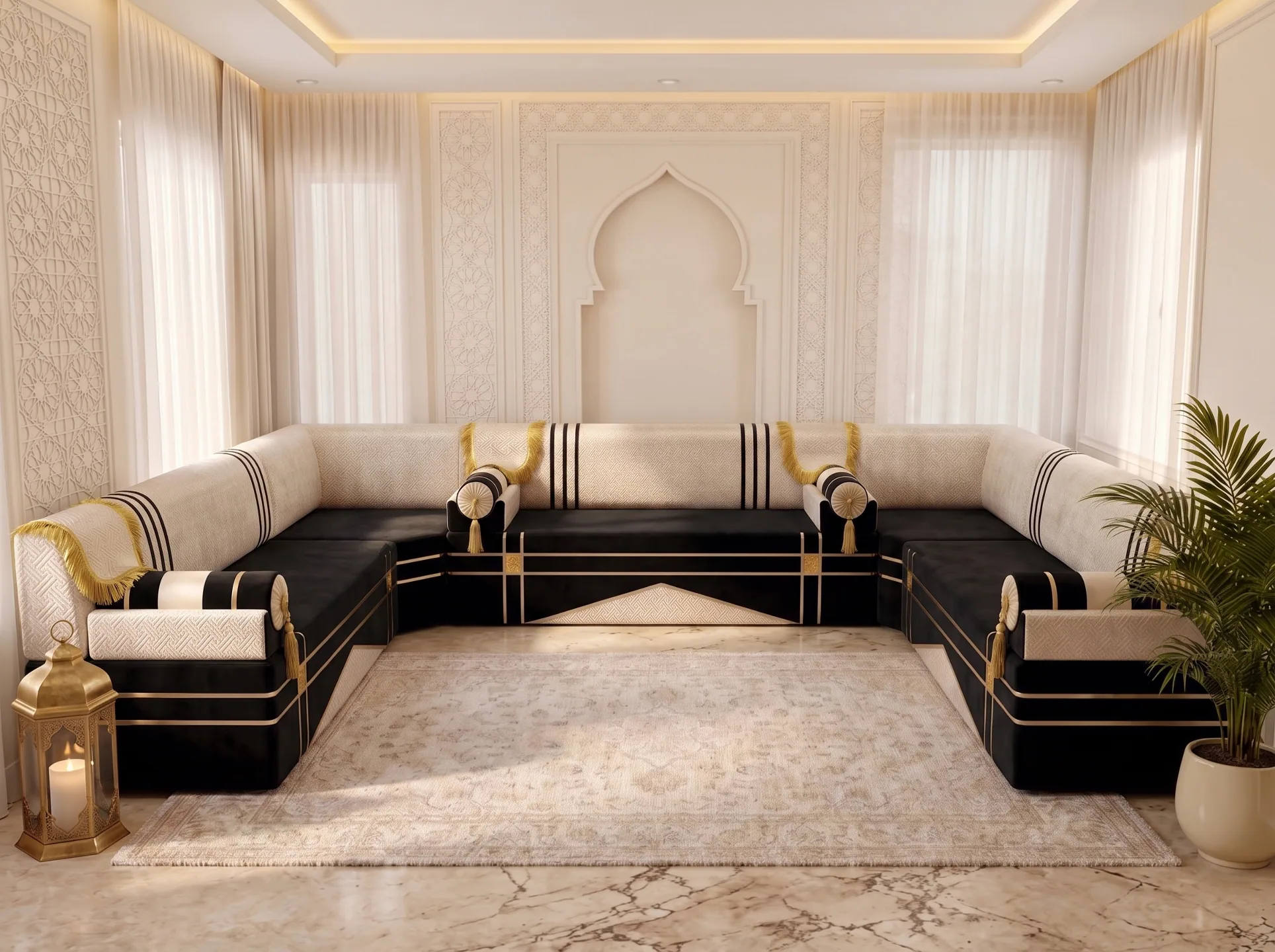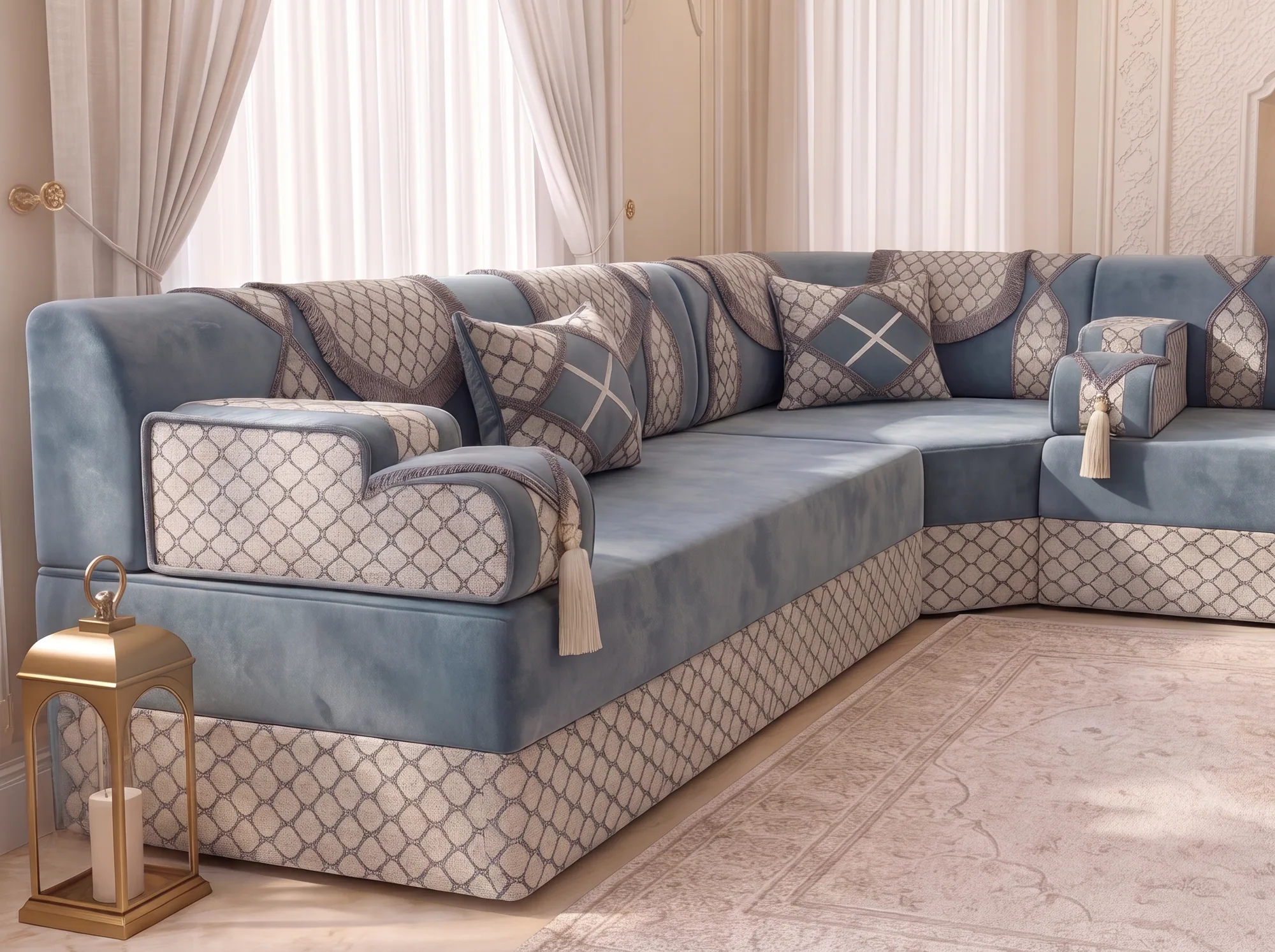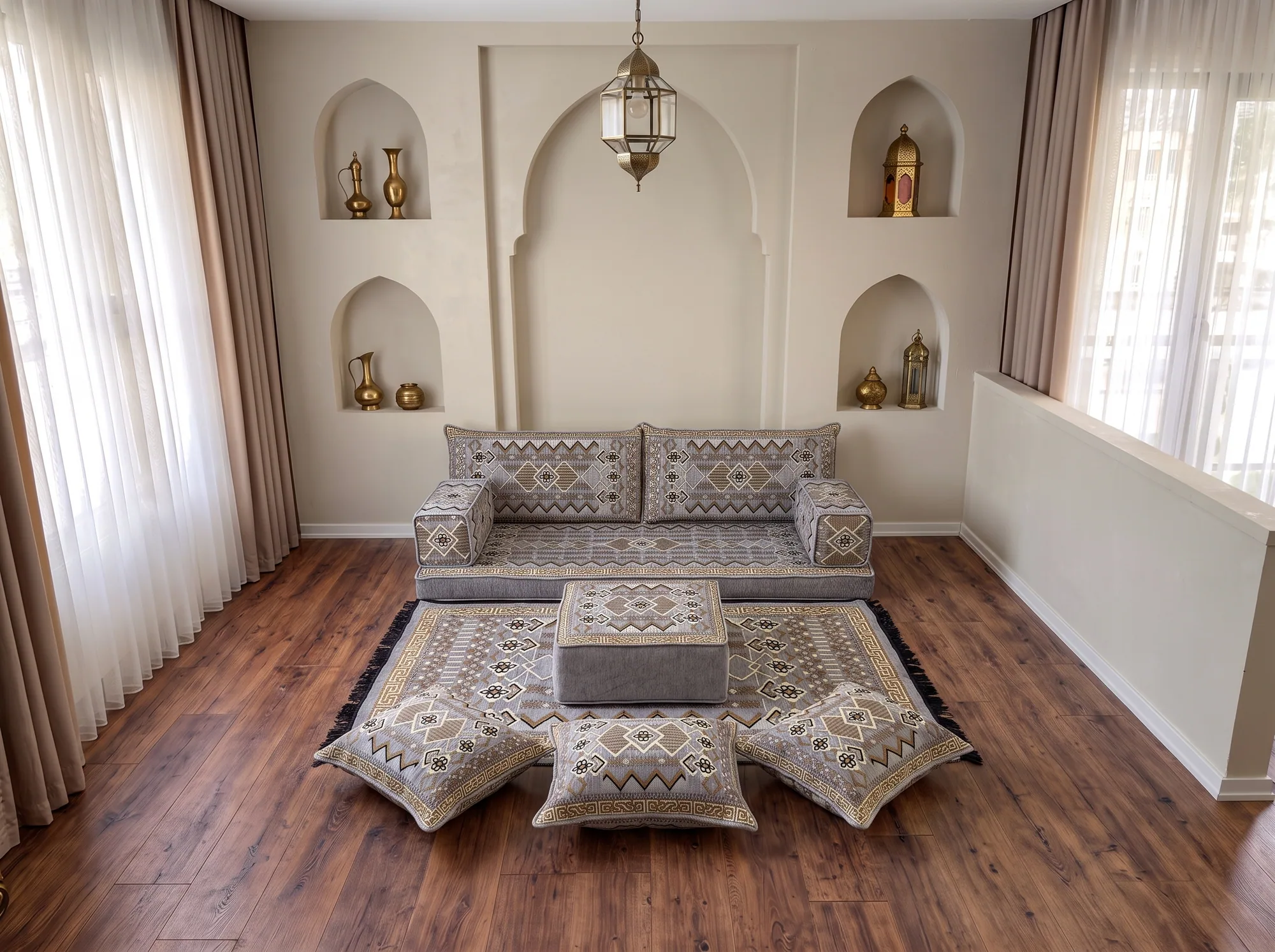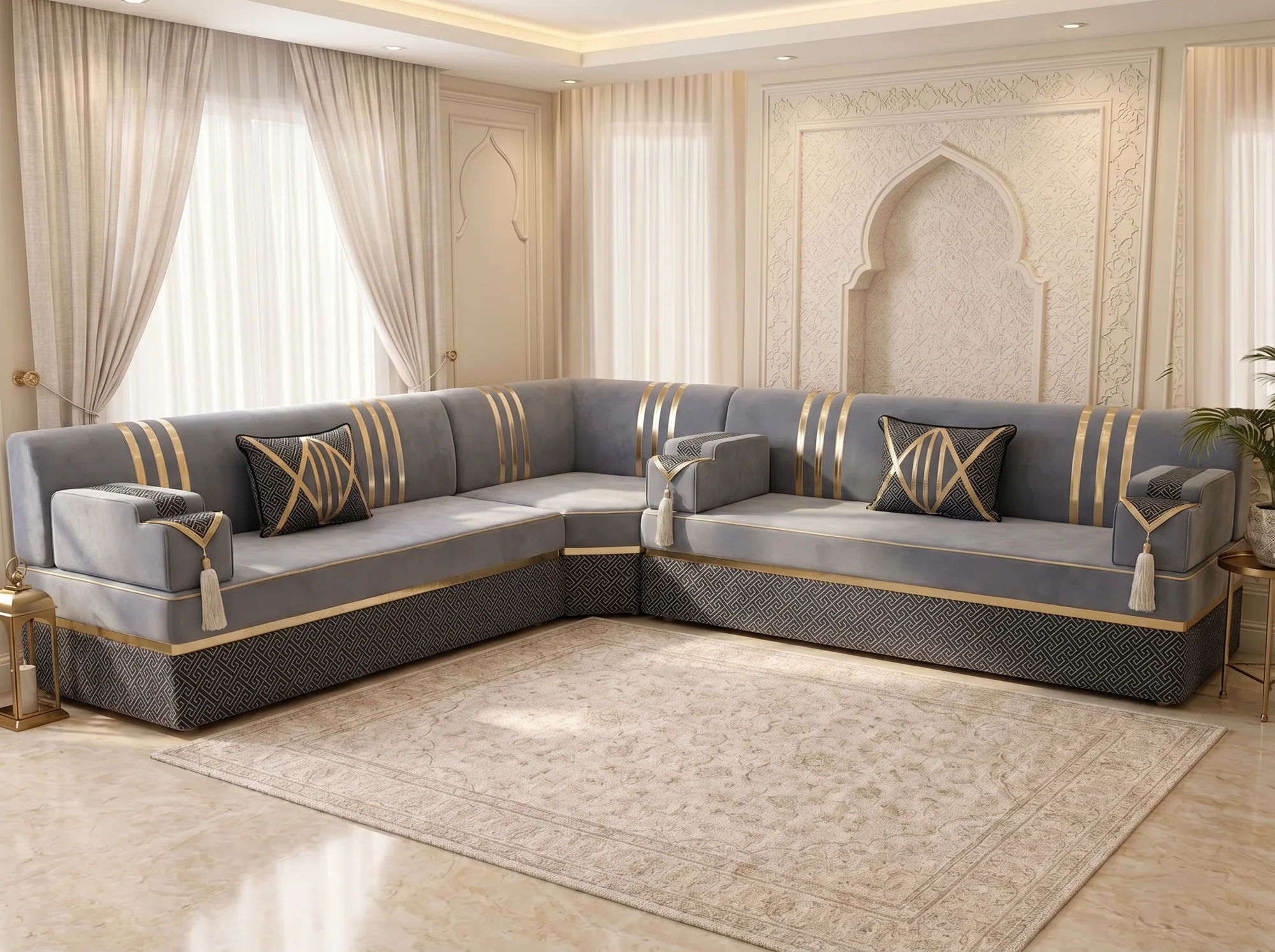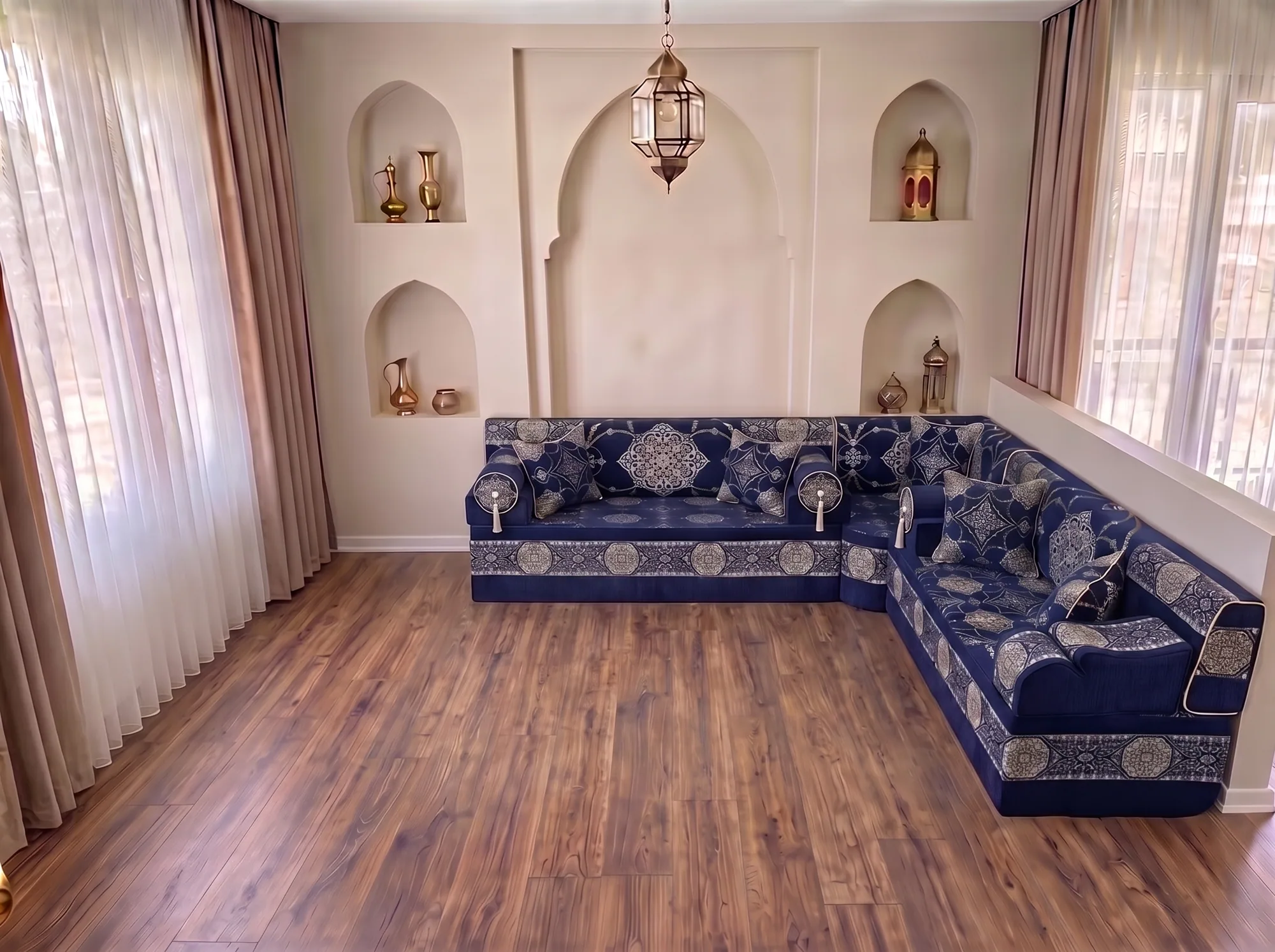
Plan one backrest for every seat mattress, with backrests on both walls at each corner. Put an armrest at every open end, then add one between each pair of sitters if you want a formal room. Throw cushions run from one per two places to one per place. Sofhu lists the exact pieces in your quote, worked out from your wall measurements.
- Backrests
- One per seat mattress is the usual plan
- End armrests
- One at every open end of a row
- Divider armrests
- Optional; one between each pair of sitters
- Corners
- Backrests on both walls, no armrest
- Throw cushions
- One per two places up to one per place
- Final count
- Listed piece by piece in your quote
On this page
It is common to measure the walls, choose the fabric and then leave the cushion count blank or guess it. It is an easy thing to get wrong. Too few armrests and a long row looks unfinished; too many and a room that should seat ten seats seven. This guide gives simple counting rules for majlis cushions, then works them through for a straight row, an L and a U.
The numbers here are planning rules of thumb. They are not a list of what any particular Sofhu set contains. Your quote states the actual pieces, worked out from your walls.
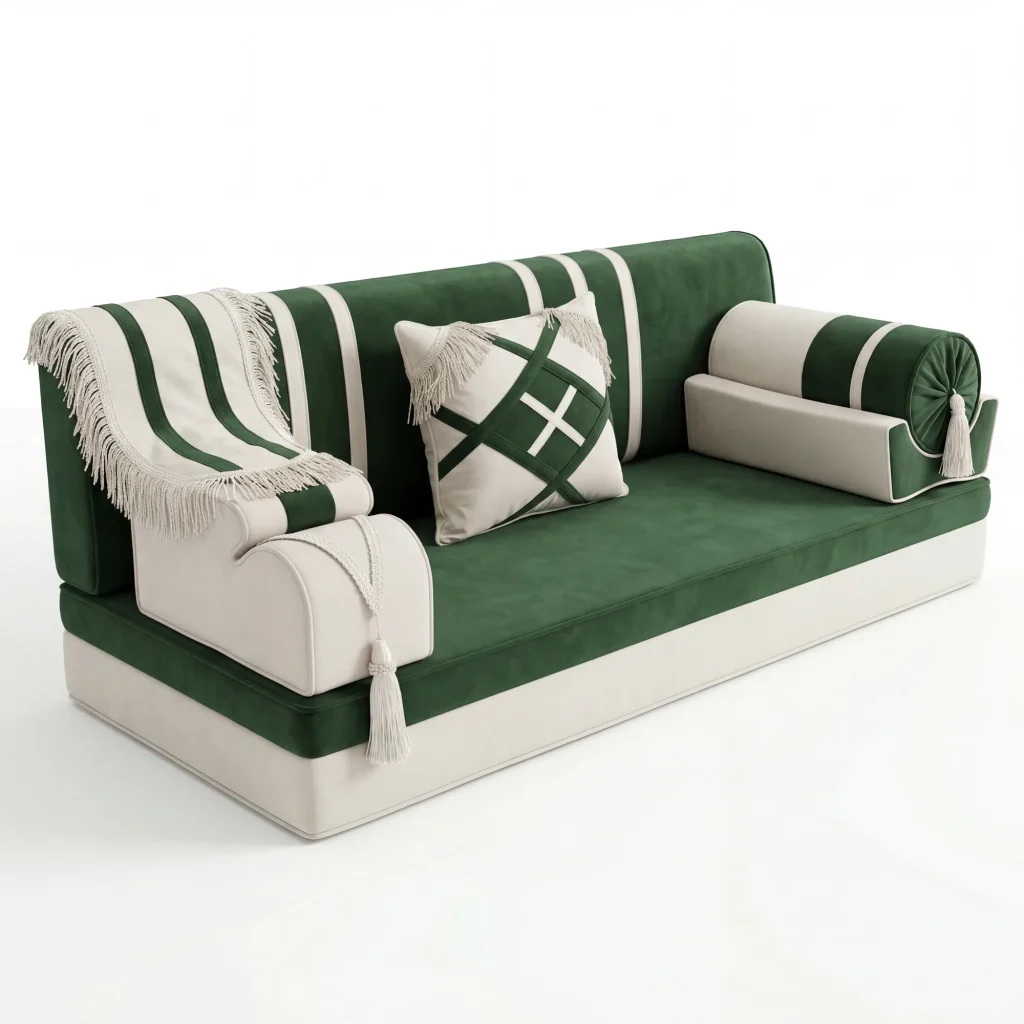
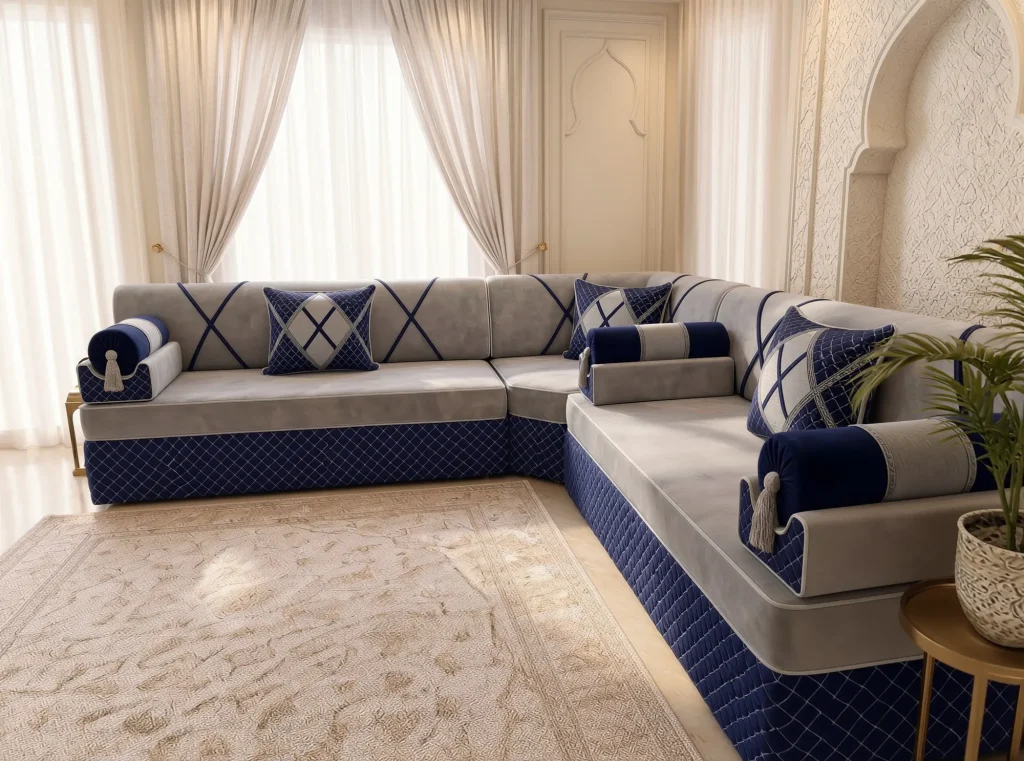
The rules cover both of Sofhu’s products, with one difference. On an Arabic floor sofa, the low set, backrests and armrests are loose cushions that you count and order. On an Arabic majlis, the raised sofa-height set, the back is fixed to each upholstered unit, so you count units and arm bolsters instead. The photos in this guide show both and say which is which.
Counting majlis backrest cushions
The usual plan is one backrest for each seat mattress, the same length as the mattress it stands on. A wall divided into two mattresses gets two backrests, and the joins line up.
That is the starting point, and there are two common reasons to move away from it.
Shorter backrests with gaps. Some designs use backrests shorter than the mattress and set an armrest or a contrast panel between them. The count goes up and each piece gets smaller.
Corners. At a corner, both walls need a back. One published Jordanian kit for a room of about 3.5 by 3.2 metres lists four mattresses, six backrests and four armrests. It is one seller’s listing, not a rule, but it shows that backrests can outnumber mattresses once a layout turns a corner.
Because floor sofas are not freestanding, every backrest needs a wall or another hard surface behind it. A row that runs past the end of a wall, across a doorway for instance, cannot have a backrest on that stretch. Mark those places on your sketch.
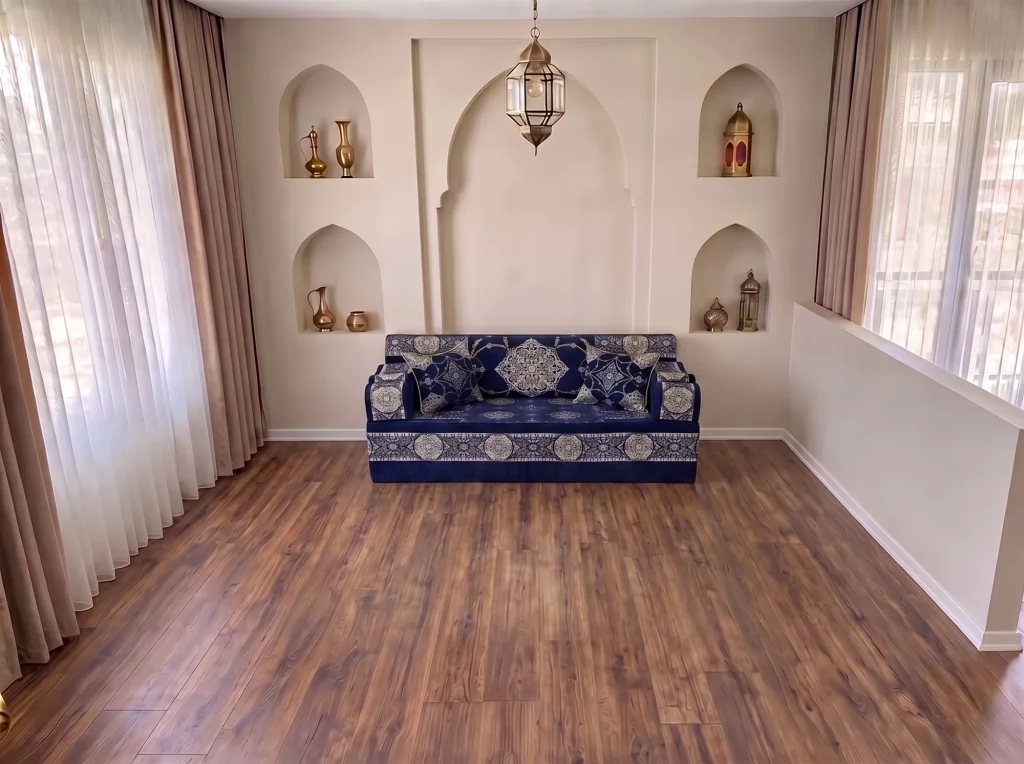
Majlis armrest cushions: ends only, or every two seats
There are two schools, and both are right for the room they suit.
Ends only. One armrest closes each open end of the seating and the row between them stays clear. This gives the most places, lets children and tired guests stretch out, and makes the seat usable as a bed. It is the natural choice for a family living room.
Every two seats. An armrest sits between each pair of sitters, so every guest has an elbow rest on one side. The room looks ordered and formal, and each place is clearly marked. It is the usual choice for a guest room, a men’s majlis or a reception area.
The cost of the second approach is length. In the example listing above, an armrest is 25 cm wide. Four of them along a wall take a metre of seating, which is more than one person’s place. Before you choose, decide which matters more in this room: how many people sit, or how comfortably each one leans. Our guide to how many people a majlis seats covers the capacity side.
A middle way works well in many homes. Order the set with end armrests fixed in the plan and a few loose bolster cushions as dividers. On ordinary days they sit at the ends or stack in a corner; when guests come they go between the places.
Corners and ends
A corner seat needs backrests on both walls and no armrest. It is deep, and one person sits in it diagonally with a throw cushion behind. Do not plan it as two places.
An end is “open” when the row stops in the room, at a door or partway along a wall. It is “closed” when the row runs into a wall. Open ends need an armrest or a tray-top arm to finish them. Closed ends need nothing. Getting this right is the quickest way to an accurate count, so label each end on your sketch.
Where you want a place of honour, tradition offers a hint. In the Turkish sedir the corner farthest from the door is the seat for the most respected guest. An armrest on each side of that place, and the best throw cushion, mark it without a word being said.
Throw cushions: how many and what size
Throw cushions do two jobs. They fill the gap behind the lower back, which matters on a deep seat, and they carry the accent colour or the contrast pattern.
For number, use places as the unit:
- Everyday: about one cushion for every two places.
- Dressed for guests: one per place.
- Plus one for each corner, where the sitter leans diagonally.
For size, keep them clearly smaller than the backrest is tall, so the backrest fabric still shows above them and guests are not pushed forward off the seat. Square is the standard shape. A long rectangular cushion suits the centre of a short row. Round bolsters belong at the ends, as armrests, not along the back.
Floor cushions are a separate question. They are extra places, not decoration, and three in front of the seating is a common number in photographs of complete sets. See the floor cushion page for how they are used.
Worked counts for straight, L and U sets
The table applies the rules above to three example rooms. “Places” means people seated comfortably, with the corner counted as one.
| Layout | Open ends | Armrests, ends only | Armrests, every two seats |
|---|---|---|---|
| Straight row, 4 places | 2 | 2 | 3 |
| L-shape, 3 + 3 places | 2 | 2 | 4 |
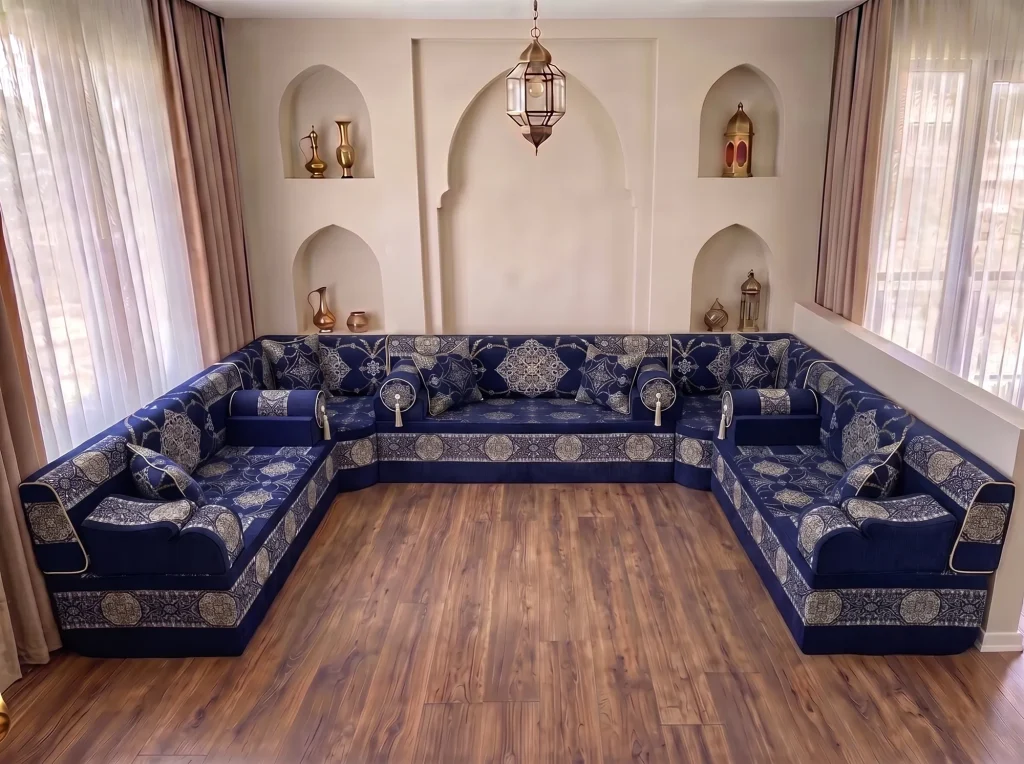
| U-shape, 3 + 4 + 3 places | 2 | 2 | 5 |
Throw cushions for the same rooms come to 2 to 4 for the straight row, 4 to 7 for the L and 7 to 12 for the U, counting one extra for each corner.
How the divider count is reached: the straight row of four takes one divider in the middle. Each arm of the L takes one. The U takes one on each side arm and one in the centre of the back wall.
A straight row against one wall with both ends meeting side walls is the exception. It has no open ends, so in an ends-only plan it needs no armrests at all, though most people still add a pair for comfort.
What to write in your quote request
A count is only as good as the sketch behind it. When you message Sofhu, include:
- The length of each wall the seating will run along, and which unit you measured in.
- Which ends are open and which meet a wall.
- Whether you want armrests at the ends only or between sitters as well.
- How many loose throw cushions and floor cushions you would like.
- Whether the seat will be used for sleeping, which favours fewer fixed dividers.
From that, the pieces are divided to fit, and the quote lists each seat, backrest and armrest so you can check it against your own count. The names of all the pieces are explained in parts of a majlis set.
You can compare layouts on the majlis sofa sets page and read about Gulf-style sets on the Arabic jalsa page. When your sketch is ready, a custom majlis is planned around it: get a quote by measurement or send the sketch on WhatsApp.