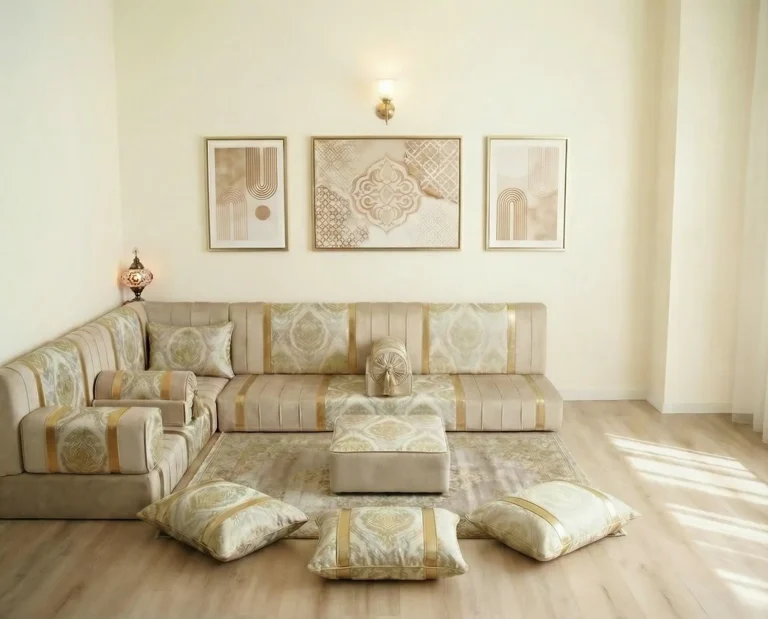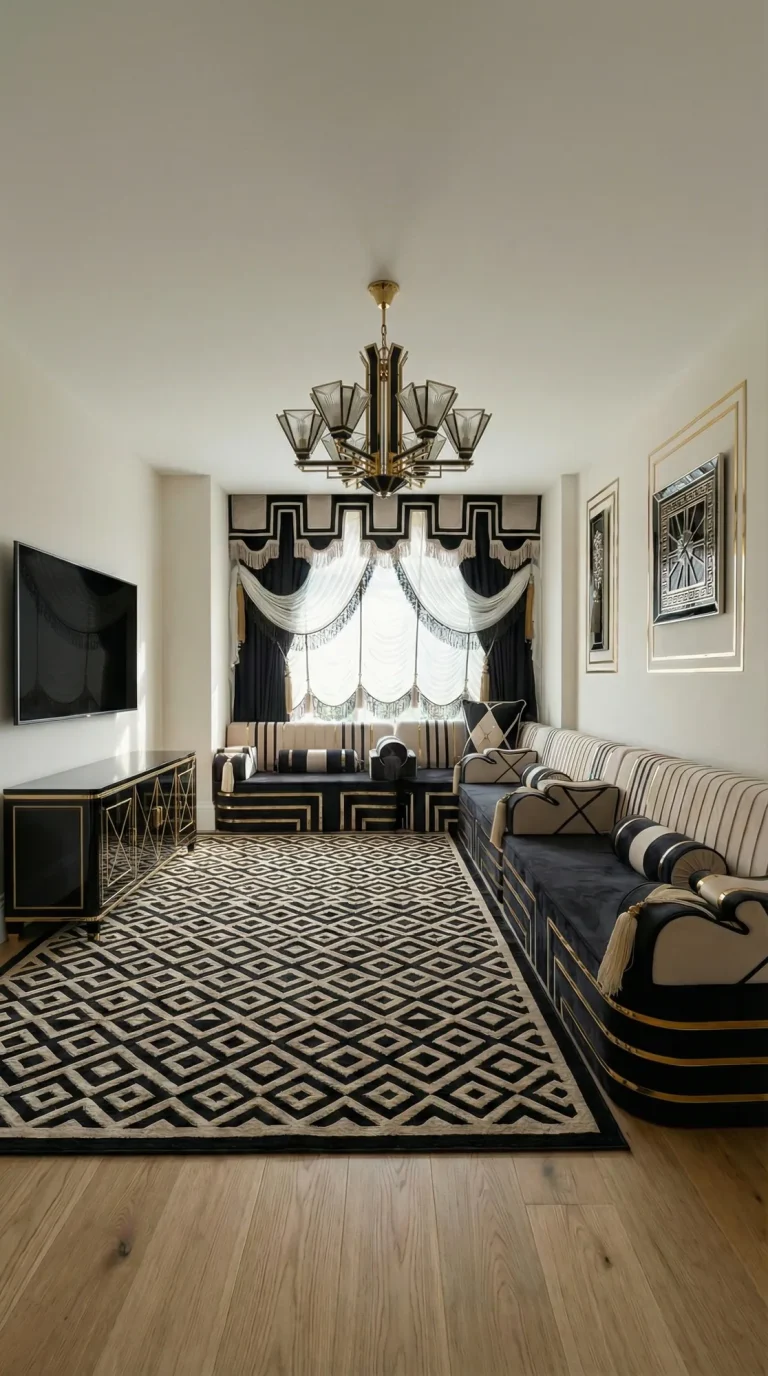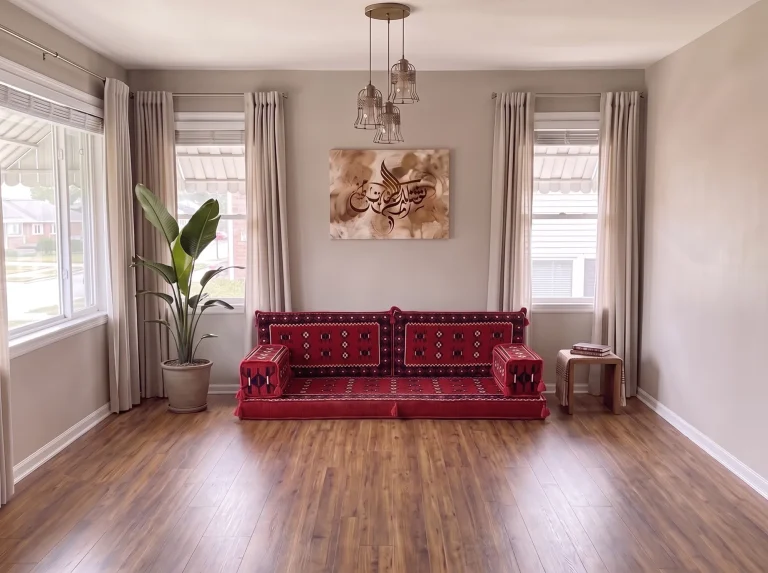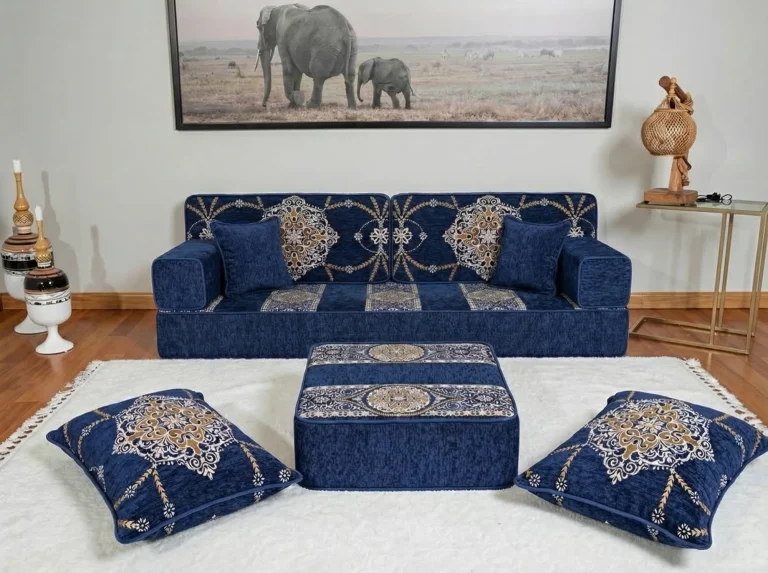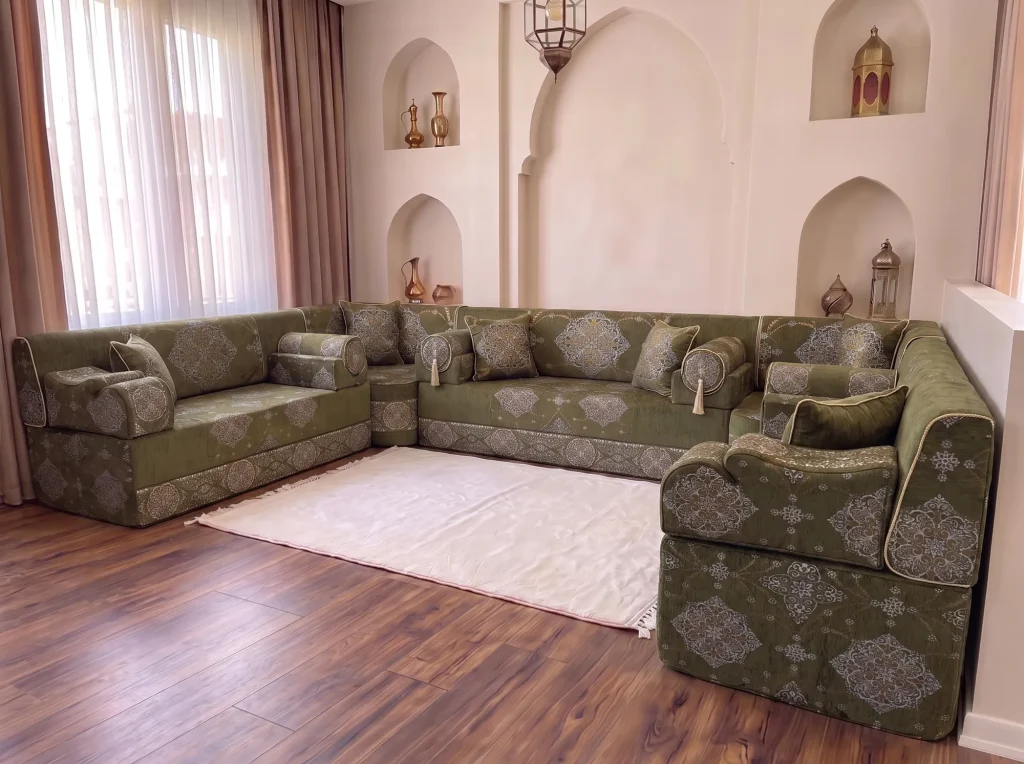
Choose a majlis if you host large groups, sit cross-legged, eat or pray in the same room and want seating cut to your walls. Choose a sectional if most evenings are two or three people facing a television at chair height. Sofhu builds majlis sets to measure, so the comparison starts with your wall lengths, not a catalogue size.
- Majlis seating
- Runs wall to wall, counted by length
- Sectional seating
- Fixed modules, counted by seat cushions
- Planning width per adult
- About 60 cm (24 in), a general bench rule
- Sofhu foam
- 32 kg/m³ (32 DNS) high-density foam, no springs
- Sofhu covers
- Zippered, removable, machine washable at 30°C
- Sizing
- Made to measure from your wall lengths
- Shipping
- Free worldwide
On this page
The majlis vs sectional question is really a question about your busiest evening. If that evening is fourteen relatives after iftar, a majlis wins before the tea is poured. If it is two people and a film, a sectional does the job with less thought. Most homes sit somewhere between, which is why the details below matter more than taste.
Here is the verdict in three lines.
- Hosting and capacity: the majlis, because it seats along every metre of wall.
- Chair-height sitting and easy standing: the sectional, unless you choose the raised Arabic majlis over the low floor sofa.
- Fit, washing and moving house: the majlis, because it is made in separate pieces to your measurements with zip-off covers.
Majlis vs sectional: the comparison table
The majlis vs sofa table below sets an Arabic sofa vs a Western sofa on the points buyers ask about most. The majlis column describes the made-to-measure, wall-lined Arabic seating Sofhu builds, in its two forms: the Arabic majlis, raised to sofa height and fully upholstered with a solid base and fixed backs, and the low Arabic floor sofa of seat mattresses and loose back cushions. The sectional column describes the ordinary L-shaped or U-shaped sofa sold in furniture shops.
| Majlis | Sectional sofa | |
|---|---|---|
| How seats are counted | By length of wall | By number of seat cushions |
| Seat height | Sofa height (majlis) or low (floor sofa) | Chair height |
| Sizing | Cut to your walls | Fixed catalogue sizes |
| Inside the seat | Solid foam, no springs | Frame, springs or webbing, cushions |
| Covers | Zippered and removable | Often fixed, sometimes loose |
| Centre of the room | Open floor | Usually a coffee table |
| Moving it | Separate sections, carried one at a time | Large modules, tight on stairs |
| Stands alone in the room | No, it leans on a wall | Yes |
One line in that table deserves a warning. Neither an Arabic floor sofa nor a majlis is freestanding. The seating needs a wall or something solid behind it, so it cannot float in the middle of an open-plan space the way a sectional can.
Seats per metre: where the majlis pulls ahead
A majlis seats more people in the same room because nothing along the wall is wasted. Designers of bench and banquette seating commonly allow about 60 cm of width for each adult, and the same rule works for Arabic seating along a wall. Measure the seating run, divide by 0.6, and you have a fair number for a relaxed evening.
Take a room where two walls give you six metres of usable run after the door and the corner are allowed for. That is ten adults at 60 cm each, and twelve or more when cousins squeeze up for a short visit. Children take less.
A sectional in the same corner behaves differently. It is as long as the factory made it, and it stops at its arms. If the walls are longer than the sofa, the remainder holds a side table or a plant. Its capacity is the number of seat cushions, and the corner cushion has no legroom of its own, so in practice it becomes the place for coats.
There is a second gain that does not show on a tape measure. A majlis keeps the middle of the room open. On a big night, floor cushions and an ottoman turn that open carpet into a second ring of seating. A sectional usually faces a fixed coffee table and has no second ring.
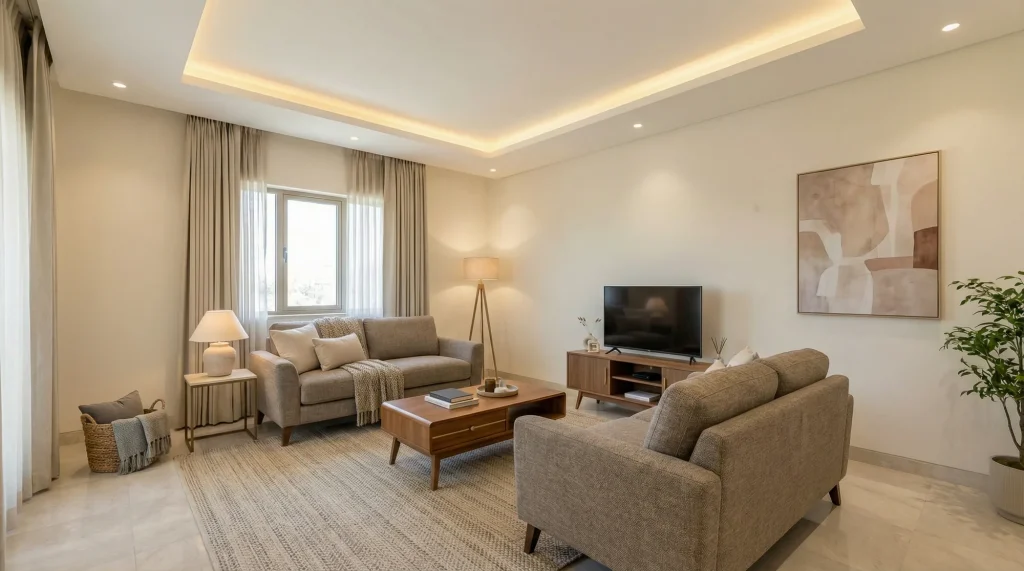
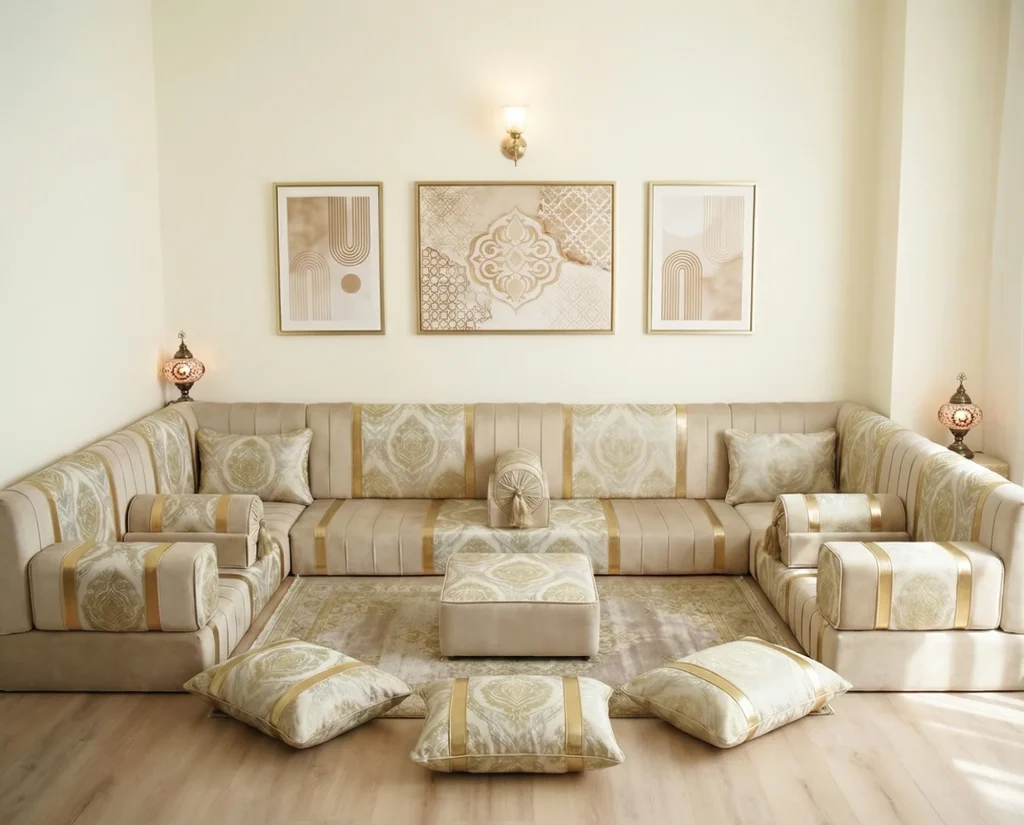
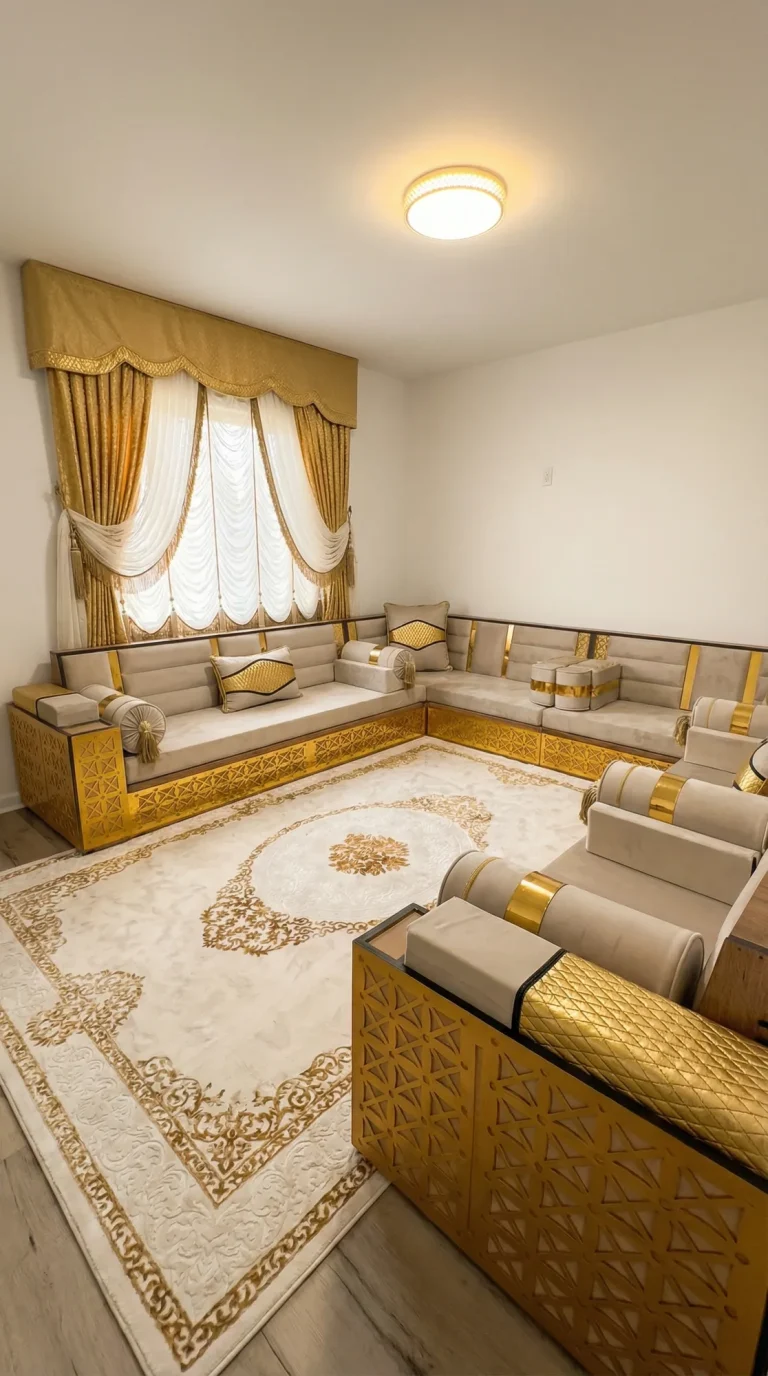
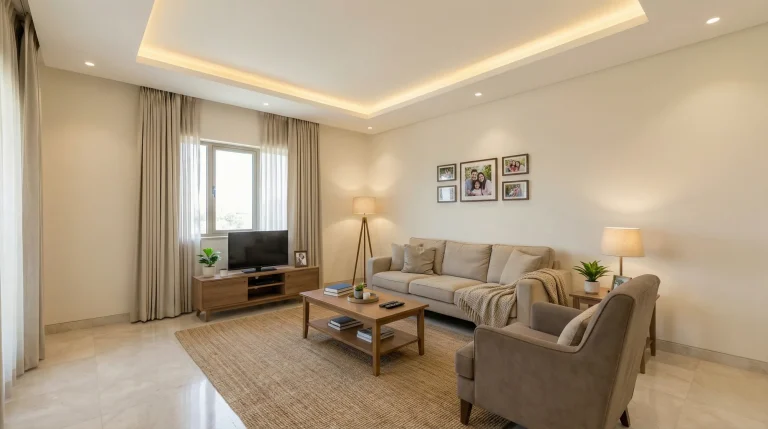
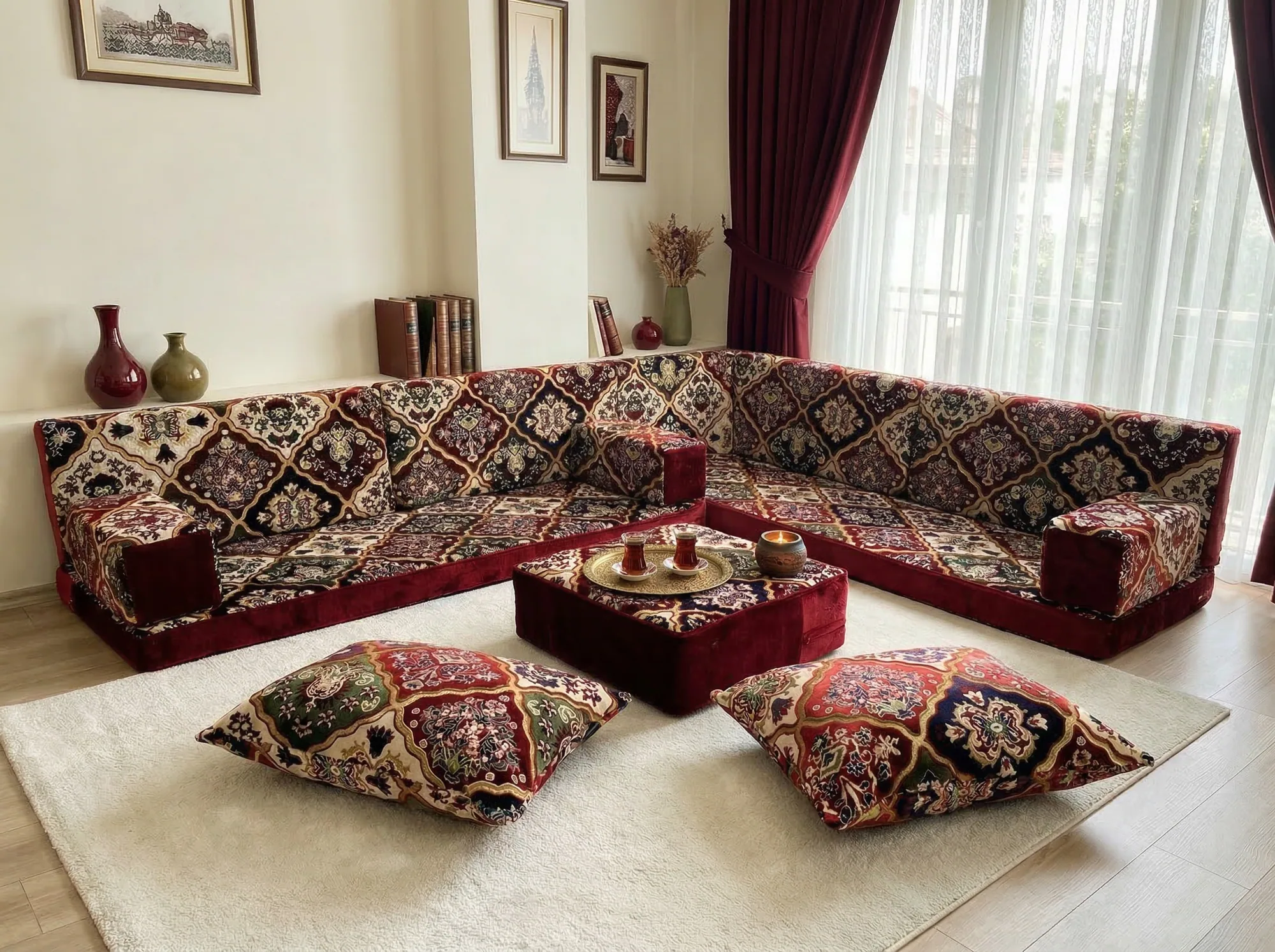
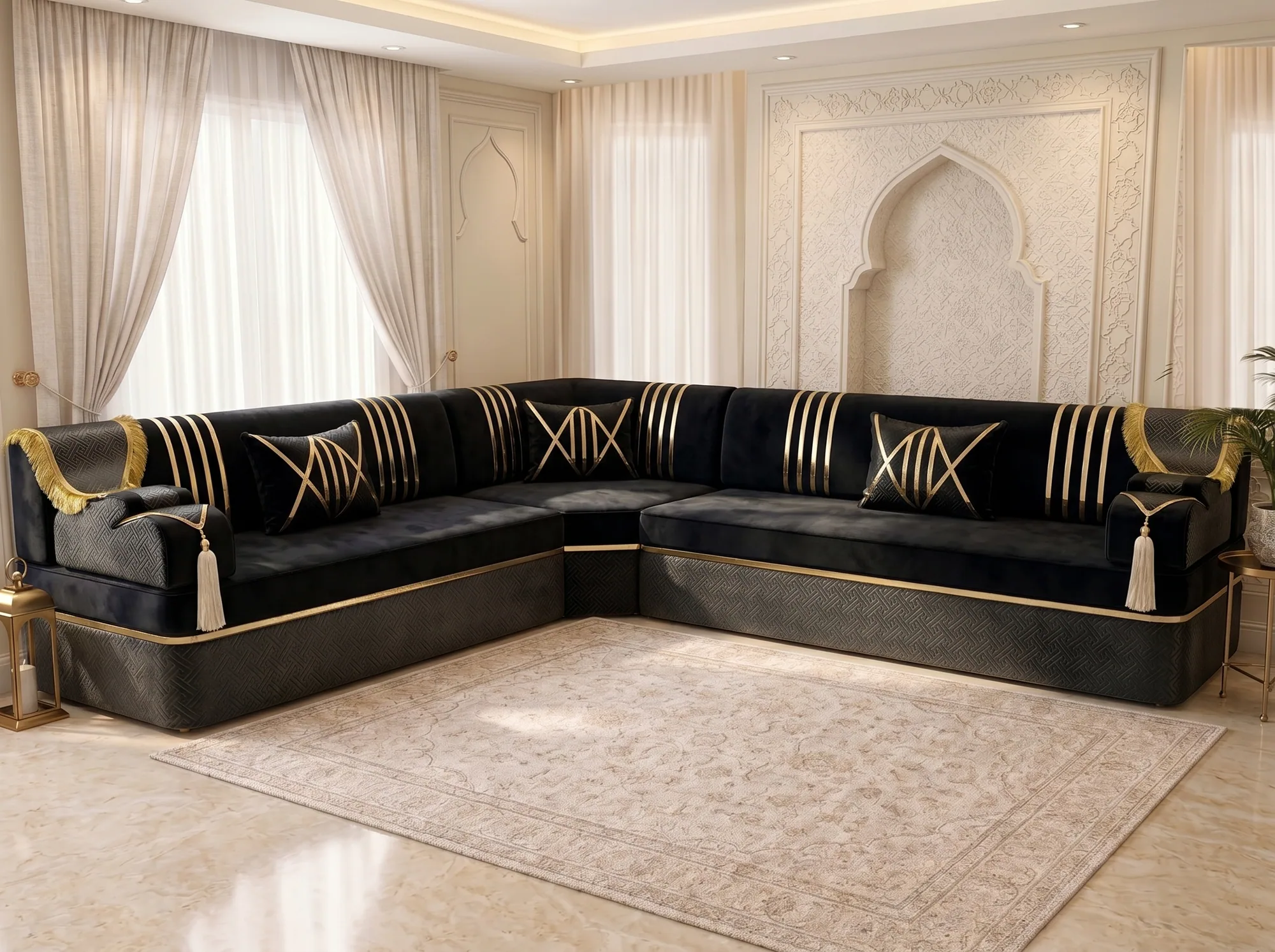
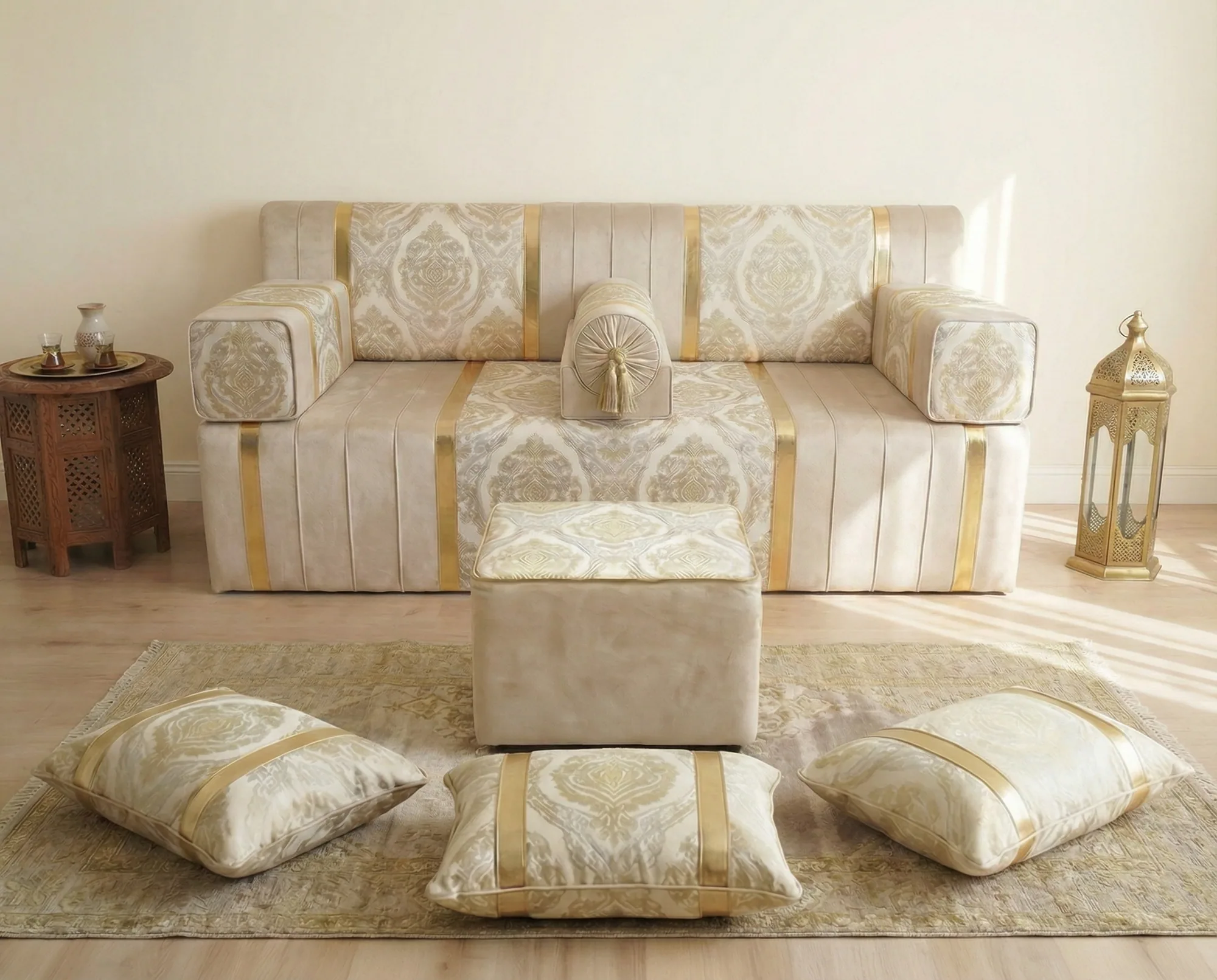
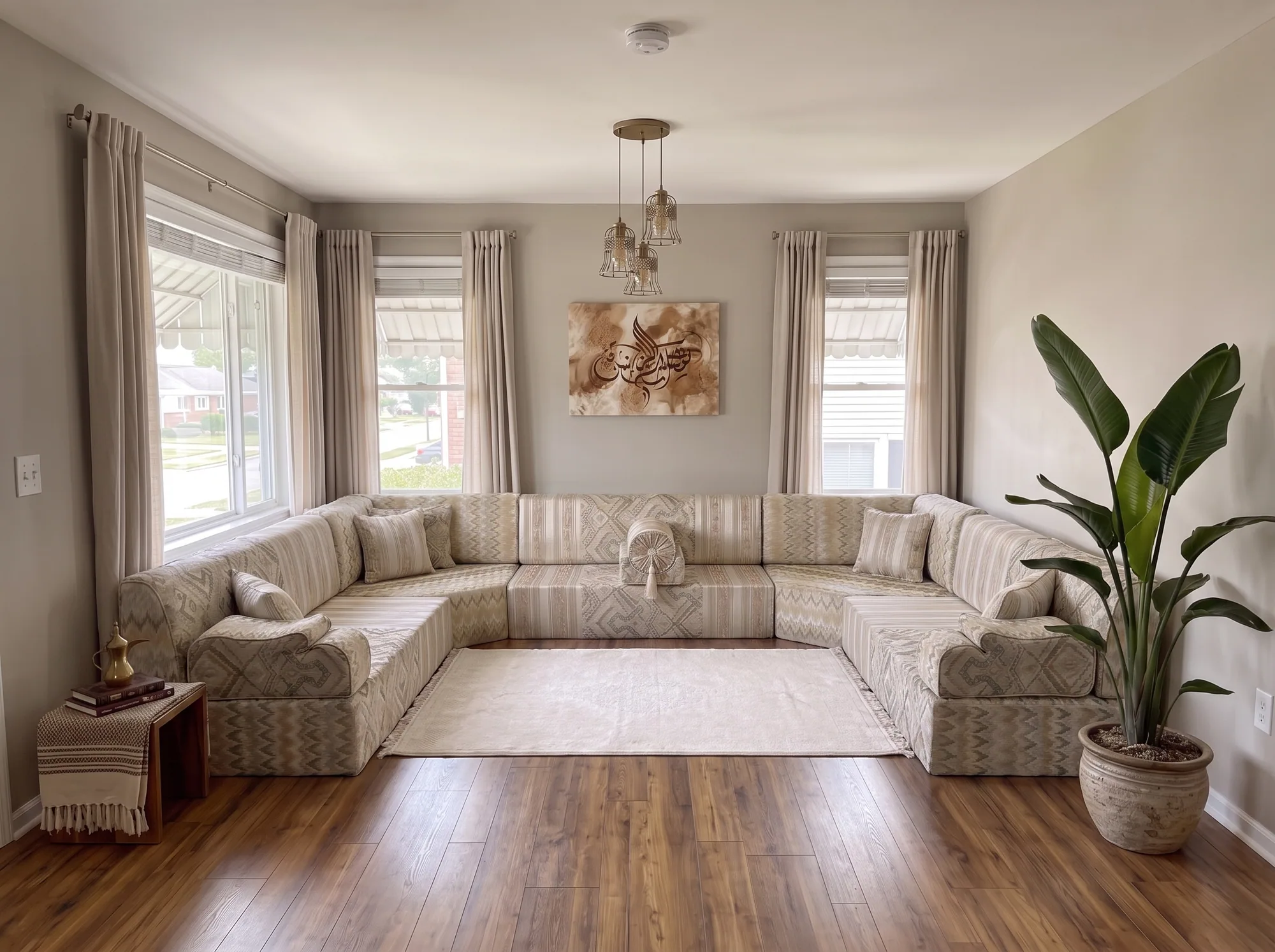
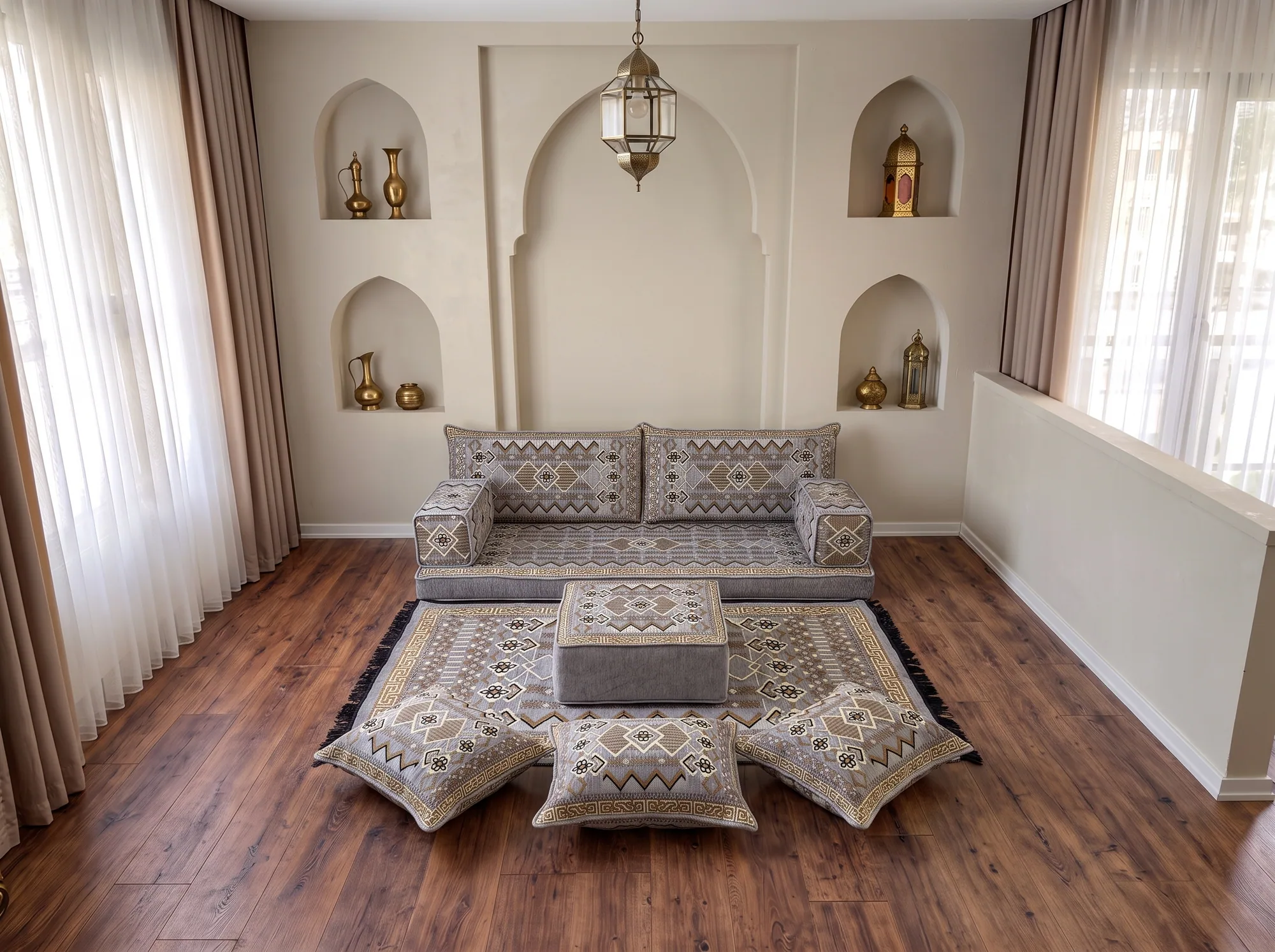
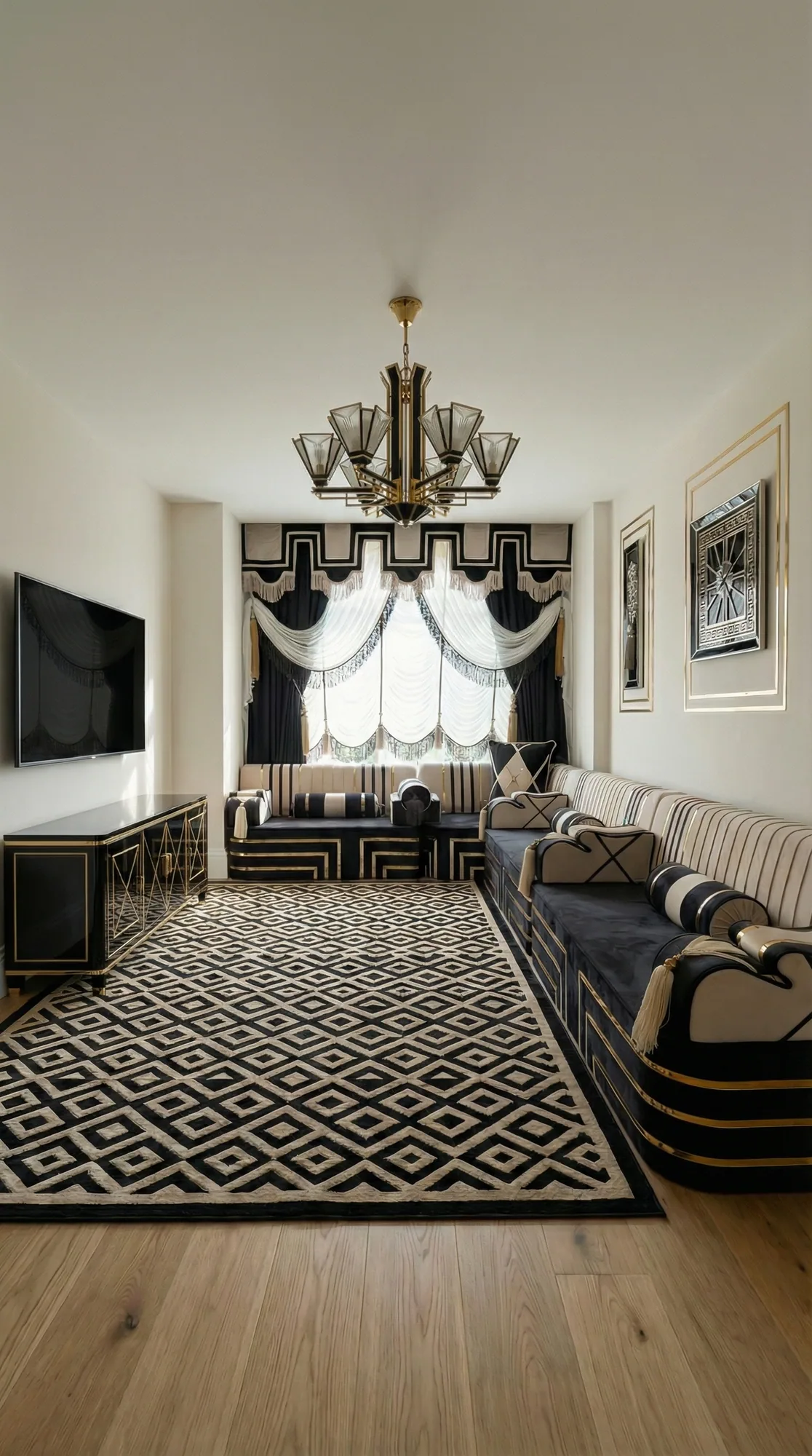
Compare the two rooms above. The first seats five or six on two sofas. The second, a low floor sofa set, lines three walls and still leaves the floor free. For the full method, including door swings and corners, see how many people a majlis seats.
Comfort and how people actually use each
Comfort depends on posture, and the two pieces are built for different postures. A sectional is built for one position: feet on the floor, back against a deep cushion, eyes forward. It is very good at that and at lying full length for a nap.
A majlis is built for changing position. People sit cross-legged, kneel, lean on an armrest bolster, stretch their legs toward the centre or turn to the person beside them. Over a long visit most guests move between several of those positions. That freedom is why many people prefer low seating to a sofa in long company, and it is also why a majlis suits a room where food is served on the floor or where the family prays.
The seat itself is firmer. Sofhu fills its seats with 32 kg/m³ (32 DNS) high-density foam with no springs inside. A firm foam seat does not hug you the way a deep sectional cushion does, and people who like to sink into a sofa should know that before ordering. On custom orders you can ask for a softer or firmer foam.
Standing up is the honest weak point of floor seating. Rising from a low seat takes more effort than rising from chair height, and that matters for older relatives and anyone with stiff knees. The answer is to choose the raised form: an Arabic majlis is built at sofa height, and a floor sofa can be ordered with a thicker seat. The majlis seat height guide explains the options.
Flexibility, moving house and cleaning
A majlis is the more adaptable piece of furniture because it is a set of separate parts. Seat cushions, backrests and armrests are individual items. Sofhu offers single-row, L-shaped and U-shaped layouts, and the modular structure allows the pieces to be rearranged when needs change. A straight run can become a corner. A long guest room set can be split between two smaller rooms.
Moving house shows the difference clearly. A sectional travels as two or three large modules that have to pass through the front door, the stairwell and the lift. Floor sofa cushions are carried one at a time. New sets leave the workshop vacuum packed, which is how a whole room of seating travels from Türkiye to your door.
Cleaning favours the majlis too. Sofhu covers are zippered and removable, and the site states they can be machine washed at 30°C. On most sectionals the main upholstery is fixed to the frame, so a spill of coffee or henna means a specialist cleaner. A floor-level set also sits flat on the floor, so there is no dusty gap underneath and nothing with legs to scratch a wooden floor.
The sectional answers back on one point: it needs no wall. In a large open-plan room where the seating has to divide the space, a sofa with its own back is the simpler tool.
Cost drivers, without the guesswork
The price of either option depends on what is in it, so compare like with like. For a sectional you pay for the frame, the suspension, the fabric and the brand, in a size somebody else chose. For a majlis the bill follows your room: metres of seating, cushion thickness, fabric, and the extras you add, such as a base, rug, ottoman or floor cushions.
Two things make a fair comparison possible. First, count seats, not pieces. A set that seats ten should be weighed against the sectional plus the armchairs you would otherwise buy. Second, ask what the foam is. Density is the figure that predicts how long a seat keeps its height, and many sofa listings never state it.
Sofhu is the manufacturer, ships free worldwide and prices by measurement, so the next step is simply to send your wall lengths through the quote form. Import duties or taxes may apply depending on your country, and you can ask about that before ordering.
Who should choose which
Choose by household, not by fashion. A majlis is the better fit when:
- you receive guests in numbers, for Eid, Ramadan evenings, weddings or weekly family visits;
- the room is used for eating on the floor, prayer or children’s play as well as sitting;
- the walls are an awkward length that no catalogue sofa fills;
- you want covers you can take off and wash.
A sectional is the better fit when:
- the household is small and guests are occasional;
- the main activity is watching a screen from one direction;
- someone at home finds low seats difficult and a raised base does not appeal;
- the seating has to stand in the open, away from any wall.
Plenty of buyers want a sectional alternative that still looks at home in a contemporary flat. That is what a modern Arabic sofa is for: plain fabrics, quiet colours and a raised profile, with the capacity of a majlis. Others keep both, and the guide to mixing a majlis with Western furniture shows how to make them sit together.
If the majlis side of the argument has won, start with the overview of Arabic sofa sets, look at how complete majlis sofa sets are put together, or browse the wider family of Middle Eastern sofas. Then measure the walls. The room will tell you the rest.