Accurate Middle Eastern set decoration starts with seat level and layout. Gulf, Yemeni and Afghan rooms sit at floor level around the walls. Moroccan salons and Ottoman sedirs are raised benches. Levantine reception rooms step up to a low sofa. Decide the country, city and decade first, then commission the seating. Sofhu makes low floor sofas and raised majlis sets to measure.
- First question
- Which country, which city, which decade
- Floor-level traditions
- Gulf, Yemeni, Bedouin, Afghan, Persian
- Raised traditions
- Moroccan sedari, Turkish sedir, Sudanese angareb
- Stepped rooms
- Damascene qa'a, Egyptian mandara
- Most common error
- Mixing Moroccan, Gulf and Afghan pieces in one room
- Sourcing
- Made to measure by Sofhu, free shipping worldwide
On this page
A viewer from Sana’a, Riyadh or Fes will know within one shot whether the room on screen is theirs. Middle Eastern set decoration goes wrong most often at the seating, because the seating tells you the country. A bench-height Moroccan banquette in a scene set in Kuwait is as jarring as a Victorian armchair in a samurai film. This guide is a working reference for set decorators, production designers and prop buyers: what sits where, at what height, and in which decade.
Why accuracy matters on screen
Seating is the largest object in the frame and the one the actors touch. It decides posture, eyelines and blocking.
- Posture. Actors on floor cushions sit cross-legged or lean on one elbow. On a raised banquette they sit upright with feet on the floor. The scene plays differently.
- Audience. Streaming puts a drama set in Baghdad in front of viewers in Baghdad. Diaspora audiences notice too.
- Meaning. These rooms are social institutions. UNESCO inscribed the majlis in 2015 as a cultural and social space, on a file from the UAE, Saudi Arabia, Oman and Qatar. What was recognised is the practice of gathering, not a furniture style, but the furniture is how the practice shows.
The single most useful question to ask the writer is: which country, which city, which decade, and whose house.
Region cheat sheet for Arabic set dressing
Seat level and layout separate the traditions more reliably than colour. Use this table as a first sort, then research the specific place.
| Tradition | Seat level | Layout | Tell-tale detail |
|---|---|---|---|
| Bedouin tent | Ground, on rugs | Around the hearth, guest side | Sadu stripes, woven divider |
| Saudi, Najd | Floor | Around the walls | Carved plaster, coffee hearth |
| Yemeni mafraj | Floor | Perimeter of a top-floor room | Low windows, coloured fanlights |
| Qatari | Low | Perimeter, room by the entrance | Windows to the street, carved gypsum |
| Iraqi mudhif | Floor | Two facing rows | Reed arches, central hearth |
| Damascene qa’a | Raised platform, low sofa | U on the platform | Step up, painted wood panelling |
| Egyptian mandara | Raised dais with mattresses | U around a paved centre | Fountain basin, wall niches |
| Moroccan salon | Bench height | Wall to wall | Round central table, matching curtains |
| Turkish sedir | Raised, built in | Under the windows | Honour seat in the far corner |
| Afghan | Floor, thin mattress | Perimeter | Toshak doubles as bed |
| Persian | Floor, on carpet | Perimeter | Rigid carpet-faced backrest |
A few notes on reading it:
- The Yemeni mafraj sits at the top of a Sana’a tower house, with windows low enough for seated guests to look out.
- In the Damascene reception room, guests left their shoes in a lower antechamber and stepped up to a carpeted area lined with a low sofa and cushions.
- The Moroccan banquette is a wooden base called a sedari with a mattress on top. Meals are eaten in the salon, at the round table.
- The Turkish sedir was built into the house and was universal in Ottoman society until Western furniture began to displace it in the nineteenth century.
- In the Iraqi marsh guest hall, cushions run in two rows against the reed walls on either side of the hearth. It is not a U.
Our comparison of Yemeni, Saudi and Moroccan majlis and the glossary of floor seating names by country go deeper. For individual traditions, see the pages on the Yemeni diwan and mafraj, Syrian and Levantine seating, the Turkish sedir and the Moroccan sedari.
Era cues: old city house versus modern villa
The decade changes the seat height. A period accurate Arabic interior from before the mid twentieth century and a present-day one in the same city can look like different countries.
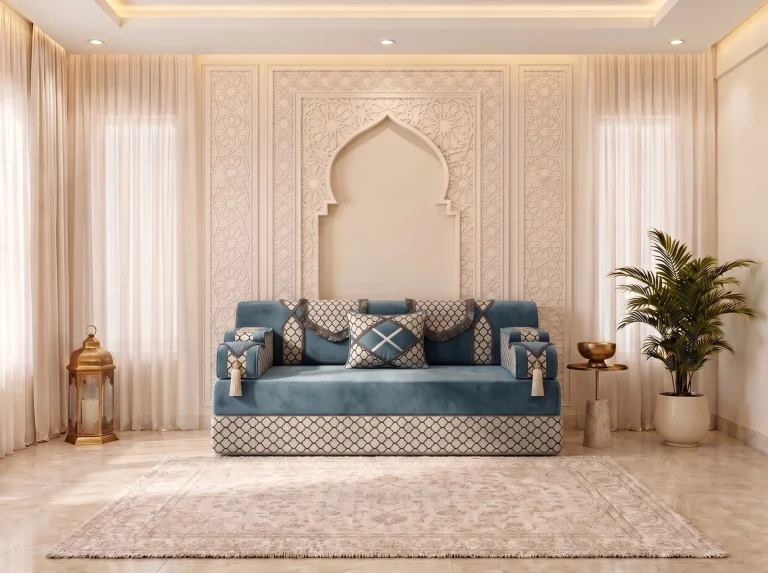
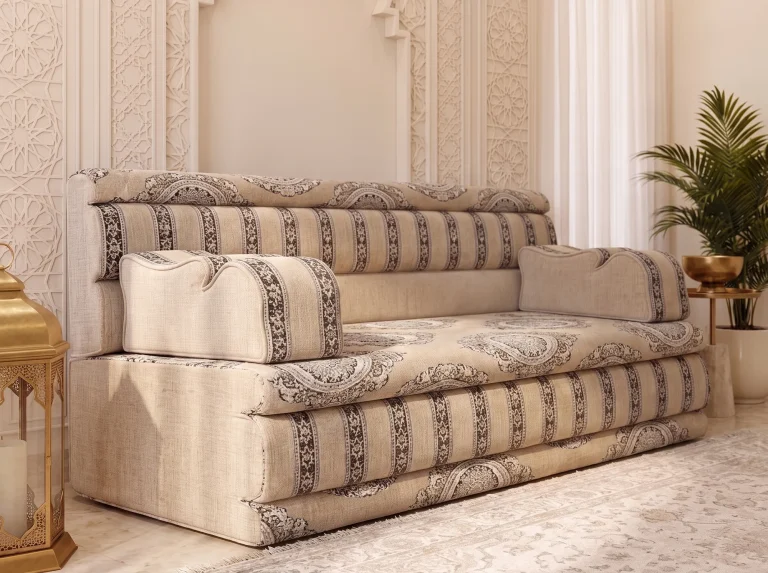
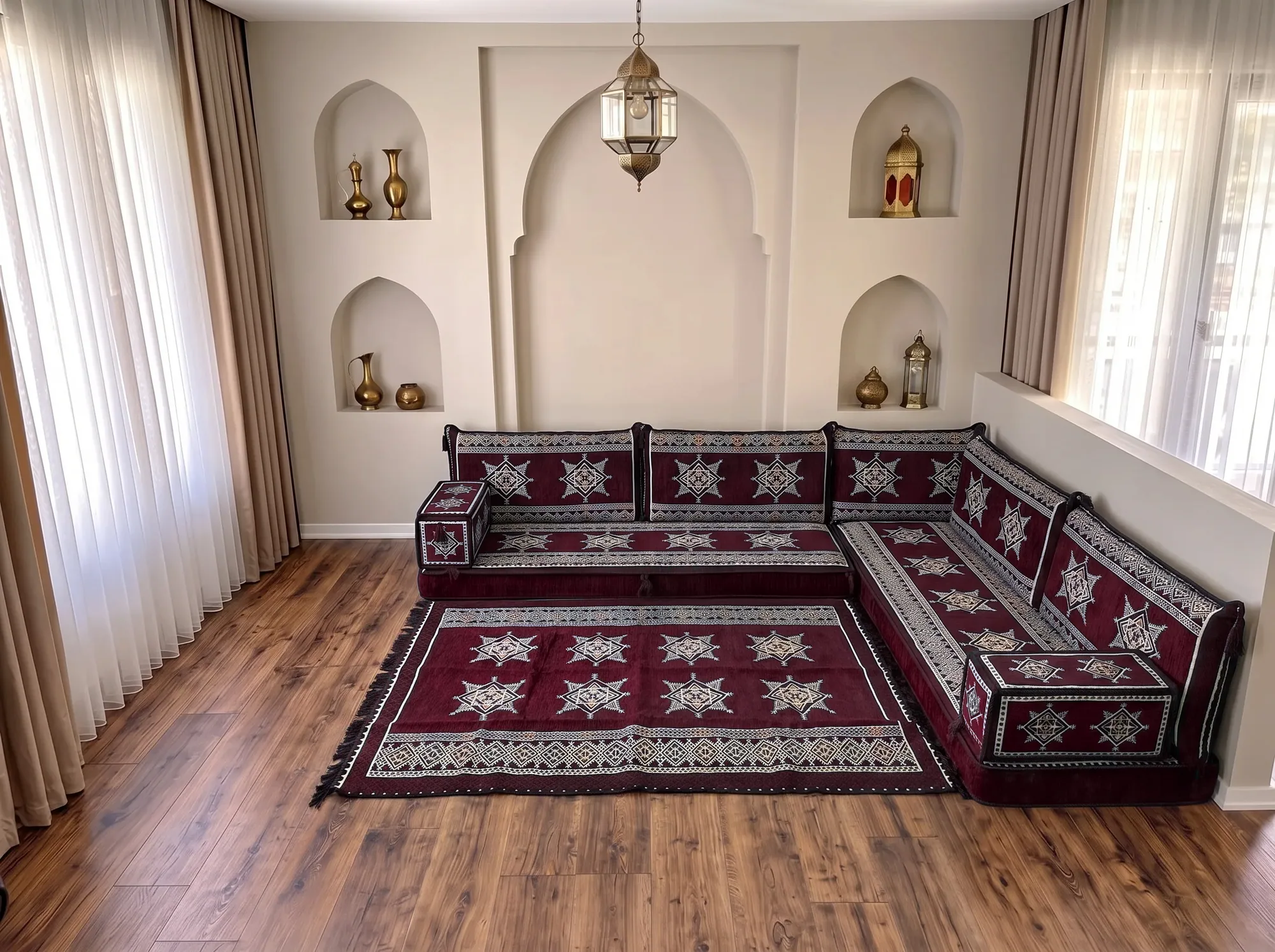
Old city house. Seating is low or built in, textiles are woven or carpet-faced, and the architecture does the decorating: carved plaster in Najd, painted panelling in Damascus, coloured glass in Sana’a, carved wooden bay windows in Jeddah. Furniture is sparse. A floor sofa with rug and loose cushions, like the one at the top of this page, is the right starting point. Dress it down and remove anything that looks new.
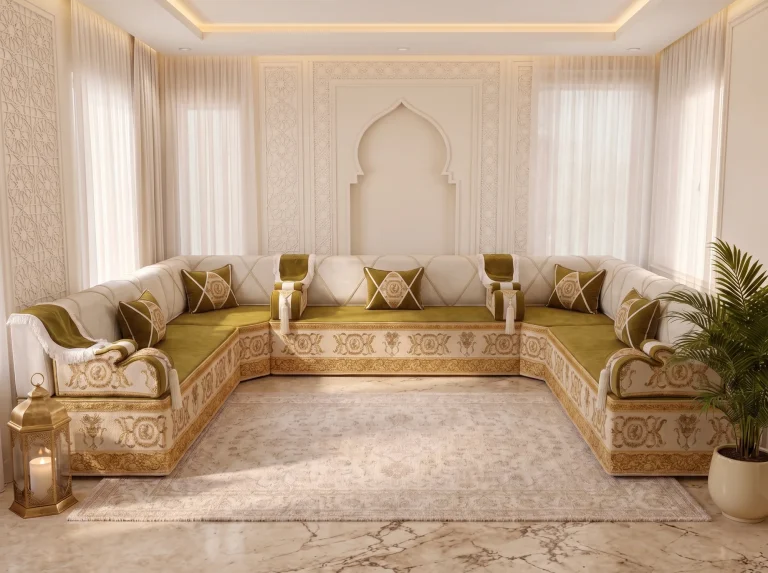
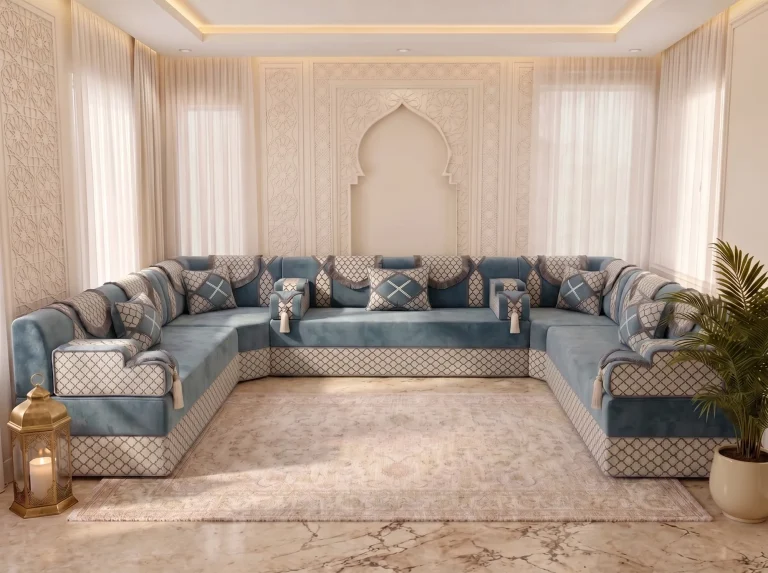
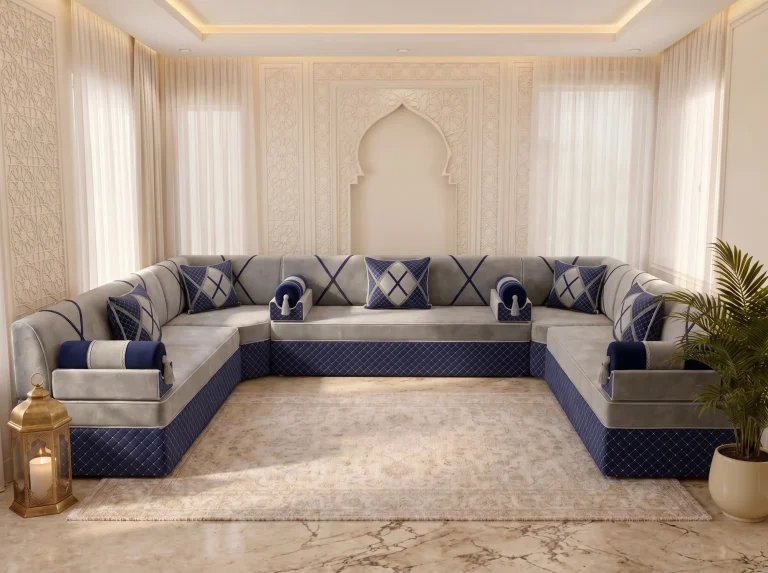
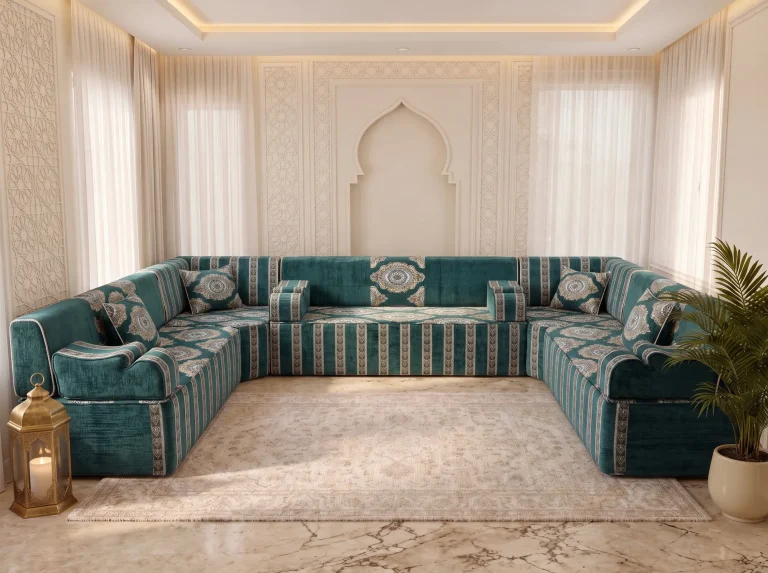
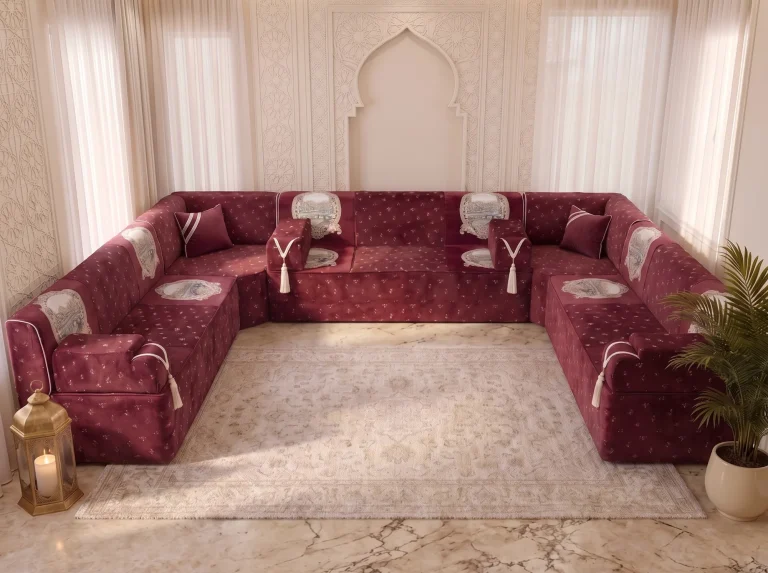
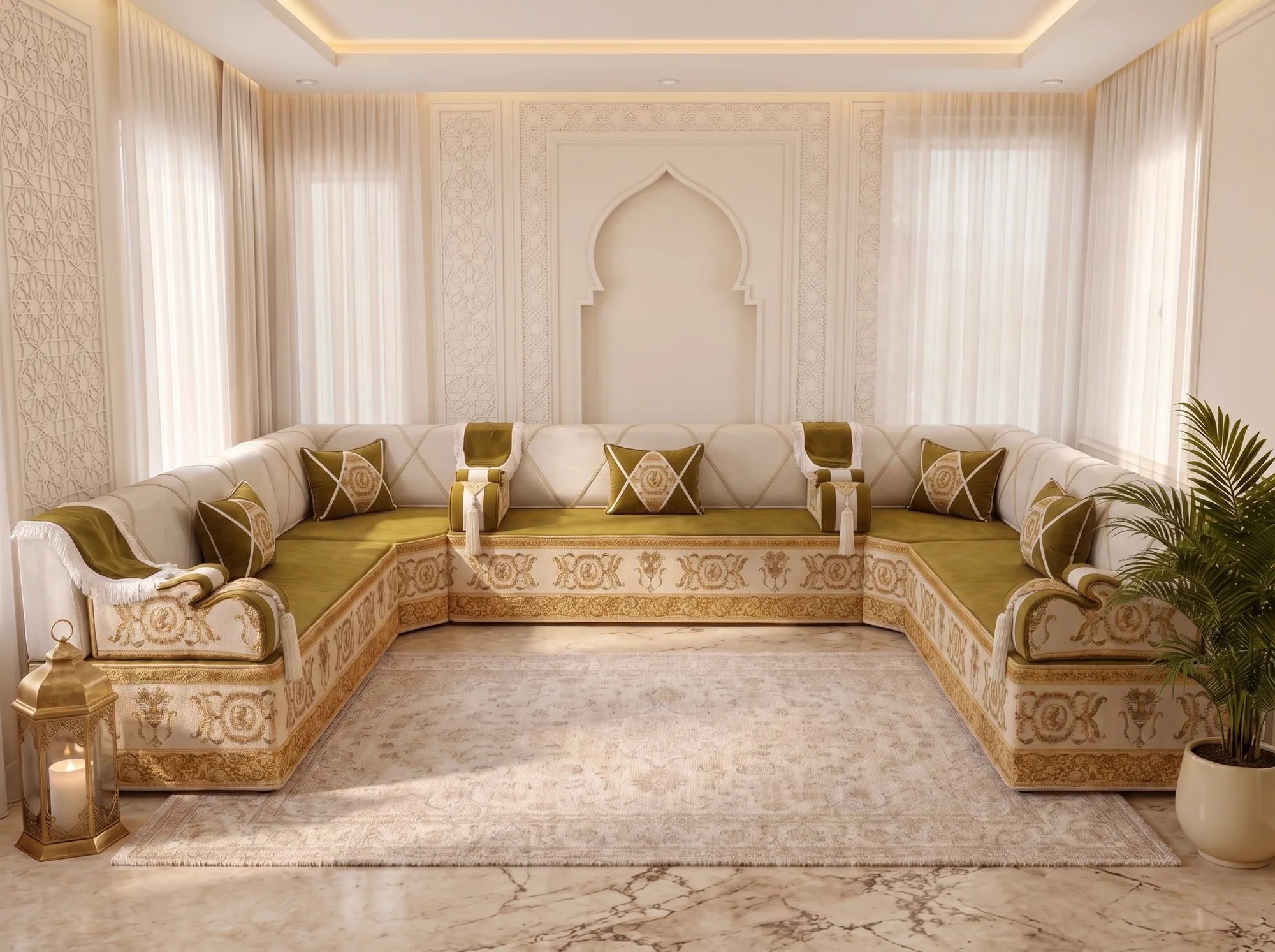
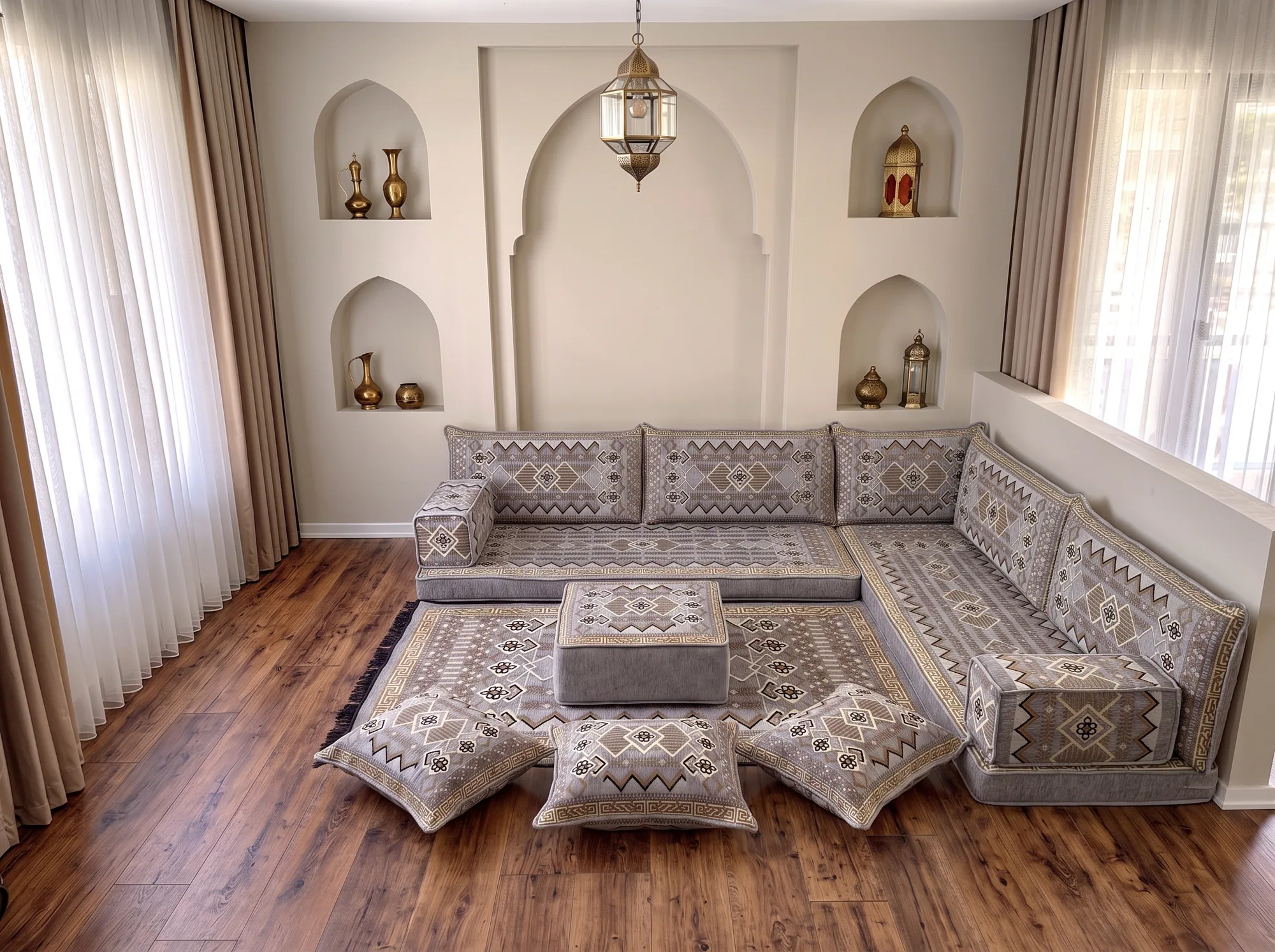
Modern villa or apartment. Dubai design sources describe the classic majlis as low, floor-level seating in deep reds and golds, and note that many modern villas now use raised divan seating instead. Present-day sets, like the two below, often have a tall upholstered base, fitted backrests, and velvet with gold or silver detail under recessed ceiling lighting. This raised type is what Sofhu sells as an Arabic majlis.
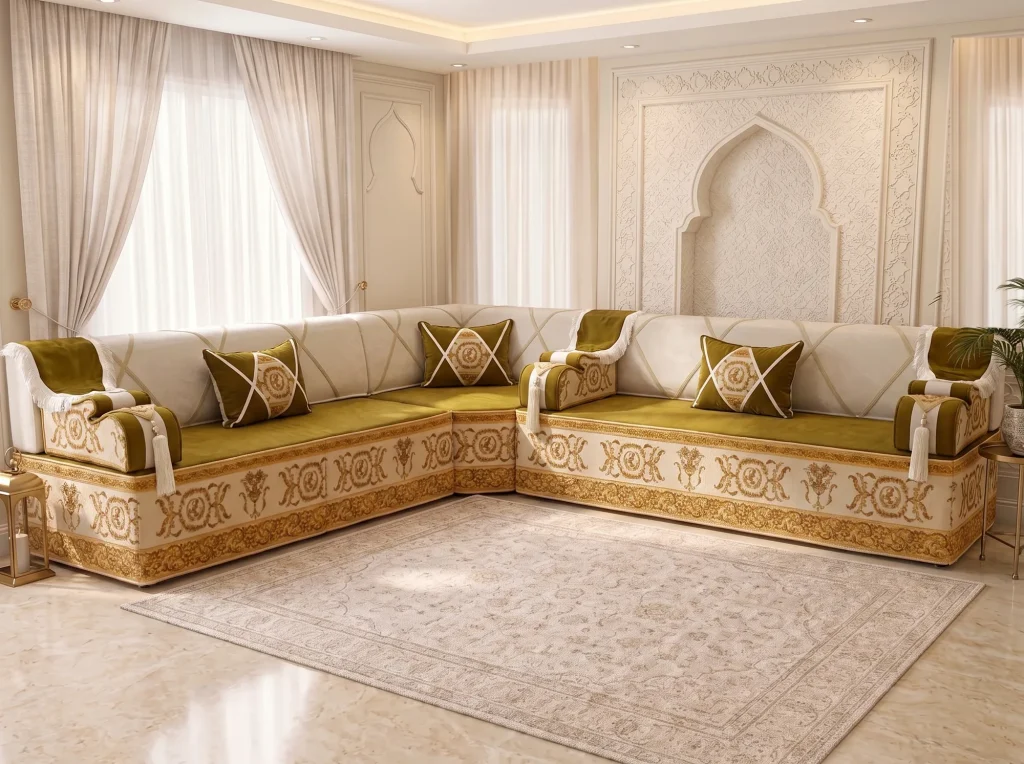
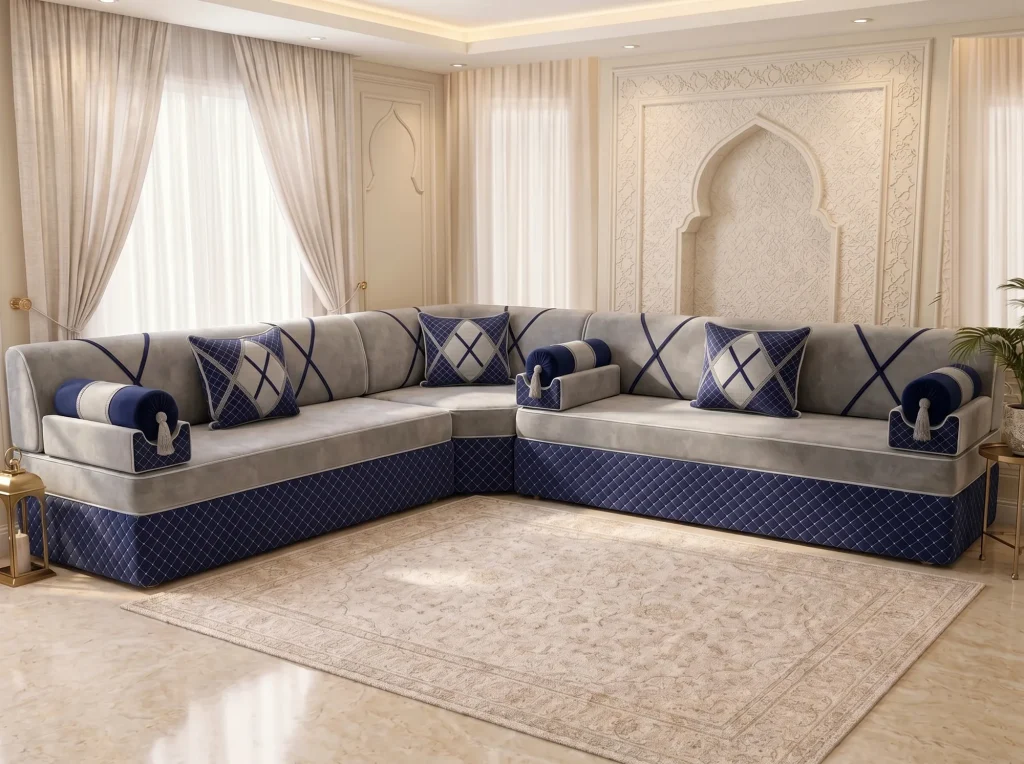
Both of these are contemporary. The olive and gold set on the left reads as a formal reception room in a wealthy home. The grey and navy set on the right reads as a younger family’s villa. Neither belongs in a scene set in 1950.
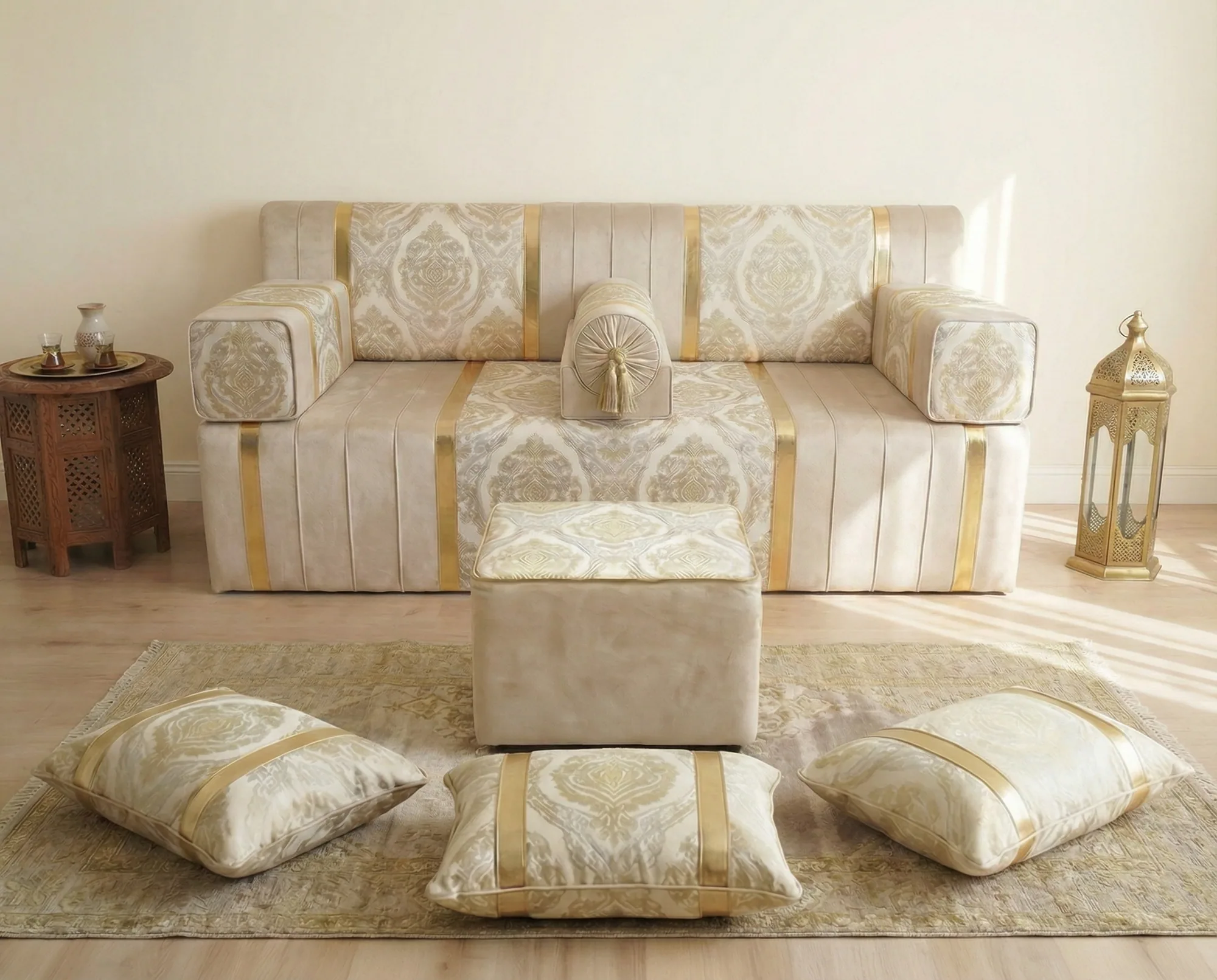
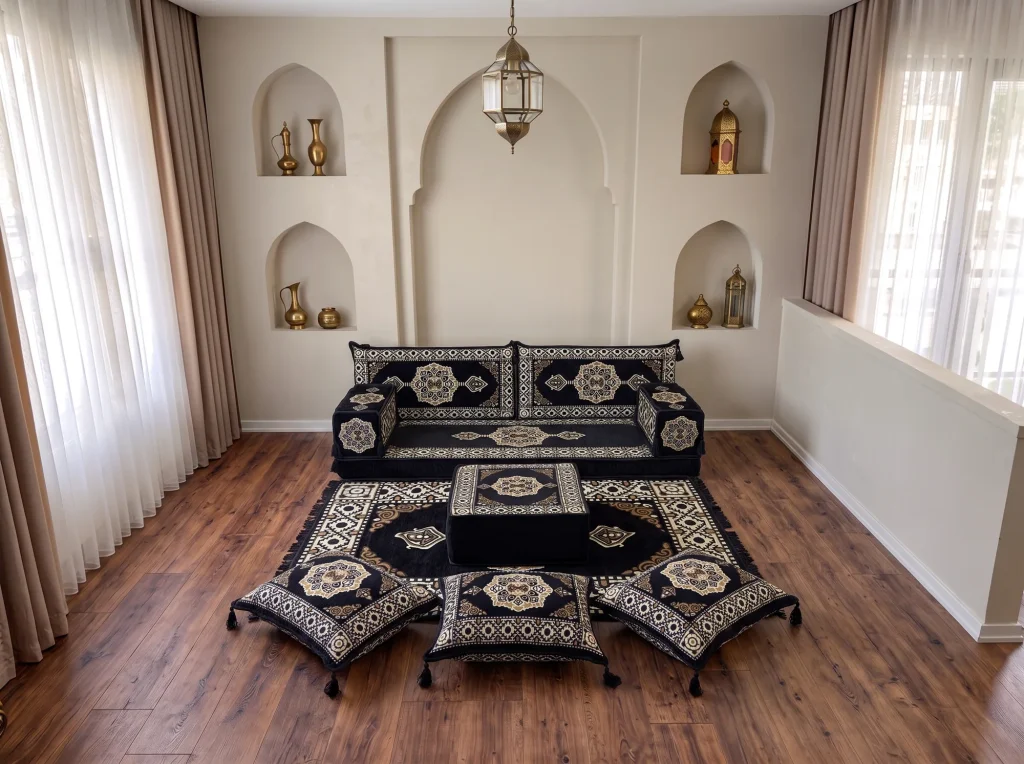
Diaspora living room. For a family in Dearborn, Birmingham or Berlin today, the honest look is a floor sofa in an ordinary rented room: plain painted walls, laminate floor, a calligraphy canvas, a houseplant.
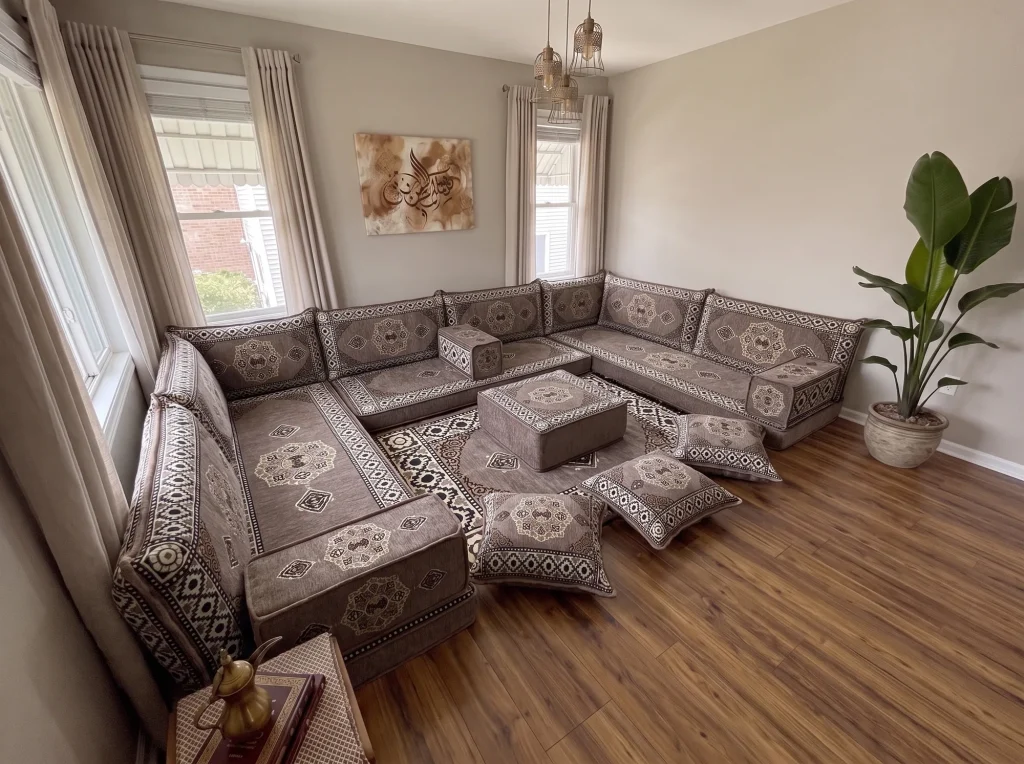
A complete floor sofa set with rug, ottoman and floor cushions in a plain living room. This is what many diaspora homes actually look like.
Common mistakes
Most errors come from treating the region as one style.
- Mixing traditions. A Moroccan lantern, a Gulf floor set and an Afghan carpet in one room. Each is real, and together they are nowhere.
- Arabian Nights dressing. Silk drapes, piles of round cushions and brass everywhere belong to a fantasy genre. If the brief is Arabian Nights set furniture for a pantomime or a fairy tale, say so openly and enjoy it. Do not use it for a contemporary drama.
- Wrong height for the country. Floor cushions in a Fes salon, or a raised banquette in a Bedouin tent.
- Cushions with nothing behind them. Floor sofas are not freestanding. Sofhu states that they need a wall or something hard behind the backrest. On a set with flown or wild walls, brace a panel behind every run or the backrests will tip when an actor leans.
- Calling every pattern traditional. The star motif on many Yemeni-style sets is a Sofhu design that customers choose for that look. We have found no source that makes it a historic Yemeni pattern. Historic Yemeni cloth is better documented as striped and ikat.
- Forgetting the coffee. In Gulf rooms the dallah, the small cups and the dates are part of the seating. An empty majlis looks unvisited.
- Shoes. In nearly all of these rooms shoes come off at the threshold. Put a row of sandals by the door.
Our guide to majlis patterns and motifs explains stars, sadu stripes and arabesque in more detail.
Sourcing: buy or commission
Commission when the set has to fit, and buy from stock dressing when it only has to suggest.
Sofhu is a manufacturer in Türkiye. It makes two main products, the low Arabic floor sofa of floor cushions and the raised, fully upholstered Arabic majlis, along with wooden bench sets, Afghan toshak and a Turkish majlis line on carved beech frames. Each order is cut to the measurements you send, in the fabric and colour you choose, and shipped free worldwide. That suits productions in three situations:
- Built sets. A run that fits a built wall exactly, with no gap at the end.
- Doubles. Two identical sets for continuity, stunts or a second unit.
- Specific palettes. A colour agreed with the designer and the director of photography, not whatever a prop house holds.
What to send for a majlis for a film set:
- Wall lengths and a plan of the set, with door and window positions.
- The country, city and decade, with reference photographs.
- Whether the seating is floor-level or raised.
- The fabric direction: plain, striped, sadu-pattern, velvet, brocade.
- Your prep and shoot dates.
Design discussions can happen by video call. Covers are zipped and washable at 30 degrees, which helps when a set is dressed and struck repeatedly. Import duty or tax may apply depending on the country you ship to, so ask before ordering.
The Middle Eastern sofa page gives an overview of the range, and majlis seating for events covers large temporary installations. The earlier article on Arabic sofas for film sets, photo shoots and productions and the page on the Turkish majlis show finished pieces. When the drawings are ready, get a quote by measurement or message on WhatsApp.