An Iraqi diwaniya is the reception hall of a house, traditionally the largest room in it. The mudhif is the arched reed guest hall of the southern marshes, where guests sit in two rows facing each other across a coffee hearth. Sofhu makes Arabic majlis sets to the customer's wall measurements that can be laid out either way: as facing rows, an L or a U.
- Native names
- ديوانية (diwaniya), مضيف (mudhif)
- Diwaniya
- The reception hall of a house, expected to be its largest room
- Mudhif
- Reed guest hall of the Marsh Arabs, kept by the sheikh
- Mudhif layout
- Two facing rows along the long walls, hearth on the centre line
- UNESCO
- Craftsmanship of the mudhif building inscribed in 2023
- Sofhu sets
- Single rows, L or U, cut to your wall lengths
- Filling
- 32 kg/m³ (32 DNS) high-density foam, no springs
On this page
Two rows or a U? That is the first thing to settle when you plan an Iraqi diwaniya, and the answer comes from the tradition itself. The classic Iraqi guest hall, the mudhif, seats people in two long rows that face each other. The Gulf majlis next door wraps three walls. Both work. Which one you order depends on the shape of your room and the way your family hosts.
This page sets out what the words mean, what the traditional rooms looked like, and how Sofhu builds seating to fit either plan.
Diwaniya, mudhif, majlis: the words
Diwaniya (ديوانية) comes from diwan and names the reception hall attached to a house, and the gathering held there. The word is best known from Kuwait, and it is also used in Iraq, notably in Anbar. See the Kuwaiti diwaniya page for the Kuwaiti institution.
Mudhif (مضيف) shares its root with madafa, the guest house of Jordan and Palestine: both come from the word for guest. It is the reed guest hall of the southern marshes.
Majlis is understood everywhere, and plenty of people search for an Iraqi majlis when they mean the same room. Use whichever word your family uses. Our glossary of floor seating names by country lines them up side by side.
The mudhif: two rows across a hearth
The mudhif is a large arched hall built entirely of reed by the Marsh Arabs of southern Iraq. The sheikh pays for it and maintains it, and it serves the whole community: guests are hosted there, weddings and funerals are held there, and disputes are resolved there. UNESCO inscribed the craftsmanship of the mudhif building on its Representative List in 2023. The same community weaves the mats and rugs that are used inside to sit on.
The interior plan is simple and strict. A coffee hearth sits on the central axis. On either side of it, along the reed walls, runs a line of cushions. An early twentieth-century visitor described them as brocaded. Guests sit in two rows looking at each other across the fire, and the host and coffee maker work in the middle. The form has also been reproduced in brick, which tells you the layout matters as much as the material.
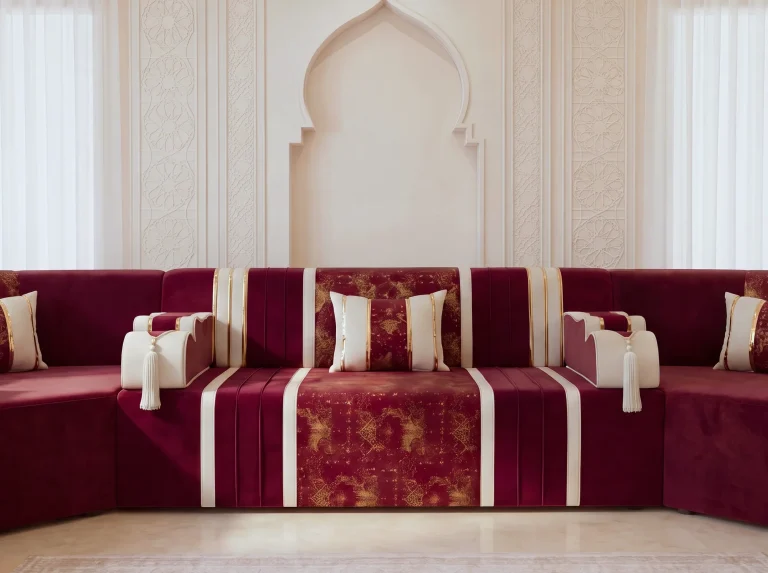
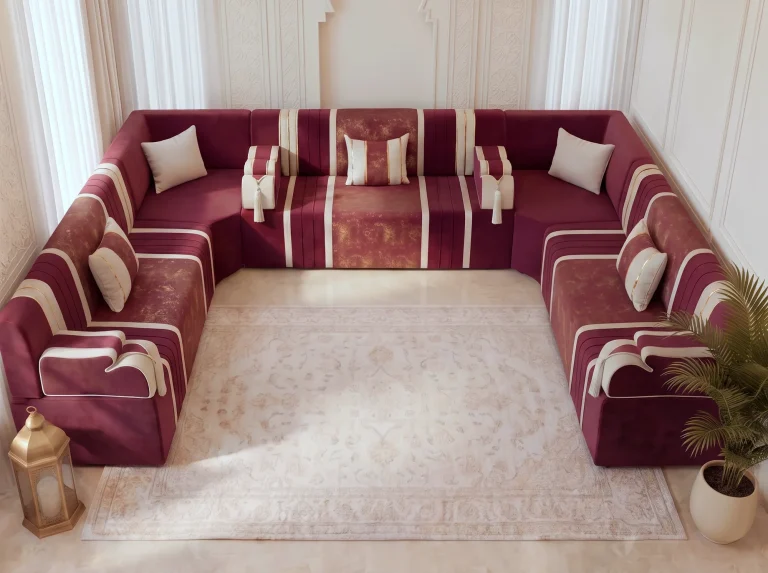
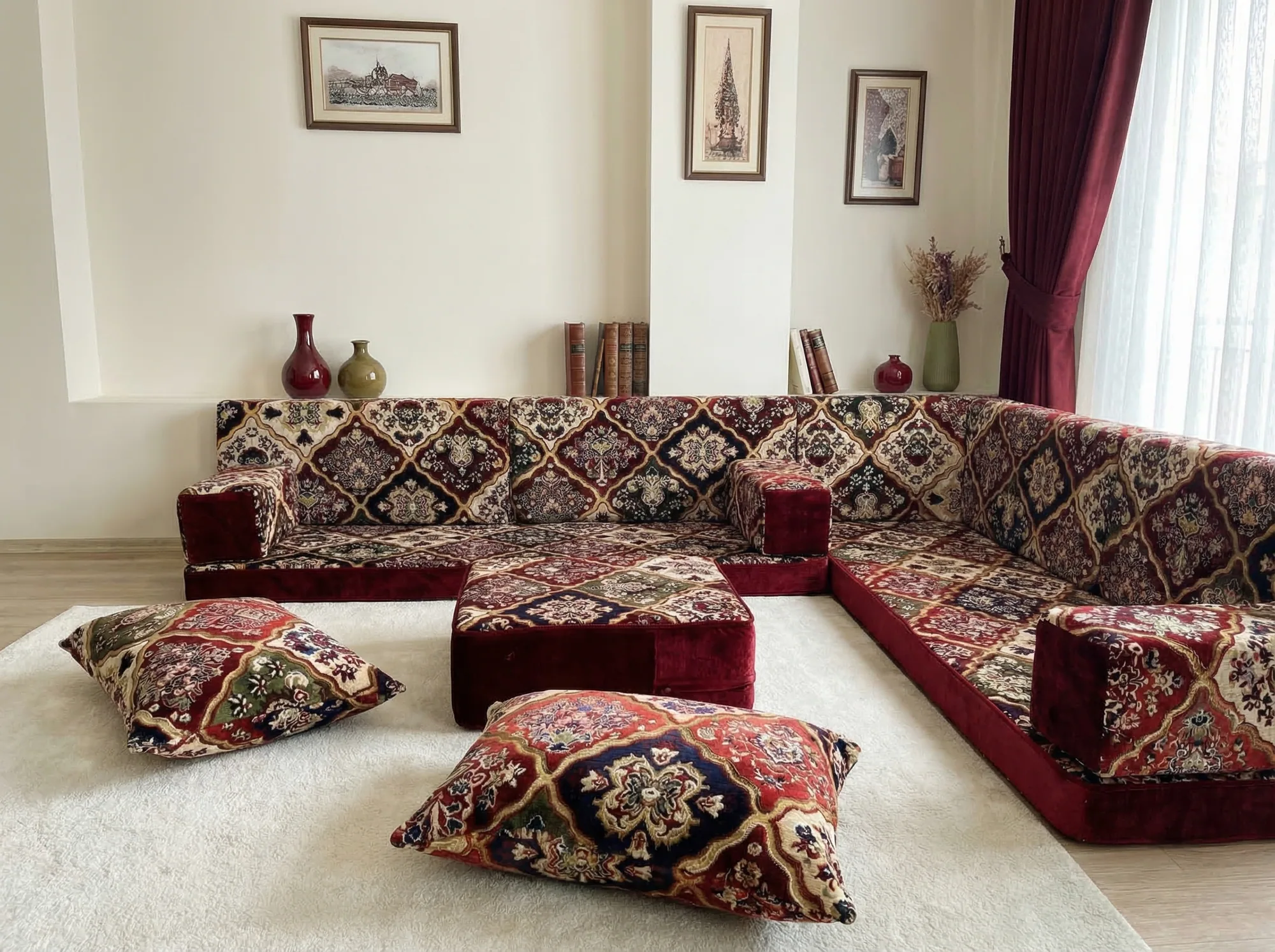
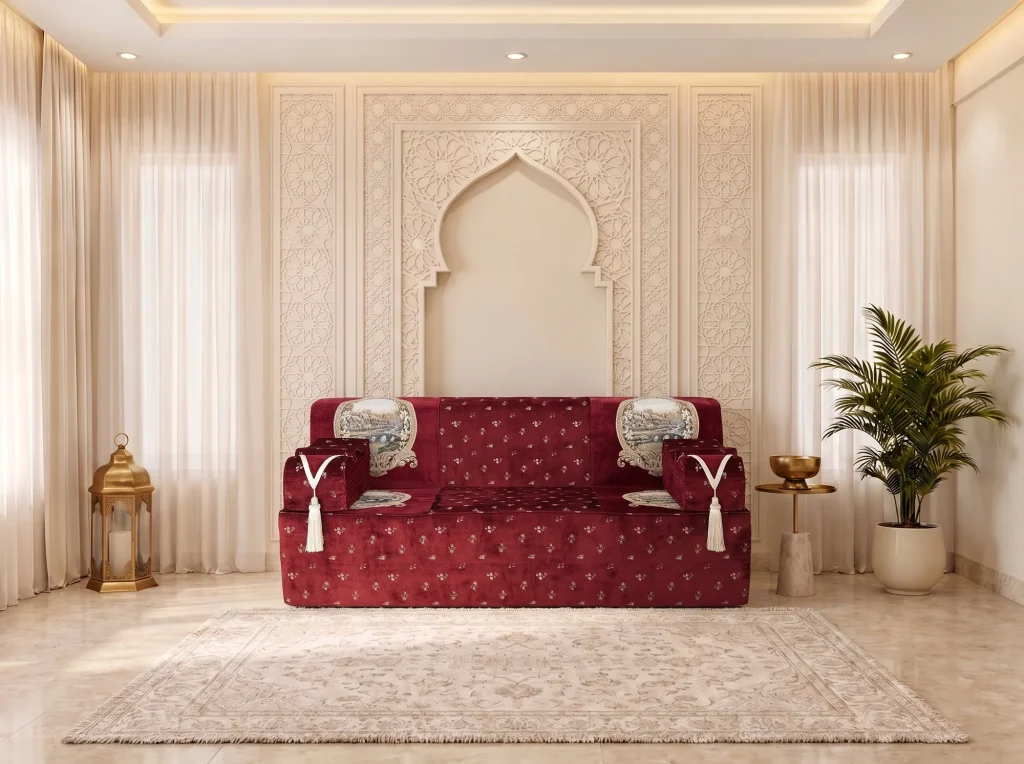
For a furniture maker the lesson is the single row. The burgundy seat at the top of this page is one straight unit against a wall. Two of those, placed opposite each other, are the mudhif plan in a modern room.
The house diwaniya: the biggest room comes first
In Anbar, a sheikh explained the priority to a reporter in plain terms: when a family builds a house, it thinks of the diwaniya first, and the room must be big even if that means the family sleeps in one room. The reception hall is not left-over space. It is the room the rest of the house is planned around.
We have not found a dependable written source for how city diwaniyas are furnished, so we will not claim a standard. Our own advice follows the use of the room: a low floor sofa where it is used by family and close friends, and a raised majlis where formal visitors are expected.
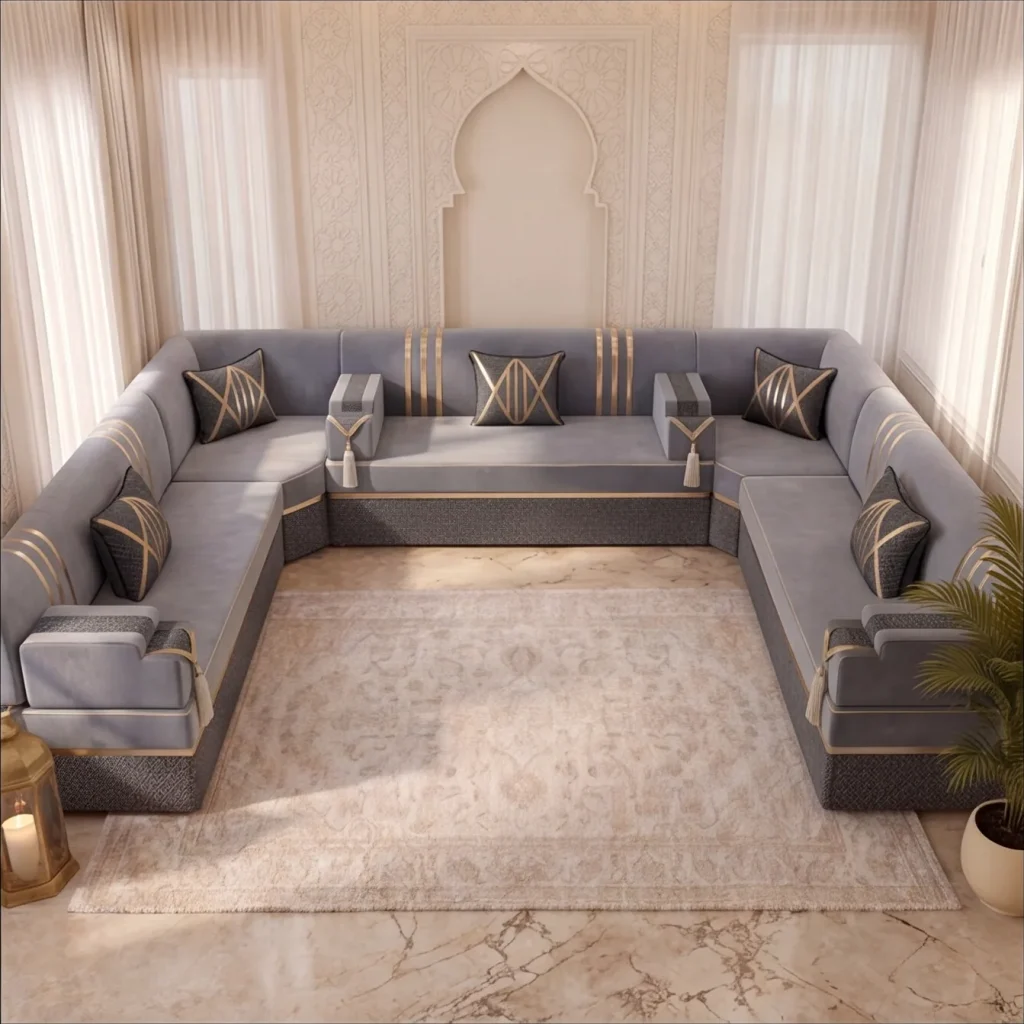
Which layout to order
| Layout | Room it suits | What it gives you |
|---|---|---|
| Two facing rows | Long, narrow hall with doors on the short walls | The mudhif plan: everyone faces someone, the centre stays free for serving |
| U shape | Square or wide room with one clear entrance side | The most seats for the floor area, with a head wall for the host |
| L shape | Living room shared with a television or dining table | A guest corner that leaves the rest of the room open |
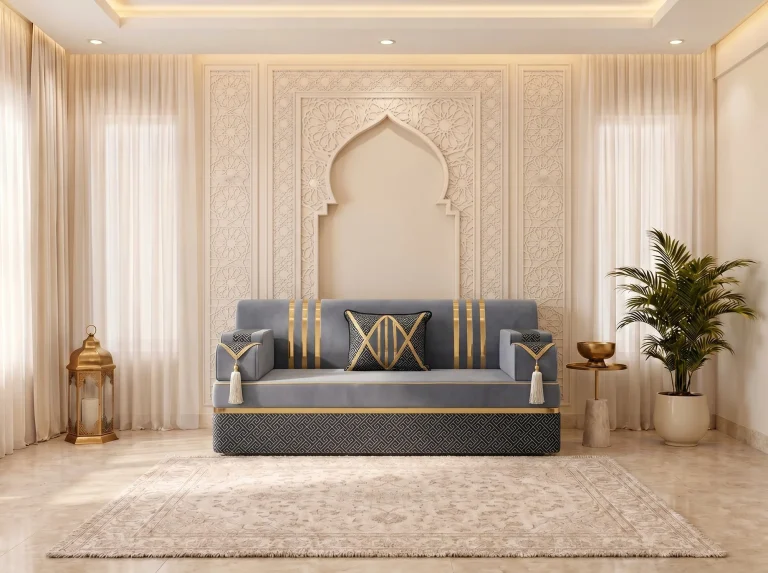
| Single row | Small reception room or hallway | One wall of seating, easy to add to later |
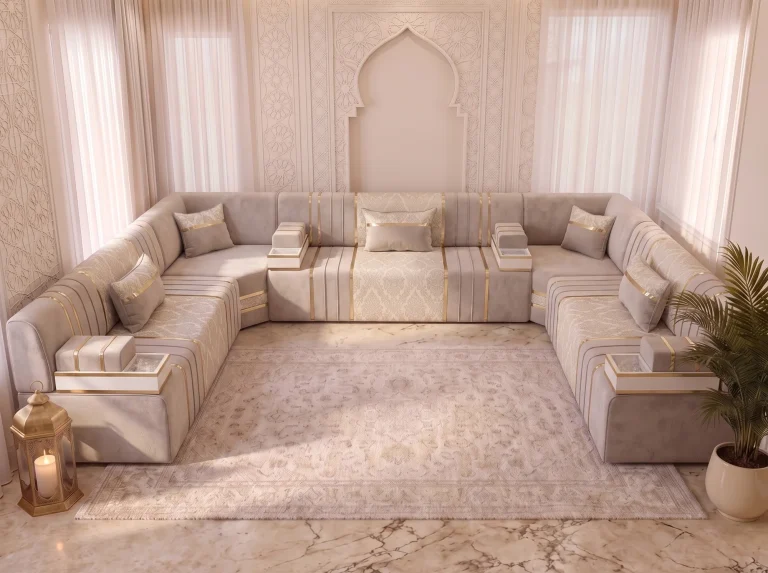
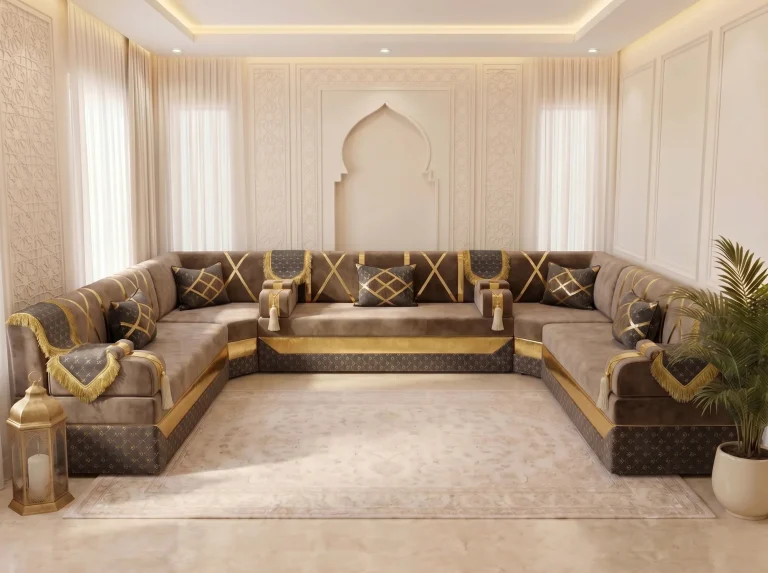
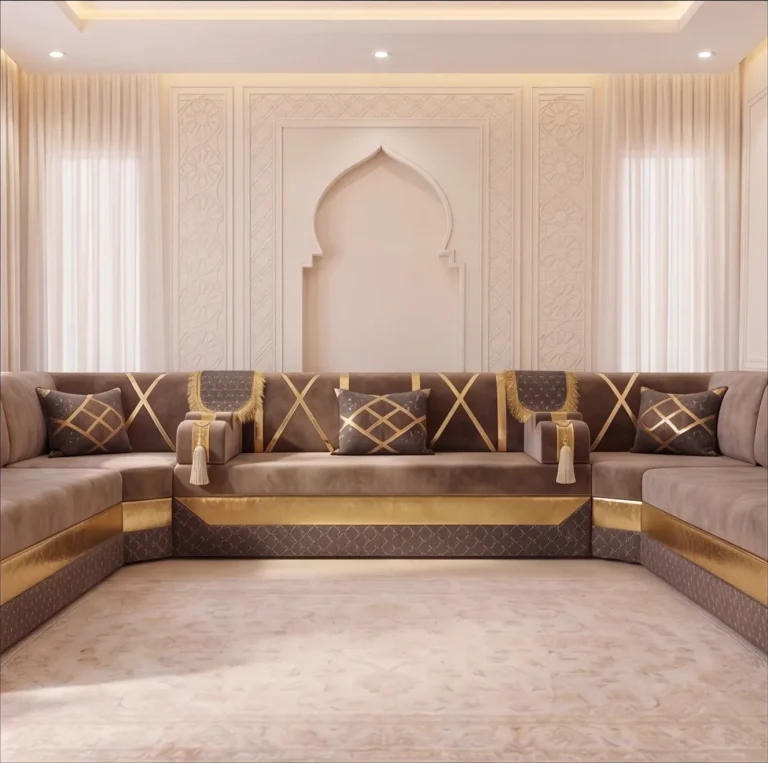
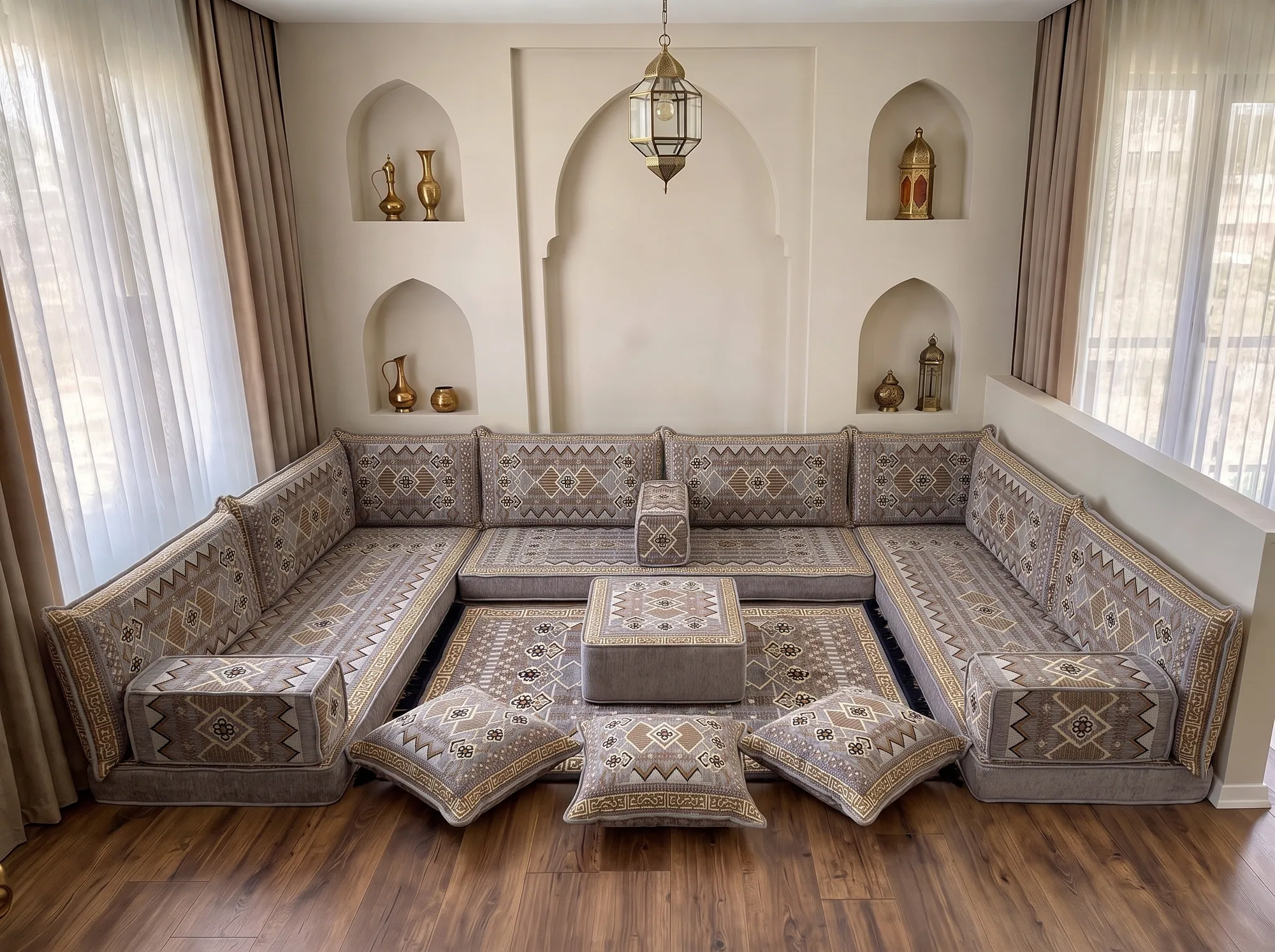
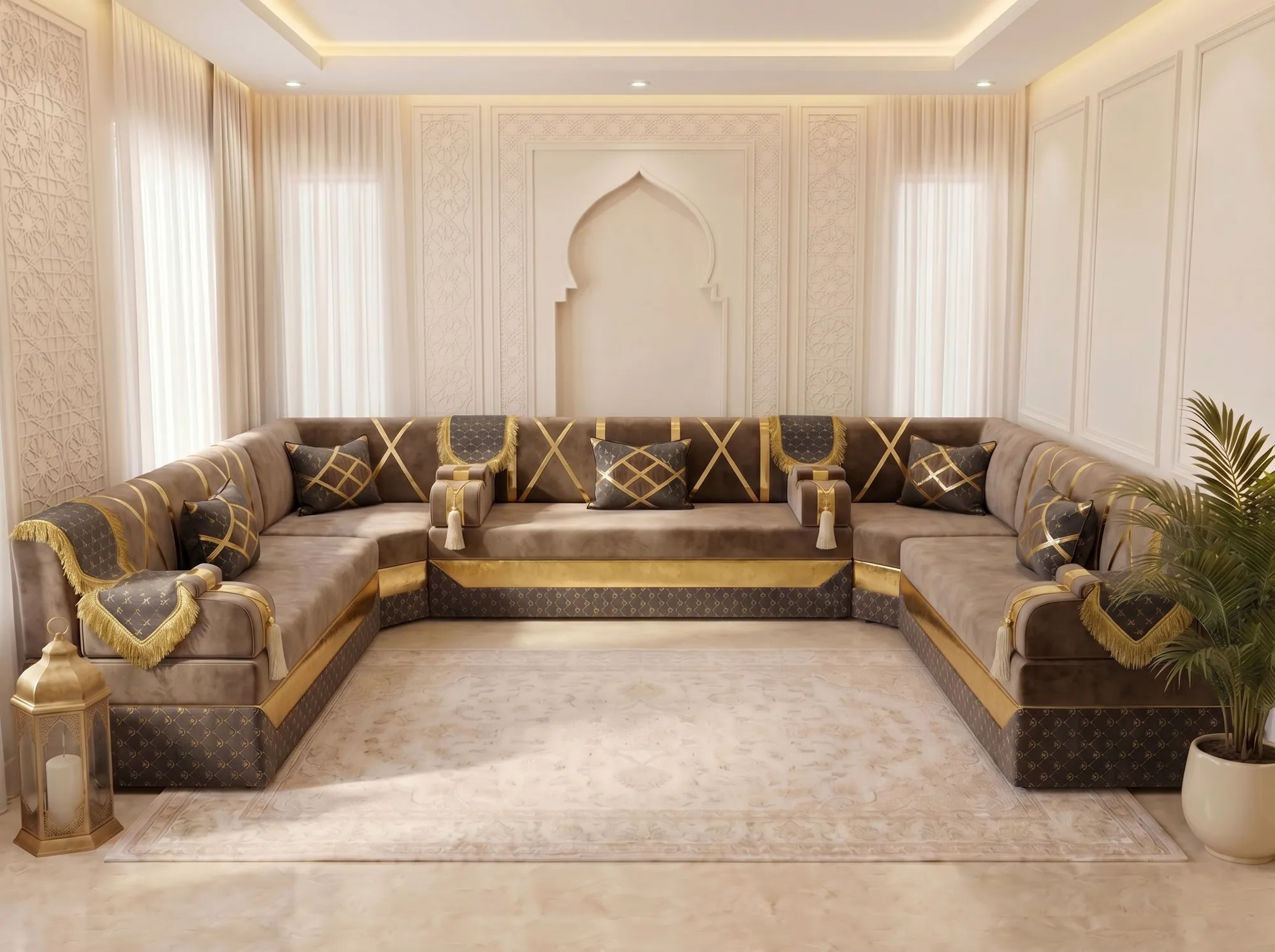
The grey set above is a U seen from the open side: three runs, two corner seats and an armrest between every few places. It holds more people than facing rows in a room of the same size, but the two people in the corners sit closer than they would in a mudhif.
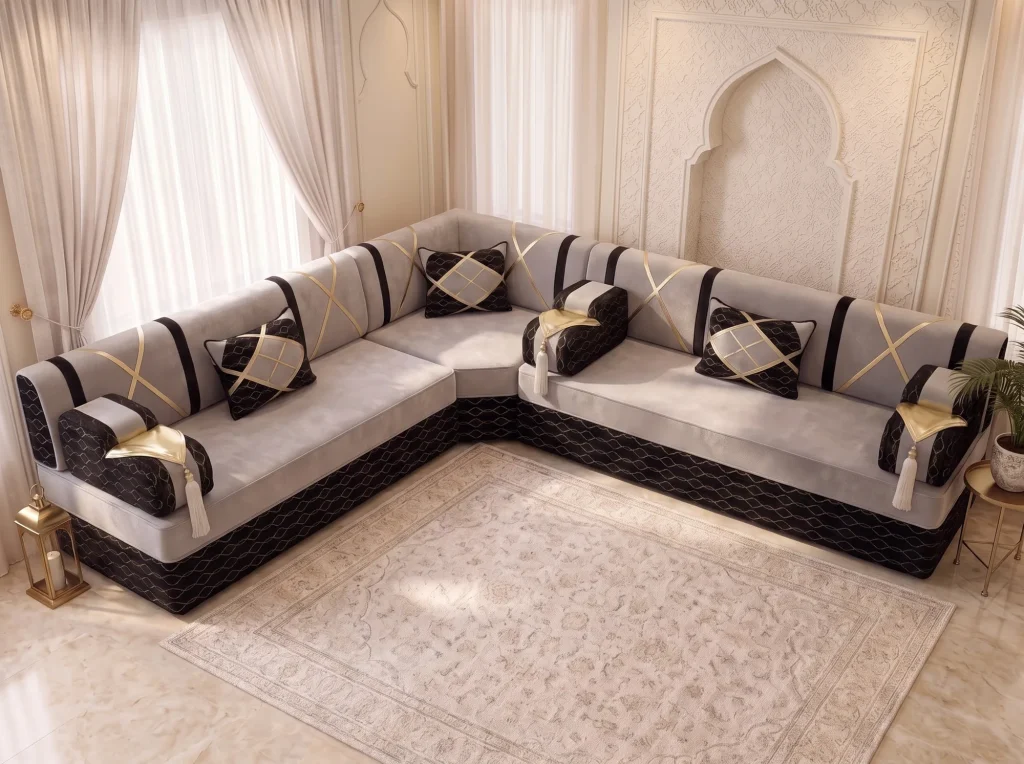
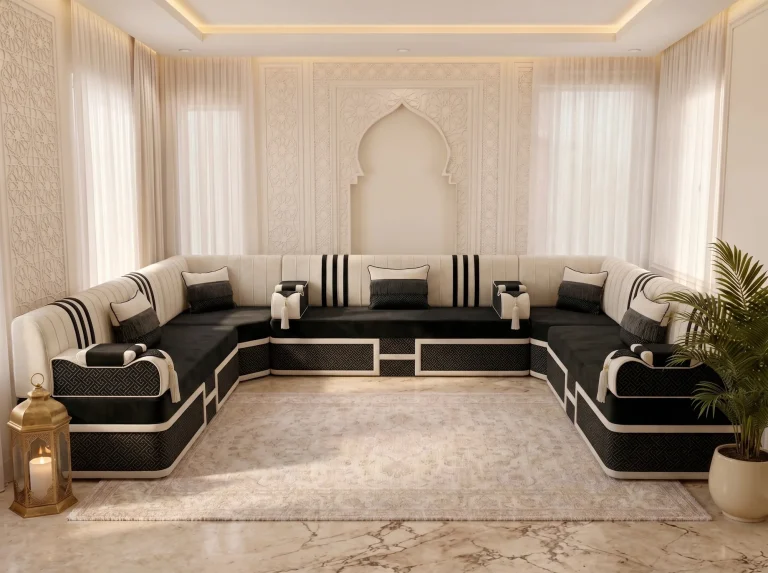
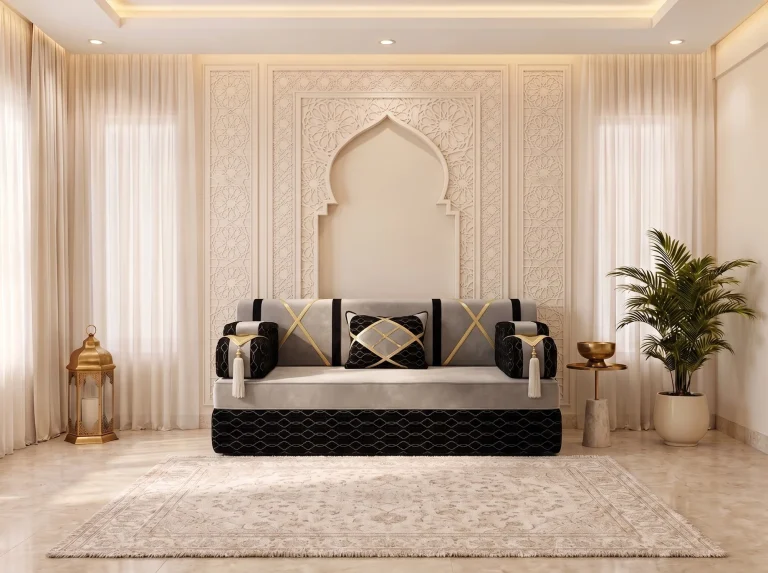
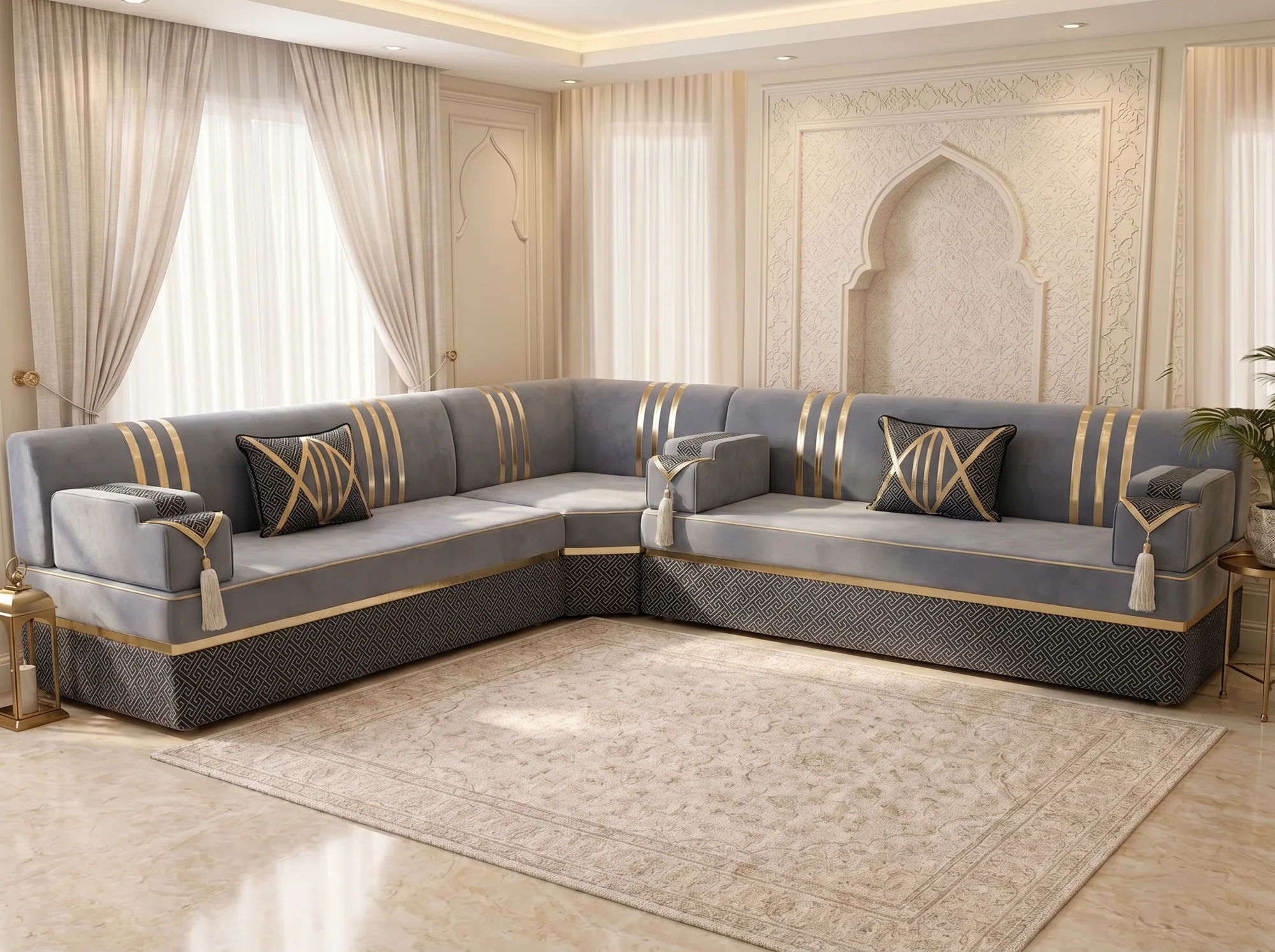
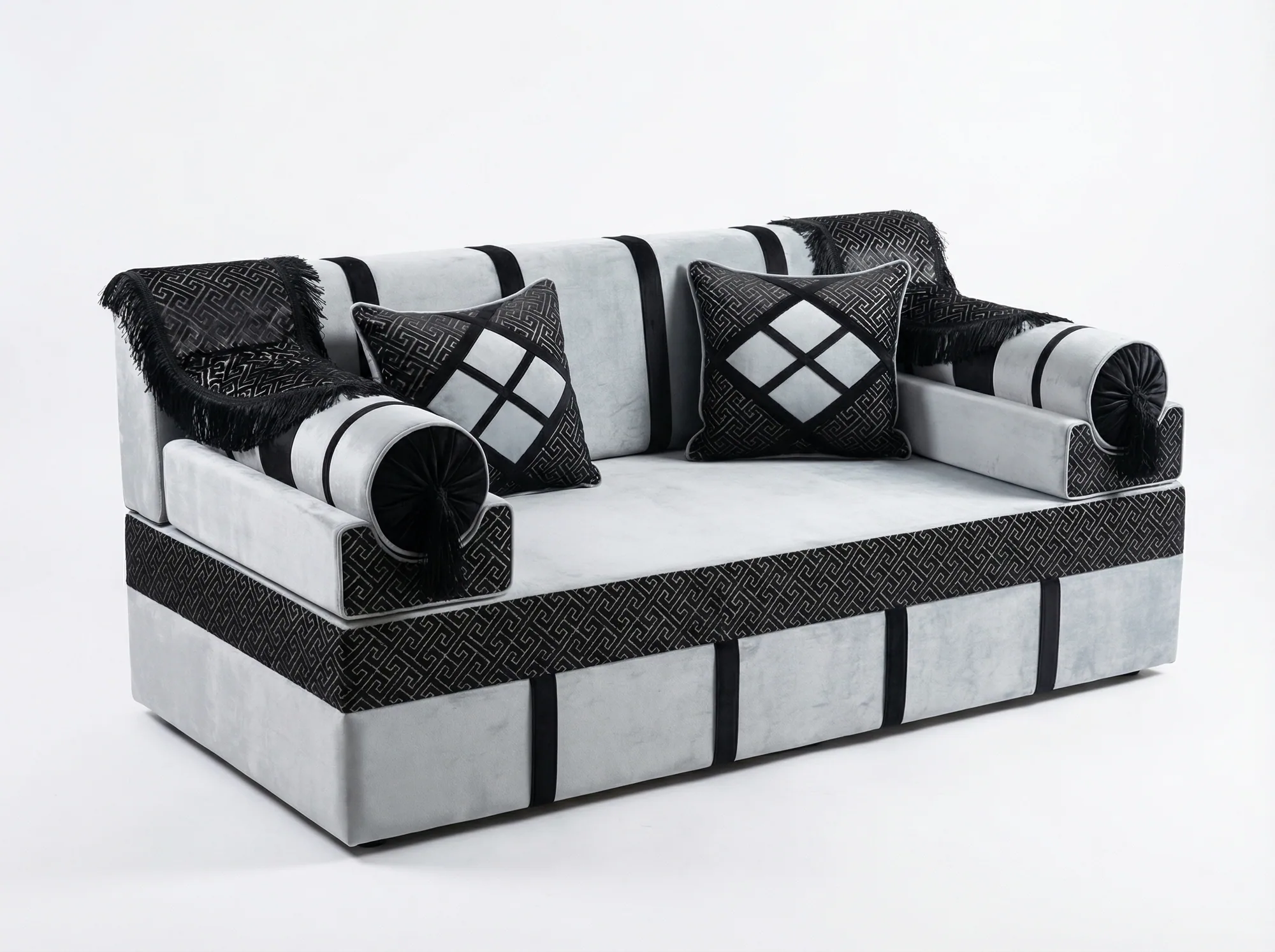
An L, like the grey and black set here, is the usual answer in an apartment. One arm can be made longer than the other to match the walls. Whatever the plan, the seating needs a wall behind it: Sofhu sets are not freestanding. The L-shape and U-shape majlis page explains corner pieces and returns.
Floor sofa or raised majlis
Sofhu makes two products, and a diwaniya can use either. The Arabic floor sofa, a low set of seat mattresses and loose back cushions, is the closest to the mudhif, where guests sit low on mats with cushions at their backs. It is relaxed, it suits long evenings, and it makes the room feel larger because the furniture stays below the window line.
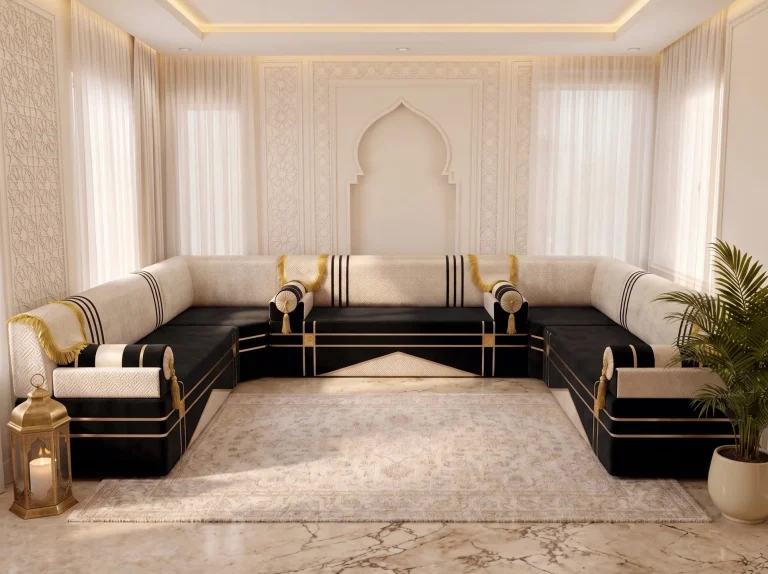
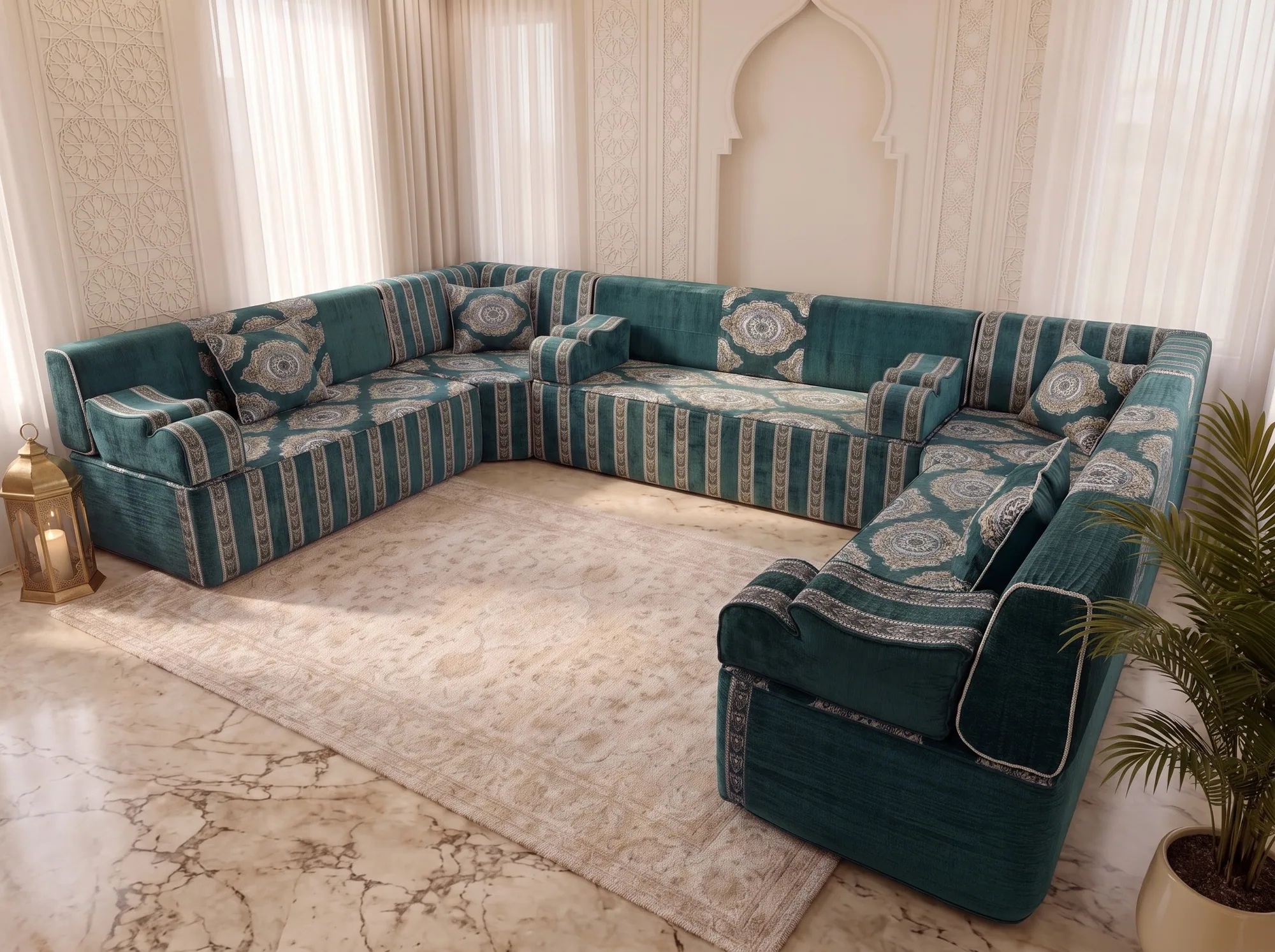
The Arabic majlis, raised to sofa height and fully upholstered with a solid base, fixed backs and arm bolsters, is easier to rise from and reads as more formal. Every set pictured on this page is a majlis. It suits the hall where elders and official visitors are received, with a floor sofa kept for the family room. Sofhu makes both and can combine them in one order. We do not quote standard heights, since each set is made to order; tell us who uses the room and we will recommend a seat thickness in the quote.
What is inside, and how it is kept clean
A diwaniya is used hard. Tea and coffee are served many times in an evening, and the same seats serve for weddings and for condolences.
- Foam. Sofhu fills its seats with 32 kg/m³ (32 DNS) high-density polyurethane foam. The figure is density, the weight of one cubic metre, and denser foam generally holds its height and support longer than light foam. There are no springs. Softer or firmer foam can be requested on a custom order.
- Covers. Every cover has a zip and comes with its foam insert. Sofhu states that covers can be taken off and machine washed at 30°C.
- Fabric. Velvet gives depth of colour for a formal hall. Linen is cooler to sit on in summer. Woven and chenille fabrics carry pattern well.
- Modules. The seating is built in sections, so a long row can be carried through a normal door and rearranged if you move.
The existing overview of diwan floor sofas from Sofhu shows the diwan models in more detail.
Iraqi homes abroad
Iraqi communities are established well beyond Iraq: around Detroit, Chicago, San Diego, Phoenix and Nashville in the United States; in Toronto, Mississauga and Windsor in Canada; in London, Birmingham and Manchester; in Munich, Berlin and Cologne; in Stockholm and Malmö; and in Sydney and Melbourne. Houses and apartments in those places were not designed with a diwaniya in mind.
The practical answers are a basement or spare room fitted as a full U, or an L in the main living room. Because the pieces are cut to the wall measurements you send, a room with an off-centre window or a chimney breast can still be seated wall to wall. Our guide to a majlis in a small apartment has worked examples.
Getting a quote for an Iraqi diwaniya
Sofhu is the manufacturer. Each set is made in Türkiye, vacuum packed and shipped free worldwide. There are no local shops; the set is built for your room and delivered to your door.
Start by measuring. The guide on how to measure a room for a majlis shows which numbers we need. Then send the measurements, a photo and your preferred layout through get a quote by measurement or on WhatsApp. Shipping is free; duties or taxes may apply depending on your country, so ask before you order.
To see the full range, go to Arabic majlis or Arabic floor sofas. Related traditions are described on the Kurdish diwan and Bedouin majlis pages.