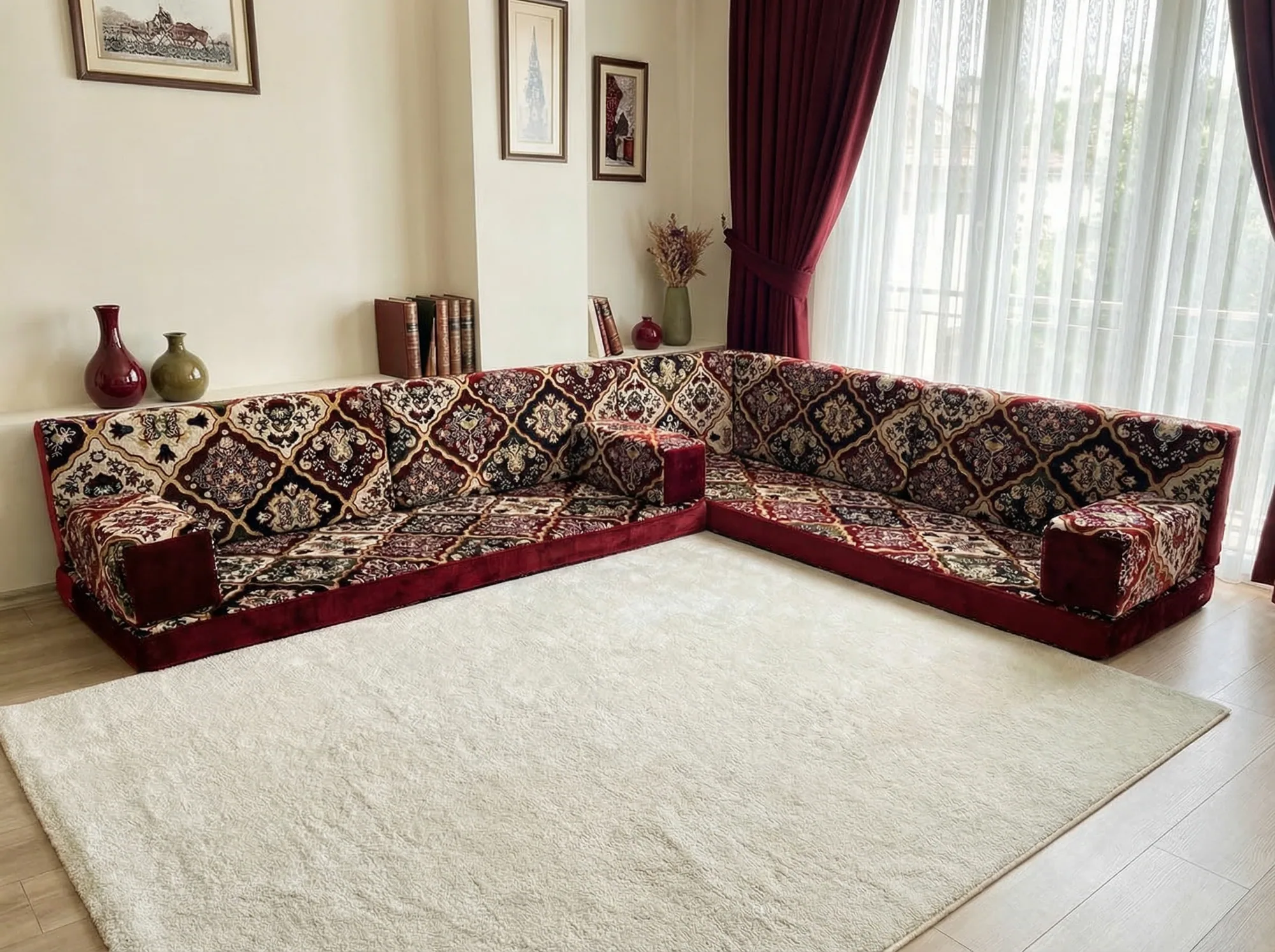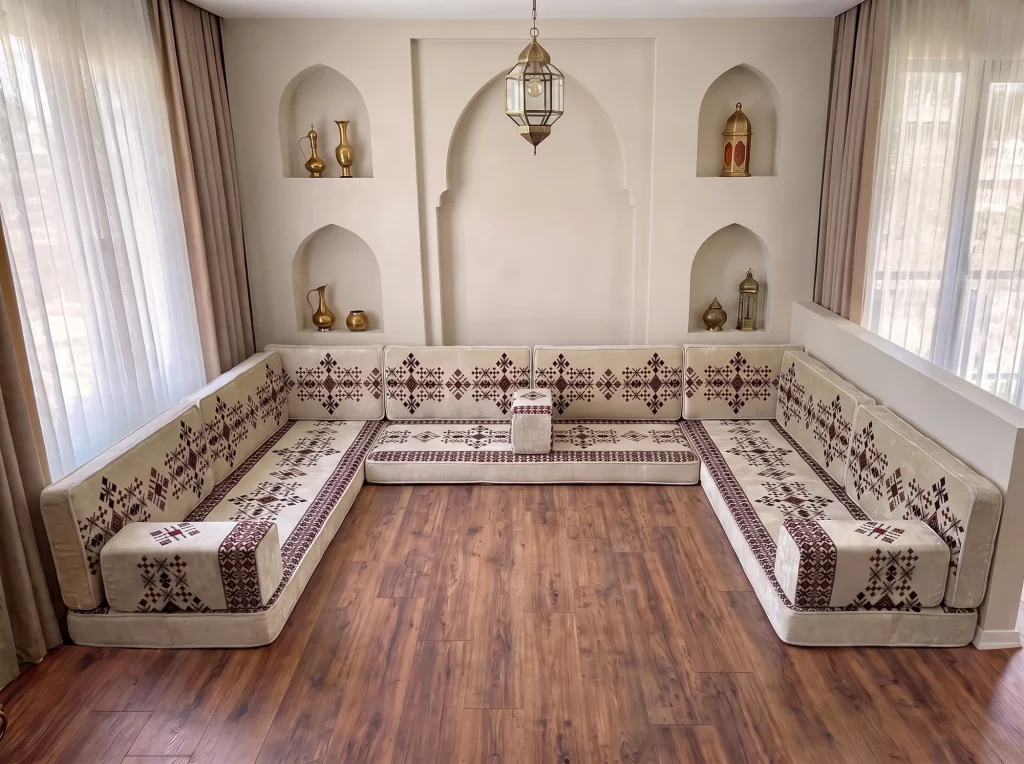
A Yemeni majlis, as made today, is floor seating around the whole edge of a long room, with tall backs and an armrest for each sitter. A Saudi majlis is a formal guest hall with cushions along the walls and, traditionally, a coffee hearth. A Moroccan salon is not floor seating: it sits at bench height on a wooden sedari. Sofhu makes floor sofas and raised majlis sets for each.
- Yemeni room
- Mafraj or diwan, often the top floor of a tower house
- Saudi room
- Majlis, a formal hall for receiving guests
- Moroccan room
- Salon with sedari banquettes around a central table
- Lowest seat
- Yemeni and Saudi (floor level)
- Highest seat
- Moroccan (bench height on a wooden frame)
- UNESCO majlis listing
- 2015: UAE, Saudi Arabia, Oman and Qatar
- Sofhu sets
- Made to measure: low floor sofas and raised majlis sets
On this page
People who search for Yemeni vs Saudi majlis usually have a photograph in mind and want the right name for it. The three traditions on this page are often sold under one label, yet they differ in the most basic thing a seat can differ in: how far it is from the floor. Two are floor seating. One is not. Start there and the rest follows.
A note on honesty before the table. The rooms themselves are well documented. The exact cushions inside them are less so, and furniture sellers have filled the gaps with confident claims. Where we rely on trade habit instead of a source, we say so.
Yemeni vs Saudi majlis vs Moroccan salon at a glance
Of all the types of majlis, these three are the ones most often confused. The quickest way to tell them apart is seat level, then armrests, then what stands in the middle of the room.
| Yemeni | Saudi | Moroccan | |
|---|---|---|---|
| Room name | Mafraj, diwan | Majlis | Salon, with sedari |
| Seat level | Floor | Floor | Bench height |
| Frame | None | None | Wooden banquette |
| Armrests | One per sitter, high | Bolsters between sitters | Usually none |
| Layout | Full edge of a long room | Along the walls, main seat facing | Wall to wall, U or full perimeter |
| Centre of room | Open floor | Coffee hearth, carpet | Large low round table |
| Hospitality | Long afternoon sitting | Coffee and dates | Tea and shared meals |
| Fabric known for | Velvet with metallic accents today | Sadu-pattern weaves, plain velvet | Jacquard, velvet, silk |
Read the armrest and fabric rows as how the styles are made and sold now. No source we trust lays down a rule for them.
Yemeni majlis style: the mafraj and its tall armrests
A Yemeni majlis is seating for people who intend to stay. In the tower houses of Sana’a the mafraj is the social room on the top floor, with wide low windows so that seated guests can look out over the city. Aramco World describes it as the preferred place to sit with friends and family in the afternoon and early evening. It is often the most decorated room in the house, with gypsum plasterwork and coloured glass above the windows. The diwan is a larger sitting room in the same kind of house.
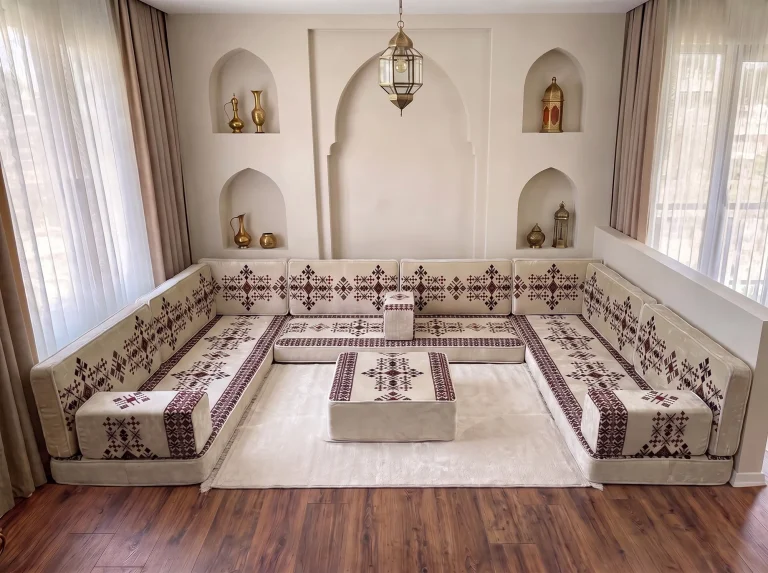
That use explains the furniture. A sitting that lasts hours calls for a firm, low seat, a tall back and something to lean an elbow on. Yemeni sets as they are made today therefore run around the whole edge of a long, narrow room, with a high armrest bolster marking each place. This is the convention of the trade and of Yemeni households abroad; the written sources describe the room in detail and say little about the cushions.
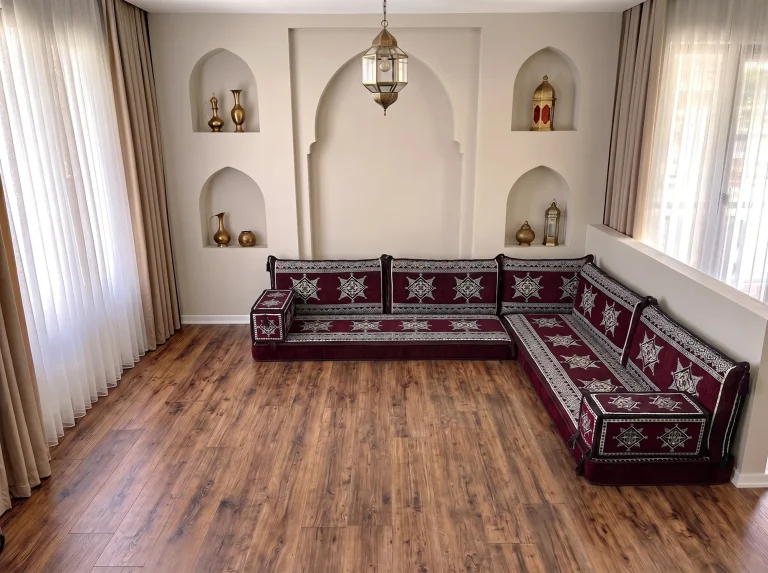
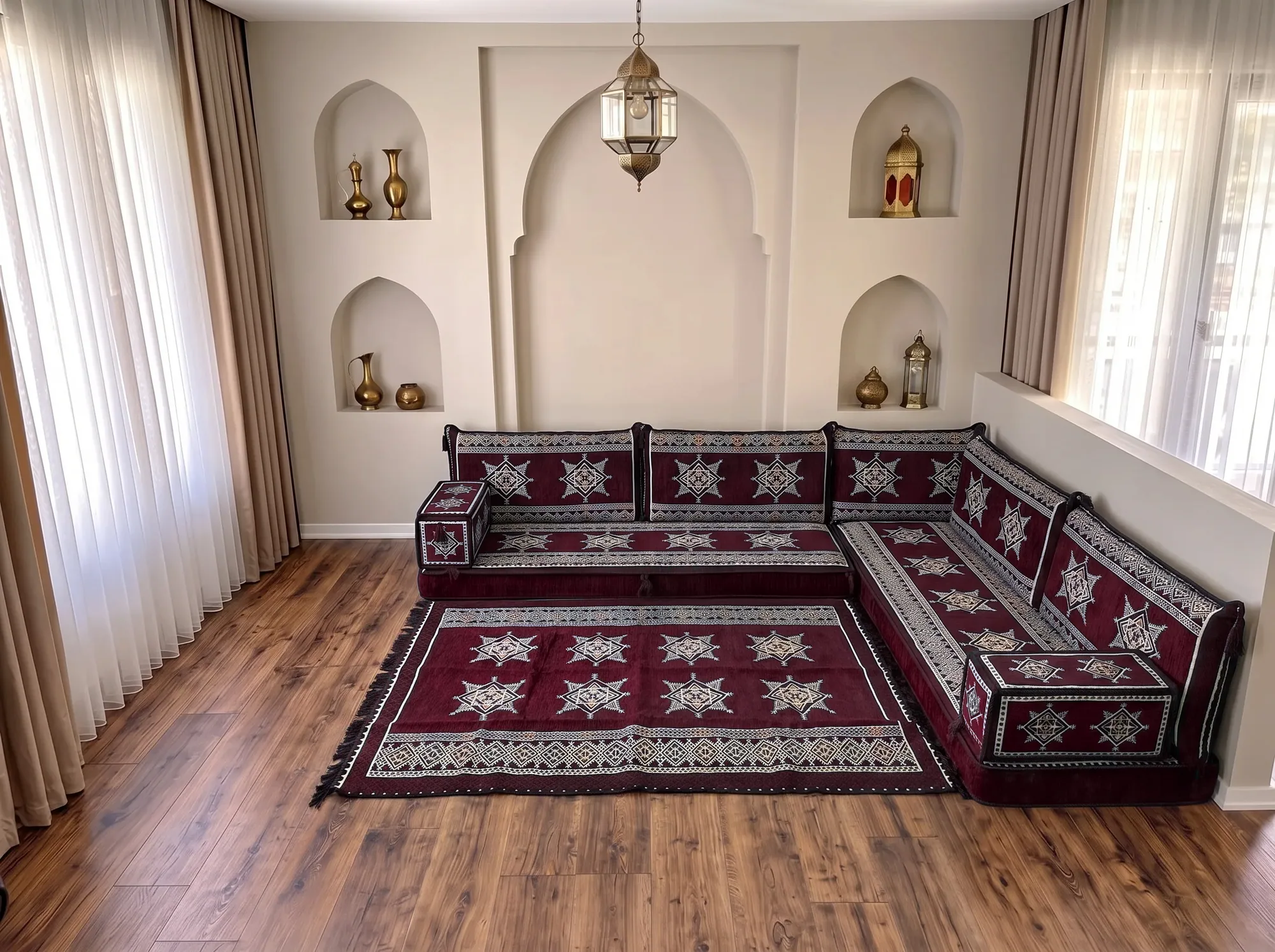
On fabric, Sofhu describes its Yemeni sets as typically using velvet with gold, silver or bronze accents and geometric or floral motifs. Many customers choose star motifs for a Yemeni-style room.
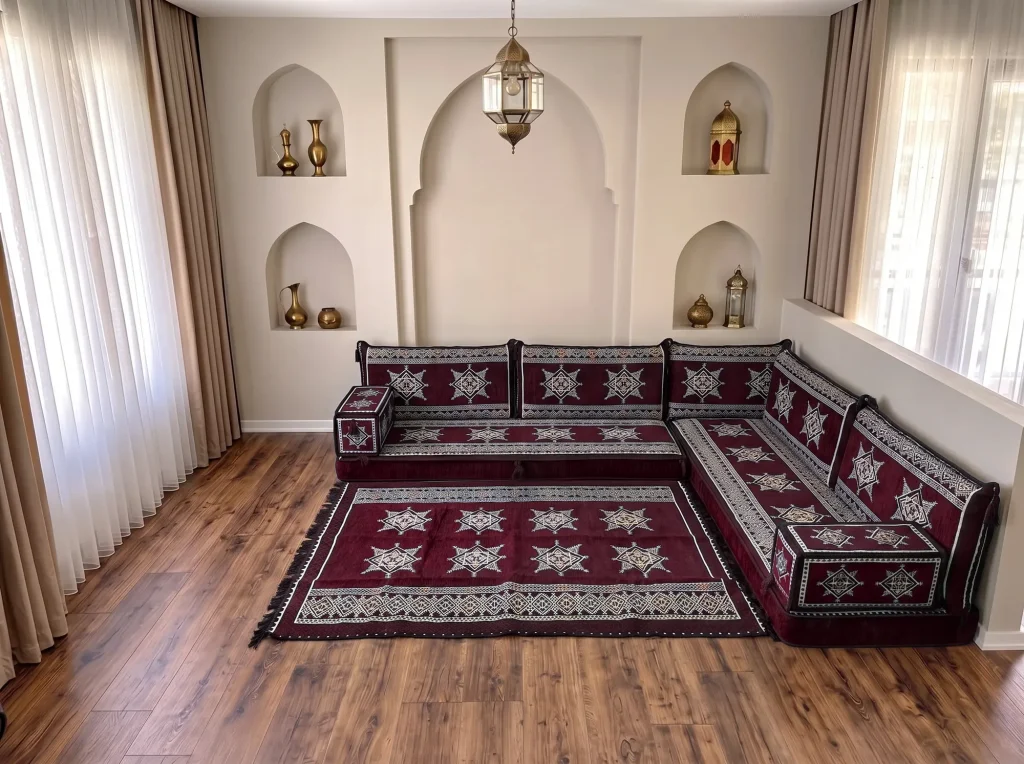
The eight-point star in that photograph is a Sofhu design. We have not found a source that names it as Yemeni heritage, and historic Yemeni textiles are known for stripes and ikat, so we do not make the claim. For the room, the vocabulary and the layout in depth, see the Yemeni diwan and mafraj page, or the existing overview of the Yemeni majlis from Sofhu.
Saudi majlis style: a formal hall for guests
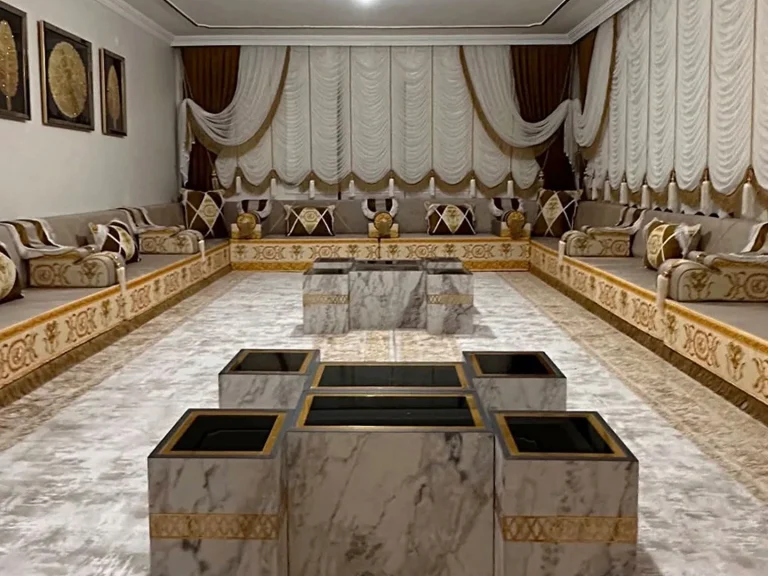
A Saudi majlis is a reception hall first and a seating style second. Saudipedia defines it as a special hall for receiving guests, usually for formal occasions, whose design reflects the owner’s regional culture. Cushions are placed around the walls, on the floor or on a raised shelf.
What changes from region to region is mostly the architecture:
- Najd, around Riyadh and Qassim: walls with incised plaster in star and geometric designs, and a coffee room with a hearth and a shelf niche for the pots.
- The north, around Hail: a stone fireplace where coffee is prepared in front of the guests, often opposite the main guest seat.
- Hijaz, in Jeddah, Makkah and Madinah: multi-storey houses with carved wooden bay windows and a separate men’s section.
- Asir, in the south-west: majlis walls painted by women in bright geometric bands, a practice UNESCO inscribed in 2017.
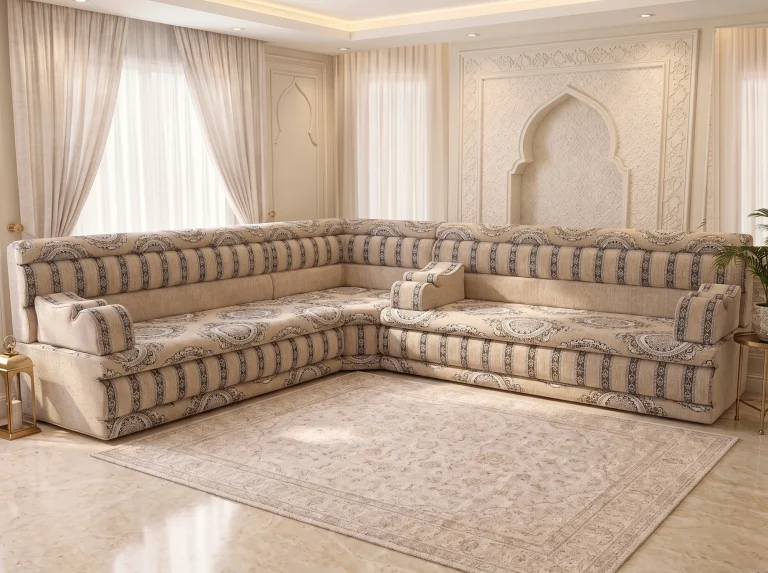
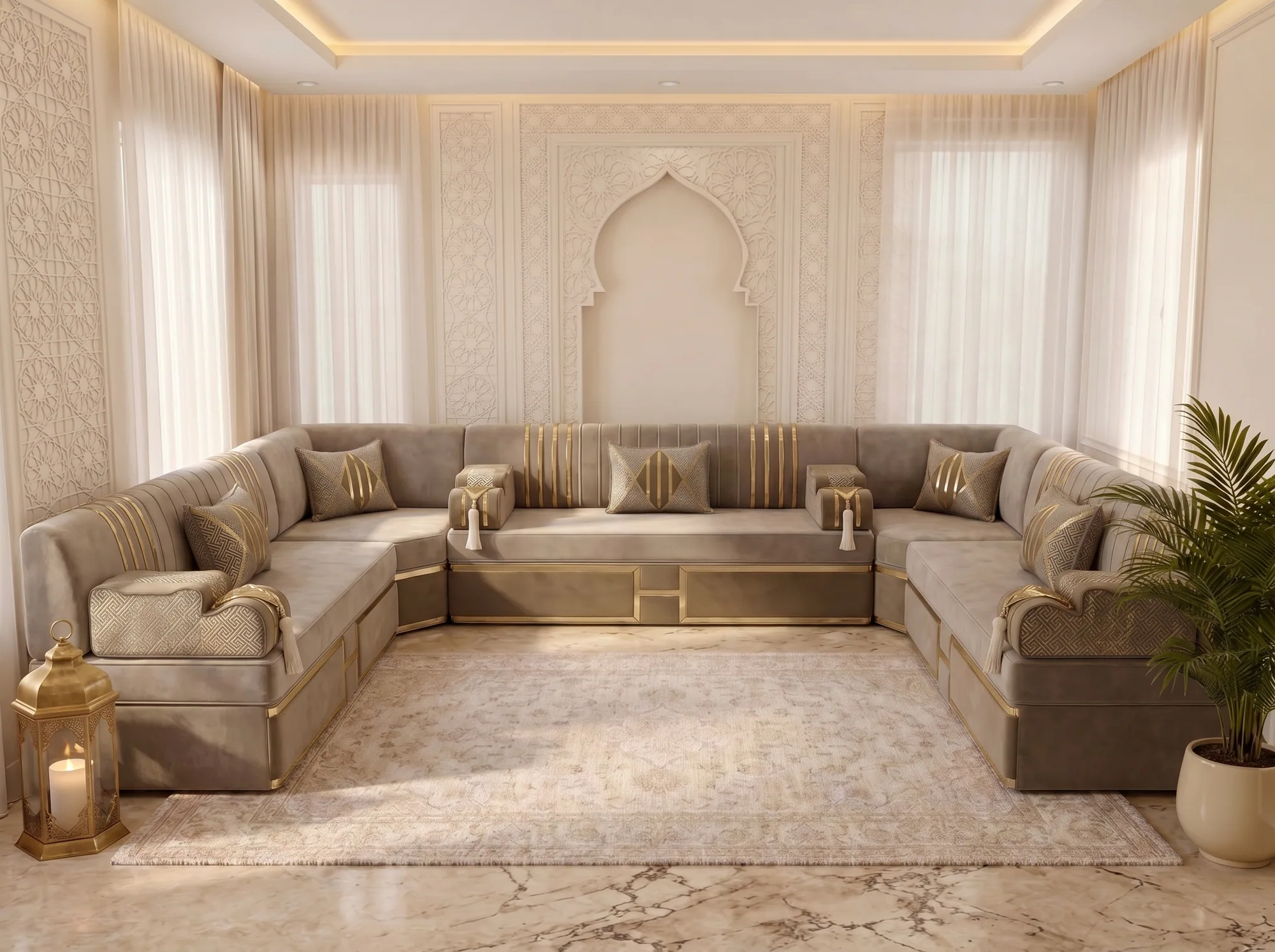
You will read online that Najdi seating is lowest and Hijazi seating sits on a bench. That may be so, but we have not found a source for it, so treat it as hearsay. What can be said safely is that the classic Saudi set is a long, even run of seat cushions with wall backrests and bolster armrests, kept symmetrical because the room is formal.
Saudi Arabia is one of the four countries, with the UAE, Oman and Qatar, behind the 2015 UNESCO inscription of the majlis as a cultural and social space. The listing covers the social practice, not a furniture style. The fabric most linked with the Gulf is sadu, the Bedouin weaving of narrow geometric bands, whose Saudi and Kuwaiti tradition was inscribed in 2020.
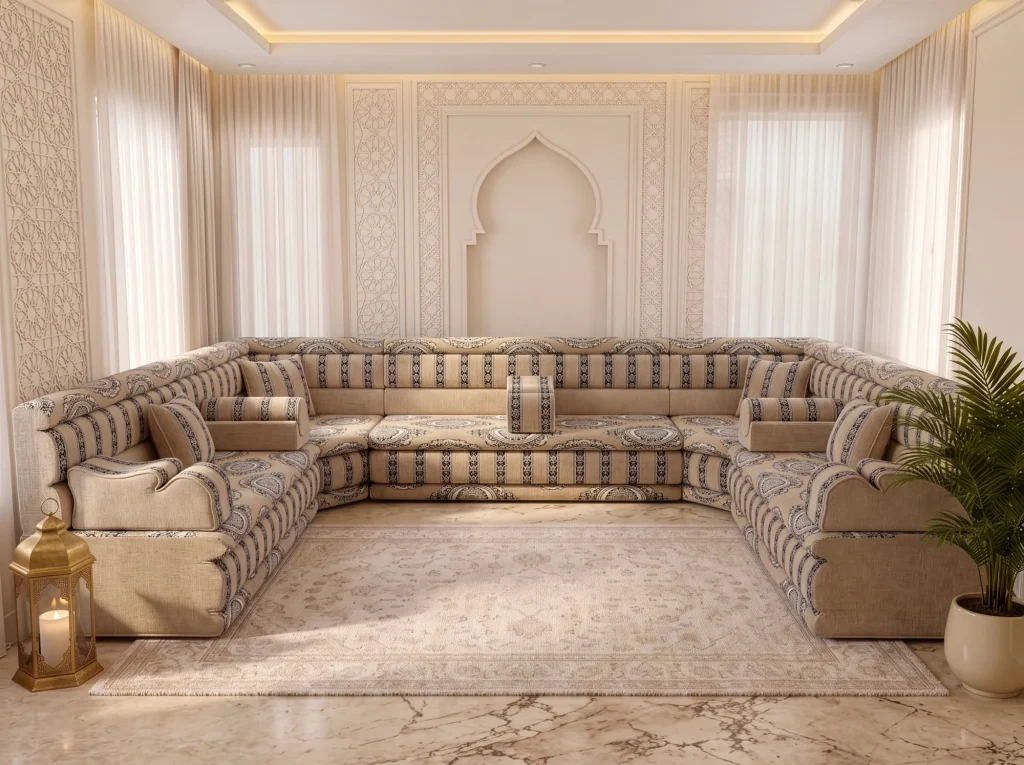
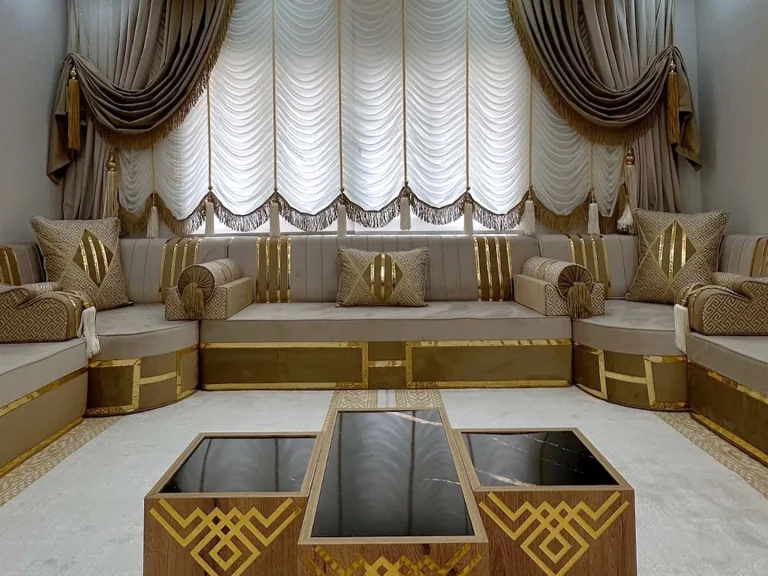
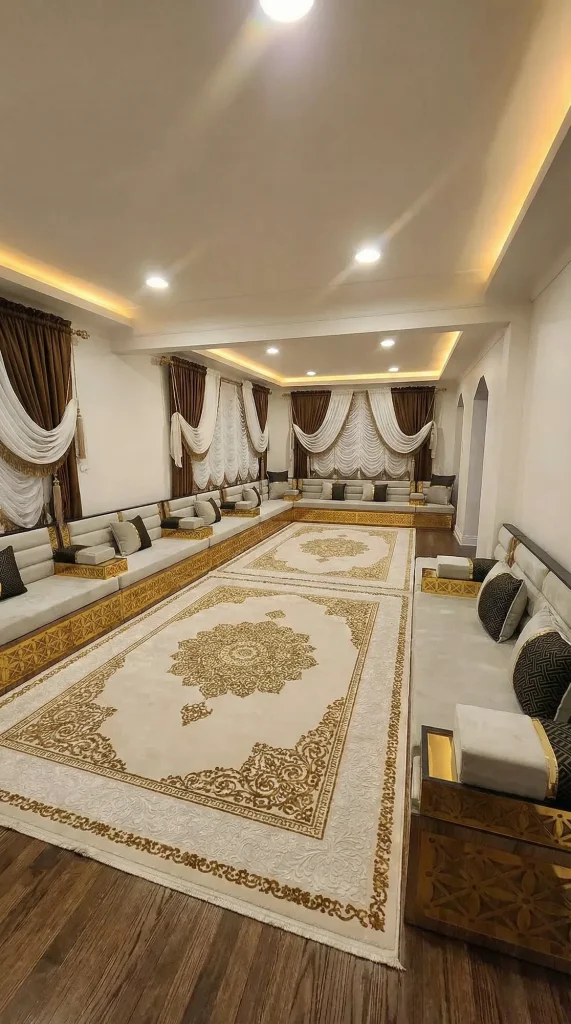
A long, calm, repeated majlis like the beige one above suits the Saudi idea of a guest hall. More on the regional rooms is on the Saudi majlis page, and the weaving has its own page under Bedouin majlis and sadu.
Moroccan majlis sofa: the sedari is a bench, not floor seating
The phrase Moroccan majlis sofa describes something that is not a majlis in the Gulf sense. The Moroccan salon is built from sedari: wooden banquette frames, often carved, each carrying a mattress and fitted back cushions. The seating occupies most of the walls and leaves the centre open for a large low round table, so that every guest can reach the shared dish. Guests are received here, tea is poured here, and the family eats here.
Three details set it apart:
- Height. The frame lifts the seat to bench height. People sit with feet on the floor.
- Fit. The run is continuous and made for the room, wall to wall.
- Covers. The fitted fabric covers are removable and are replaced when a family wants a new look. Curtains usually match.
Morocco World News notes regional variety inside the country as well: an Andalusian-influenced north with embroidery and cooler colours, refined velvet in Fes and Rabat, and simpler, warmer salons in the south.
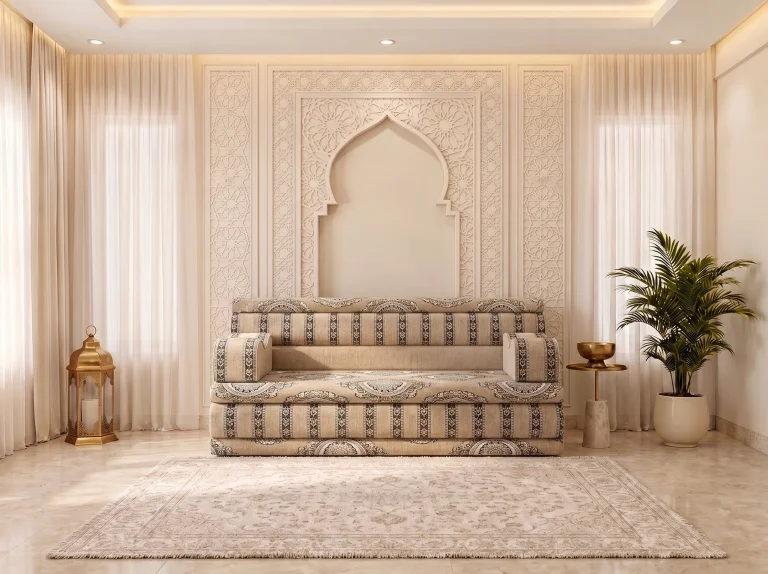
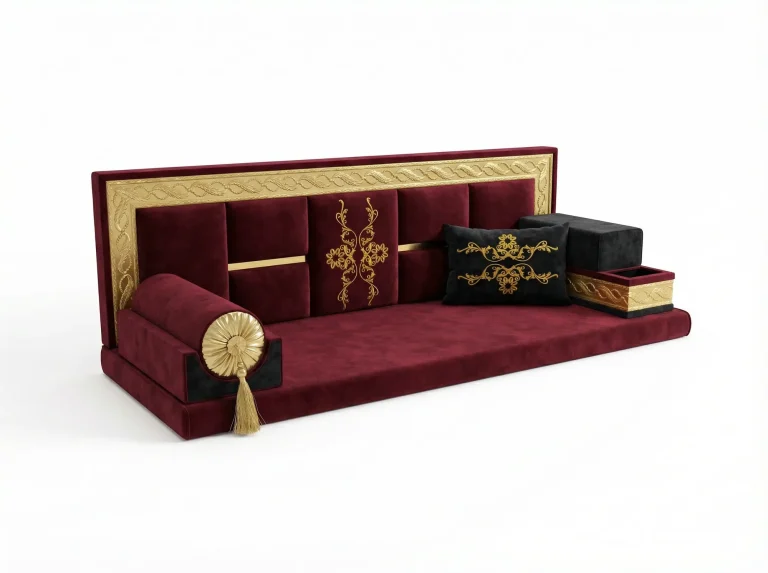
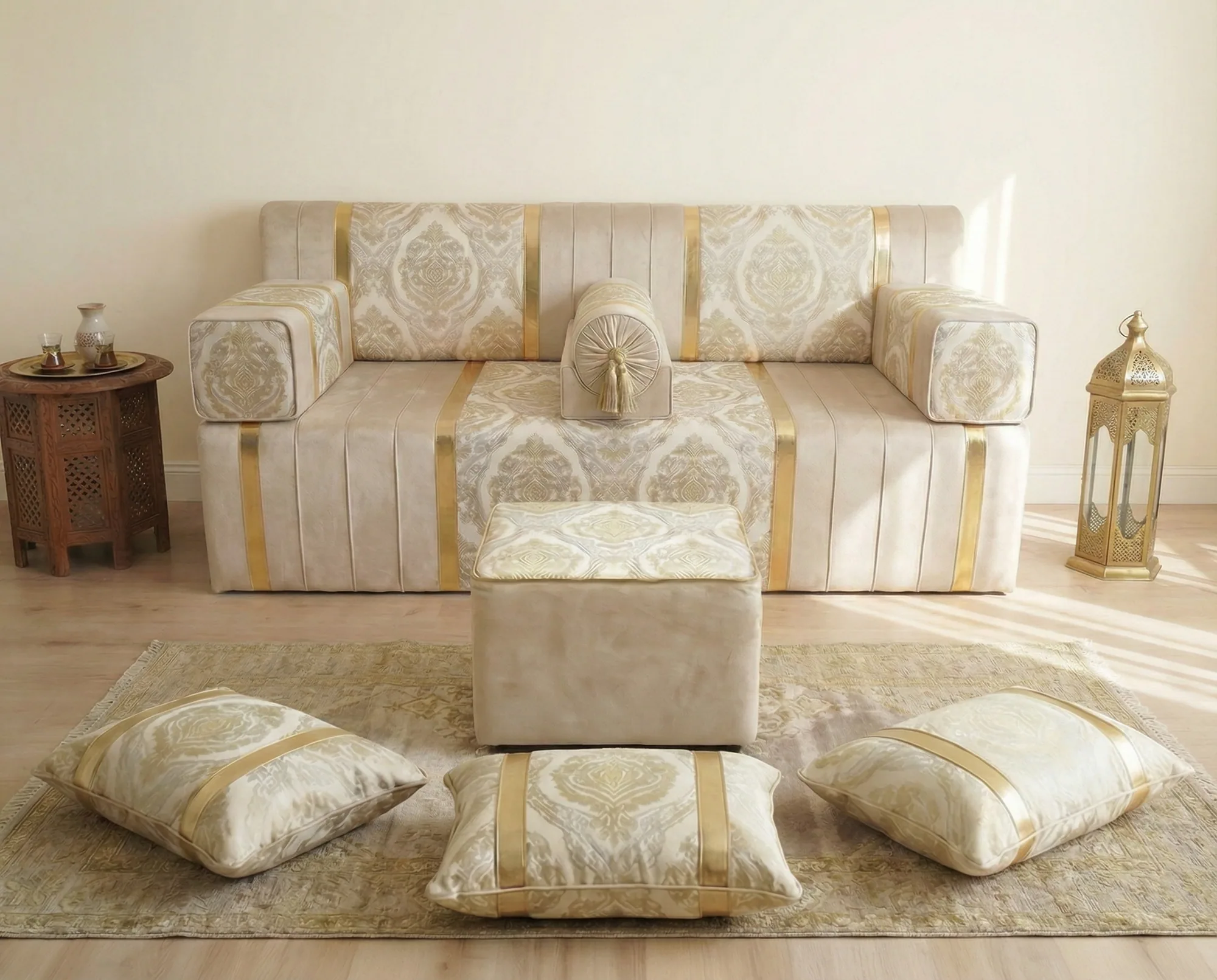
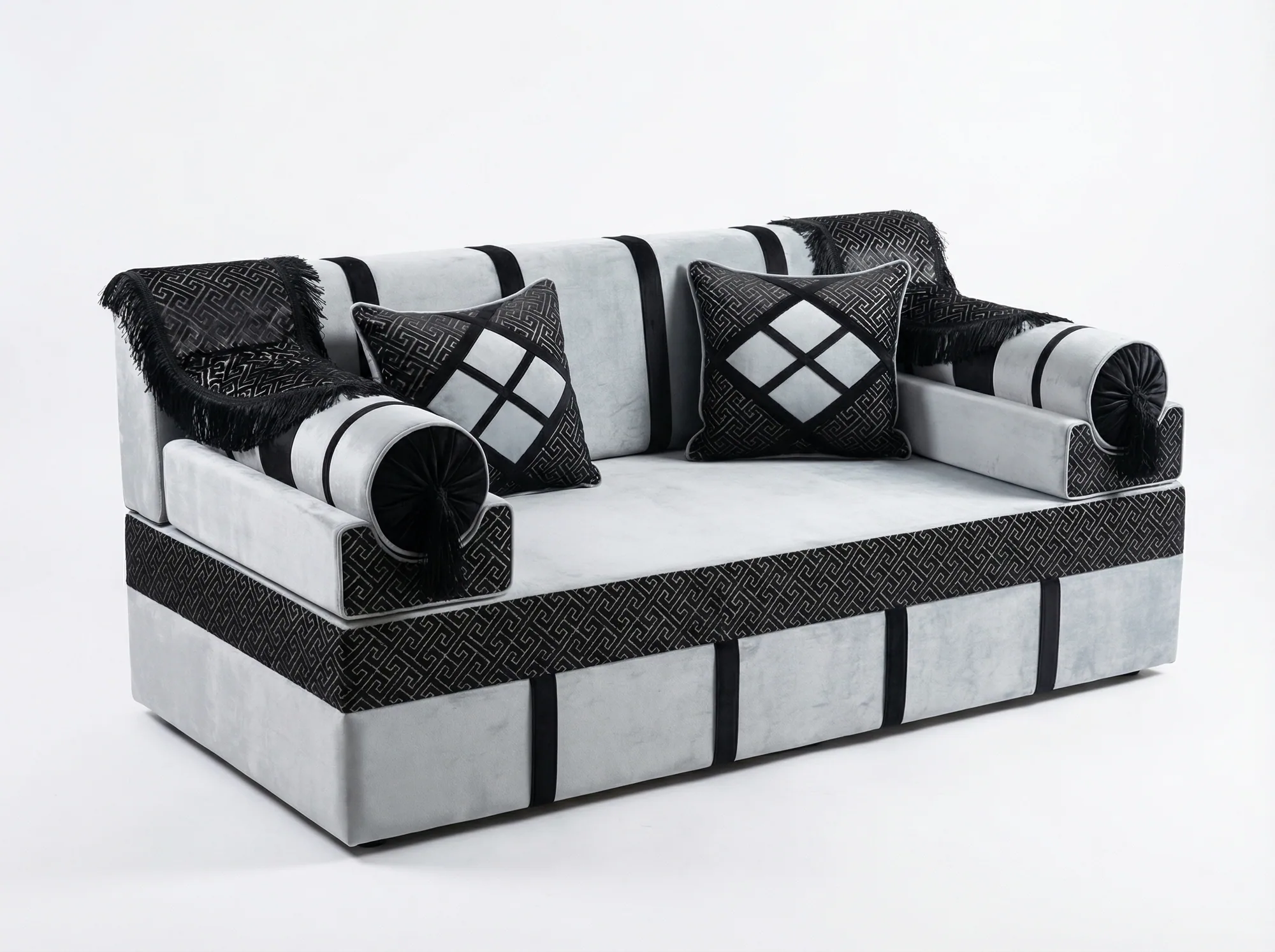
So the difference between a Moroccan and an Arabic sofa is structural. Sofhu makes two products of its own and names them separately. The Arabic floor sofa sits at floor level: a seat mattress with loose back cushions and armrest blocks, and no frame. The Arabic majlis is raised to sofa height on an upholstered base with tall fixed backs and arm bolsters, which brings it close to the Moroccan seat height. We also make wooden bench sets, described on the cedar Arabic majlis page. None of these is a carved Moroccan sedari, and we would not sell one as such. The Moroccan sedari page explains how close a made-to-measure raised set comes.
Which suits which room
Match the style to the shape of the room and to the people who will sit in it.
- Long, narrow room or a converted spare bedroom: the Yemeni approach. Seating on every wall uses the length, and armrests divide a long run into comfortable places.
- Large square reception room used on formal occasions: the Saudi approach. An even U with the main seat facing the door, plain or sadu-pattern fabric, and an open carpet.
- Room where the family also eats, or where elders prefer a chair-height seat: the Moroccan approach, or a raised majlis with a table in the centre.
- Small flat: a single row or an L in whichever fabric you like. At that size the tradition shows in the fabric more than in the layout.
Climate and floor matter too. A floor sofa on a cold tiled floor wants a good rug under it. A raised majlis keeps the seat well clear of the floor and is easier for stiff knees. The trade-offs are set out in floor seating vs a raised diwan.
Mixing elements respectfully
Mixing is normal. Homes everywhere take in new fabrics and shapes over time, and families abroad combine what they grew up with and what fits the flat they live in now. Two habits keep a mixed room from looking like a costume.
First, name things accurately. A floor sofa in a star fabric is a floor sofa with a Sofhu star design, not an antique Yemeni pattern. A raised majlis with a round table is Moroccan-inspired, not a sedari. Guests who know the real thing will respect the honesty.
Second, borrow function before decoration. Take the armrest for each sitter because your gatherings are long. Take the bench height because your father’s knees need it. Take the central table because you serve meals in the room. Decoration chosen for a reason tends to look right.
All three directions are available made to measure. Browse the wider Arabic majlis range, check the names used country by country, then send your wall lengths for a quote by measurement.