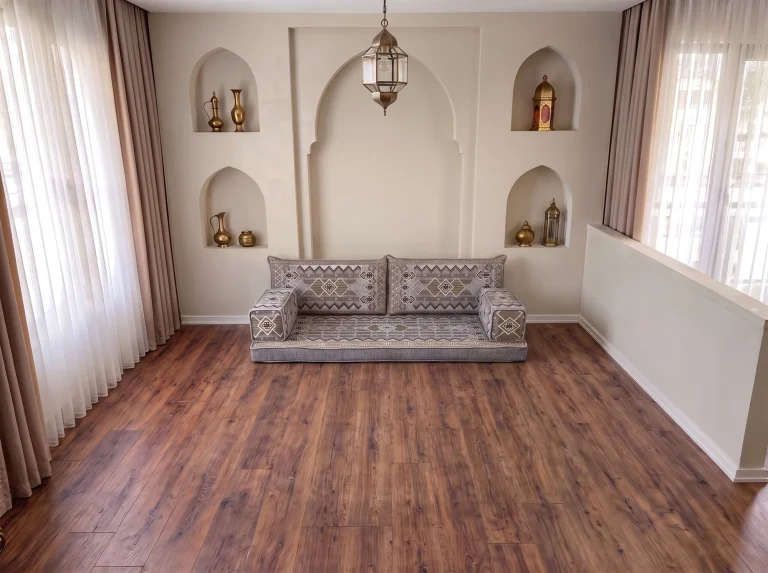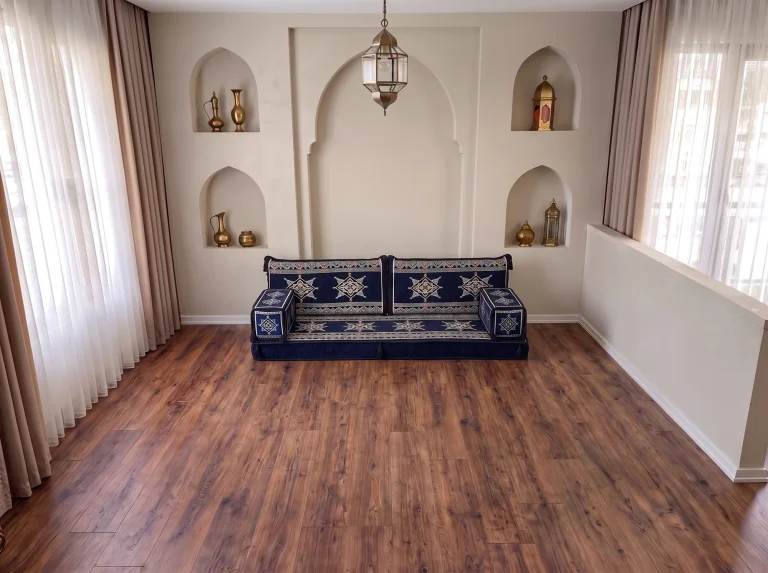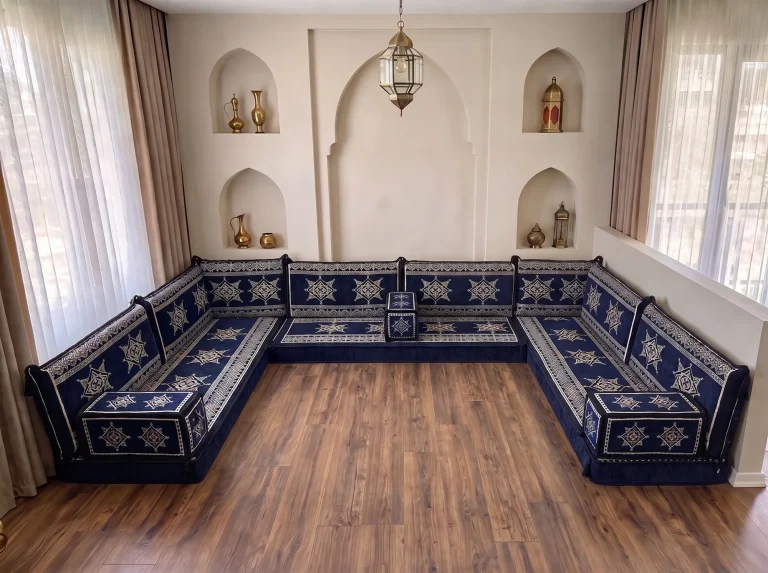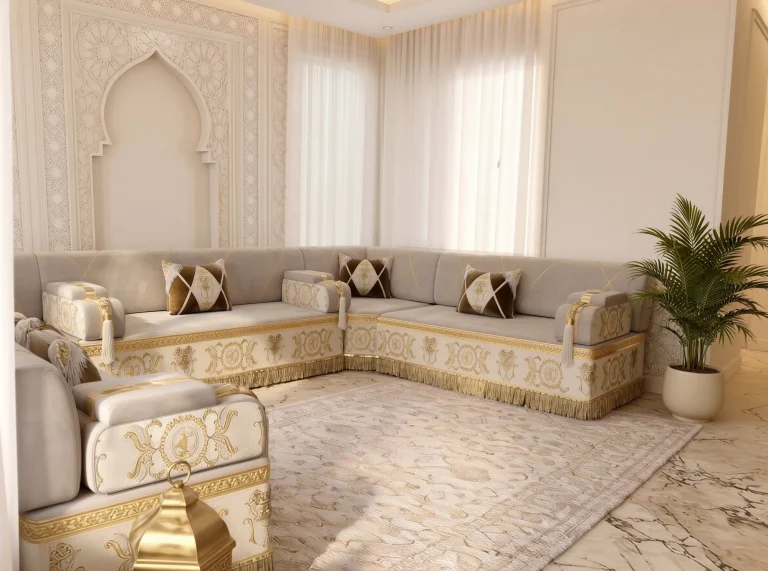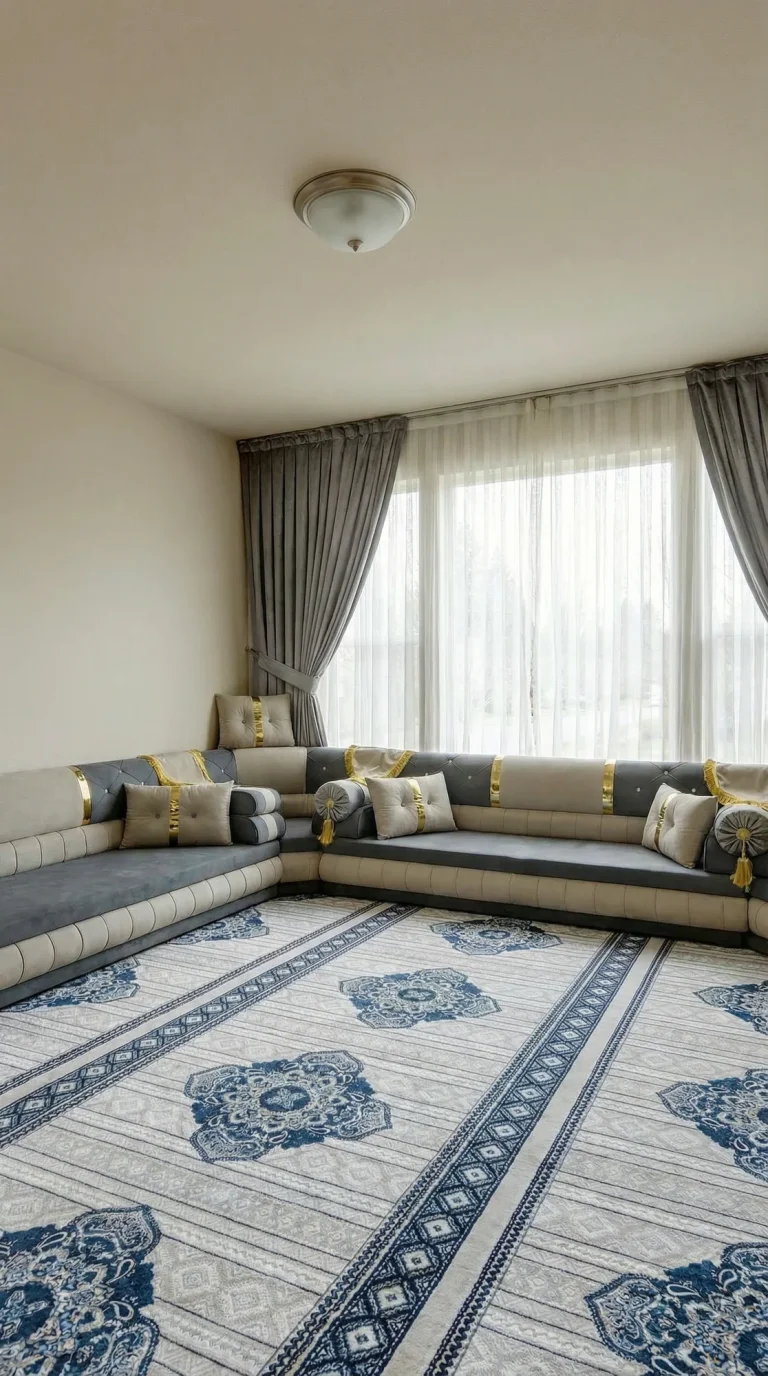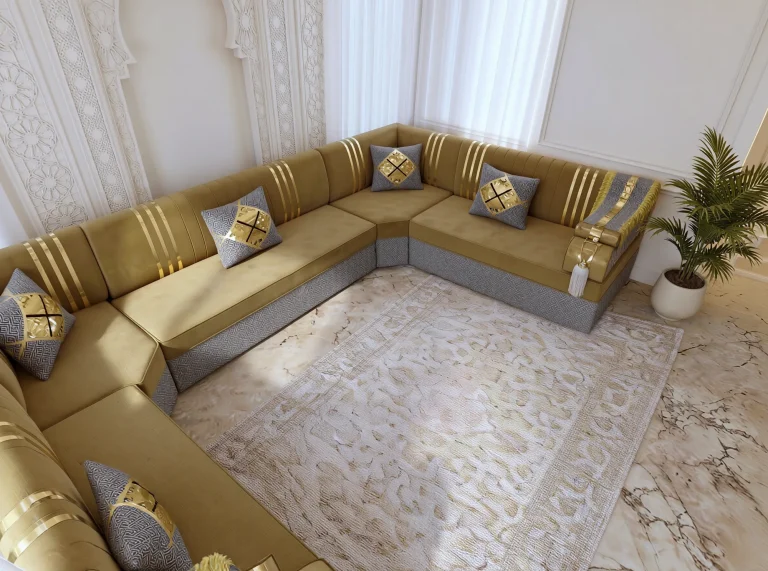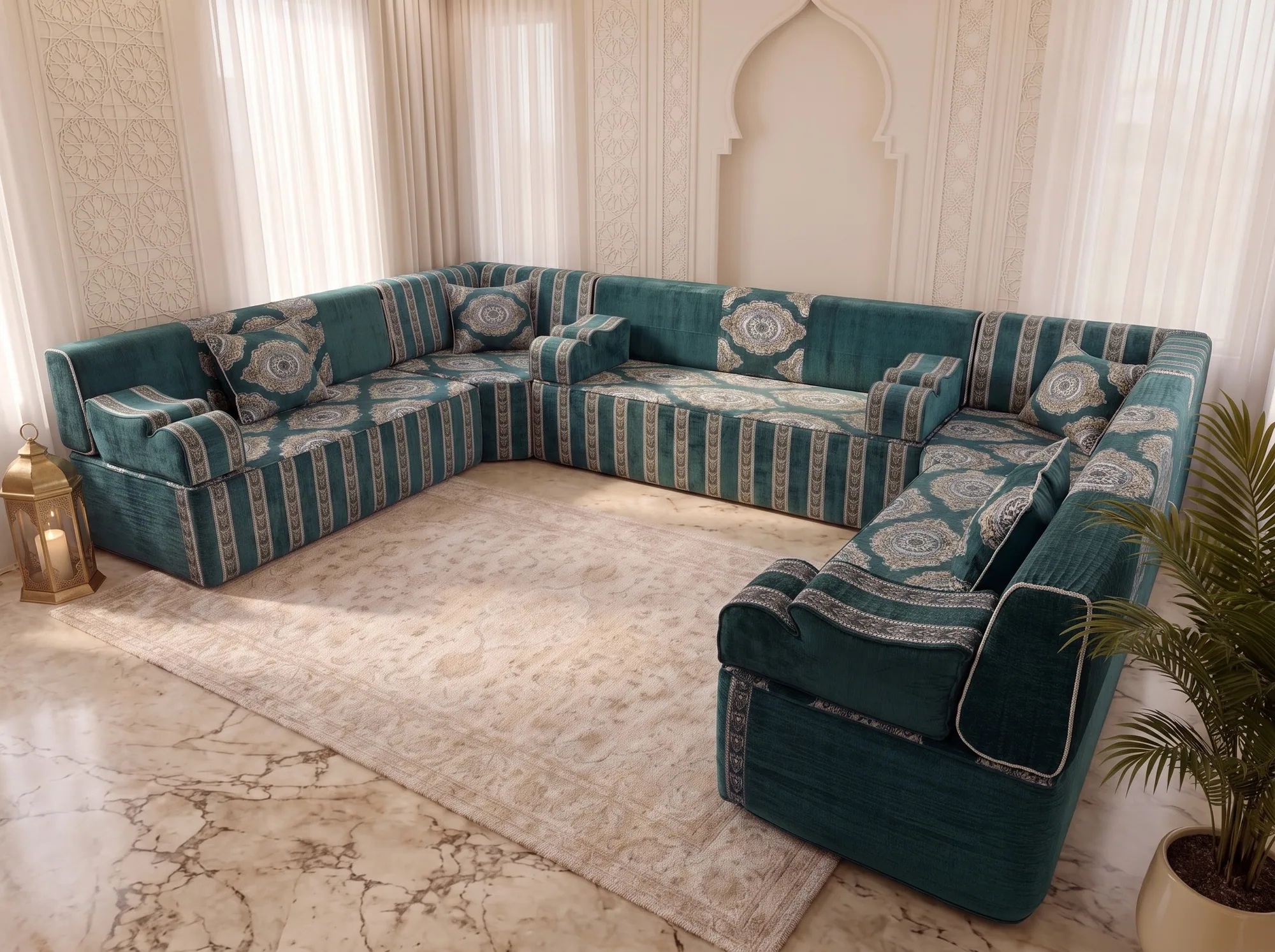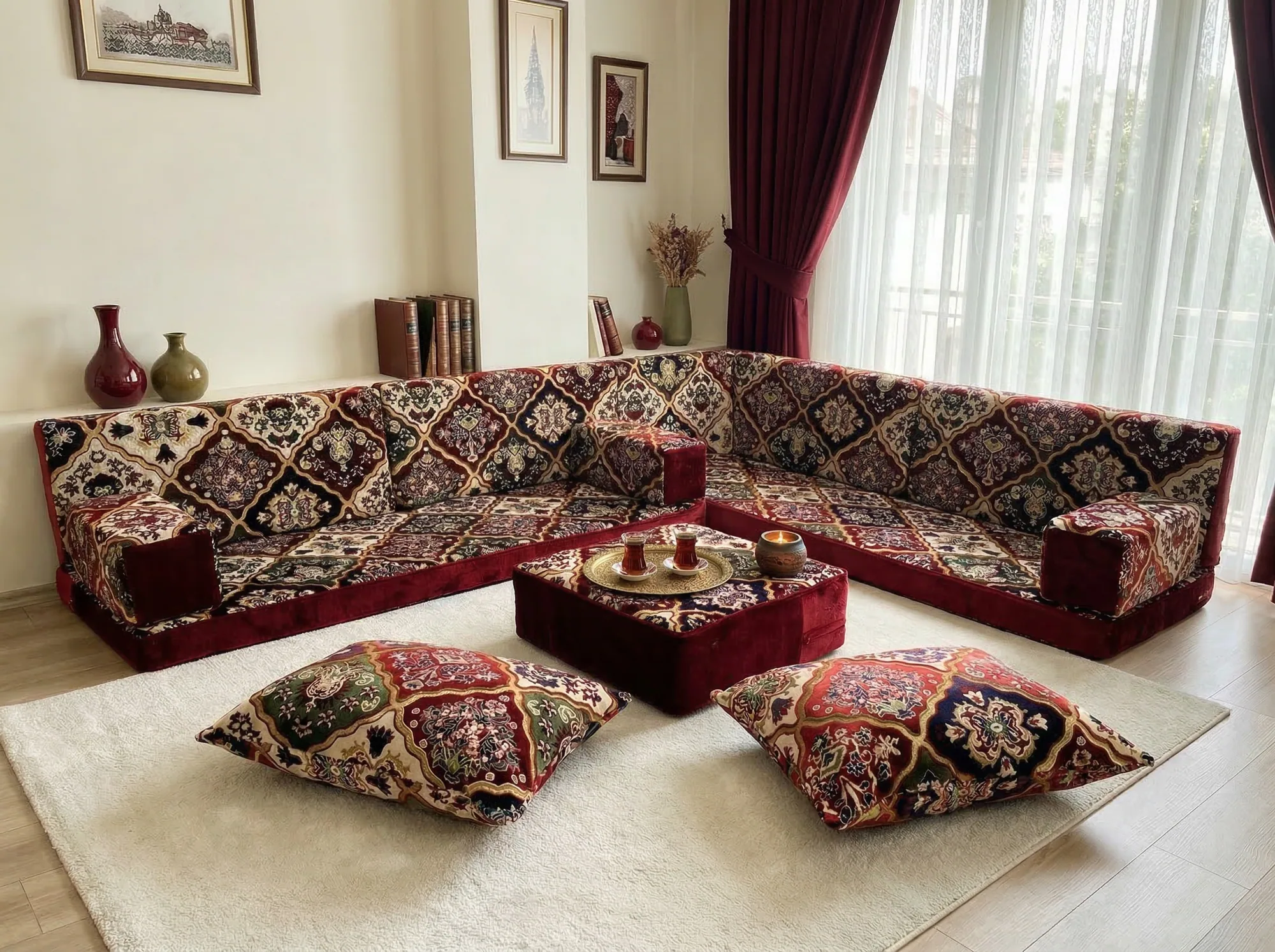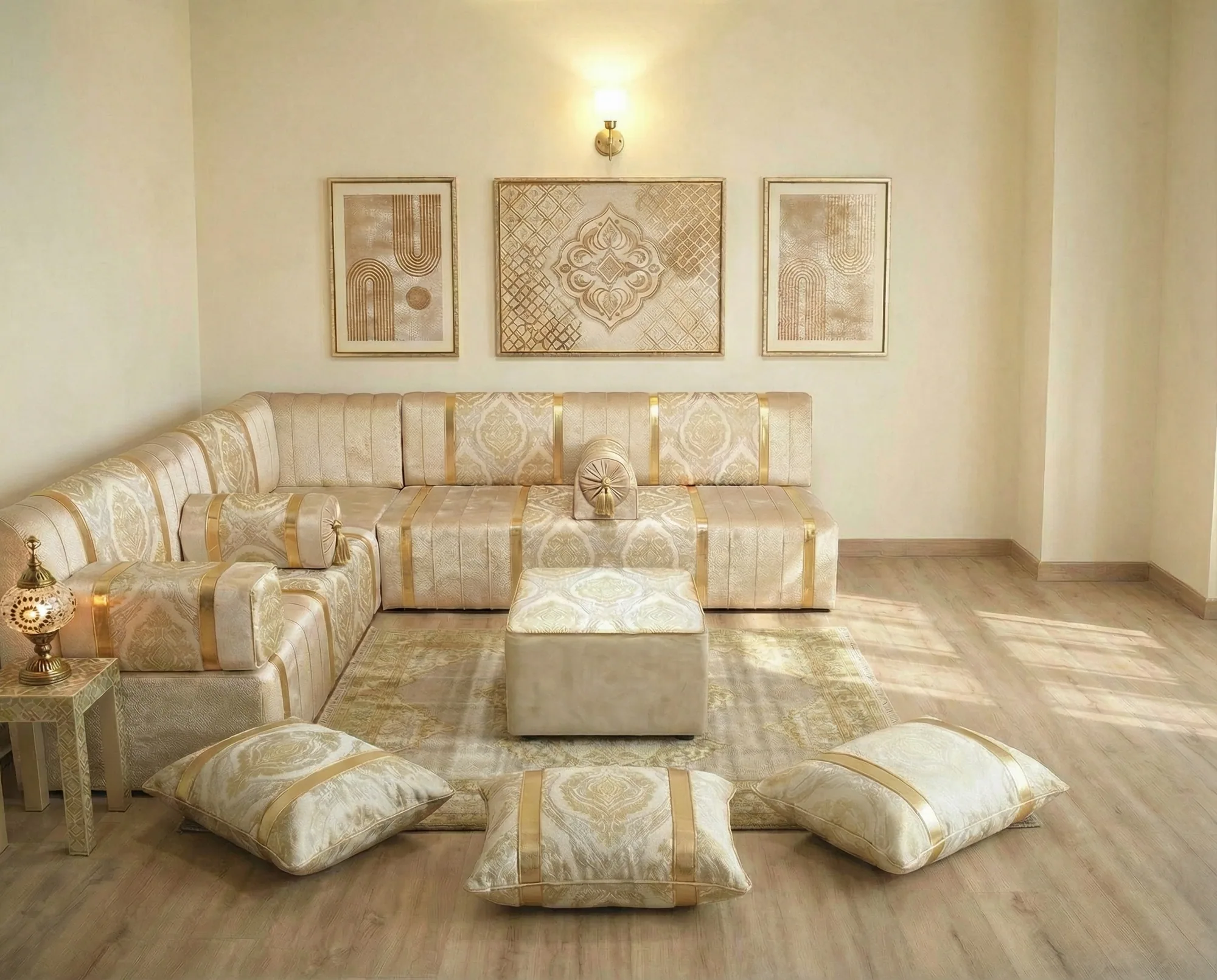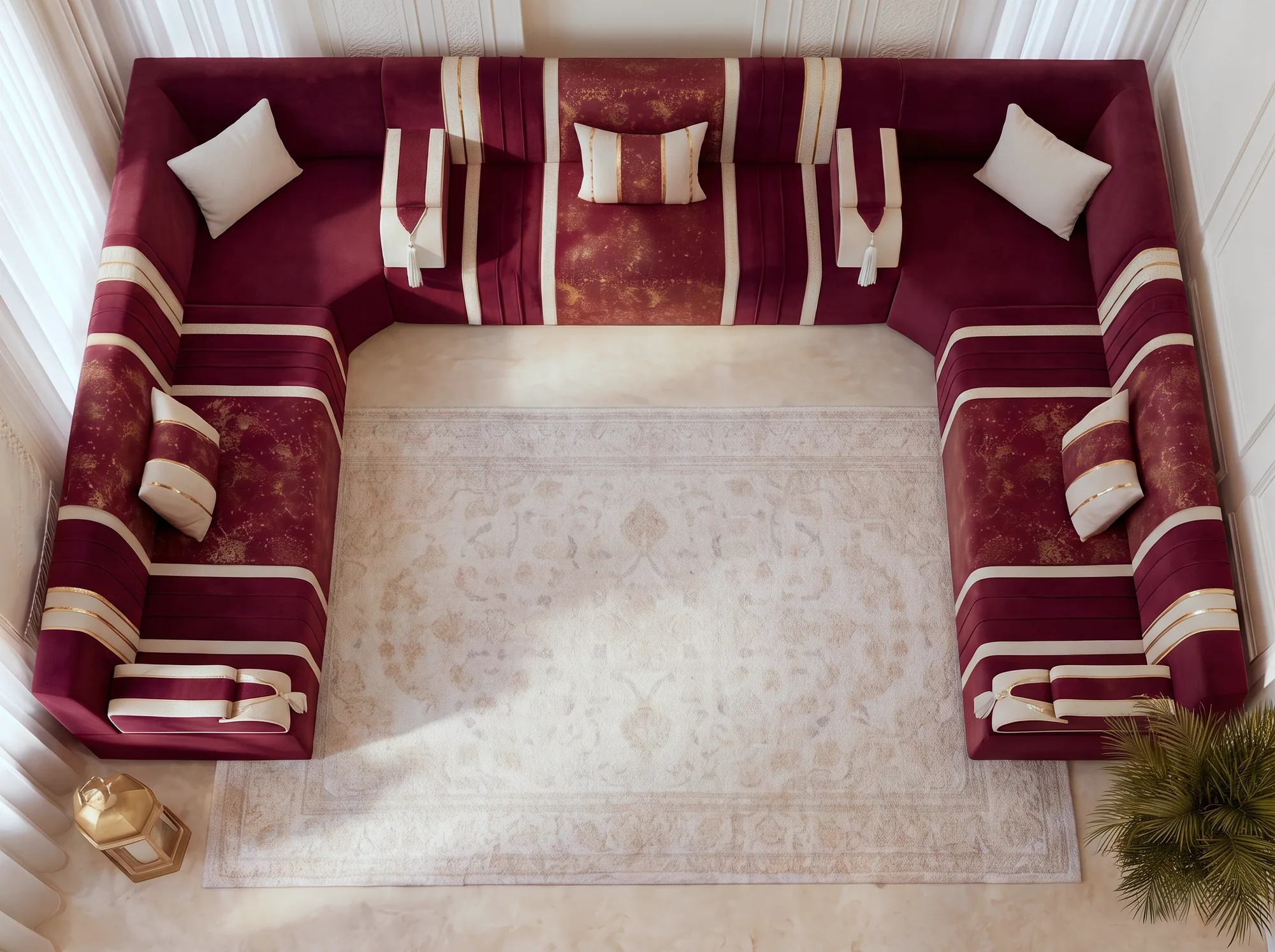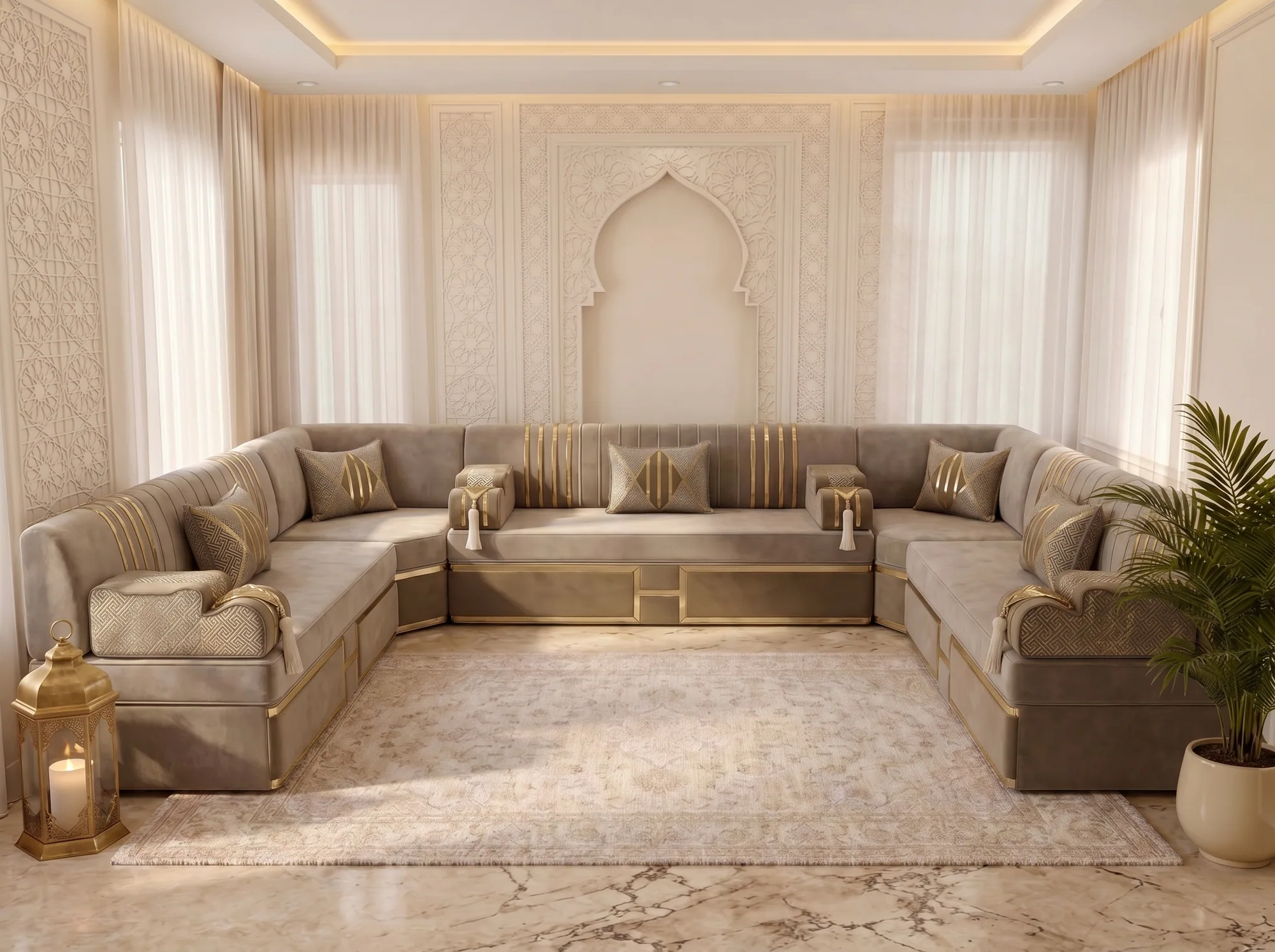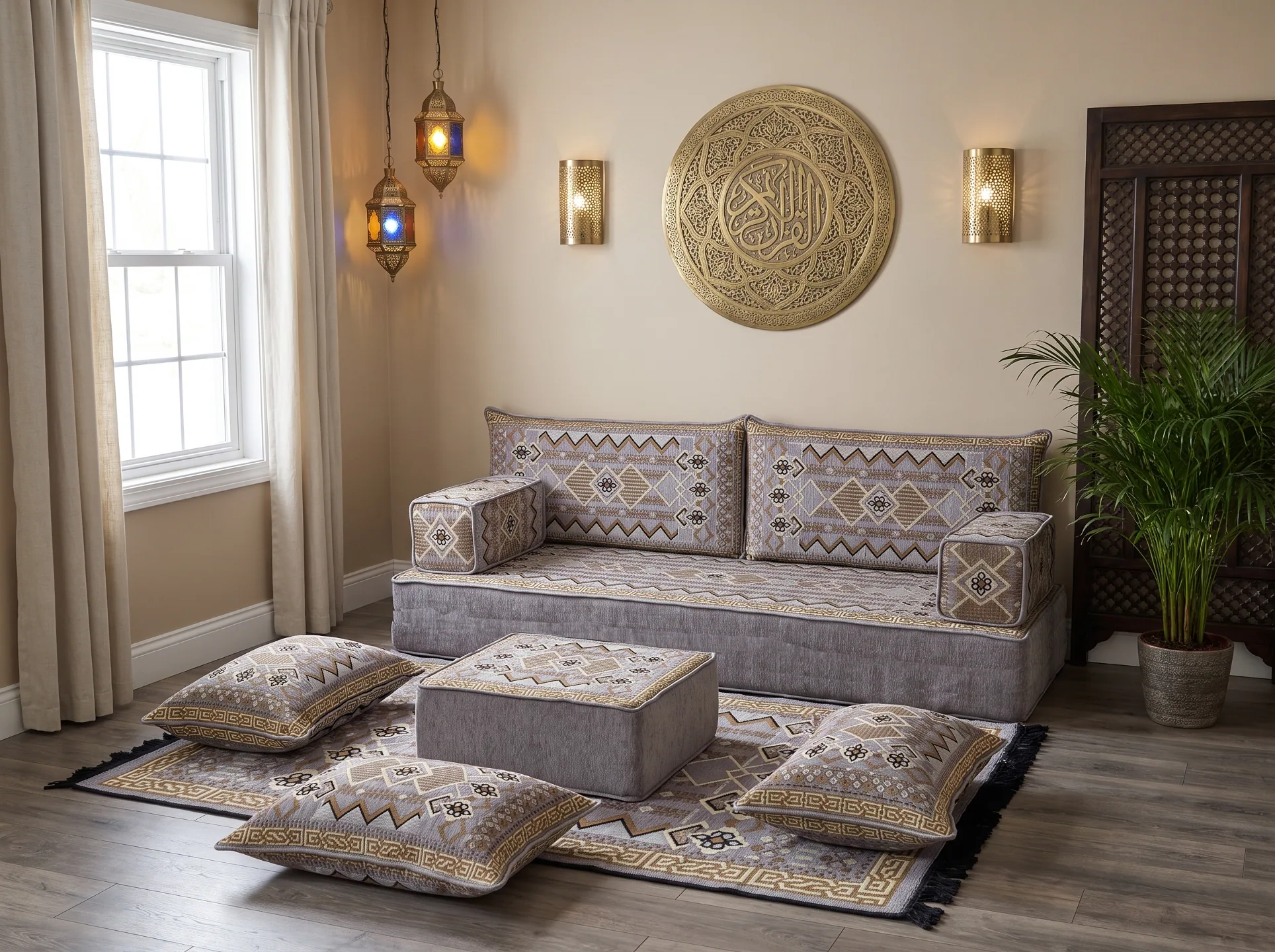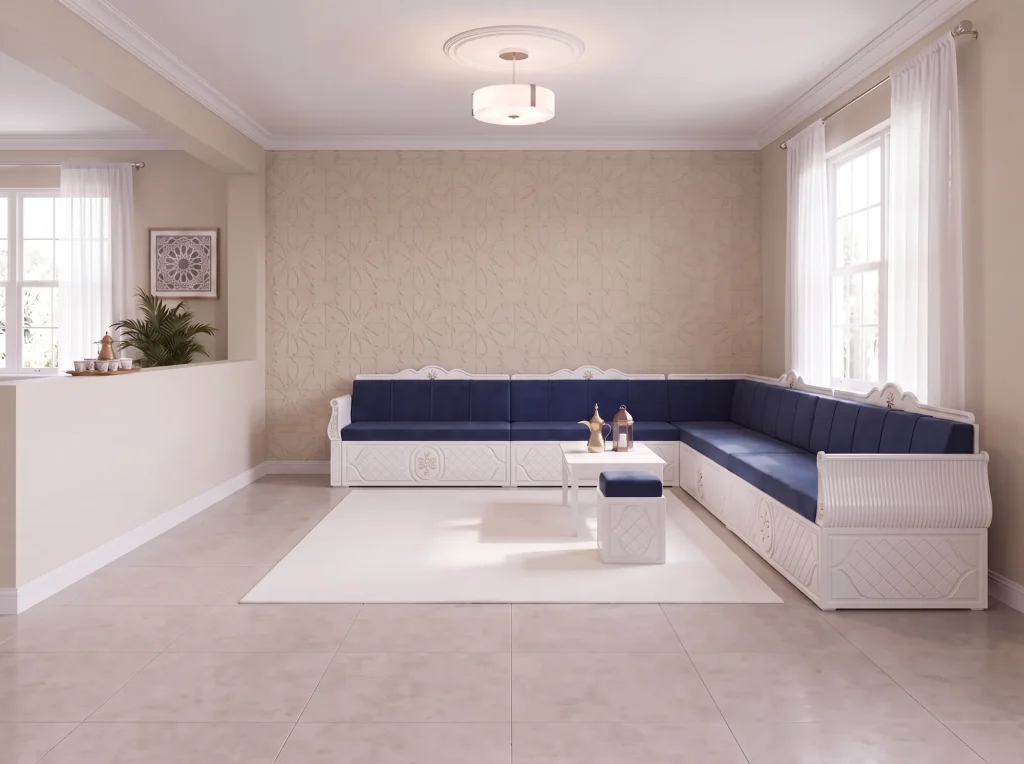
Sudanese seating is traditionally raised, not floor-level. Its best-documented piece is the angareb, a low rope-strung wooden bed that people sit on as well as sleep on, and the men's guest room is often called the diwan or salon. Sofhu makes raised Arabic majlis and wooden-base sets, and low floor sofas, in Türkiye to your wall measurements, with free worldwide shipping.
- Arabic
- صالون سوداني (salon sudani); ديوان (diwan); عنقريب (angareb)
- Traditional seat
- The angareb, a rope-strung wooden bed-bench
- Seat level
- Raised, at bed height, not on the floor
- Guest room
- The diwan or salon on the men's side of the house
- What Sofhu makes
- Raised majlis and wooden-base sets; low floor sofas
- Filling
- 32 kg/m³ (32 DNS) high-density foam, no springs
- Sizes
- Cut to your wall measurements
- Shipping
- Free worldwide from Türkiye
On this page
Anyone looking for a Sudanese majlis should know one thing before choosing a set: Sudan sits higher than the Gulf. The seat that Sudanese homes are known for is the angareb, a rope-strung wooden bed at bench height, and the room where men receive visitors is often called the diwan or the salon. A low floor sofa is an Arabian style that some families add by choice. This page explains what is documented about Sudanese seating, what is not, and how Sofhu can build either for your room: the Arabic majlis, raised to sofa height and fully upholstered with a solid base and fixed backs, or the Arabic floor sofa, a low set of seat mattresses and loose back cushions.
Sudanese majlis, salon or diwan: which word fits
The honest answer is that “Sudanese majlis” is mostly a search term, while salon (صالون, said “saloon”) and diwan (ديوان) are the words used for the guest room itself. Majlis is understood everywhere Arabic is spoken, so nobody will misunderstand you. But if you are describing the room to an older relative, salon or diwan is more likely to be the word they use.
Studies of Sudanese homes describe a house in two domains: a family and women’s side, and a men’s and visitors’ side. The diwan belongs to the second, often toward the front of the house, and each side can have its own courtyard (hosh). A comparison of detached houses in Khartoum found separate entrances and separate sitting rooms for men and women. So the Sudanese salon answers the same need as a Gulf majlis, a place to receive guests without disturbing the family, even though the furniture inside it is different.
The angareb: a bed that is also the seat
The angareb (عنقريب) is the most common bed in Sudan and the piece that defines Sudanese seating. It is a low wooden frame strung with woven rope or palm fibre, light enough for one person to carry, and used with or without a mattress on top. Its form has been traced back to the Bronze Age Kerma culture.
Because it is so easy to move, the angareb is not treated as fixed furniture. It goes where the people go: into the shade during the day, out into the yard in the evening when the air cools. People sit on it as readily as they sleep on it. It also has a place at weddings and at funerals, and offering a guest a bed is a common gesture of hospitality. A smaller relative, the banbar, is a low square stool made the same way.
What we could not confirm from any published source is the often-repeated picture of a diwan lined wall to wall with angarebs. It may well be accurate in many homes. We leave it out as a general claim because we could not find it documented.
Where floor-level Arabic seating comes in
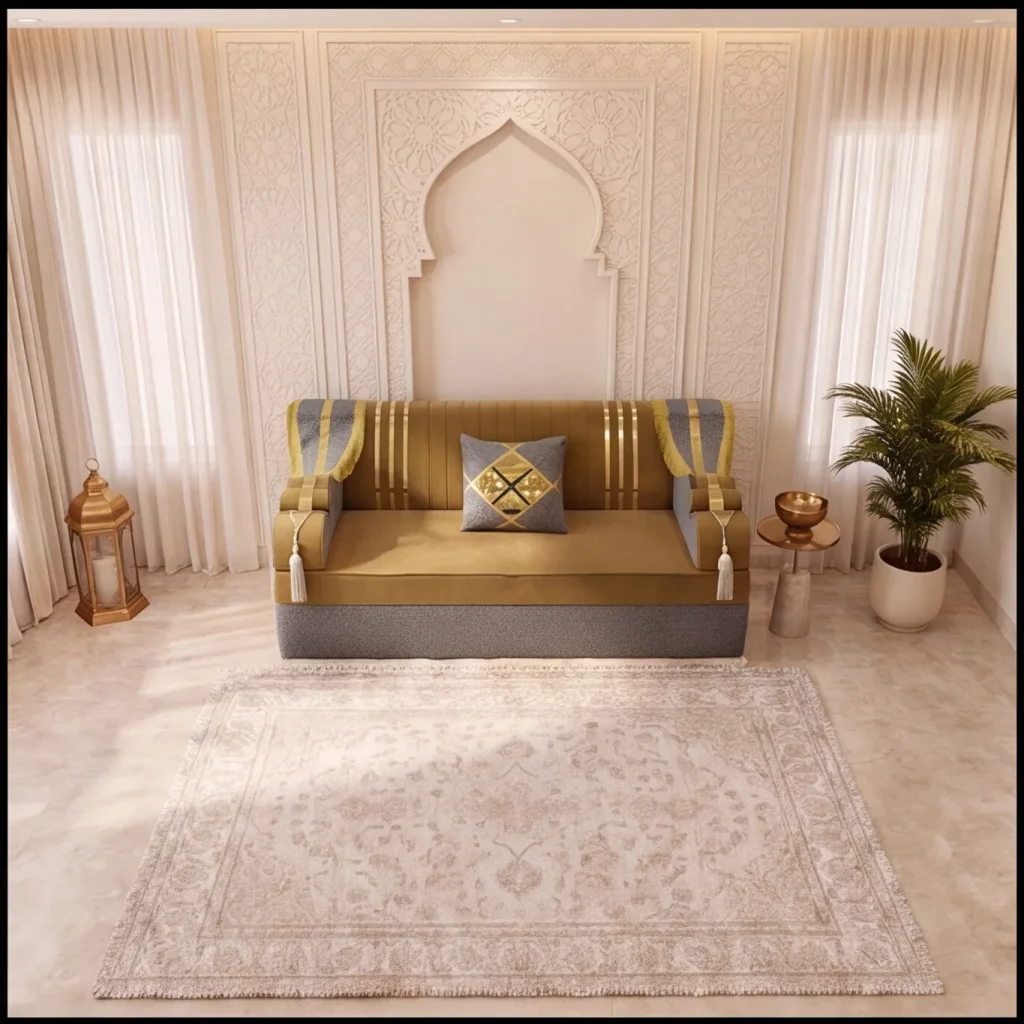
A floor sofa in a Sudanese home is a borrowed style, and a comfortable one. Low Arabic floor seating belongs to the Arabian Peninsula. We found no source describing it as a Sudanese tradition, so we do not sell it as one. What it offers is practical: it seats many people along the walls, it leaves the middle of the room open for a tray or a meal, and children can climb on and off it easily.
Families who want that feel can put it in the family sitting room and keep a higher seat in the formal salon, or do the reverse. There is no rule to break here, only a room to plan.
Raised or floor-level: choosing for a Sudanese salon
Start from who will sit there most. A raised seat is closer to the Sudanese habit and easier for older guests. A floor seat holds more people and suits long, informal evenings.
| Raised majlis or wooden-base set | Arabic floor sofa | |
|---|---|---|
| Closest to | The height of an angareb or bench | Arabian floor seating |
| Best for | Formal diwan, elderly guests | Family room, large gatherings |
| Base | Upholstered base or wooden bench frame | Seat mattress on the floor |
| Needs a wall | Ask when you request a quote | Yes, back cushions lean on the wall |
Sofhu’s wooden bench sets appear on the site under the name cedar Arabic majlis sets. “Cedar” there is the site’s rendering of the Turkish word sedir, a wooden divan, and does not describe the timber. The comparison of floor seating and a raised diwan goes through comfort and space in more detail, and there is separate advice on hosting elderly guests in a majlis by mixing seat heights in one room.
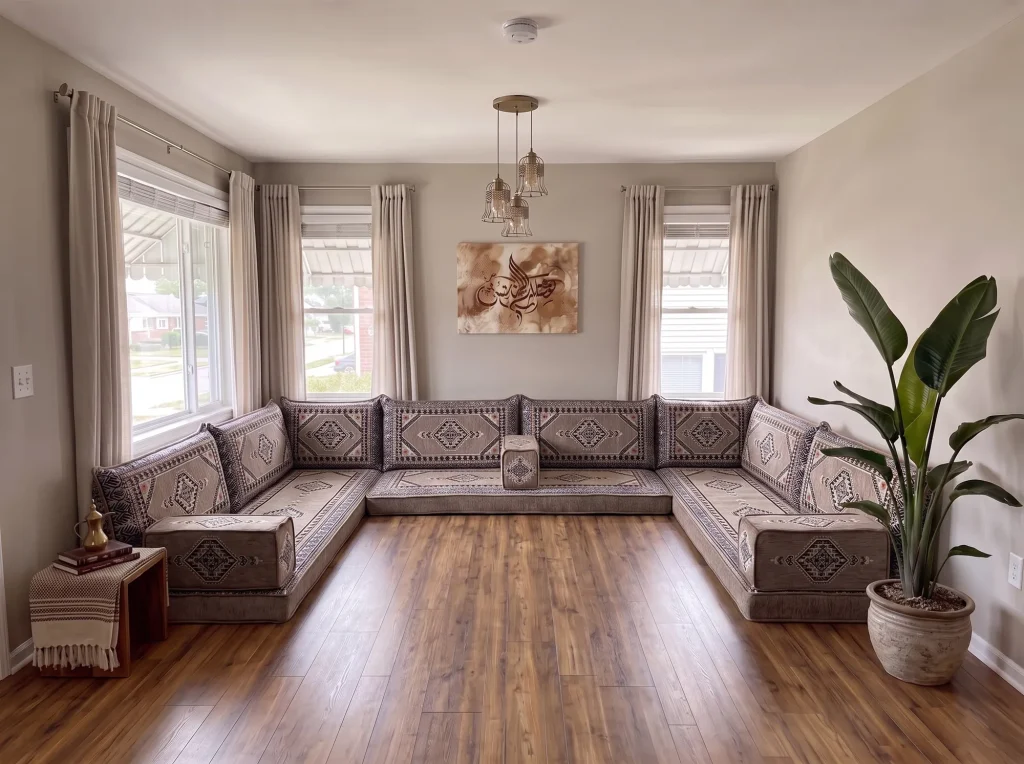
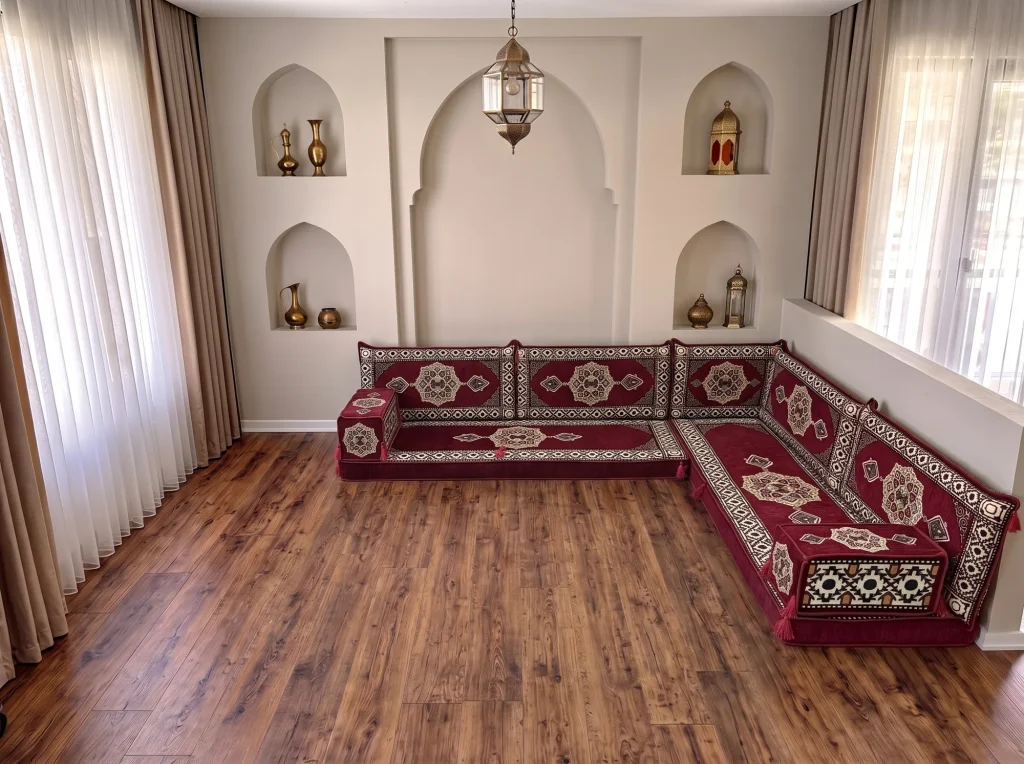
Layout follows the walls. A single run suits a narrow salon. An L-shape frees a window wall or a doorway. A U-shape uses three walls and is the natural choice for a dedicated guest room. Floor sets are not freestanding, so every run needs a wall or another solid surface behind it.
What goes inside the cushions
The filling decides how the seat feels after years of guests, more than the fabric does. Sofhu cushions are filled with 32 kg/m³ foam, written 32 DNS in the Turkish trade, which means one cubic metre of it weighs about 32 kg. There are no springs inside.
Density is the amount of material in the cushion, not its hardness. The Polyurethane Foam Association notes that denser foam generally keeps its original properties better, which is why a 32-density cushion holds its height and support longer than budget foam that feels firm only when new. On custom orders you can ask for a softer or a firmer feel, and for a thicker or thinner seat.
Fabric for a hot, dusty climate
For Sudan, and for Sudanese families in the Gulf, choose a fabric you can wash often. Sofhu’s linens are described as absorbent with a porous weave that feels fresh in hot weather, and the linen floor sofa page shows how they look made up. Flat woven fabrics resist wrinkling. Velvet gives the richest colour, at the cost of a warmer seat. The full fabric list names each series.
All covers are zippered and come off. The site states they can be machine washed at 30 degrees, which matters in a room where dust settles daily and tea is served constantly.
Measuring and ordering from Sudan or abroad
Every Sofhu set is made to the room, so the order starts with your walls, not with a catalogue size. Send the length of each wall that will carry seating, the position of doors, windows and sockets, and a photo of the room. Say whether you want a raised majlis, a wooden-base set or a floor sofa, and which side is the men’s diwan if you are furnishing both.
Sofhu is the manufacturer. Sets are made in Türkiye, vacuum packed, and shipped free worldwide, whether the address is in Khartoum, Riyadh, Northern Virginia, Nashville or Iowa, where Sudanese communities have settled in the United States. There are no local shops to visit: the set is built to order and delivered to your door. Duties or taxes may apply depending on the destination, so ask before ordering.
For the wider picture, read the guide to the Arabic majlis and the overview of Arabic sofa sets. Neighbouring traditions are covered under Egyptian Arabic seating, the Libyan marbouaa and the Saudi majlis, and the floor seating names by country guide sorts out salon, diwan and majlis. When you have your measurements, get a quote by measurement or send them by WhatsApp.