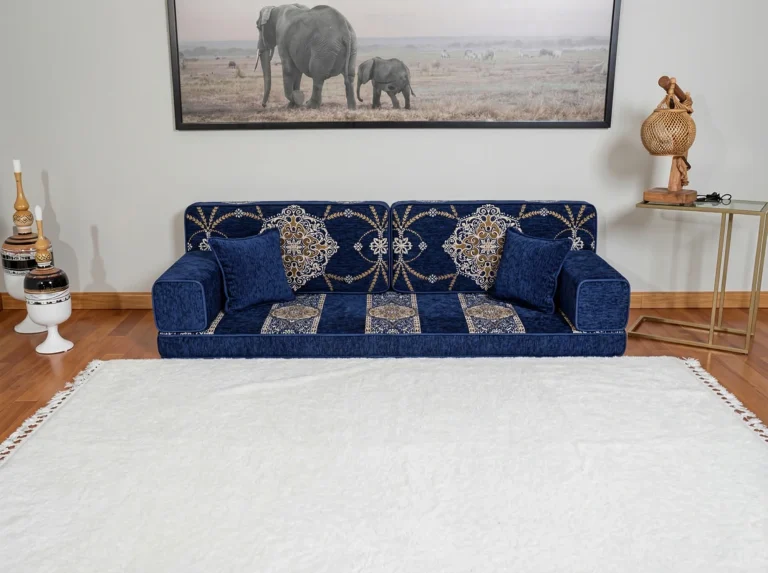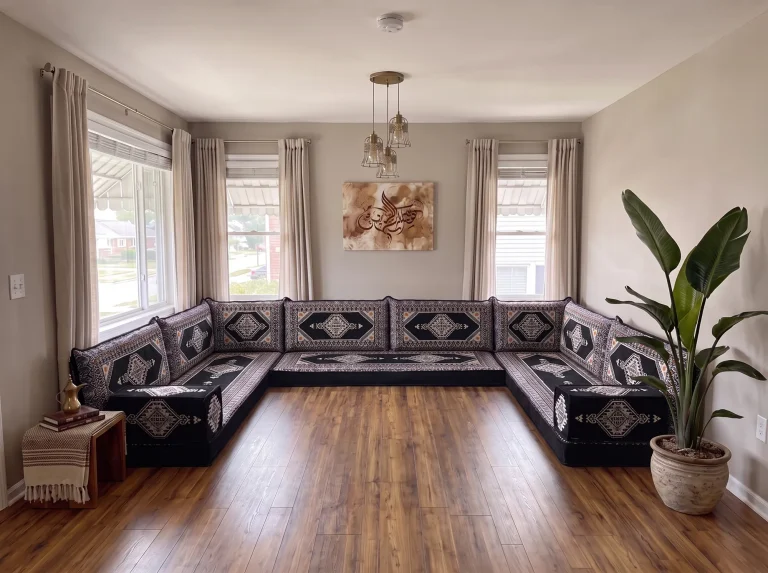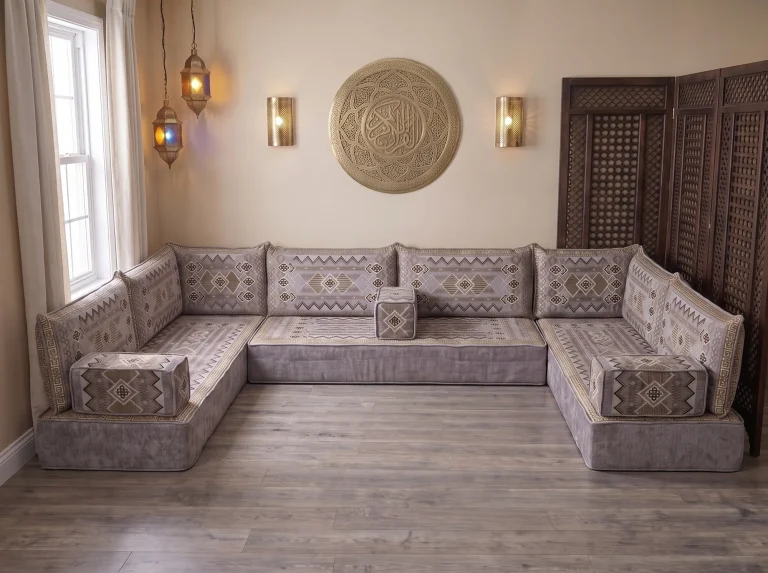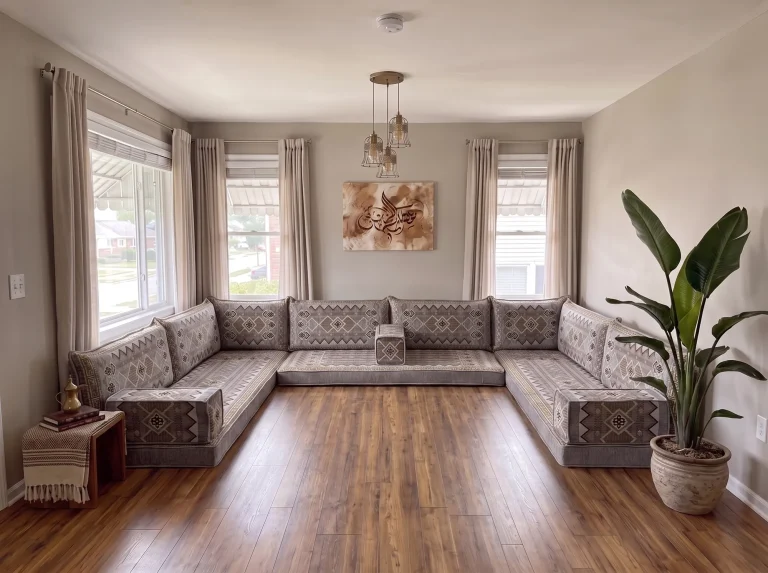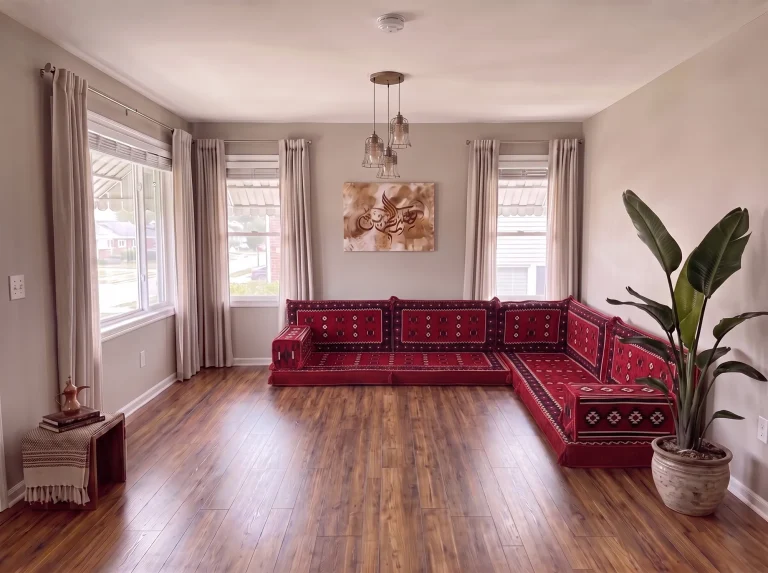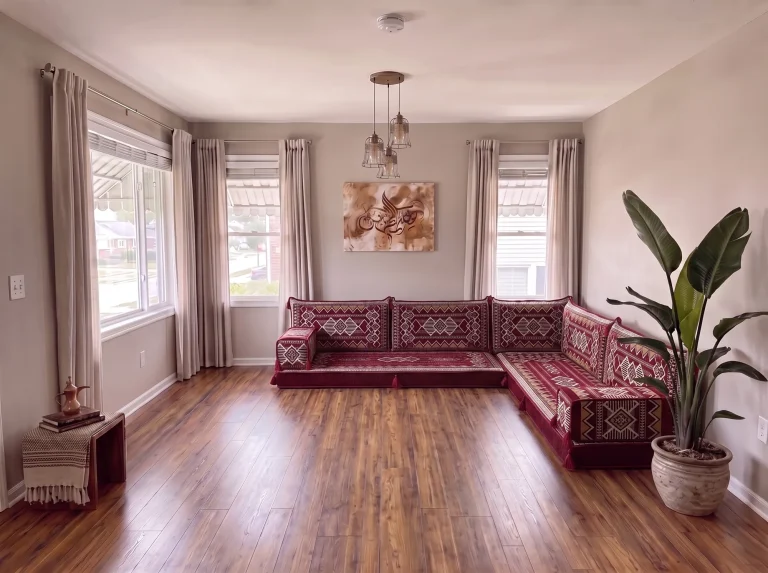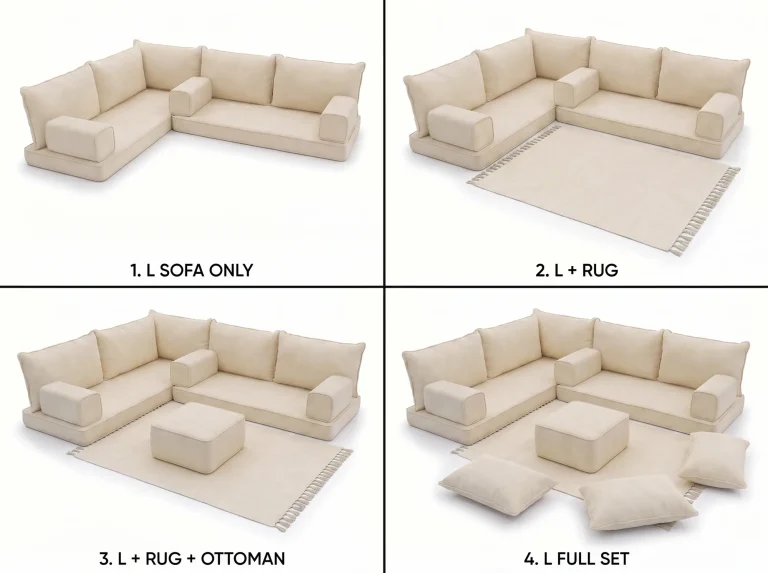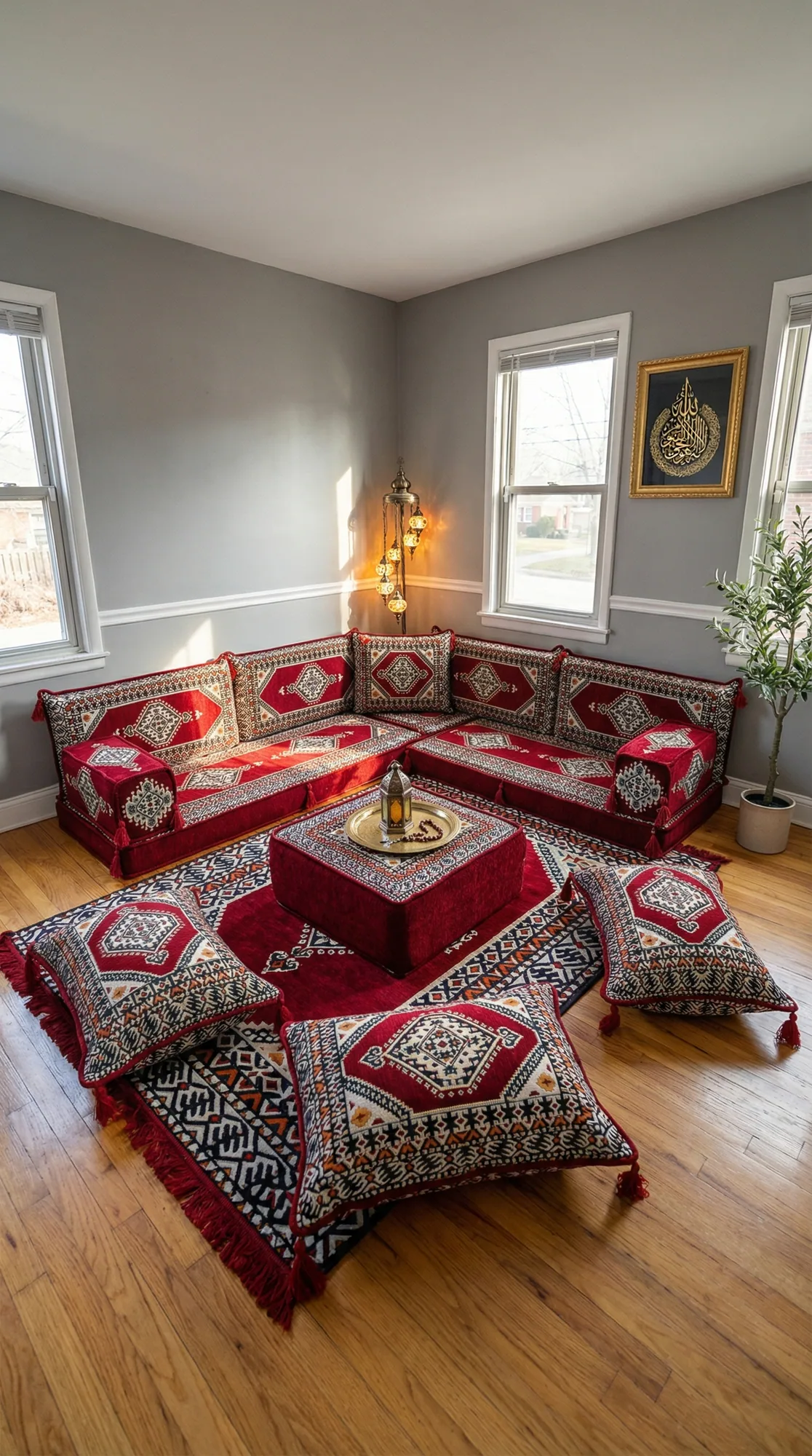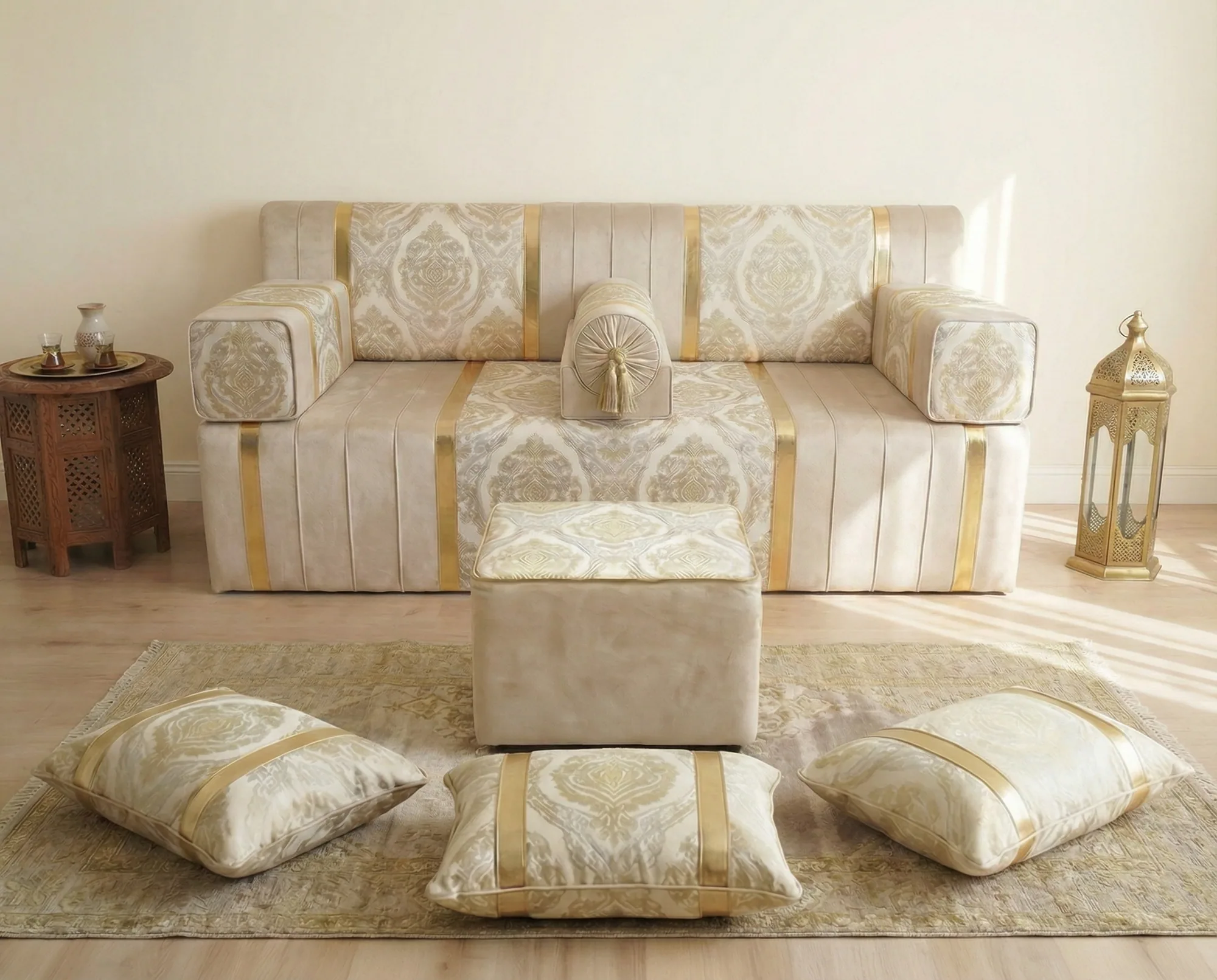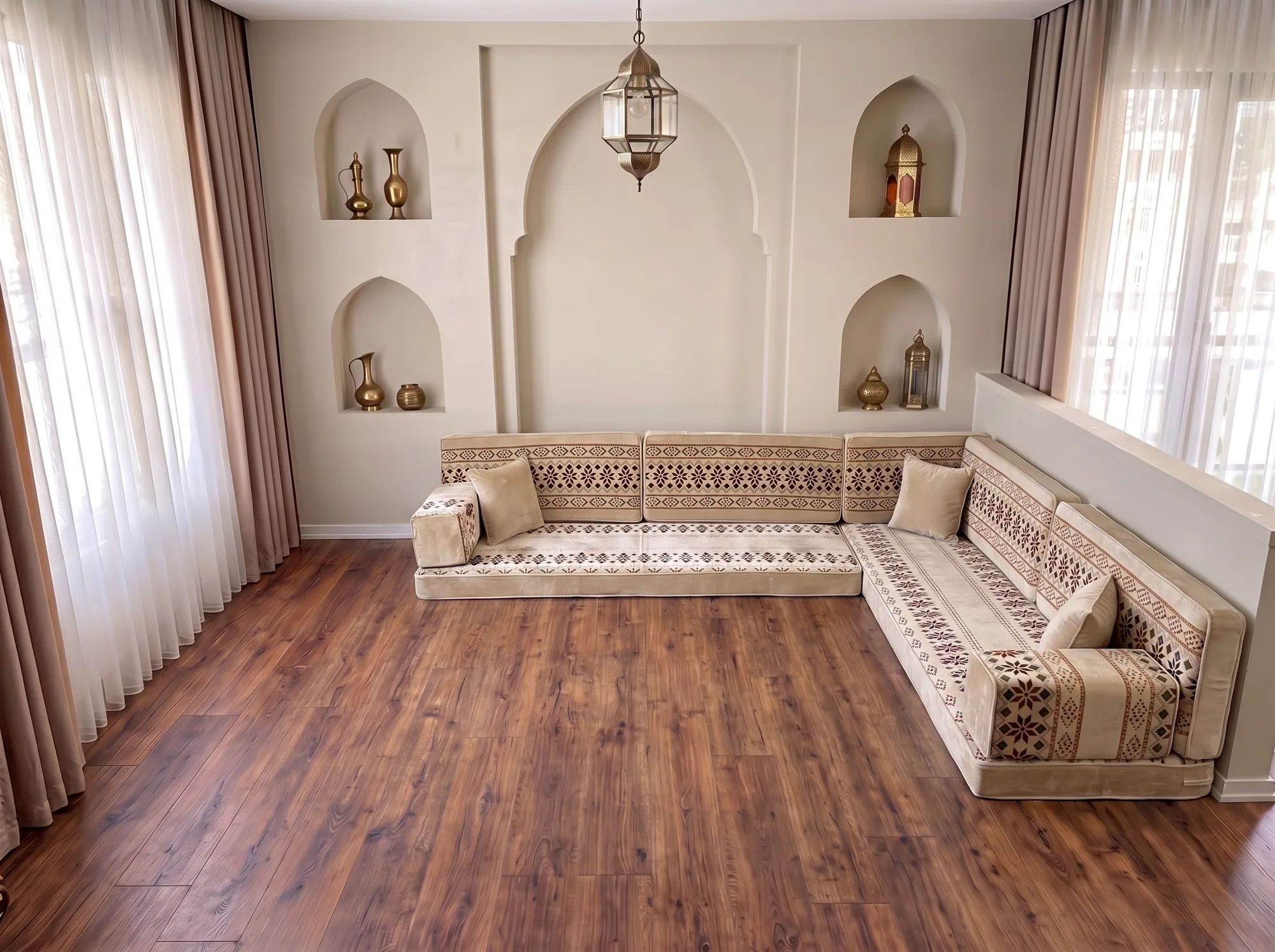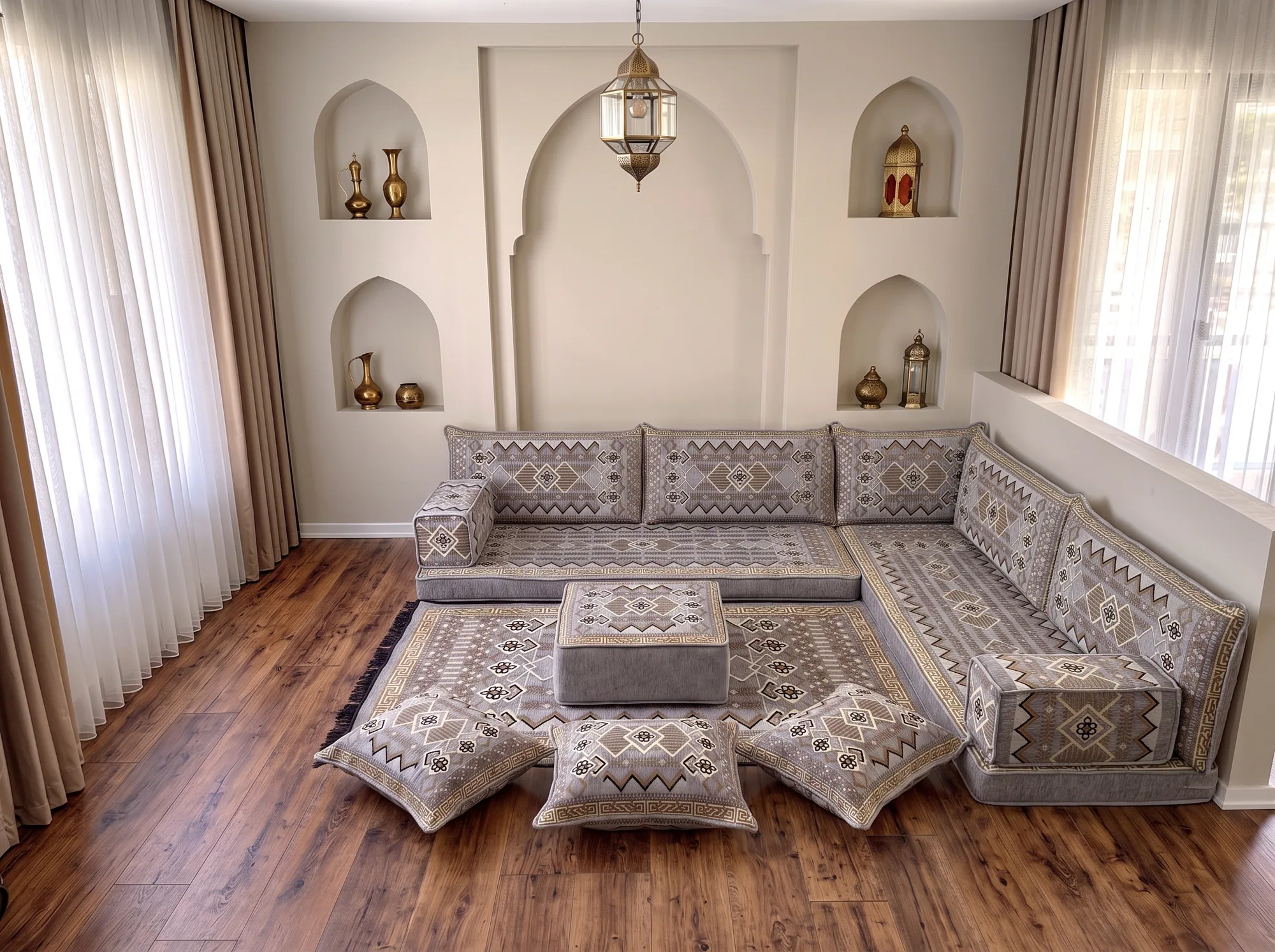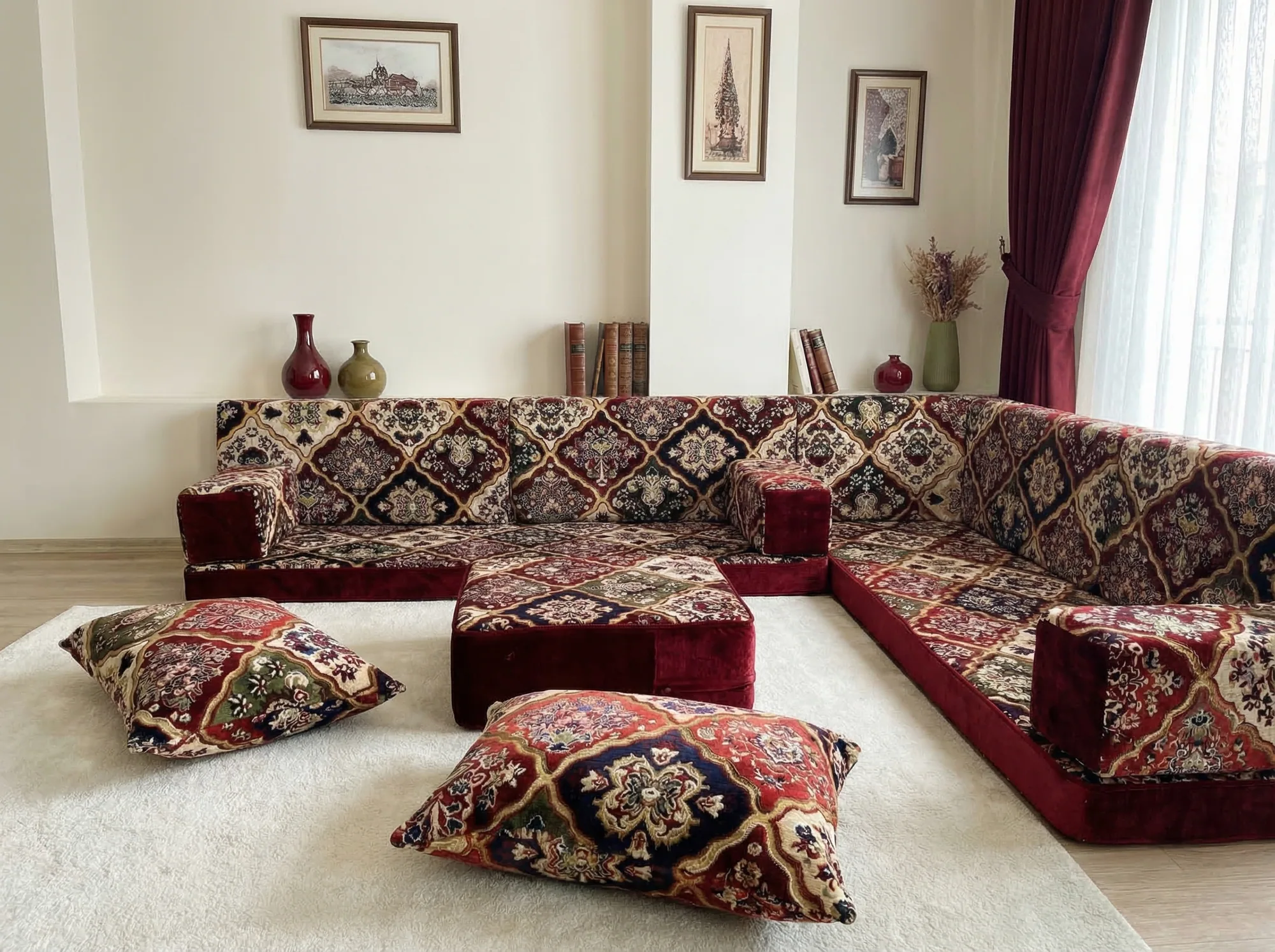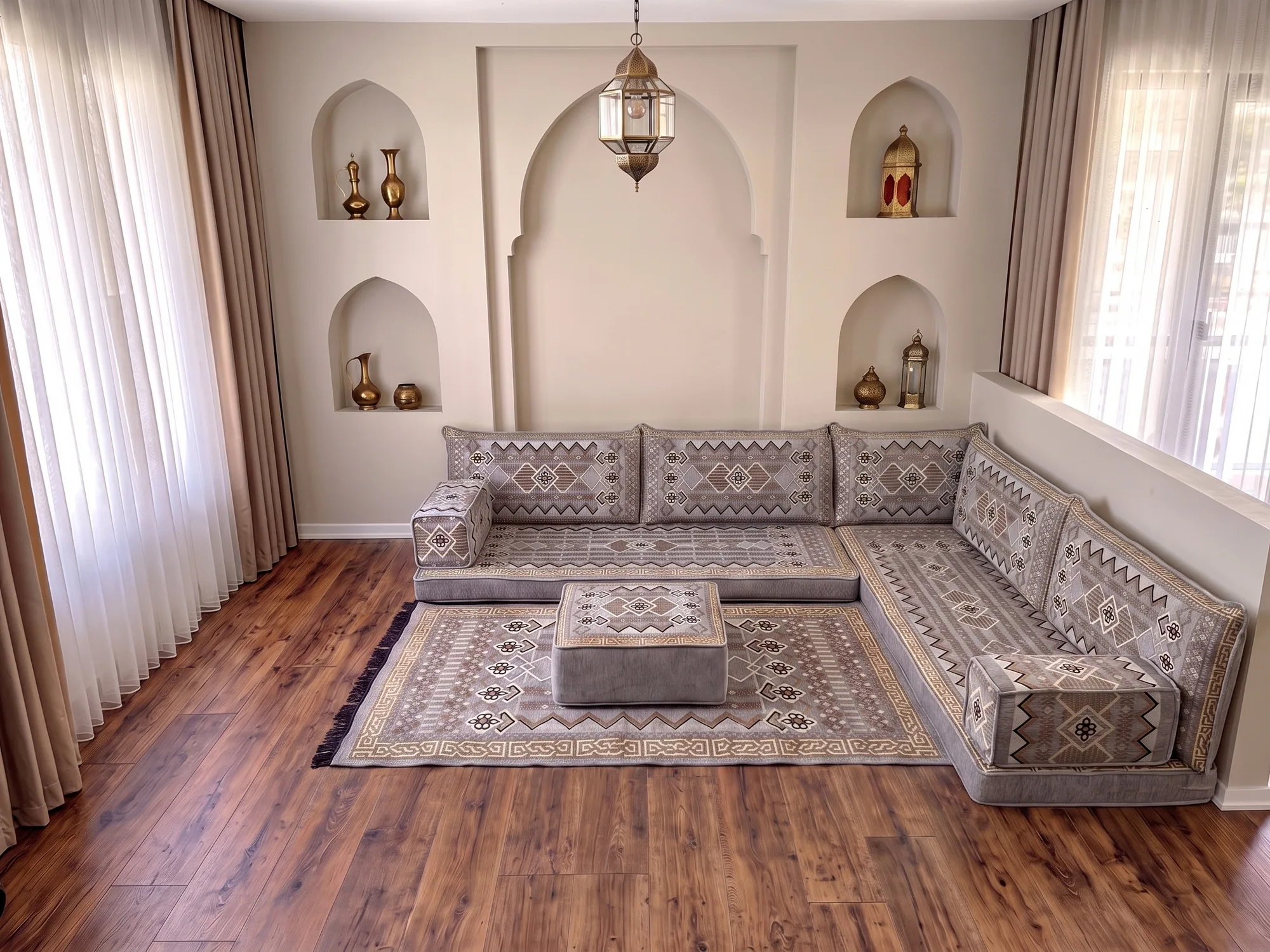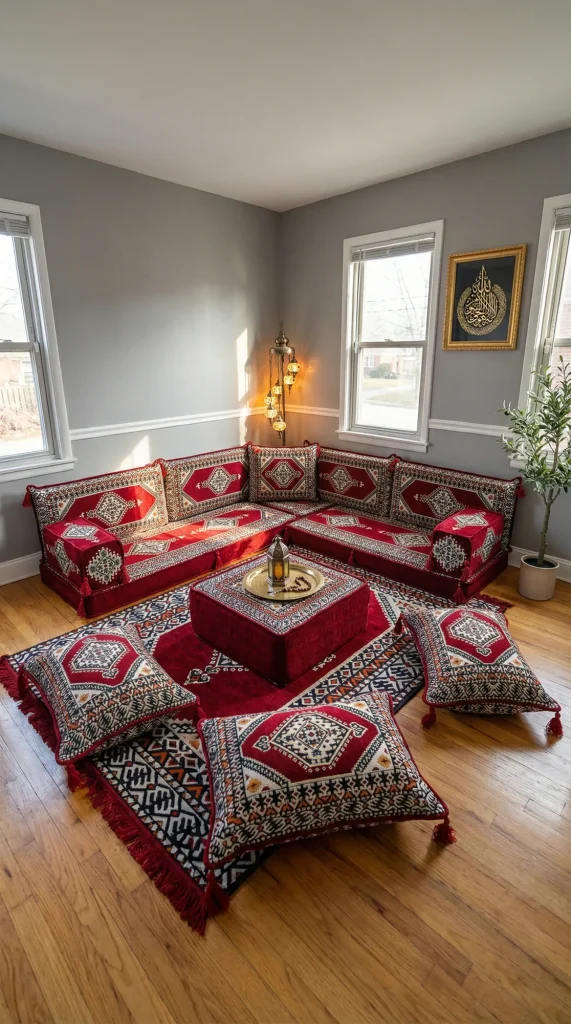
A Persian poshti (پشتی) is a firm, upright backrest, traditionally a small hand-knotted carpet stuffed and stood against the wall, with a thin seat pad in front and a large carpet covering the floor. Sofhu does not weave poshti; it makes Arabic floor sofas in carpet and kilim patterns, cut to your walls and shipped free worldwide.
- Persian
- پشتی (poshti, also pushti or poshty)
- Meaning
- "For the back", from posht, back
- Traditional form
- A small hand-knotted carpet used as a backrest
- Main furnishing
- The floor carpet
- Layout
- Around the perimeter of the room
- What Sofhu makes
- Arabic floor sofas in carpet and kilim patterns
- Filling
- 32 kg/m³ (32 DNS) high-density foam, no springs
- Shipping
- Free worldwide from Türkiye
On this page
Is a poshti a cushion, a carpet or a piece of furniture? It is all three. The Persian poshti is a small carpet made to be leaned on, and the room built around it treats the floor carpet as the main furnishing. This page describes how that arrangement works, where it differs from an Arabic majlis, and how to get the same way of sitting from upholstered floor seating made to your room.
What a Persian poshti is
A poshti (پشتی) is a backrest. The name comes from posht, the Persian word for back, so it means roughly “for the back”. In its traditional form it is a small hand-knotted carpet, rectangular and upright, stuffed firm and stood against the wall.
It is not a soft cushion. A poshti keeps its shape and holds the sitter upright, which suits long conversation and meals taken at floor level. In front of it lies a thin seat pad, and under everything lies the carpet. Rug dealers group the poshti with related pieces from neighbouring weaving cultures: the Baluch balisht, the Turkish yastık and the Uzbek napramach. All are small woven or knotted bags and panels made to be sat against.
The poshti is not a museum object either. Persian-language buying guides still treat it as a current product and advise balancing modern fabrics against its traditional character.
From saddle to sitting room
According to the dealers who trade in them, poshti began as something to lean on while travelling. The covers were stuffed and used for support on saddles, and the custom is traced by the trade to the Safavid era. They were woven everywhere carpets were woven: in cities, in villages and in nomad camps, including among the Qashqai, the Afshar and Arab weavers of southern Iran.
These are dealer accounts, not academic history, and we repeat them as such. What they explain well is why a poshti looks the way it does. It is a carpet first, built to take weight and friction, and a backrest second.
The carpet is the furniture
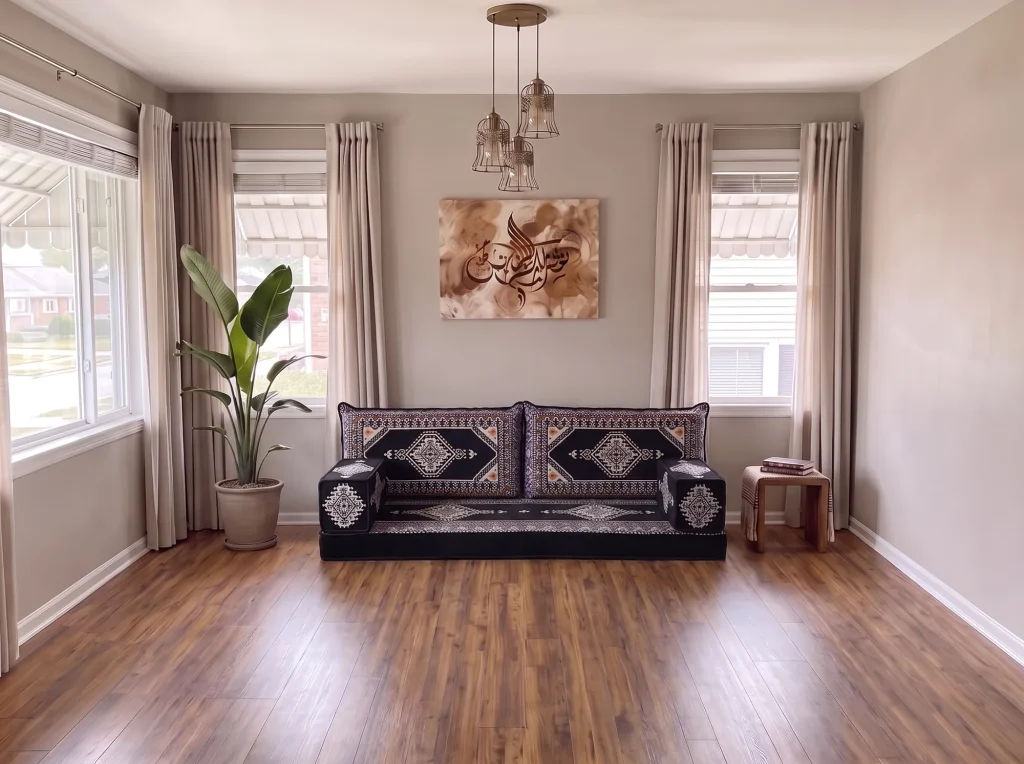
In a poshti room the floor carpet does the work that sofas and tables do elsewhere. The backrests line the walls, the seat pads sit in front of them, and the carpet fills the middle. People sit around the edge and face inward, and the centre stays clear.
Three consequences follow for anyone planning such a room:
- Size the seating to the carpet. The carpet should show as one field in the middle, not disappear under the seats. The guide on what size rug goes with a majlis explains how much to leave visible.
- Keep the seat low. A thick seat hides the carpet’s border and changes the feel of the room. Sofhu’s cushion thickness can be chosen, so ask for a lower seat if the carpet is the point.
- Leave the run unbroken. The poshti arrangement, as the sources we found describe it, has no armrest bolsters between sitters, unlike Gulf seating.
The Afghan room next door follows the same logic with different words, as described under Afghan toshak floor seating.
Persian sofa or Persian couch: what the search usually means
People who look for a Persian sofa or Persian couch are generally after one of two things. Some want this low perimeter seating with upright backs. Others want a Western-height sofa in a carpet-pattern or ornate fabric. The first is a floor set. The second is a matter of upholstery on a raised base.
Sofhu makes both. The Arabic floor sofa, the subject of this page, is a low cushion set with a seat mattress on the floor and loose back cushions against the wall. The Arabic majlis is a different product: raised to sofa height and fully upholstered, with a solid base, tall fixed backs and arm bolsters. Sets on a wooden bench base are made too, so either reading can be met. Be clear in your request which you mean, because the two rooms sit very differently. The overview of oriental sofa sets covers the raised options, and Middle Eastern sofas and couches compares floor and low seating across the region.
Poshti cushion and floor sofa backrest compared
A poshti cushion and the back cushion of a floor sofa do the same job in different materials.
| Traditional poshti | Floor sofa back cushion | |
|---|---|---|
| Face | Knotted carpet pile | Fabric cover with a zip |
| Filling | Stuffed firm | Foam |
| Cleaning | As a rug | Cover removes for washing |
| Made by | Carpet weavers | Sofhu, to measure |
Neither replaces the other. A knotted poshti is a textile with its own value. An upholstered backrest is easier to live with day to day, lighter to move and simpler to clean. The article on the parts of a majlis set names each cushion in an upholstered set.
Colour and pattern: reds, medallions and geometry
Deep red is the colour most associated with this kind of seating, and with good reason. Turkmen weaving, whose designs are often linked with poshti in the trade, is described as a rich madder red carrying rows of repeating geometric medallions called gul. We could not verify the common claim that one particular red Turkmen design is the standard Iranian poshti, so we do not state it.
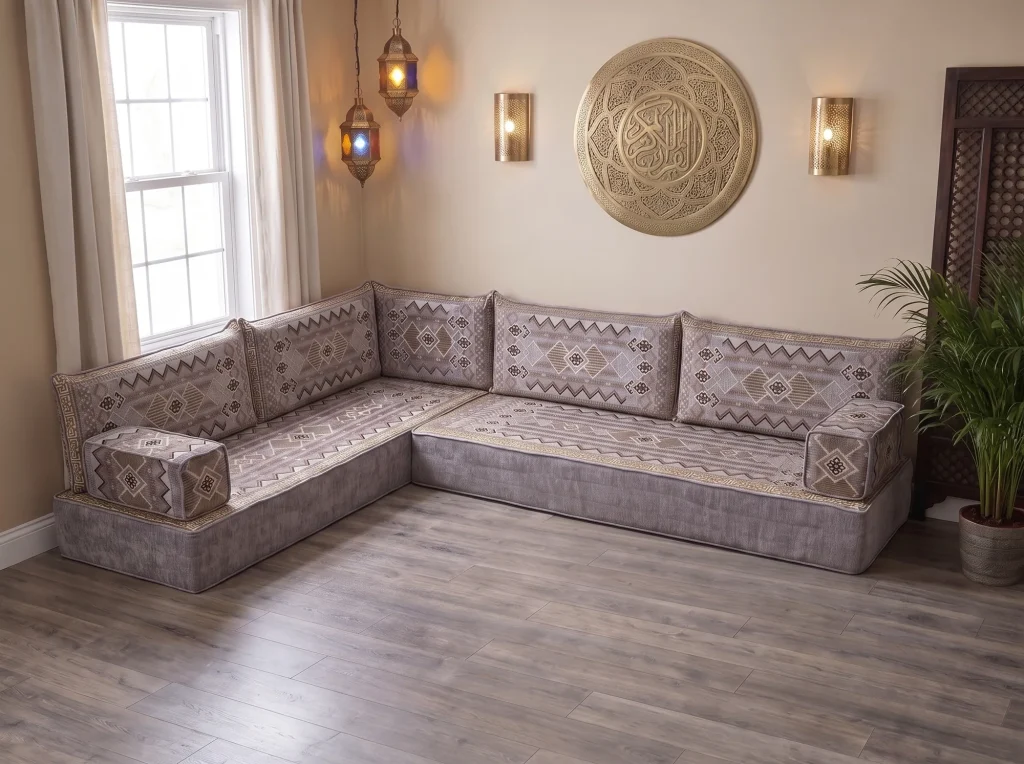
For an upholstered set, the nearest equivalents in Sofhu’s range are carpet-pattern and kilim-pattern fabrics. The red kilim corner at the top of this page shows the effect: stepped geometric motifs in red, cream and black on seats, backs and floor cushions. Calmer rooms can take the same geometry in grey and gold. These are Sofhu designs in a carpet manner, not reproductions of any Persian rug. The guide to majlis patterns and motifs shows more, and Sofhu’s kilim and rug page covers the floor.
Building Persian floor seating with Sofhu
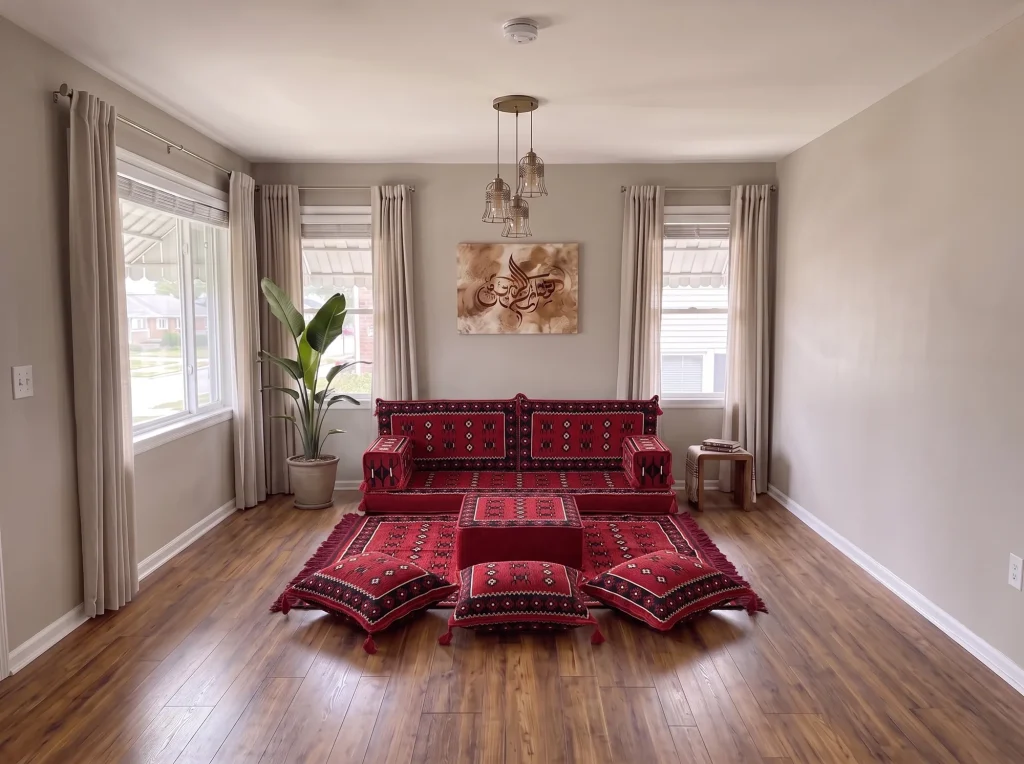
A Sofhu floor sofa gives you the poshti arrangement in foam and fabric: a seat cushion on the floor, an upright backrest against the wall, and armrests only if you want them. Sets come as a single row, an L-shape or a U-shape. They are not freestanding, so the backrests need a wall, exactly as poshti do.
The filling is 32 kg/m³ foam, written 32 DNS in the Turkish trade. That number is the weight of a cubic metre of foam. It tells you how much material is in the cushion and says nothing by itself about hardness. The Polyurethane Foam Association notes that denser foam generally keeps its original support better, which is what you want from a seat used every day. There are no springs. On custom orders you can ask for a firmer or softer feel.
Covers are zippered and removable. The fabric list names the chenille, velvet, woven and linen series available.
Measuring and ordering
Sofhu makes each set in Türkiye from your wall measurements, so begin with the room. Send the length of each wall that will carry seating, the positions of doors and windows, the size of your carpet, and a photo of the carpet laid in the room. Mention whether you want armrests and how low you want the seat.
Sets are vacuum packed and shipped free worldwide. Iranian communities abroad are largest in southern California, around Los Angeles, Orange County and San Diego, with others in Texas, the Toronto area, Germany and Sweden. The existing page on Arabic sofas in California covers ordering there. There are no local shops, and duties or taxes may apply depending on the destination, so ask before ordering.
For neighbouring traditions see the Turkish sedir and şark köşesi and the Kurdish diwan. When your measurements are ready, get a quote by measurement or send them by WhatsApp.