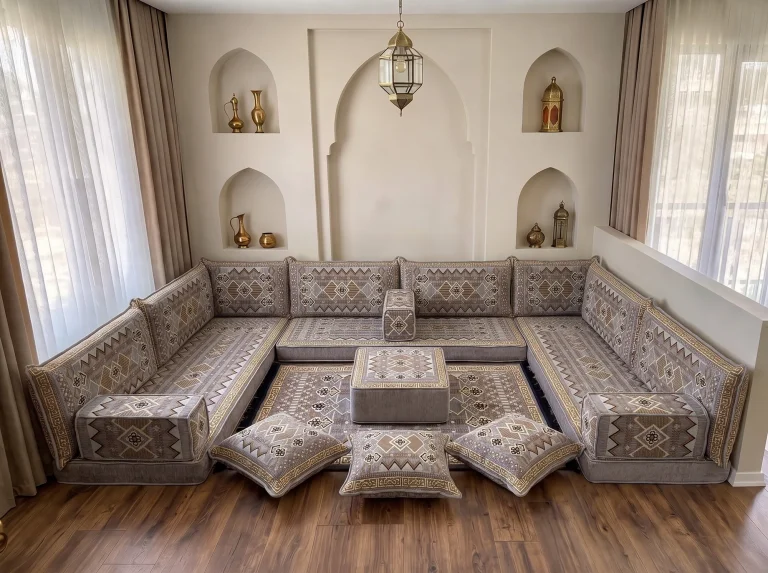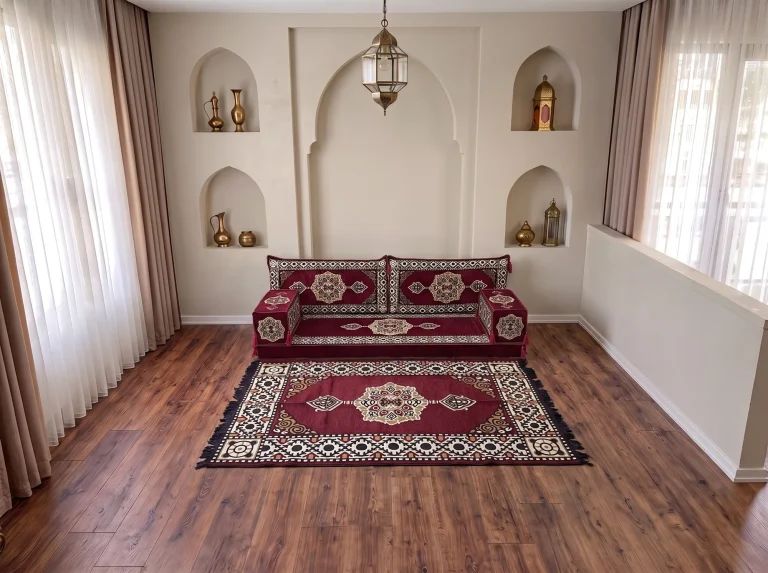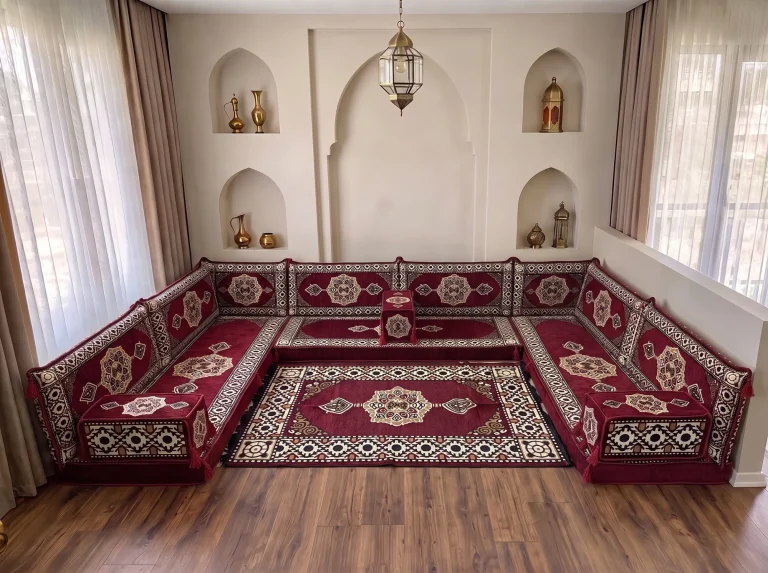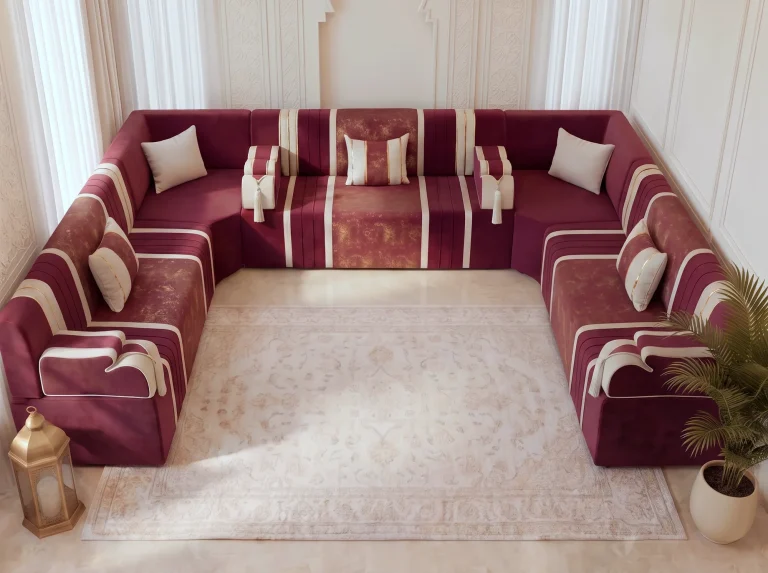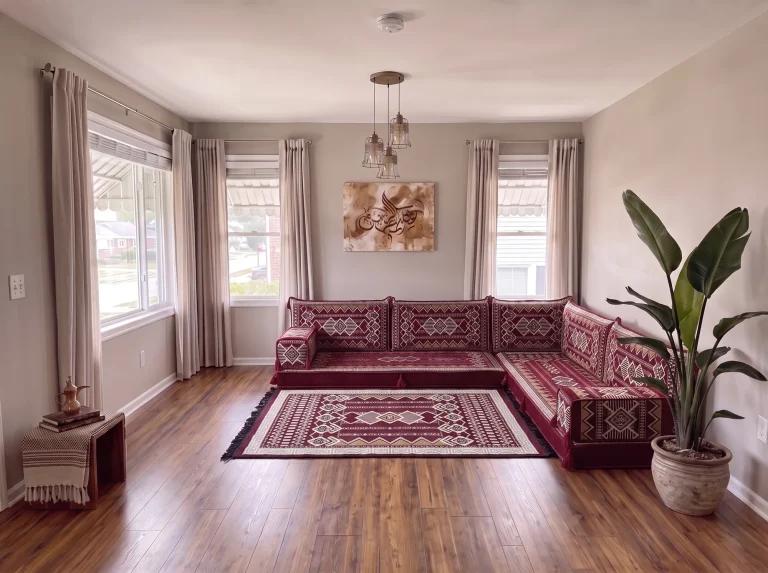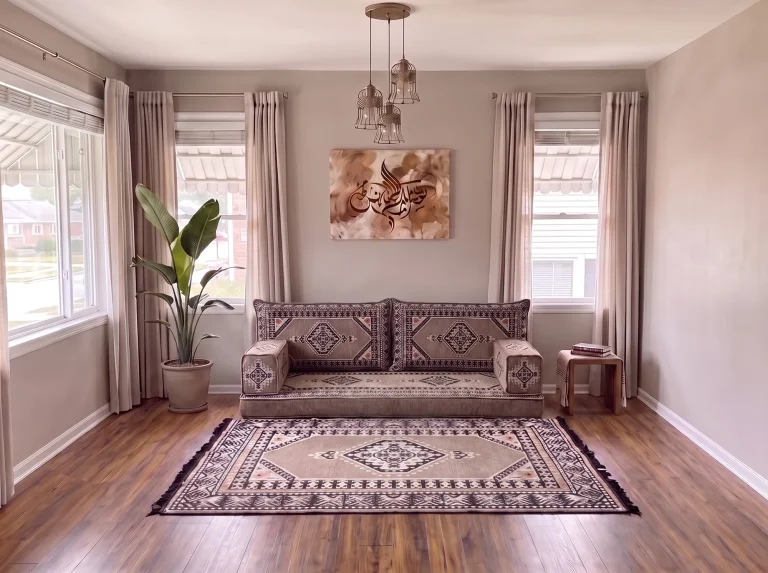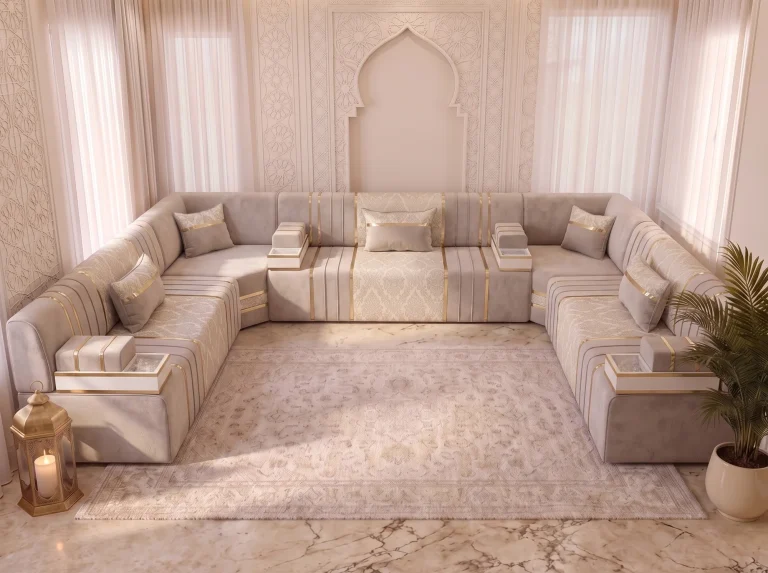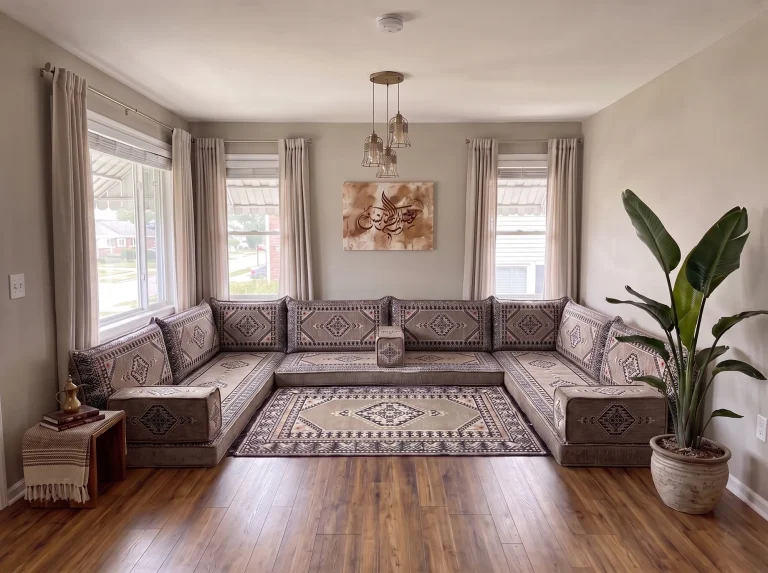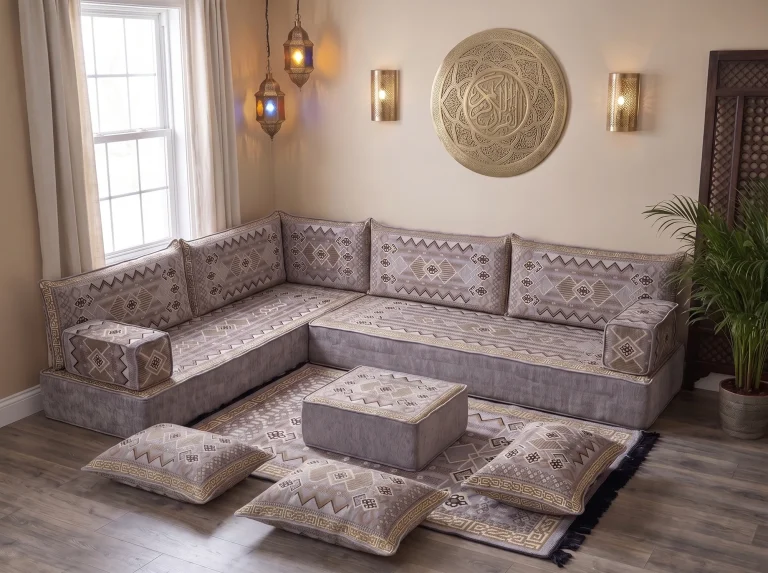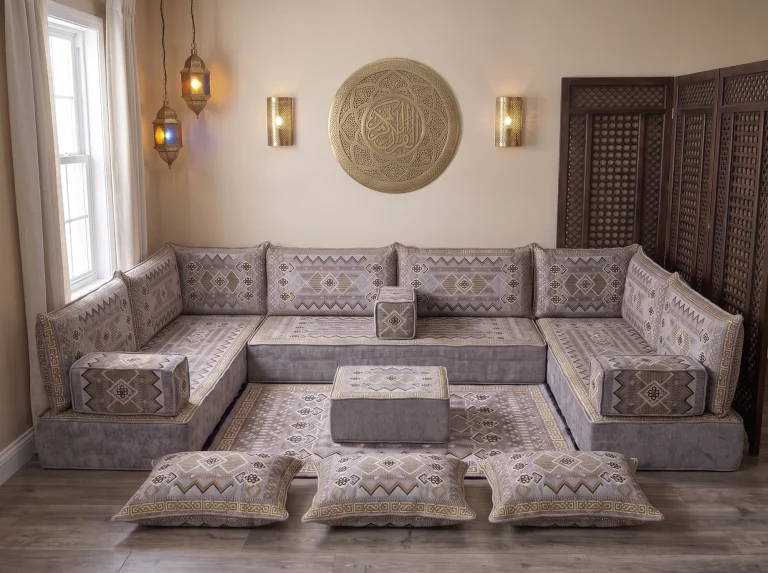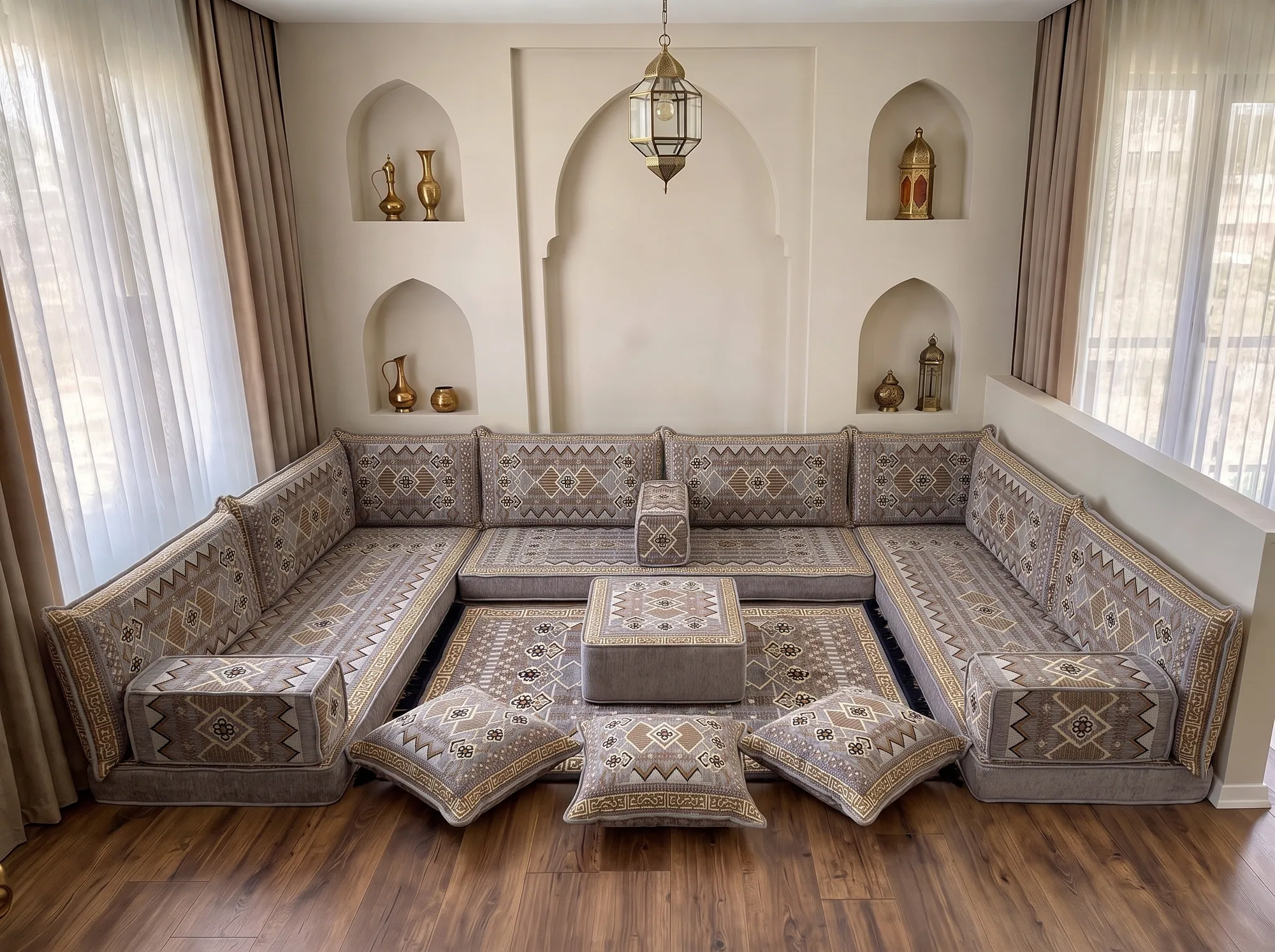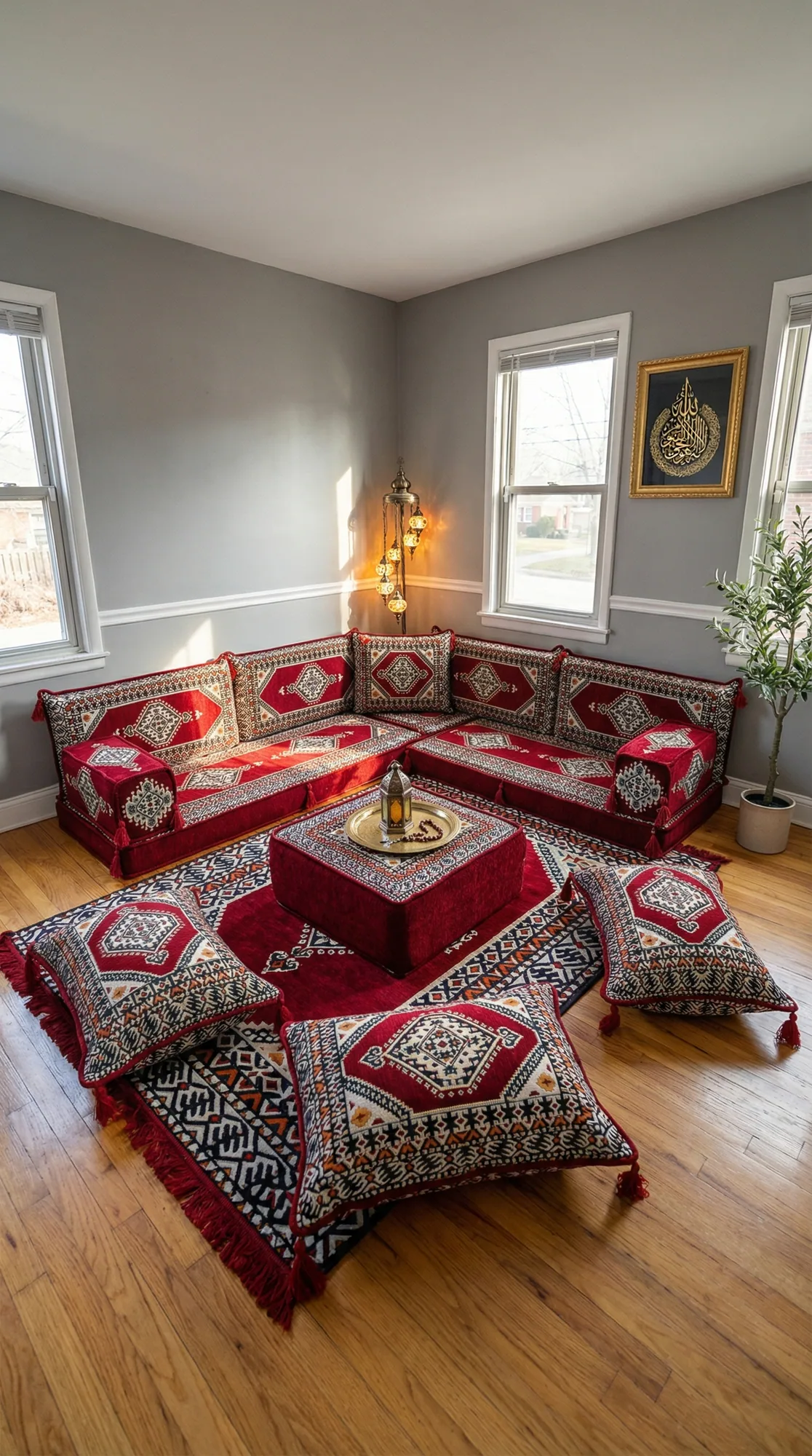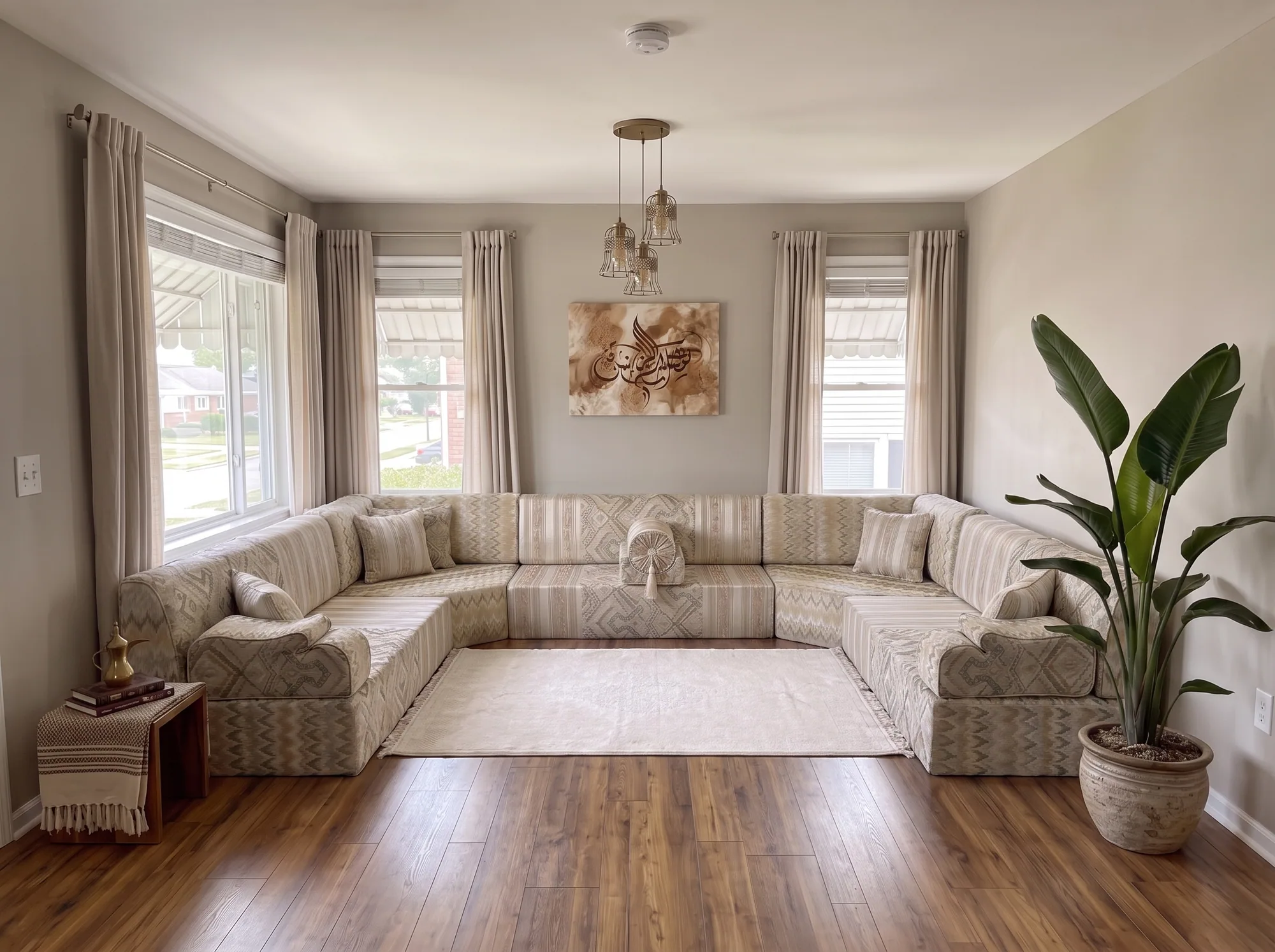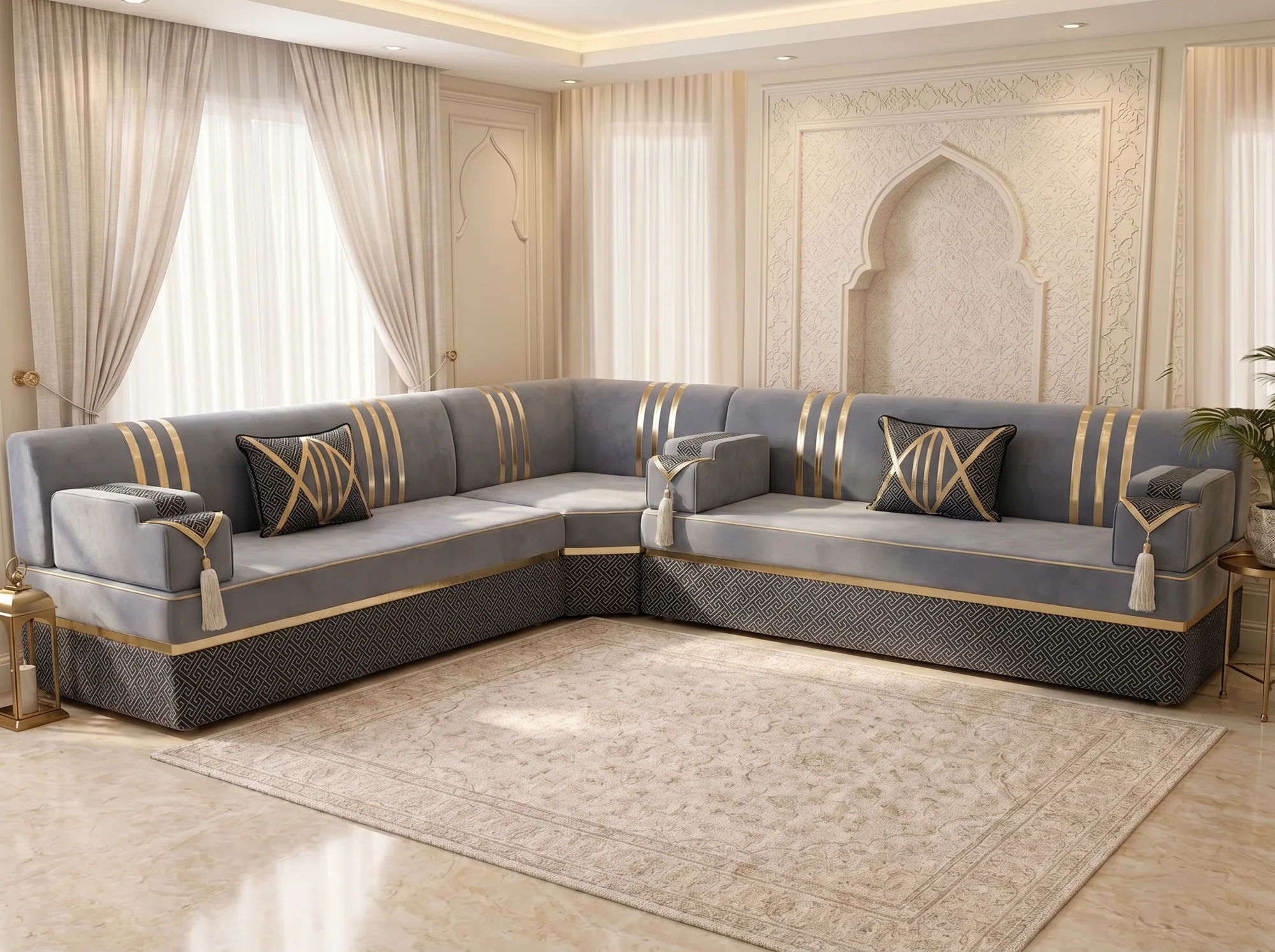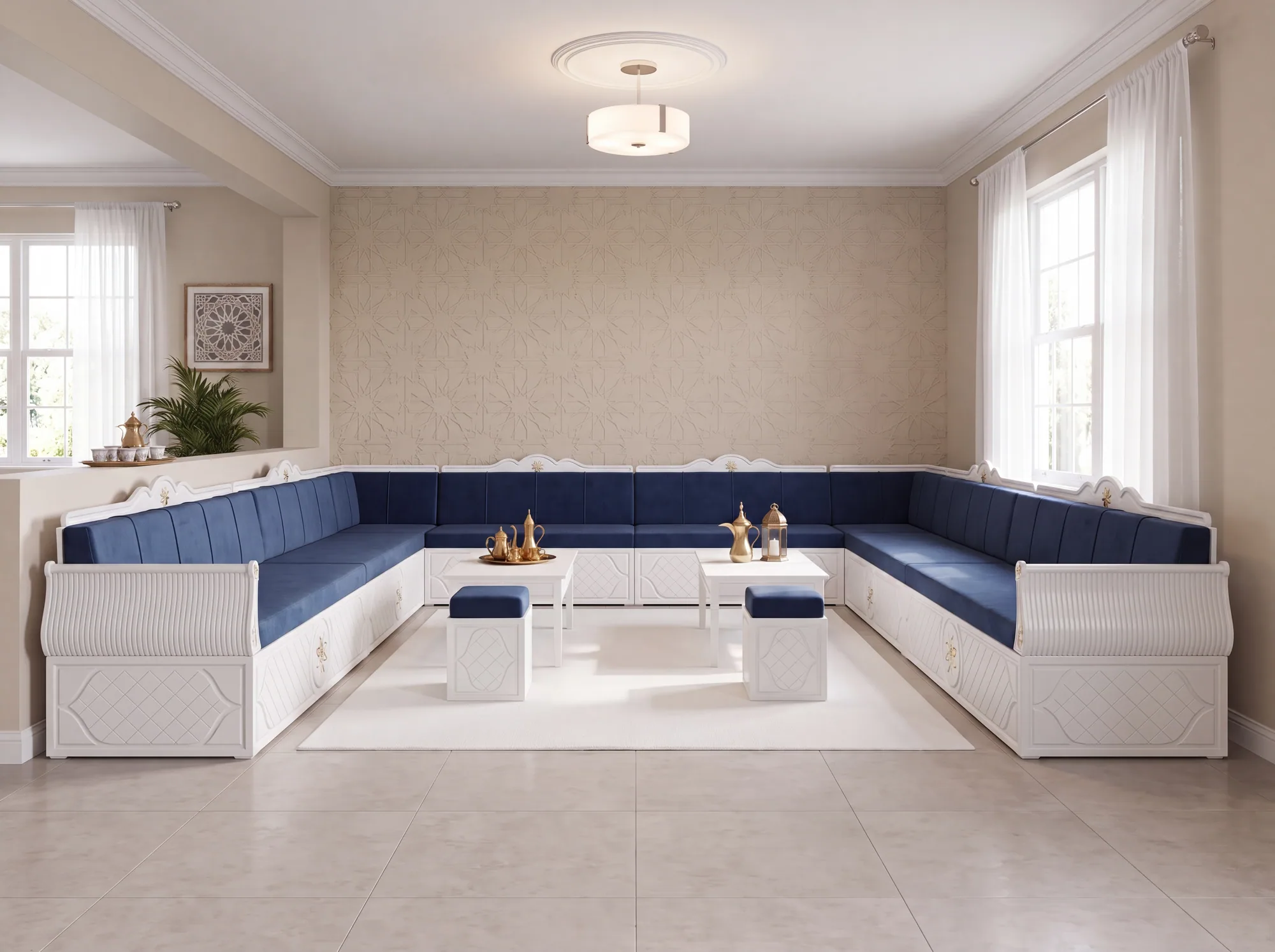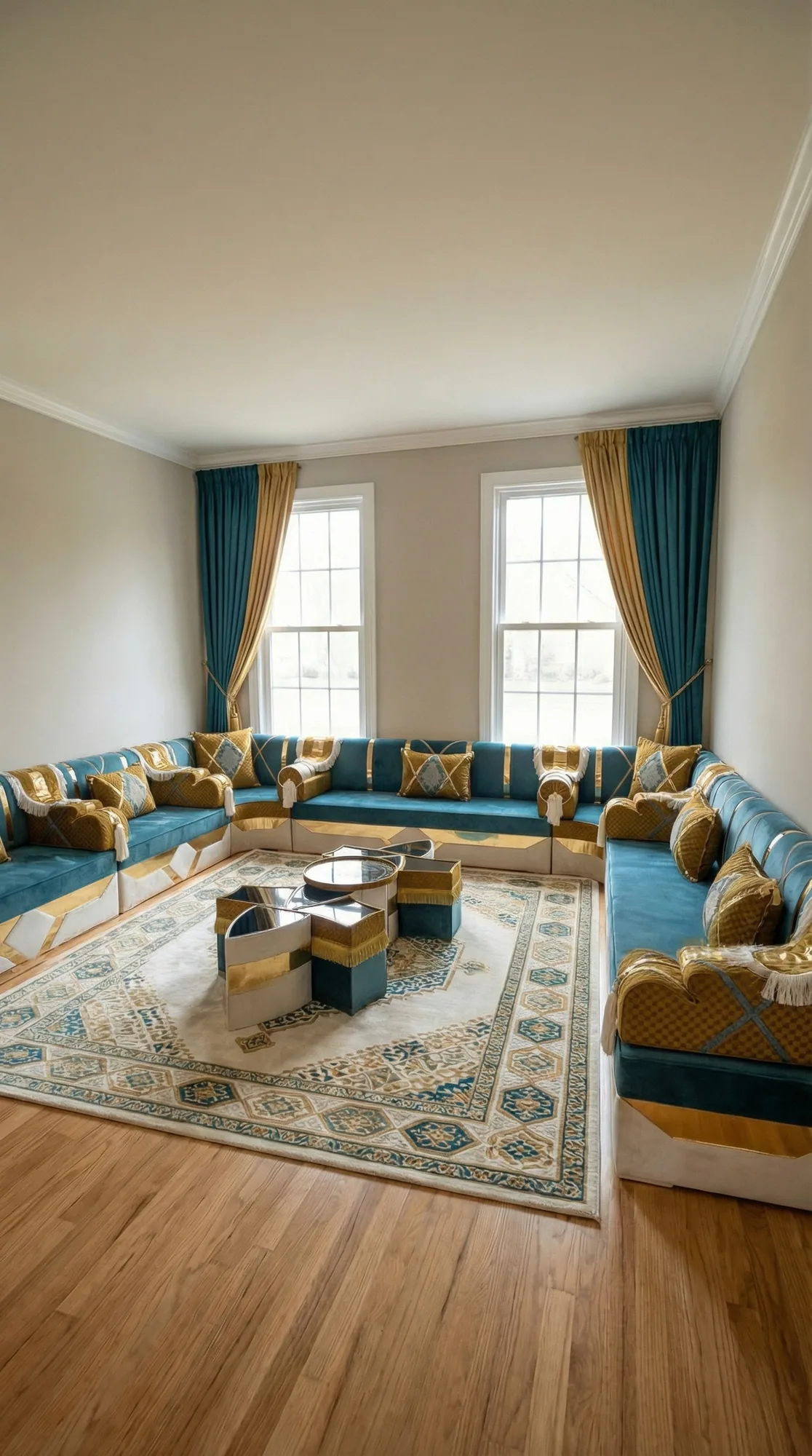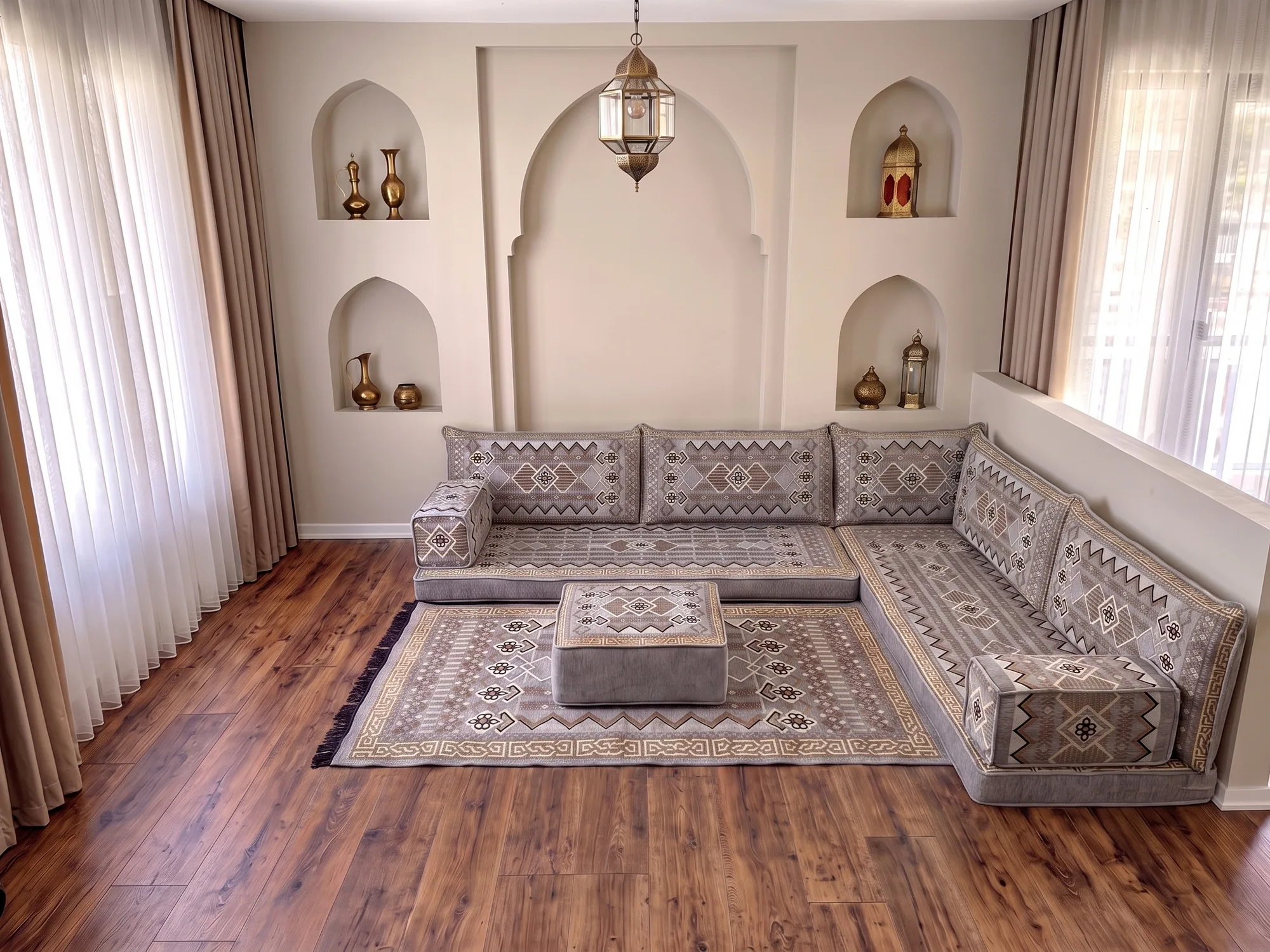
Size the rug to the open floor the seating frames, not to the room. For a U-shape that is the back wall minus two seat depths; for an L, each wall minus one seat depth. Leave a hand's width of bare floor at the seat fronts, or tuck the edge just under them. Sofhu can quote a matching rug with your set.
- Sizing rule
- Fit the open floor inside the seating
- U-shape rug width
- Back wall minus two seat depths
- L-shape rug
- Each wall minus one seat depth
- Best pile near floor seats
- Flat-weave or low pile
- Pattern rule
- One busy surface, one calm one
- From Sofhu
- Rugs and kilims offered as set complements
On this page
In a majlis the carpet came first. The classic description of the room is carpets on the floor and cushions against the wall, and the rug is still where the tray is set down, where children sit, and where the eye rests when the room is full. So choosing a rug for majlis seating is not an afterthought. Get the size right and the seating looks as if it was built for the room. Get it wrong and a good set looks adrift.
The usual living-room advice, “front legs on the rug”, does not translate, because a floor sofa has no legs. This guide replaces it with rules that fit low seating, layout by layout.
The rules are written for the Arabic floor sofa, the low cushion set that most photos here show. They work the same way for the Arabic majlis, the raised, upholstered sofa-height seating Sofhu also makes, because it lines the walls and frames the same open floor.
On the rug or around it?
There are three ways to place a majlis carpet, and each has a use.
Rug inside the seating. The rug fills the open floor in front of the seats and stops just short of them, leaving a narrow strip of bare floor. It is the easiest to live with: the rug lifts out for cleaning without moving a single mattress.
Rug tucked under the seat fronts. The rug is a little larger and its edges slide a short way under the mattresses. The seats pin it in place, so it cannot creep on a smooth floor, and no edge is left to trip on.
Rug under everything. One large rug or fitted carpet covers the whole room and the seating stands on it, wall to wall. This is the traditional look and the warmest underfoot. It needs a flat, firm rug, and it means lifting the seats to clean or change it.
The arrangement to avoid is the half-and-half: a thick rug that runs under only part of a seat. The mattress then sits at a tilt, and the backrest leans away from the wall.
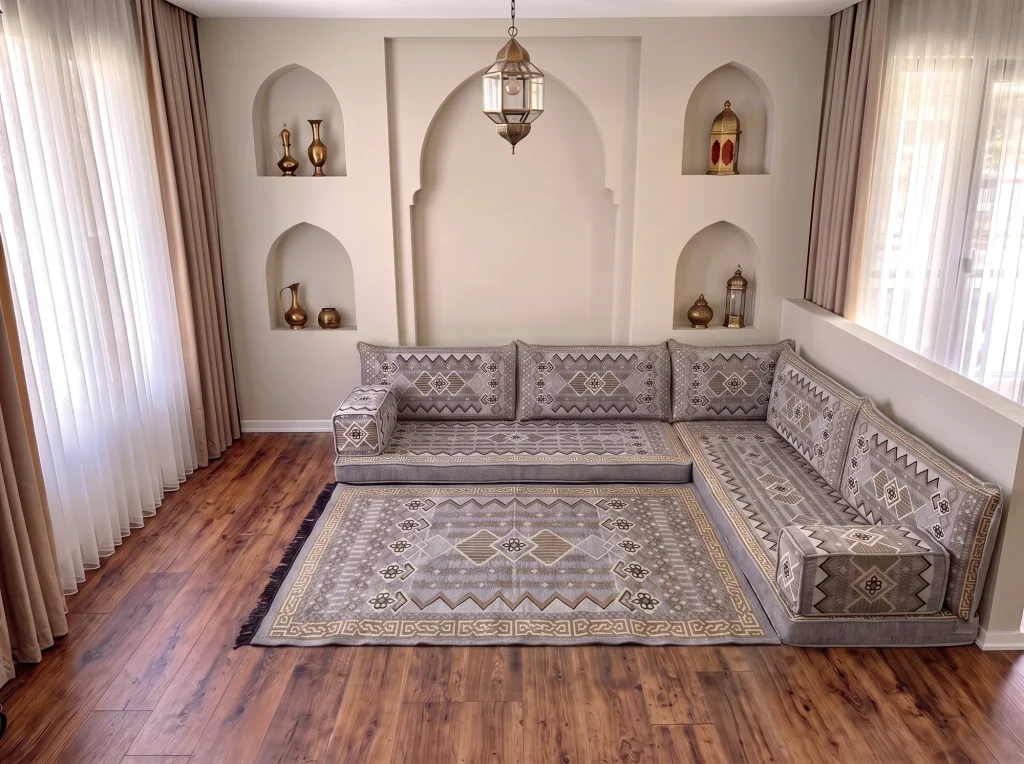
Rug size for floor seating, layout by layout
Work from the open floor, not from the room size. The open floor is what is left after the seats have taken their depth from each wall. You need one number first: the depth of your seats from the wall to the front edge.
| Layout | Rug width | Rug length |
|---|---|---|
| Straight row | The row length, or a little less | Deep enough for a tray and floor cushions |
| L-shape | Short wall minus one seat depth | Long wall minus one seat depth |
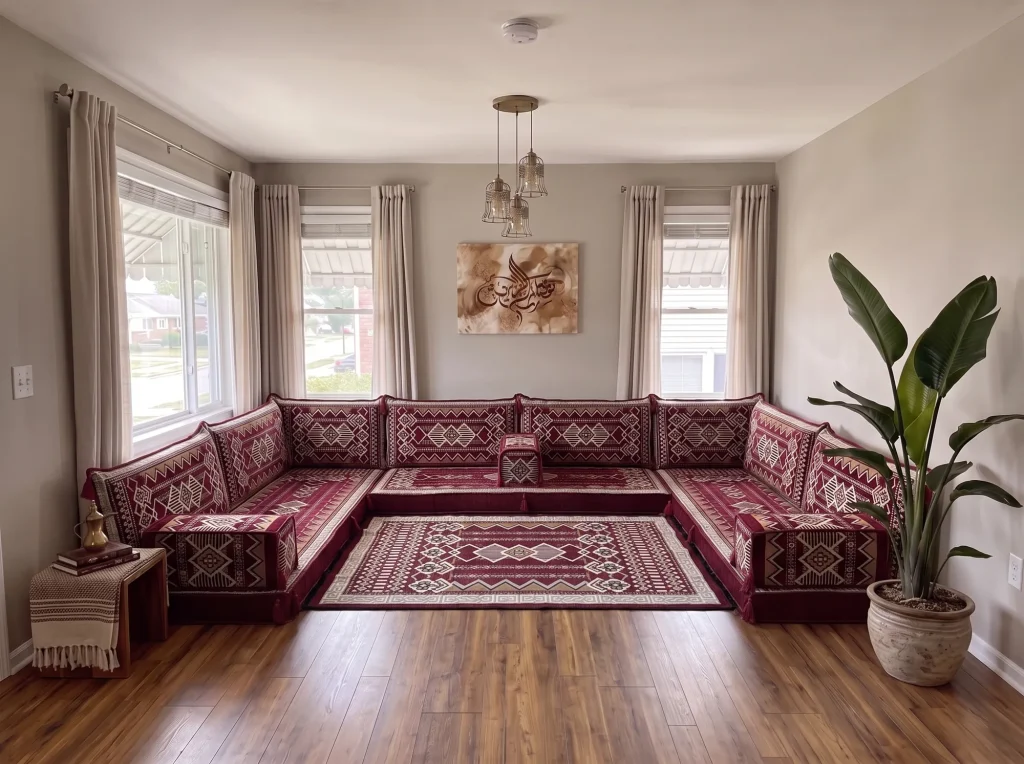
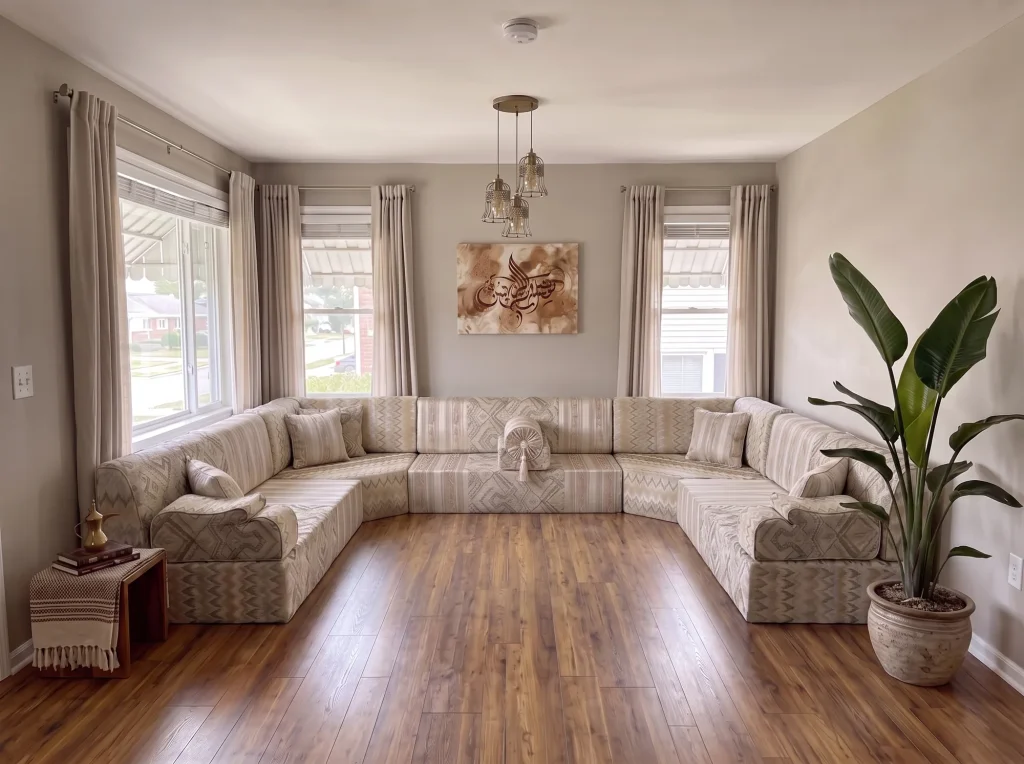
| U-shape | Back wall minus two seat depths | Side wall minus one seat depth, or longer |
Take a little off each figure if you want bare floor showing at the seat fronts, or add a little if you want the rug tucked under.
A worked example makes it concrete. Suppose a U-shape on a back wall of 3.5 m with side rows of 3 m, and seats 65 cm deep. That depth is only an illustration, taken from the middle of the range seen in published listings. Measure your own.
- Clear width between the side rows: 3.5 m minus two depths of 0.65 m leaves 2.2 m.
- Clear length from the back seat to the ends of the arms: 3 m minus 0.65 m leaves 2.35 m.
Rugs are commonly sold in sizes such as 5 × 8 ft (about 152 × 244 cm), 6 × 9 ft (about 183 × 274 cm), 8 × 10 ft (about 244 × 305 cm) and 9 × 12 ft (about 274 × 366 cm). In this room the 6 × 9 fits: at 183 cm wide it leaves a strip of floor on each side, and its extra length simply runs out of the open end of the U into the room. The 8 × 10 is wider than the gap and would have to go under the seats on both sides.
For a straight row there is no enclosed floor, so the rug’s job is to mark out the sitting area. Match its long side to the row, or keep it slightly shorter, and make it deep enough that floor cushions and an ottoman can stand fully on it.
Before buying, mark the rug’s outline on the floor with painter’s tape and live with it for a day.
Pile height under and beside floor seats
Low seating puts people close to the rug. They sit on it, rest glasses on it and lean a hand on it to stand up. That changes what works.
- Flat-weaves and low pile are the practical choice. A tray stands level, a tea glass does not tip, and an ottoman does not rock. If the rug goes under the seats, they stay flat.
- Medium pile is comfortable for sitting directly on the floor and fine in the centre of the room, as long as it stops short of the seats or runs fully under them.
- Deep shag is the poorest match. It hides crumbs in a room where food is served, makes tables unsteady and lifts the front of any seat that rests on it.
Low tables matter here too. If you use a tray table or a low wooden one, see our guide to coffee tables for floor seating.
Pattern and colour against patterned upholstery
Most majlis fabric already has something to say: stripes, medallions, stars, kilim geometry. The rug should either agree with it or step back.
Match. A rug woven or printed to echo the upholstery makes the whole floor part of one design. Many Sofhu sets are shown this way. It is the surest route to a finished room, and it suits formal guest rooms.
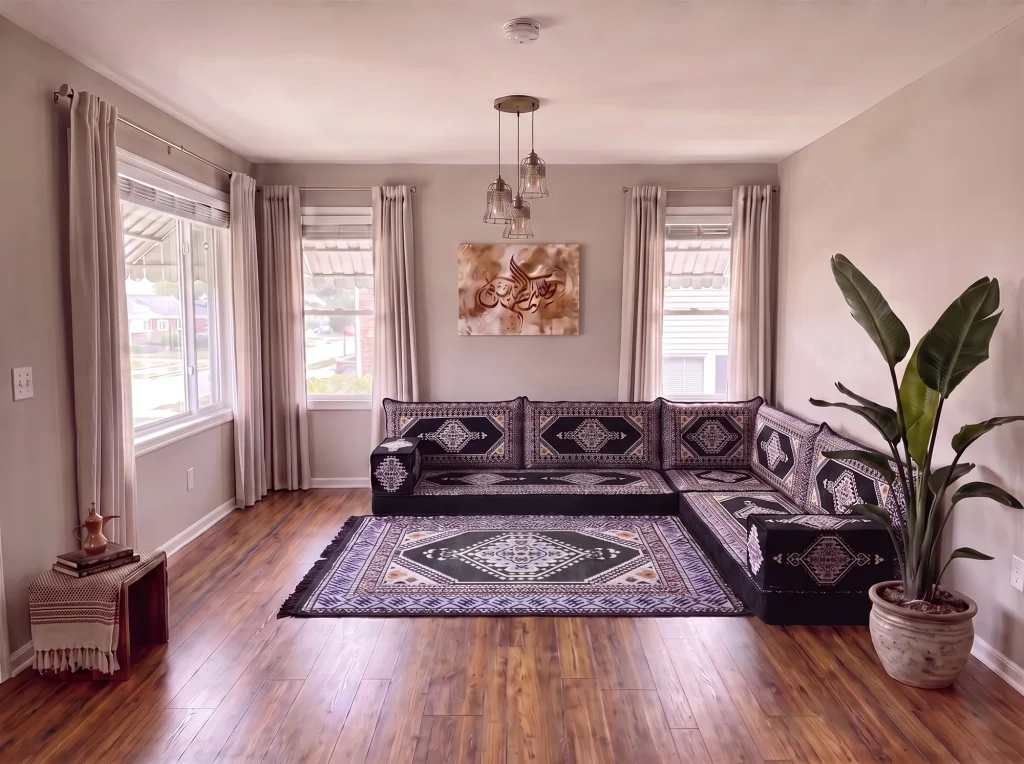
Step back. With busy seats, choose a calm rug: a plain field with a border, a tone-on-tone weave, or an old-style design so faded it reads as texture. Pick up one colour from the upholstery, ideally the quietest one.
Lead. With plain seats, such as the grey, beige and cream velvets on our modern Arabic sofa page, the rug can carry the pattern for the room.
Two rules keep you safe. Do not put two bold patterns of the same scale next to each other. And decide whether the floor or the seating is the darker of the two; a room where both are dark feels smaller, and one where both are pale shows every mark. Our guides on how to choose majlis colours and majlis patterns and motifs go further.
Kilims, Persian rugs and plain carpets
Kilim. A kilim rug with a majlis is a natural pairing. It is flat-woven, light, easy to shake out and reversible in most cases. Its geometric patterns sit well with kilim-pattern and sadu-stripe upholstery. Being thin, it wants a non-slip underlay on hard floors.
Persian and other knotted pile rugs. A knotted rug with a central medallion suits a U-shape especially well, because the seating frames the medallion on three sides. Check the pile height if any of it will run under the seats, and keep heavy patterns for rooms with quieter upholstery.
Plain carpet or wall-to-wall. A fitted carpet in a neutral colour is the simplest floor for a majlis, and common in homes across the diaspora. Floor-level seating does not scratch or dent what is under it. A smaller flat-weave laid on top in the centre defines the sitting area and takes the spills.
Ordering the rug with the seating
If you want the carpet for your Arabic sofa to match it exactly, order them together, so the colours are chosen side by side. Send the clear floor size you worked out above along with your wall lengths, and say whether you want the rug to stop at the seat fronts or tuck under them.
You can see sets with and without rugs on the Arabic floor sofa and oriental sofa pages, and compare layouts on the L-shape and U-shape majlis page. For more majlis rug ideas in real rooms, look through the galleries, then get a quote by measurement or send your measurements on WhatsApp.