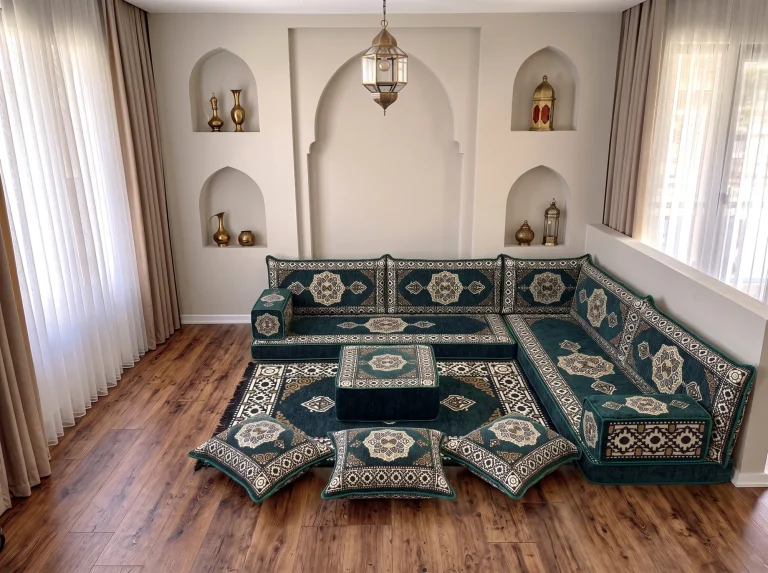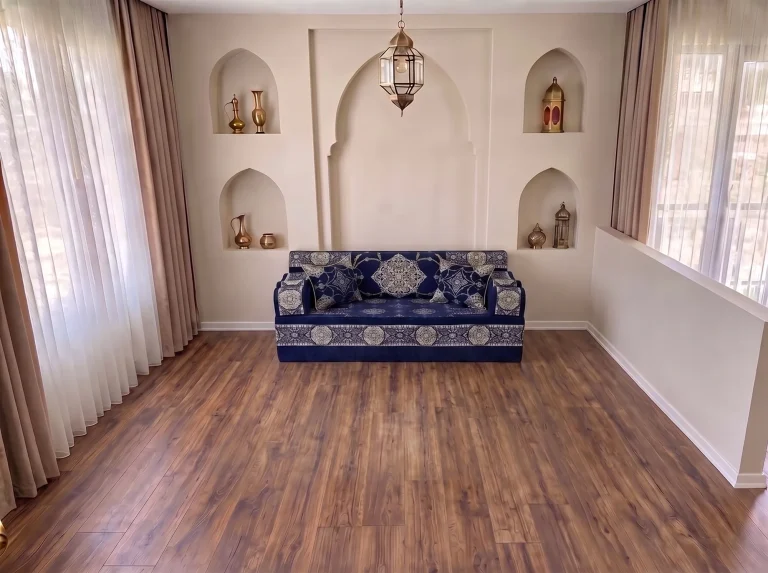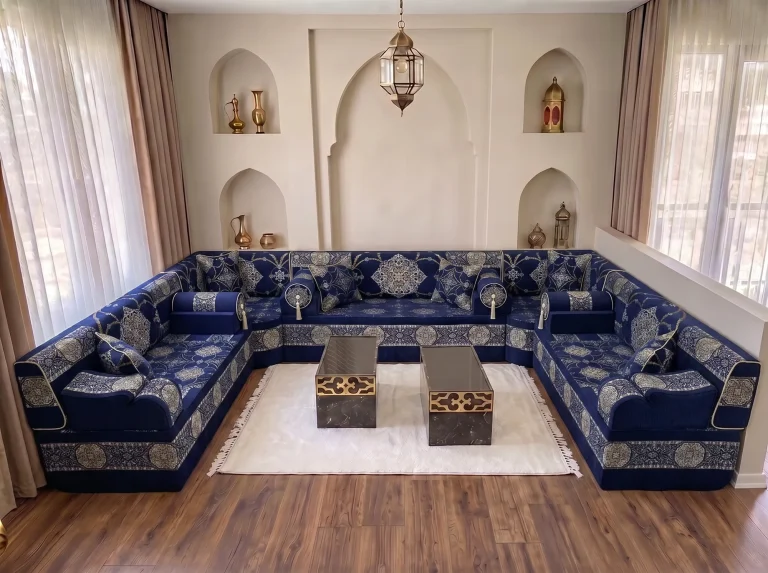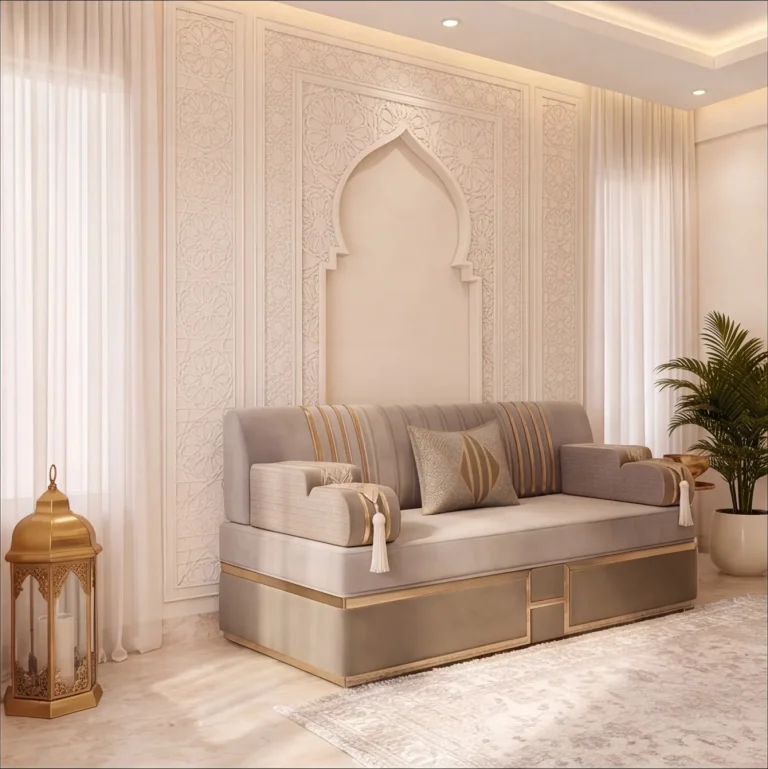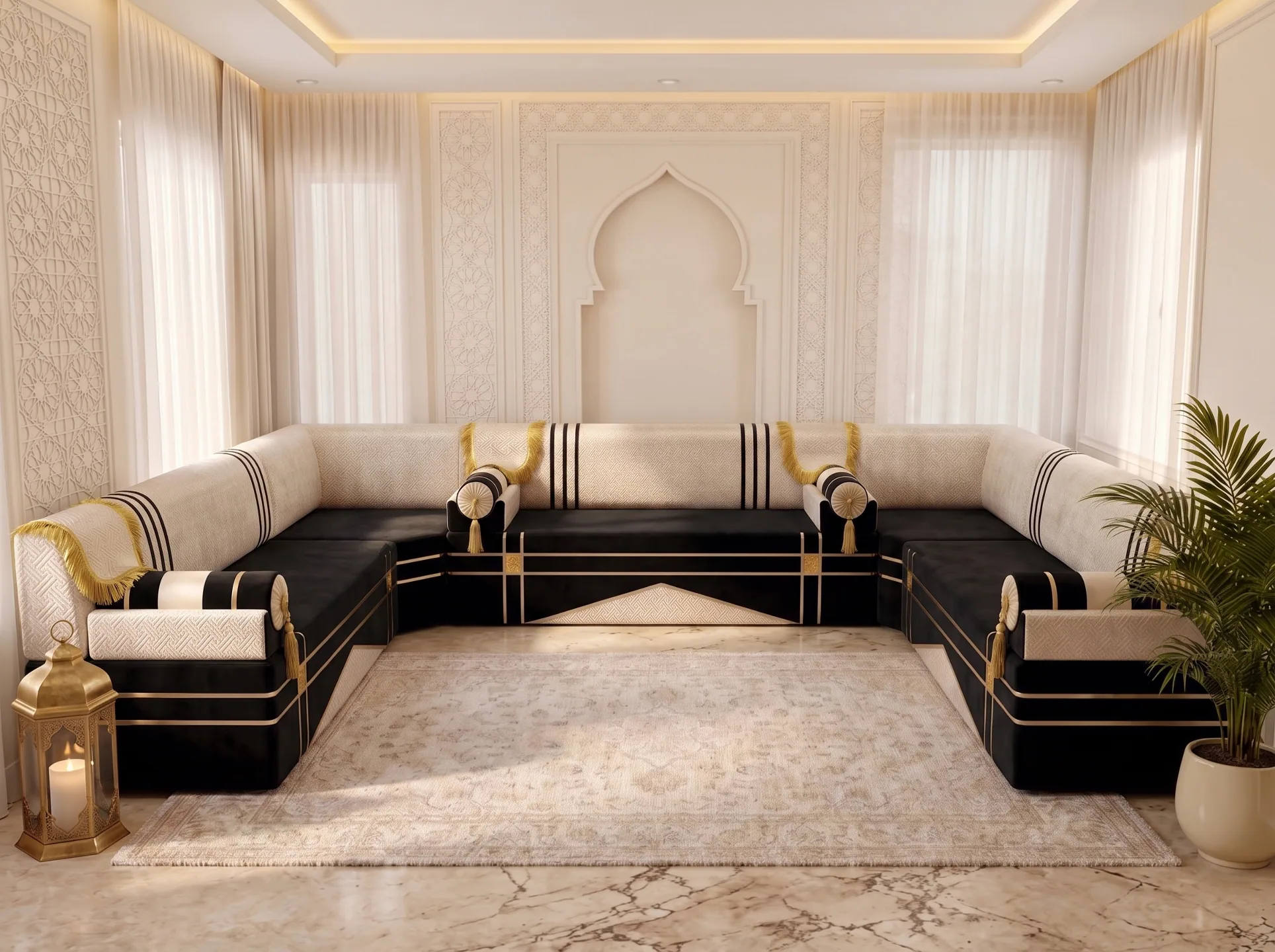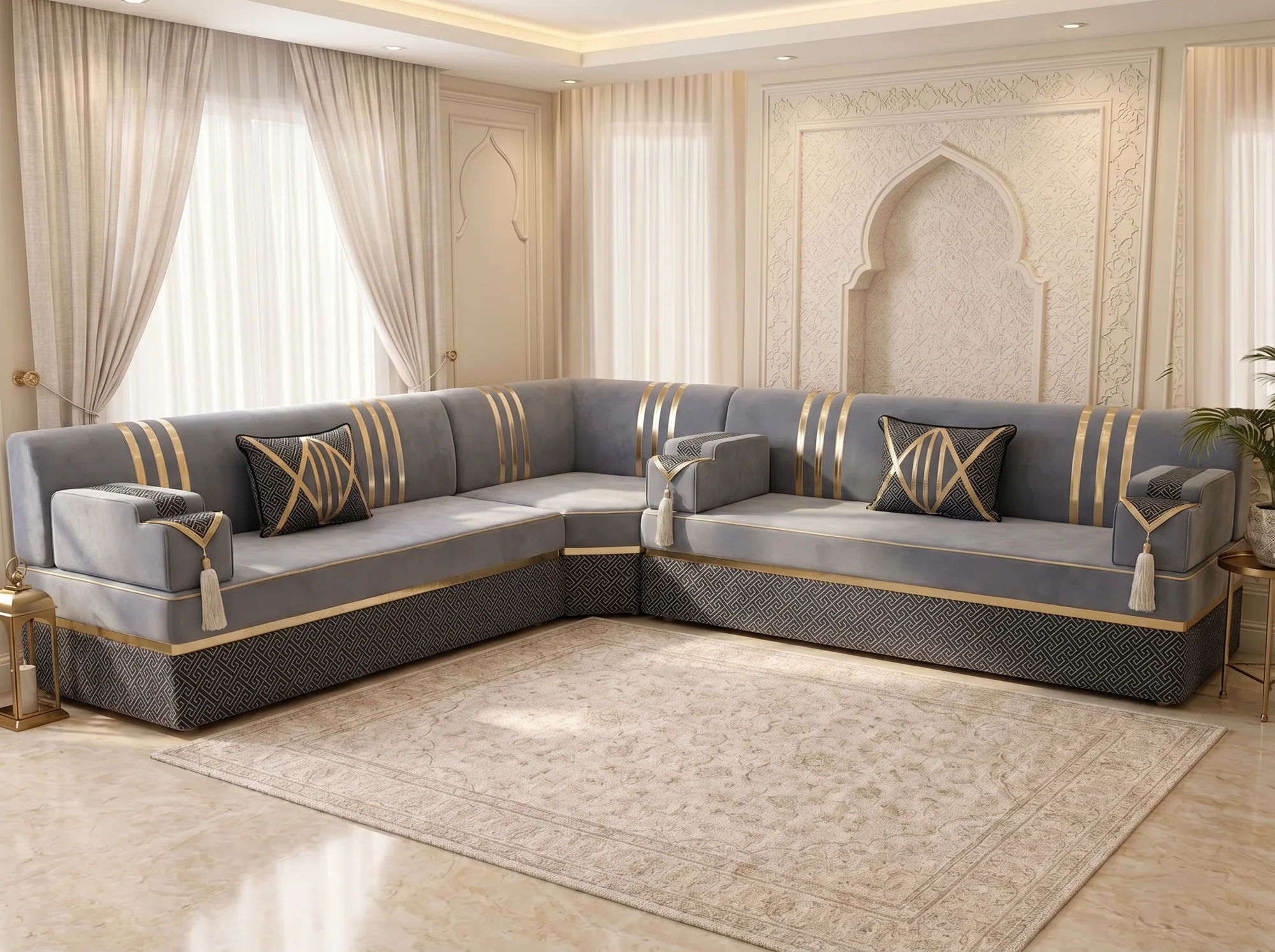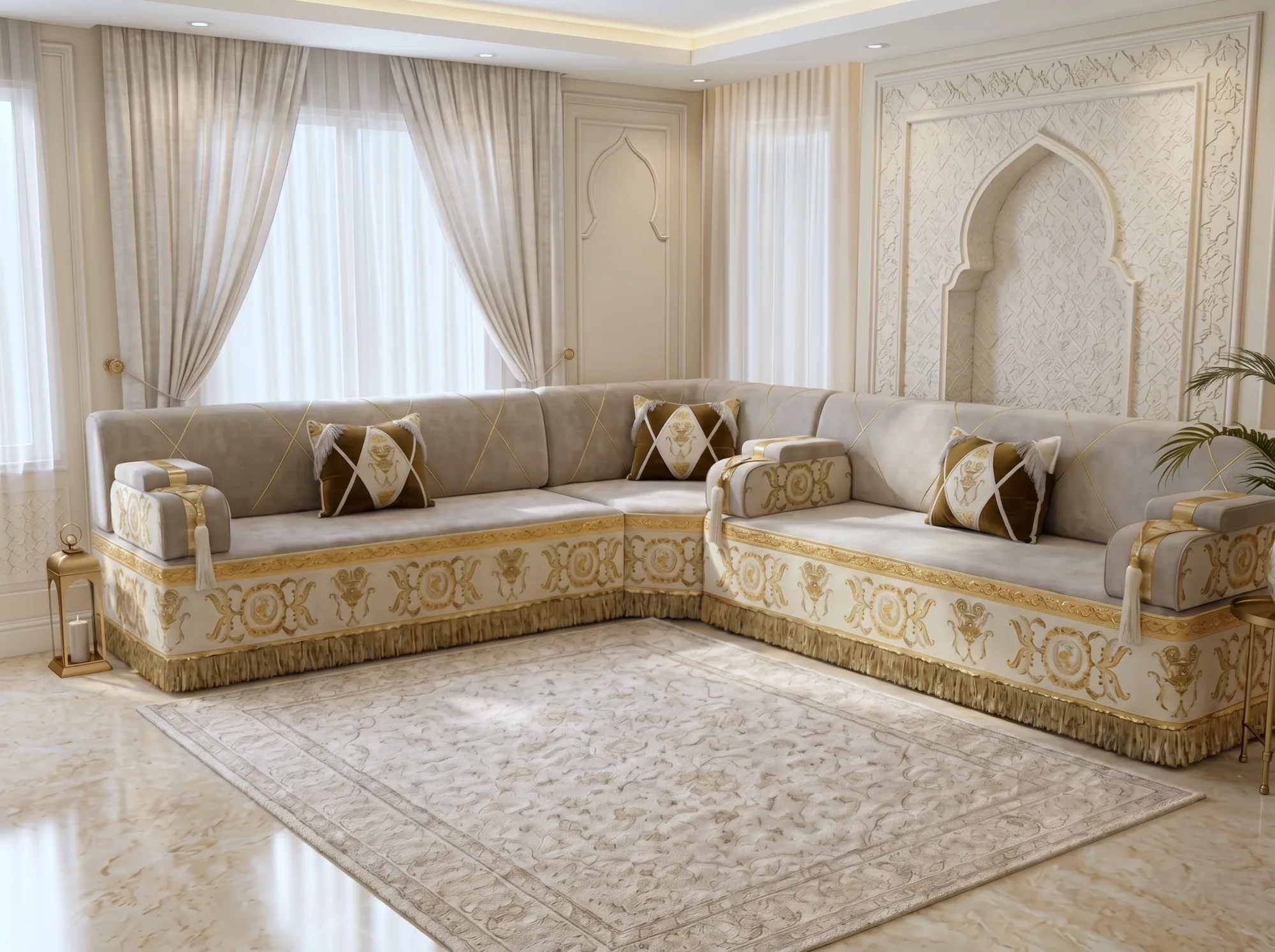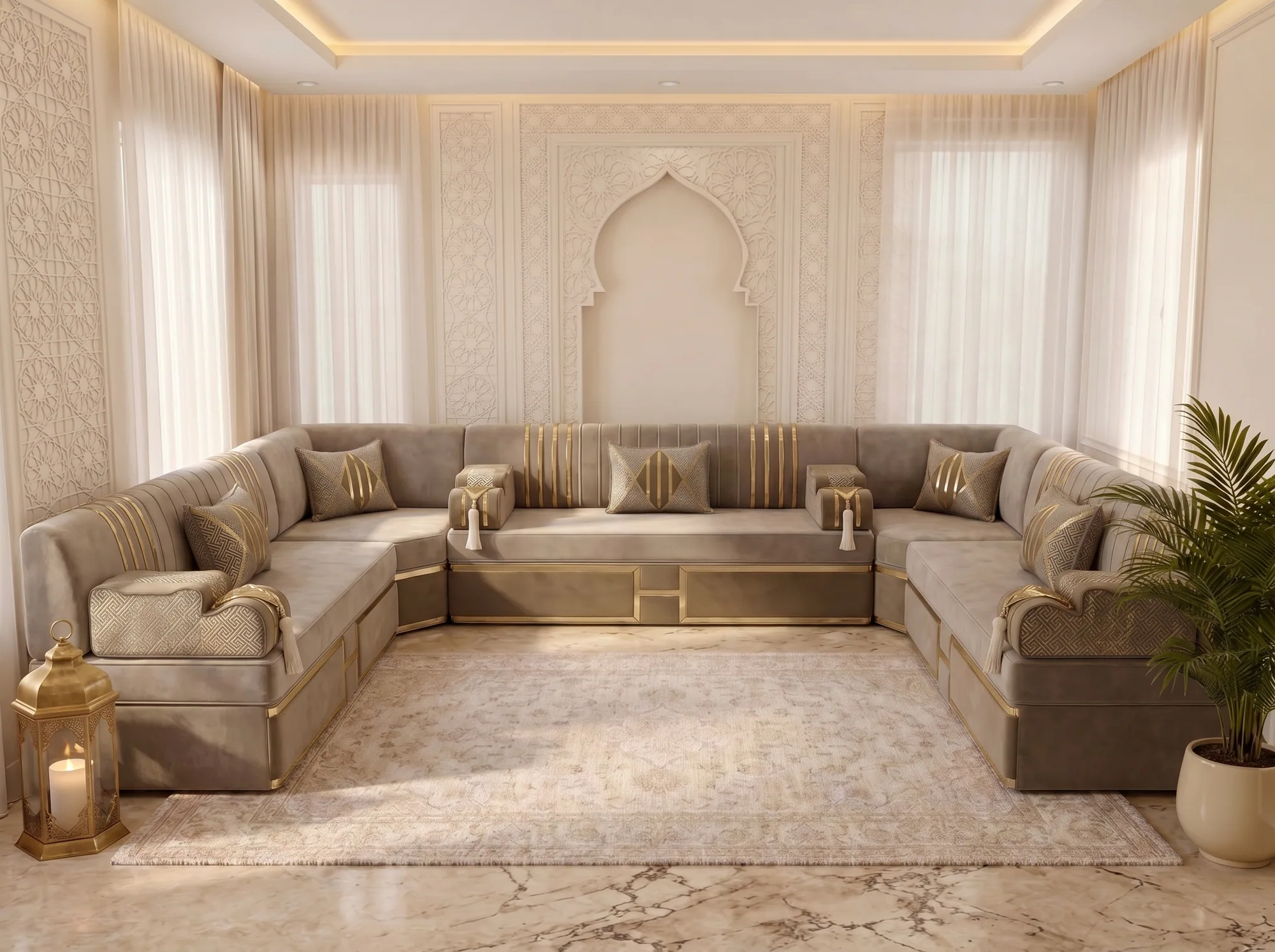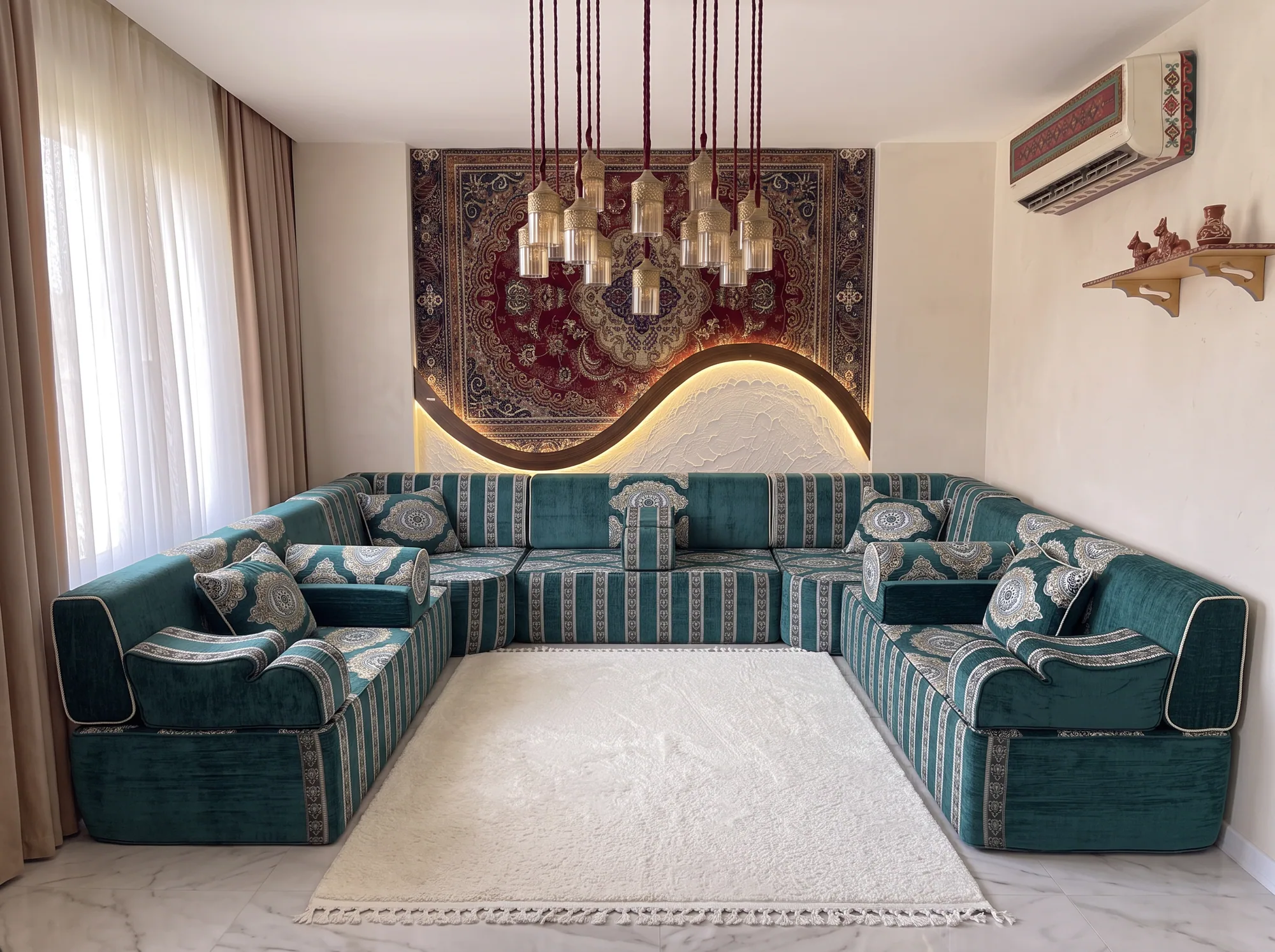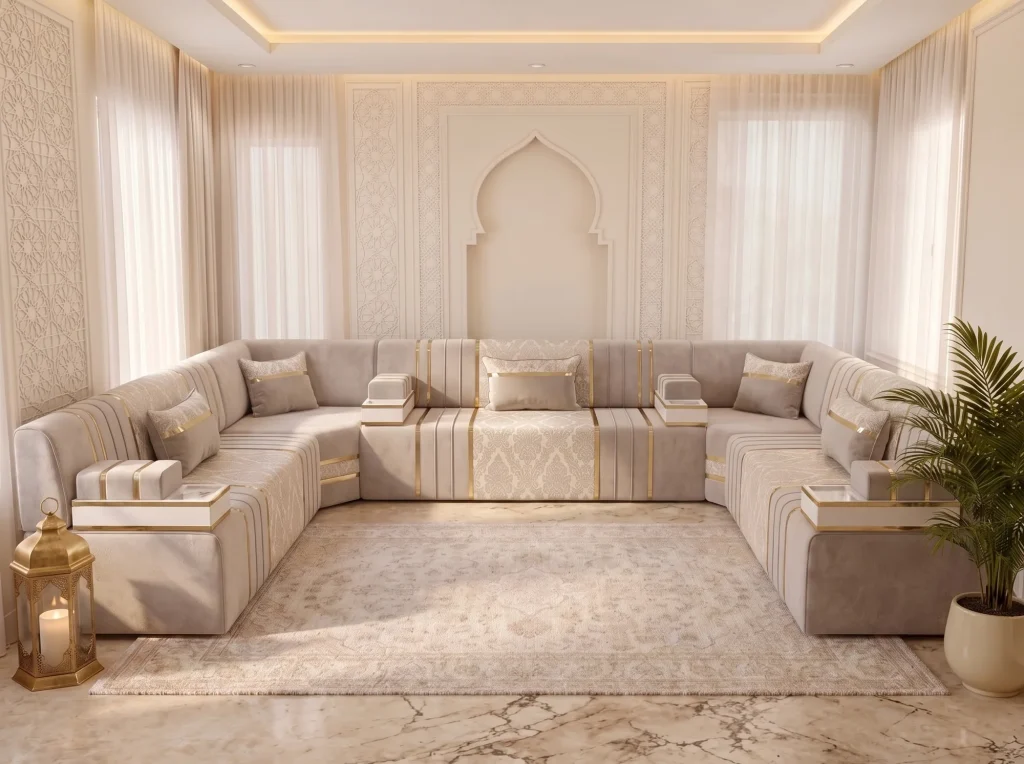
An Omani majlis is the guest room of a house. The sablah (سبلة) is something wider: a communal hall where a village or neighbourhood meets, elders settle disputes and the youngest serves coffee. Its traditional seating is benches built into the walls. Sofhu makes perimeter seating to measure for either kind of room: the raised Arabic majlis, closest to a wall bench, or a low floor sofa.
- Native names
- سبلة (sablah, pl. sabal) and مجلس (majlis)
- What the sablah is
- A communal meeting hall for a village or neighbourhood
- Traditional seating
- Benches built into the walls, around the room
- UNESCO
- Oman is one of four states on the 2015 majlis inscription
- Sofhu sets
- Raised Arabic majlis or low floor sofa, cut to your wall lengths
- Filling
- 32 kg/m³ (32 DNS) high-density foam, no springs
- Shipping
- Free worldwide from Türkiye
On this page
An Omani majlis and an Omani sablah are two different rooms, and the difference decides what seating you need. The majlis is the guest room of a house. The sablah is a hall that belongs to a village or a neighbourhood. This page explains both, says plainly what is and is not known about their traditional seating, and shows how a made-to-measure set from Sofhu fits each one.
If you are looking for the product page for buyers in the Sultanate, go to Arabic sofas in Oman. What follows is about the tradition and how to plan for it.
What a sablah is
A sablah (سبلة, plural sabal) is a communal council hall. Elders meet there to settle local disputes, often before the matter needs a judge. It is also a place of learning: the old and the young sit in the same room, the youngest pours the coffee, and manners are picked up by watching. In recent years women have also reserved the hall for their own meetings.
That public role sets the sablah apart from its neighbours in the Gulf. A Saudi majlis or an Emirati jalsa is usually part of one household. The sablah is shared. Oman is one of the four states, with the UAE, Saudi Arabia and Qatar, behind the 2015 UNESCO inscription of the majlis as a cultural and social space, and the country chose the sablah as the theme of its pavilion at the 2025 Venice Architecture Biennale. Our article on the majlis on UNESCO’s heritage list covers what that inscription does and does not mean.
Benches on the wall: what the traditional room looked like
The traditional sablah is not a floor-cushion room. The clearest account describes a sparse room with little more than benches built into the walls. People sit around the perimeter, facing the centre, so that everyone can see and hear whoever is speaking.
We want to be straightforward about the limits of what we know. We have not found a dependable source for the cushions, colours or fabrics that Omani families used at home, and we will not invent one. What can be said is about the building: carved plaster fretwork in Oman has been linked to Indian traditions.
So when you order Omani majlis seating from us, you are not buying a replica of a historical object. You are getting the same arrangement the sablah has always had, a continuous seat around the walls, built as upholstered sections with firm foam.
Omani majlis seating today: floor level or bench height
The first decision is seat level, and it should follow who sits in the room.
| Room | Who uses it | Seat level that suits it |
|---|---|---|
| Family majlis | The household, close relatives, children | An Arabic floor sofa, relaxed and easy to stretch out on |
| Formal guest majlis | Visitors, in-laws, business guests | An Arabic majlis, raised and closer to the wall-bench feel |
| Community sablah | Mixed ages, long meetings | A raised majlis on the main walls, so elders can sit and rise easily |
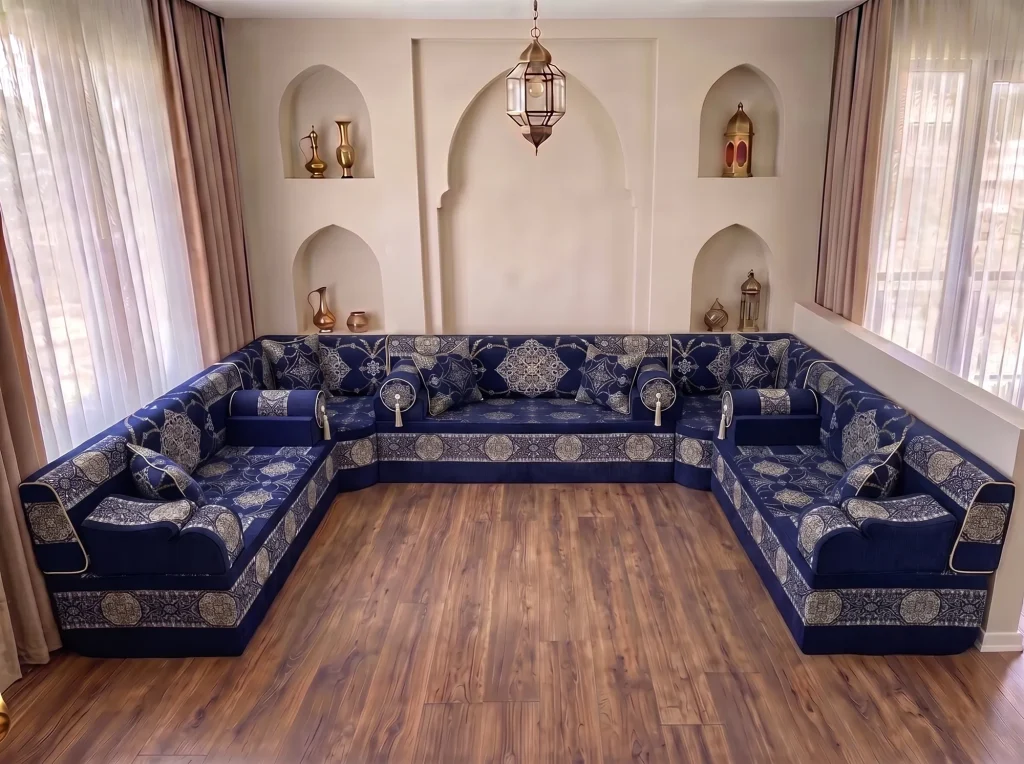
Sofhu makes two products, and they answer this choice. The Arabic majlis is raised to sofa height on an upholstered base with a fixed back, and it is the closest thing in our range to the built-in bench of a sablah: you sit down onto it, not down to the floor. The Arabic floor sofa is a low set of loose cushions, the choice for a room where people lean back for hours, eat from a cloth on the carpet or let children play. A house with two sitting rooms can have one of each. Our guide to floor seating versus a raised diwan goes through the trade-offs in more detail. We do not publish standard heights because every set is made to order; tell us who will use the room and we will suggest a seat thickness with your quote.
Layout: keep the perimeter, keep the centre open
A sablah works because nobody has their back to anybody. Keep that rule and the room will feel right.
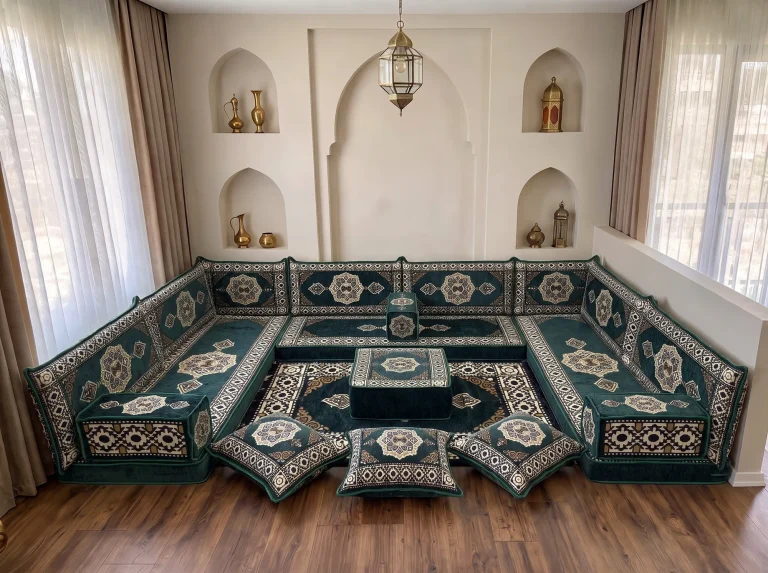
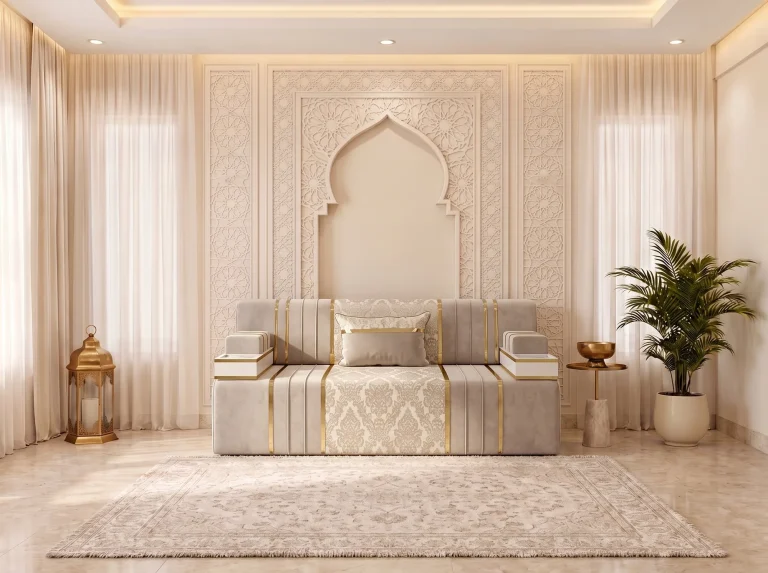
- U shape. Three walls of seating with the open side towards the door is the standard answer for a dedicated guest room. The beige majlis at the top of this page is laid out this way, with the centre of the room left open.
- L shape. Two walls, for a living room that has to keep a television wall or a dining area.
- Two facing rows. Good for a long, narrow hall where a U would leave the far end too distant.
Plan the layout along solid walls. A majlis is built to line them, and the back cushions of a floor sofa lean on them, so tell us about low windows, radiators or sockets. The page on L-shape and U-shape majlis layouts shows how corners are resolved.
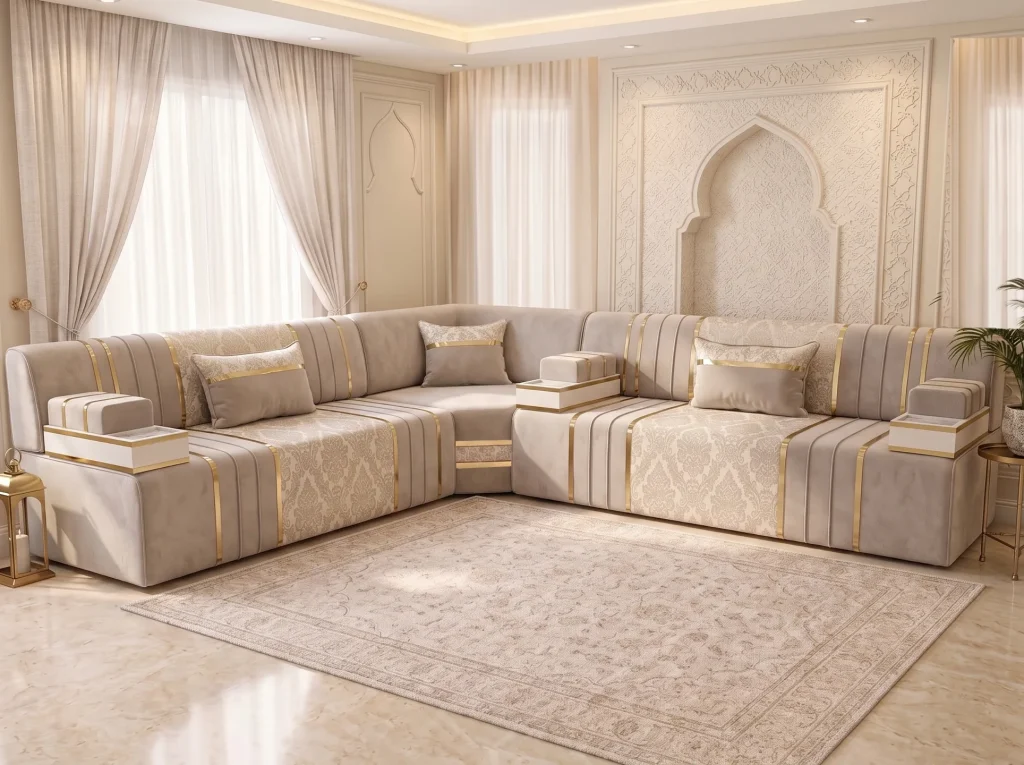
In a room where coffee is served many times a day, think about where the cup goes. The beige set above has armrests with a flat tray top, which keeps cups off the carpet. A small table at each corner does the same job.
Fabric and foam for long sittings
A sablah meeting can run long, and so can a family evening. Two things decide whether the seat still feels good after years of that: the foam inside and the cover outside.
Sofhu fills its seats with 32 kg/m³ (32 DNS) high-density polyurethane foam. The number is a density: one cubic metre of the foam weighs about 32 kg. Density tells you how much material is in the cushion, not how hard it feels, and denser foam generally keeps its height and support longer than light foam. There are no springs inside. On a custom order you can ask for a softer or a firmer feel.
For covers, think about how the room is cooled and how often it is used:
- Linen for a room that is open to warm air. Sofhu describes its linen as breathable, with a refreshing effect in hot weather.
- Velvet for a closed, air-conditioned guest majlis where a richer surface is wanted.
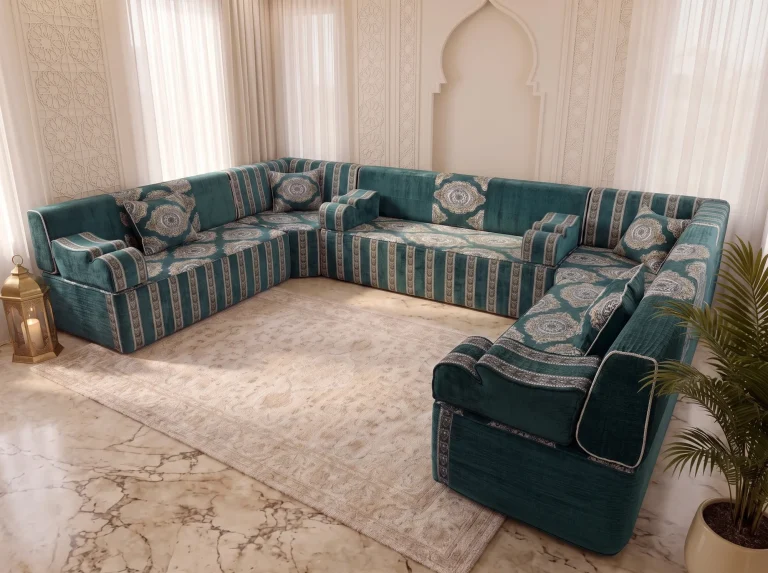
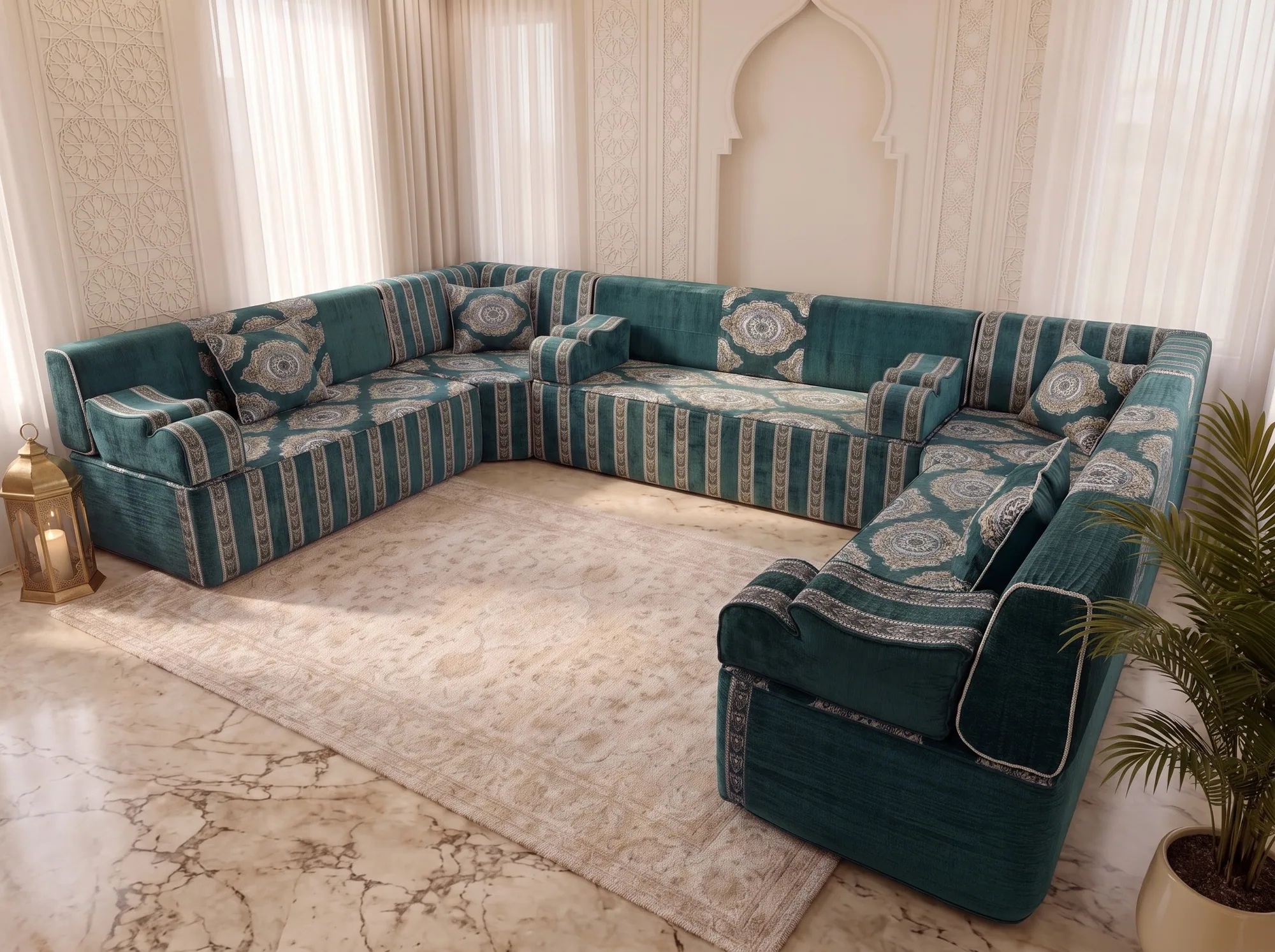
- Chenille and woven jacquards when you want pattern, such as the medallion fabrics in several of our photos.
All covers are zippered and include their foam inserts. They come off, and Sofhu states they can be machine washed at 30°C. See the fabrics page for the series we work with.
Colour and pattern, without borrowed heritage
We do not label any of our fabrics “Omani”, because we cannot source such a claim. Choose by the room instead. Deep green, navy and burgundy hold their own against white plaster walls and a patterned carpet. Beige and cream suit a modern villa with marble floors.
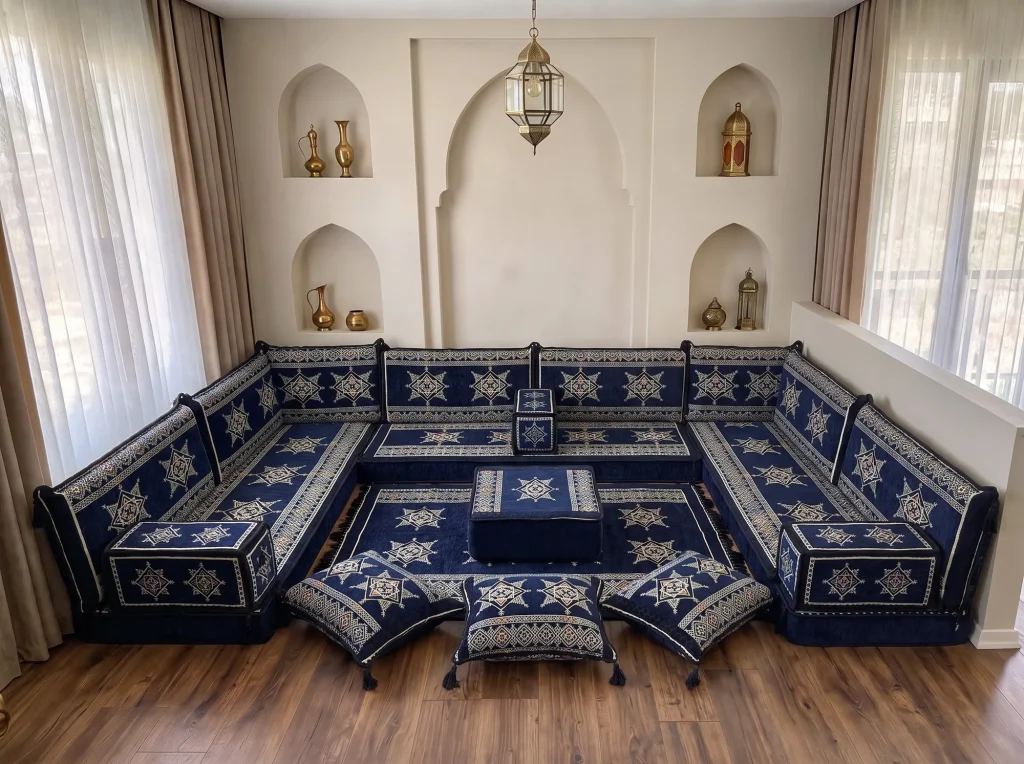
The navy floor sofa above uses a star motif. That is a Sofhu design. It is popular, and it looks at home in a Gulf guest room, but it is not a pattern we attribute to Oman or to any single tradition.
How to order an Omani majlis from Sofhu
Sofhu is the manufacturer. Sets are made in Türkiye from your measurements and shipped free worldwide, to Oman and to Omani families living abroad.
- Measure each wall the seating will run along, and note doors, windows and anything fixed to the wall. Our guide on how to measure a room for a majlis shows what to write down.
- Tell us the kind of room: family majlis, formal guest room or community hall.
- Choose a seat level, a layout and a fabric direction. Photos of the room help.
- Send it all through get a quote by measurement or on WhatsApp.
The set is vacuum packed for transport and expands when the bags are opened. Shipping is free; duties or taxes may apply depending on the destination, so ask us before ordering. For the wider range, start at the Arabic majlis page, and for one-off rooms see custom majlis. Neighbouring traditions are described on the Bahraini majlis page.