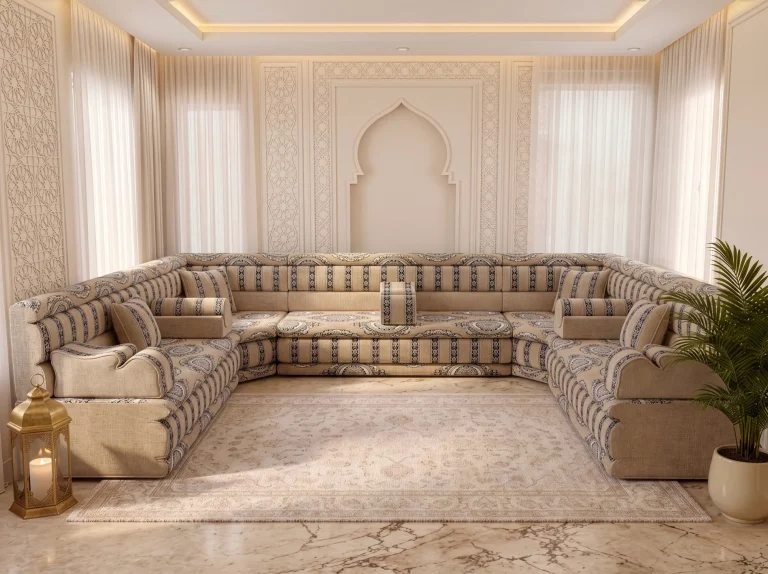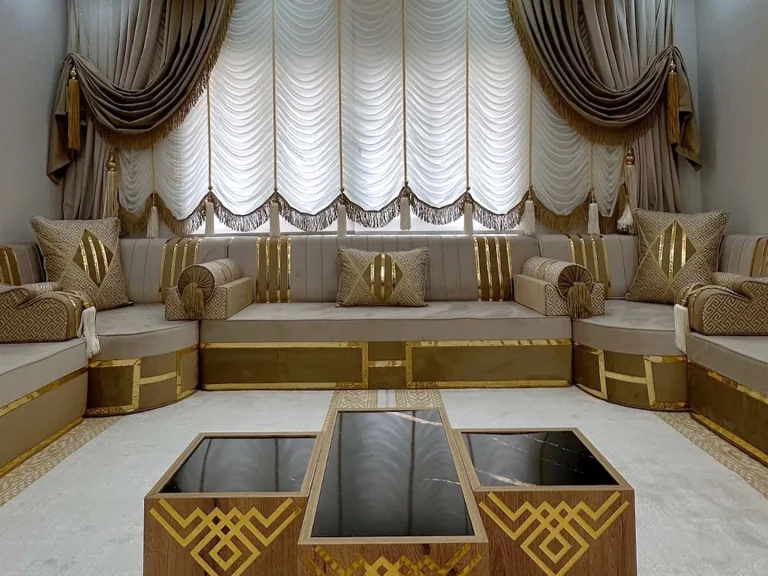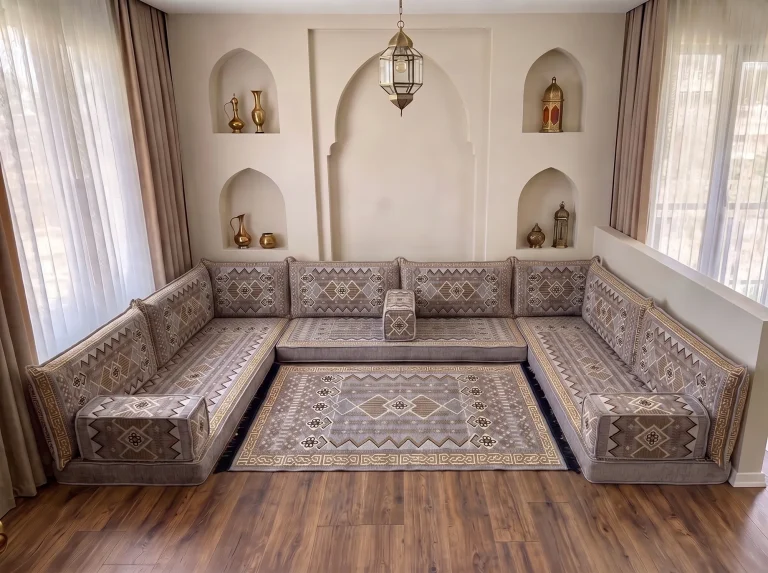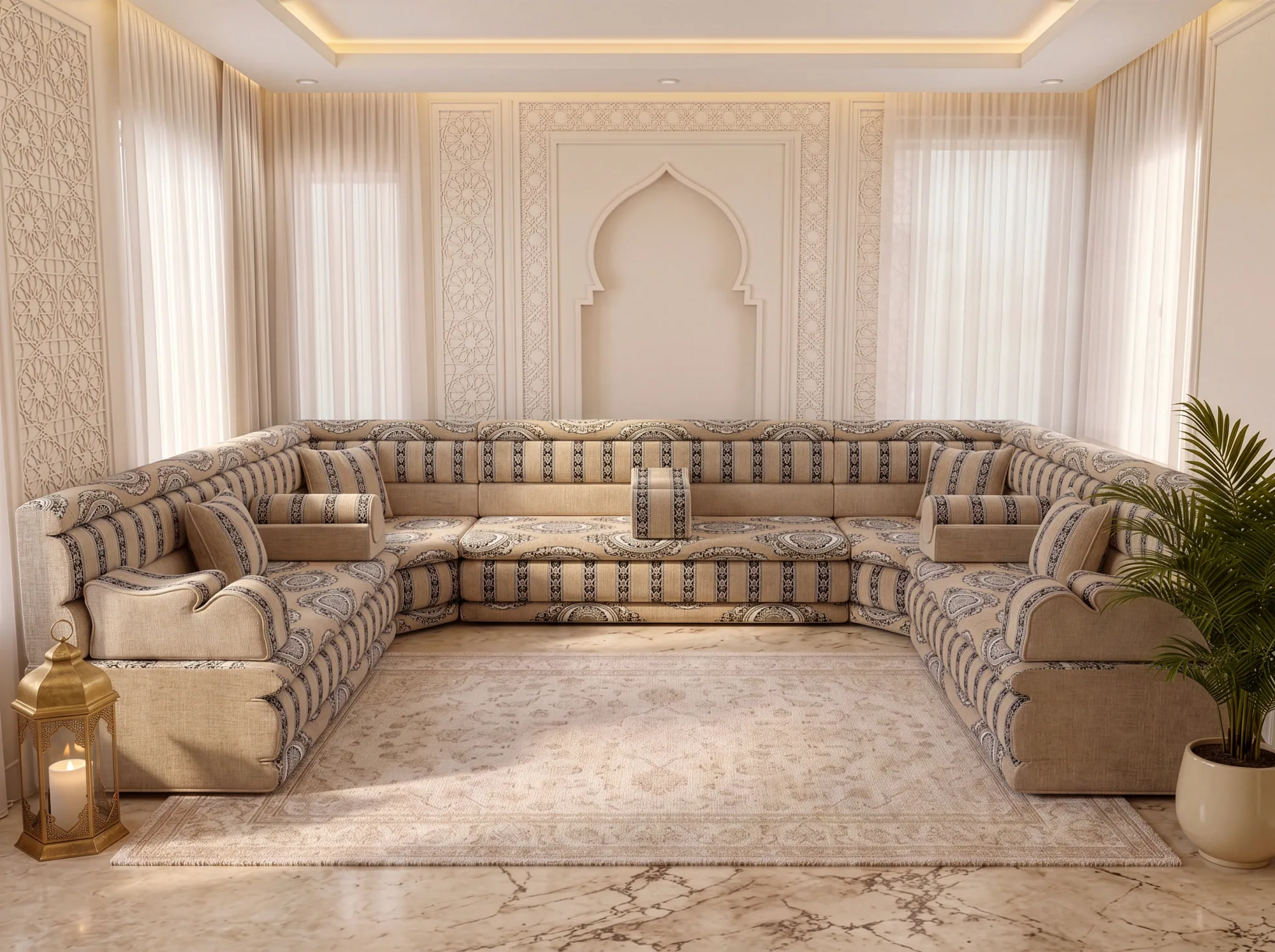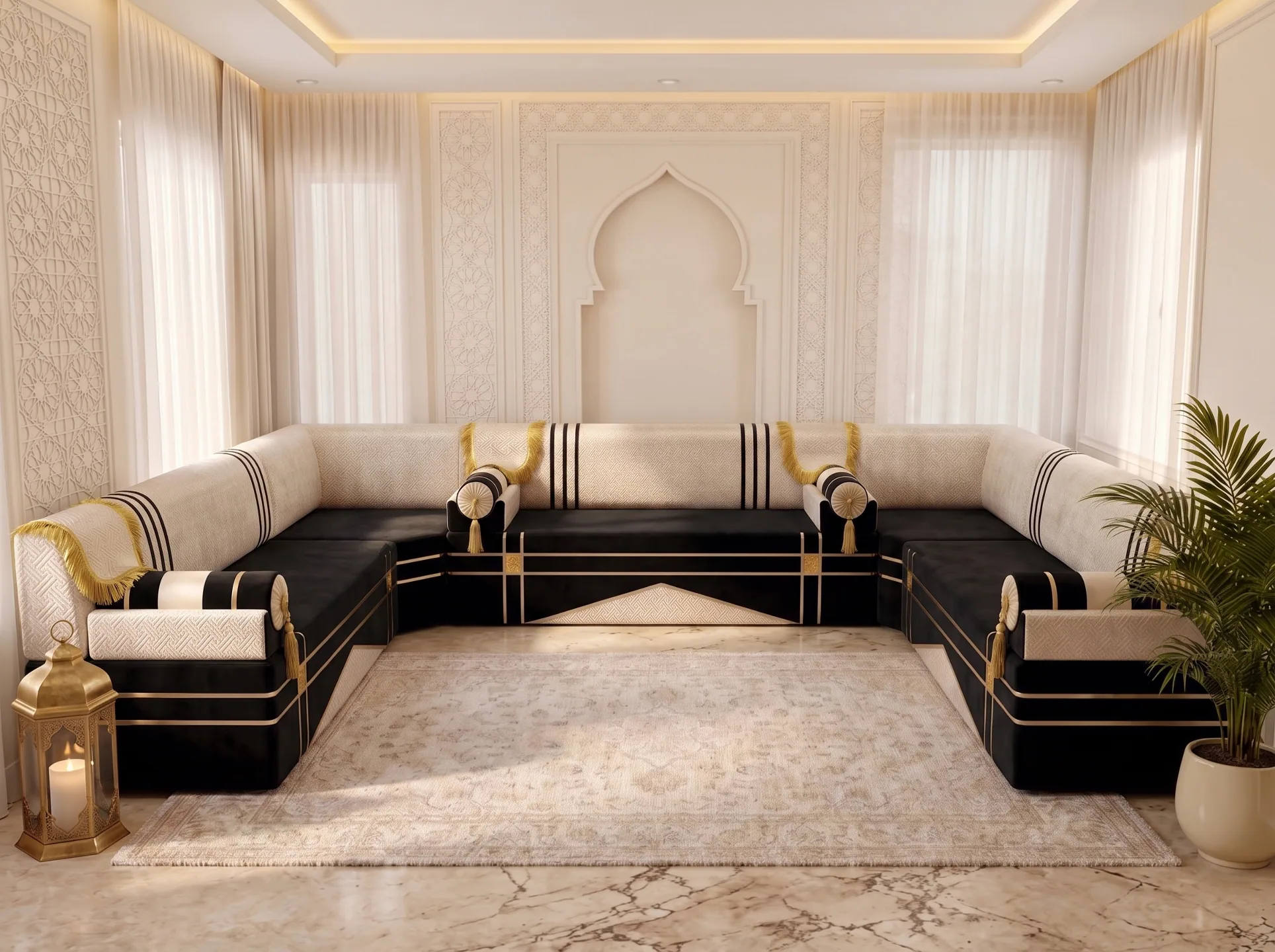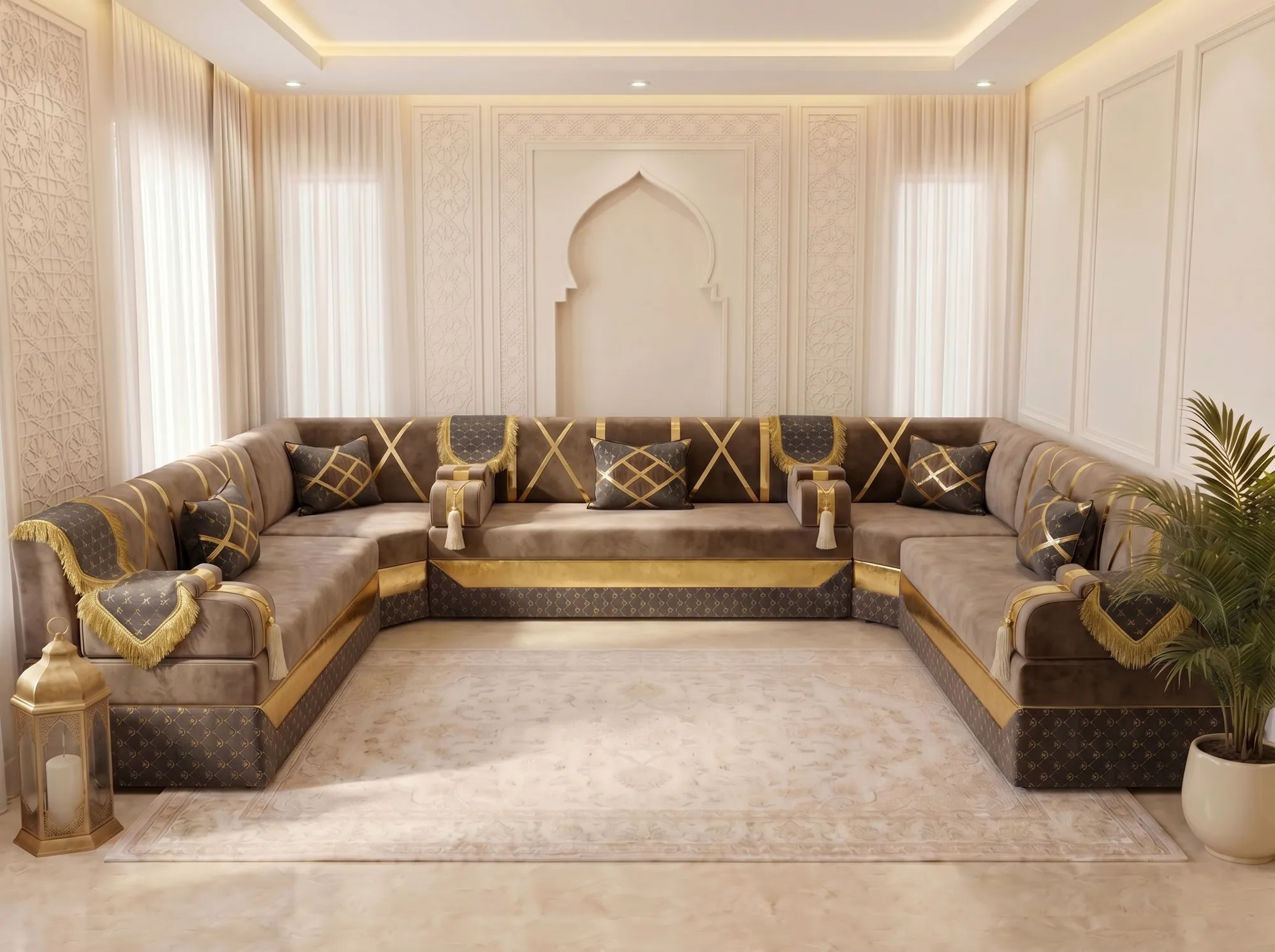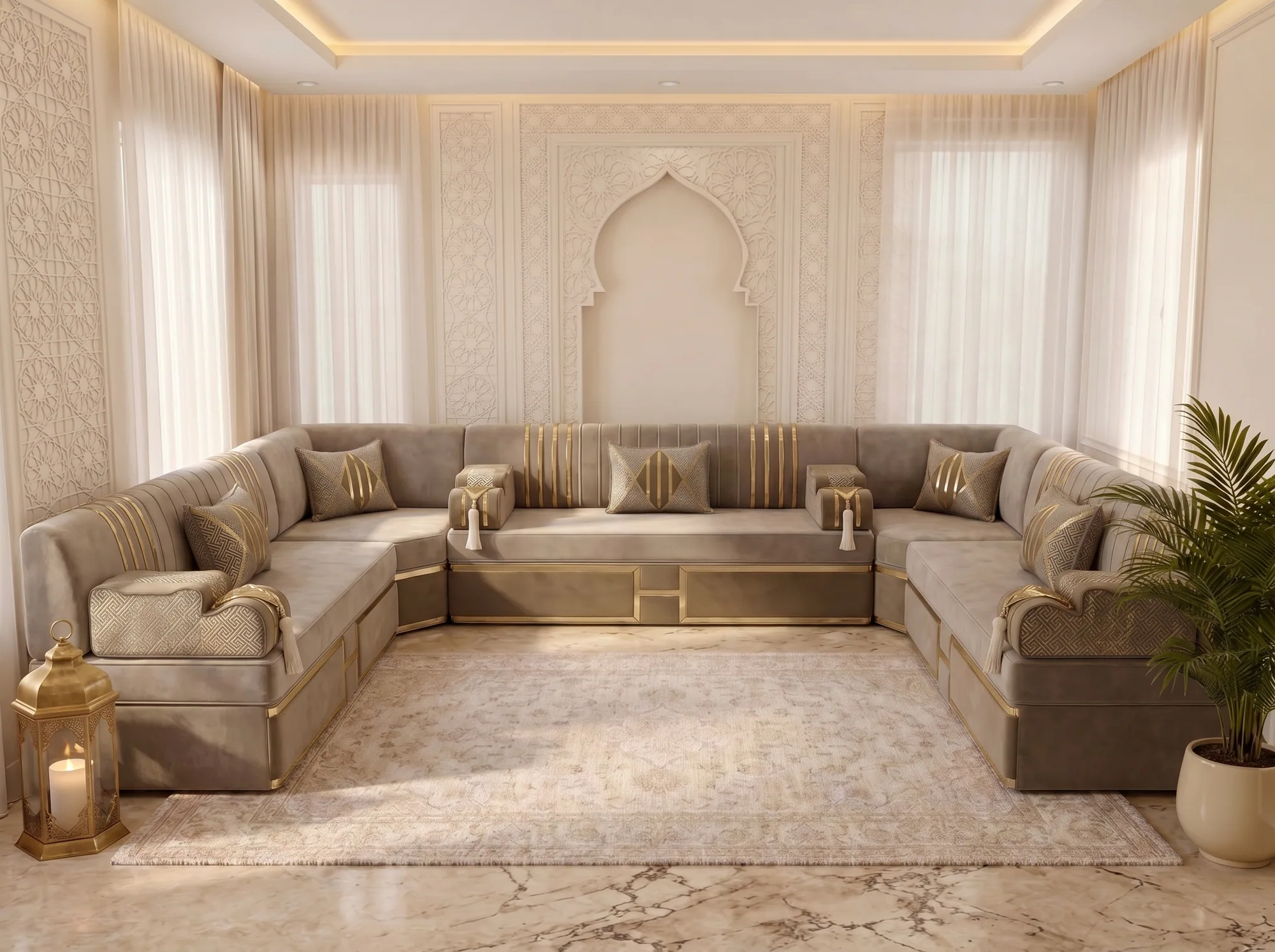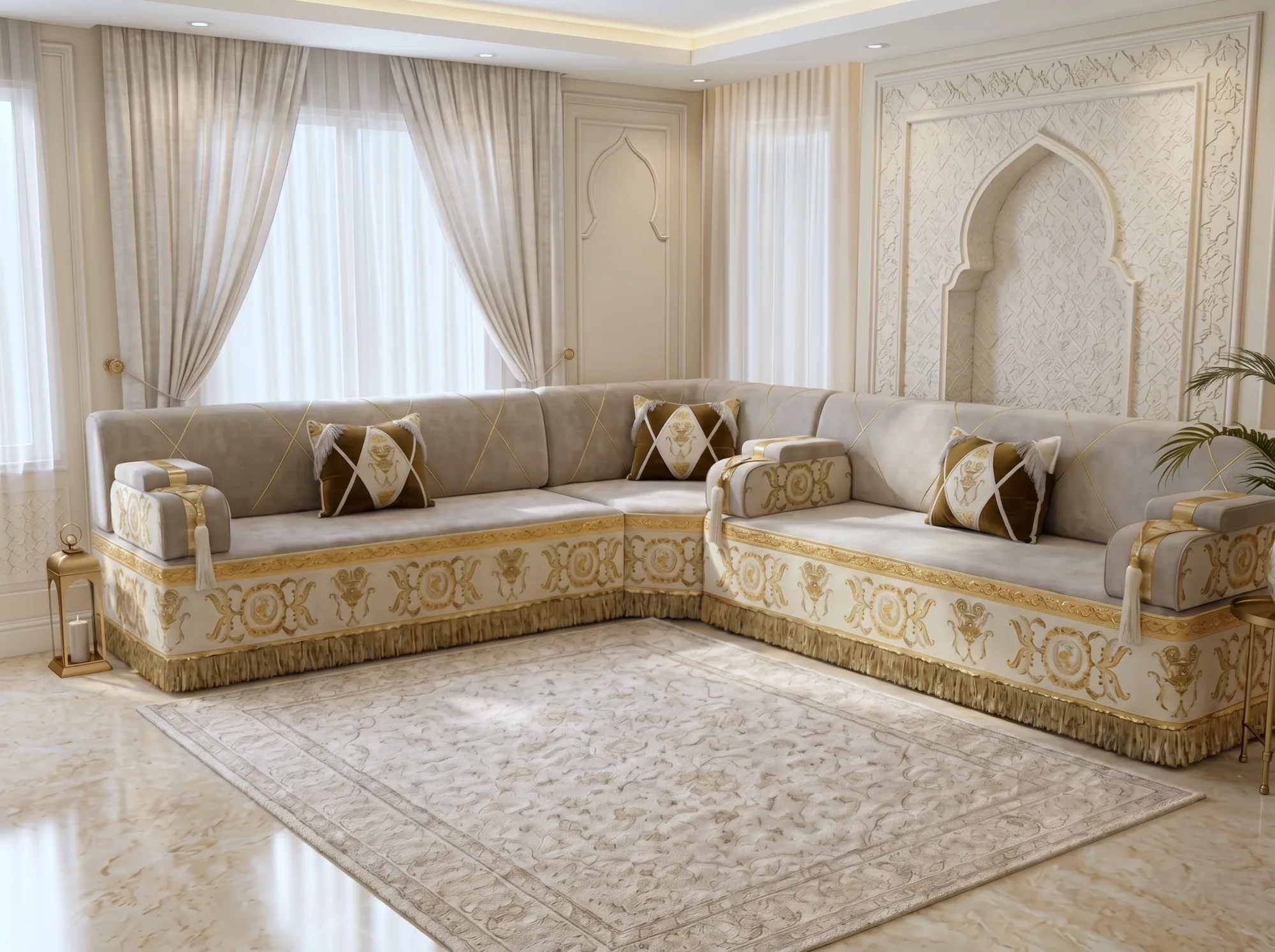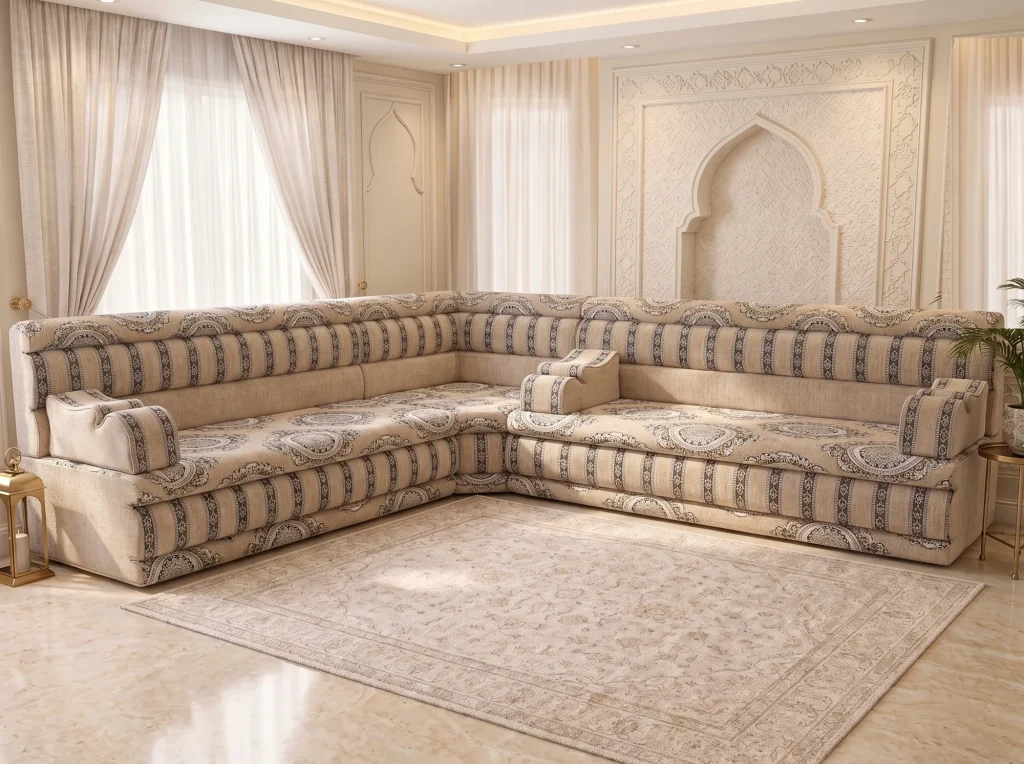
Sofhu builds Arabic majlis and floor sofa sets in Türkiye to the buyer's wall measurements and ships them free to all six GCC states: Saudi Arabia, the UAE, Qatar, Kuwait, Bahrain and Oman. Each state clears imports through its own customs authority under the GCC's common tariff framework. Send the room measurements for a quote and ask how customs duty and VAT are handled for your country.
- Countries covered
- Saudi Arabia, UAE, Qatar, Kuwait, Bahrain, Oman
- Shipping
- Free worldwide; MENA is a Sofhu priority market
- Customs
- Each state's own authority, under the GCC common tariff
- Made to measure
- From your wall lengths: single row, L-shape or U-shape
- Foam
- 32 DNS, meaning 32 kg/m³ density; softer or firmer on request
- Local outlets
- None; built to order in Türkiye and delivered to your door
On this page
The Gulf does not need anyone to explain the majlis to it. Local upholsterers and furniture makers are not hard to find. So a guide to majlis delivery across the GCC from a workshop in Türkiye has to be about practical matters only: what Sofhu makes, how a large room is measured from a distance, which authority clears the shipment in each state, and what happens on delivery day.
Sofhu is a manufacturer. Each set is built in Türkiye to the wall lengths the buyer sends, and shipping is free worldwide.
Why some Gulf buyers order from Türkiye
There are three plain reasons, and none of them is that local makers fall short.
Buying from the maker. The person you send measurements to is the workshop that cuts the foam and sews the covers. Layout, fabric, foam feel and stitching details are decided in one conversation, by message or video call.
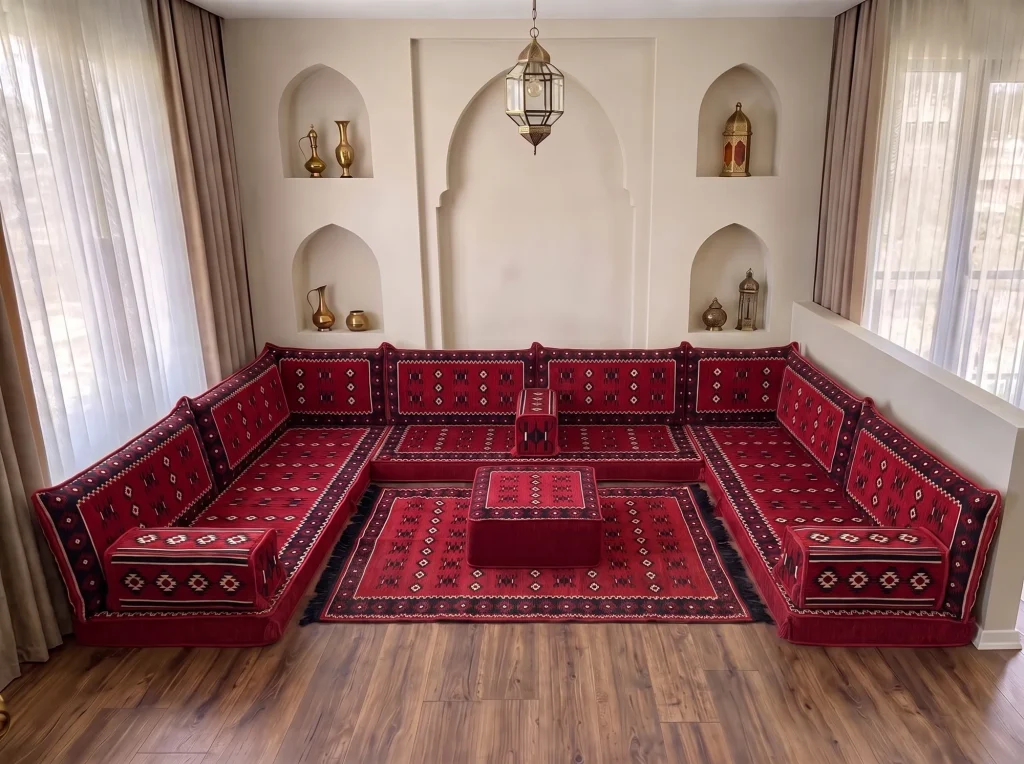
Two products and a Turkish line. Sofhu makes the Arabic majlis, raised to sofa height and fully upholstered, with a solid base, tall fixed backs and arm bolsters, and the Arabic floor sofa, a low seat mattress with loose back cushions, an ottoman and floor pillows. It also makes a Turkish majlis on a frame of solid beech with hand-carved accents and velvet-textured upholstery, described on the Turkish majlis by Sofhu page. Interior designers in Dubai note that many modern villas now use raised divan seating in the majlis, while floor-level seating remains the classic form. One maker can supply both.
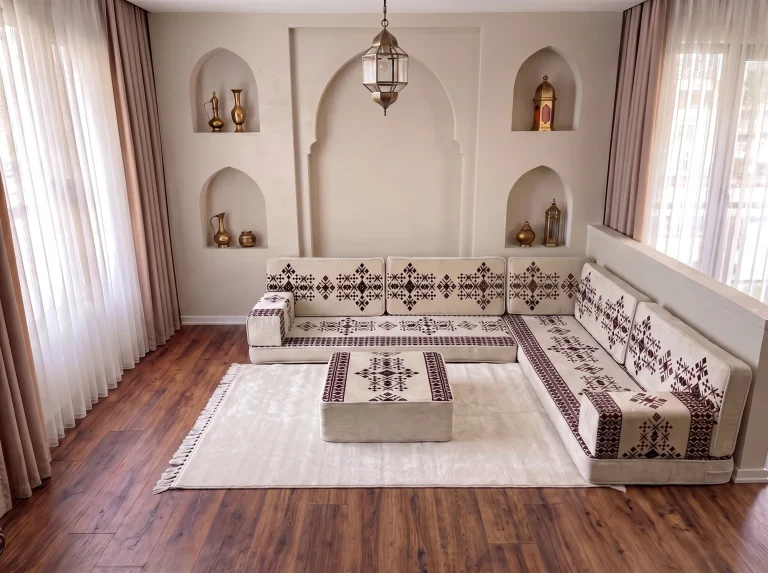
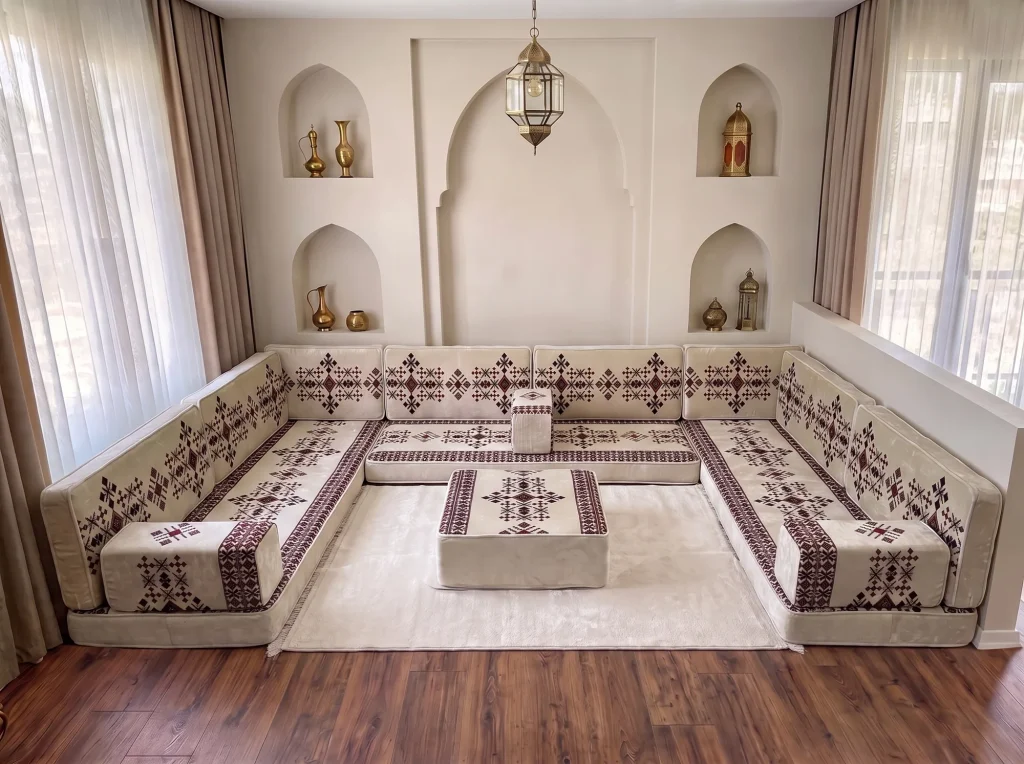
Fabric range. Velvet, chenille, linen and woven kilim-type fabrics are offered, and the designs include sadu-pattern floor sofas such as the cream one below.
Six countries, six customs authorities
The GCC states formed a customs union in 2003 and apply a common external tariff to goods arriving from outside the bloc. Clearance itself is national. Each state has its own authority, its own electronic system and, where it has introduced one, its own VAT.
| Country | Customs authority | Sofhu page |
|---|---|---|
| Saudi Arabia | Zakat, Tax and Customs Authority (ZATCA) | Arabic sofa in Saudi Arabia |
| UAE | Federal customs authority, with Dubai Customs, Abu Dhabi Customs and other emirate bodies | Arabic sofas in UAE |
| Qatar | General Authority of Customs | Arabic sofas in Qatar |
| Kuwait | General Administration of Customs | Arabic sofas in Kuwait |
| Bahrain | Customs Affairs | Arabic sofas in Bahrain |
| Oman | Directorate General of Customs, Royal Oman Police | Arabic sofa in Oman |
No duty or VAT rate appears in this guide. The figures belong to those authorities, they are published on their websites, and they were not confirmed with Sofhu for this article. What a buyer should do is the same in all six states:
- Ask Sofhu for the tariff code and declared value on the commercial invoice.
- Ask what origin document travels with the shipment. Gulf customs authorities commonly ask for a certificate of origin with commercial imports.
- Ask how duty, and VAT if your country levies it, are handled on the quote: included, or collected by the carrier on arrival.
- In Saudi Arabia, ask your carrier or clearing agent whether the goods need registering on the national product conformity platform before shipment.
Sofhu confirms free shipping. How duties are treated is not stated on its website, so get the answer in writing. This matters whether you want a majlis from Turkey to Saudi Arabia, a Turkish majlis in the UAE, or to import furniture to Qatar for a new house.
Measuring a diwaniya or a large majlis
Reception rooms in the Gulf are bigger than the living rooms most measuring guides are written for. A Kuwaiti diwaniya is typically a U-shaped hall with its own door from the street. A Qatari majlis traditionally sits near the entrance of the house, facing the street. A Bahraini majlis is typically a long room lined with carpets and cushions. Scale changes how you measure.
Measure each wall in sections. On a long wall a tape sags and the reading drifts. Mark the wall every few metres, measure each section, add them up, then measure the whole length once as a check.
Record every opening. Large halls have more than one door: the guest entrance, the door to the house, a service door for coffee and food, sometimes a washroom door. Each breaks the run and each creates two open ends that need armrests.
Mark the air conditioning. Split units, floor-standing units and low return grilles need clear space. Note their position and height, as backrests must not block them.
Mark columns and niches. Give the width and depth of anything that steps out from or into the wall. A floor sofa leans on the wall behind it, and a majlis is built to line it, so the workshop needs the true line of the wall.
Say where the head of the room is. In a diwaniya the elders and the host sit at the head. Tell Sofhu which wall that is, so armrests, corner pieces and any centre feature are planned around it.
Decide the armrest rhythm. On a long run, armrests divide the seating into places. More armrests mean fewer but more defined seats. The guide to how many people a majlis seats helps with that decision.
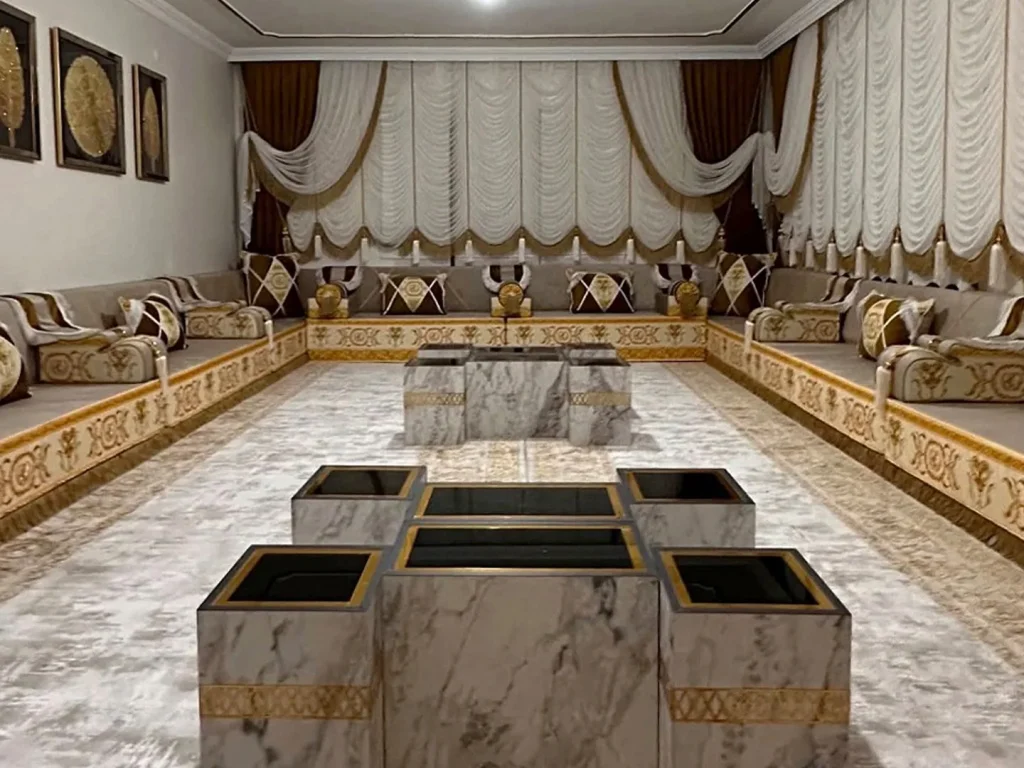
For custom majlis delivery in Kuwait or anywhere else in the region, a phone video walking slowly round the room is a useful addition to the sketch. The full method is on the custom majlis page. The style pages for the Kuwaiti diwaniya, the Qatari majlis, the Saudi majlis and the Emirati jalsa describe how the room is used in each tradition.
Fabric and foam for Gulf rooms
Rooms in the Gulf are air-conditioned for most of the year, so indoor fabric choice is less about heat than about use. A formal majlis that receives guests weekly needs a hard-wearing weave. Sofhu describes its velvet as durable and easy to clean, and its chenille as shedding very little. For a covered terrace or a room that is opened to the evening air, linen is the cooler fabric to sit on.
All covers are zipped and removable, and Sofhu states they can be machine washed at 30 degrees. In houses where coffee, tea and bukhoor are part of every visit, that is a practical point.
The cushions are filled with 32 DNS polyurethane foam, which means foam weighing 32 kg per cubic metre. Density indicates how well a cushion keeps its height over time, not how hard it feels. On custom orders you can ask for a softer or firmer foam. For a room where elders sit for long evenings, say so, and discuss the seat height and firmness with the workshop.
Timing an order around Ramadan and the camping season
Demand for seating in the Gulf follows the calendar. Ramadan is the peak season for visiting. In Bahrain, for example, guests move from one majlis to another through the night after iftar and the evening prayer. Eid, weddings and the cooler months of desert camps follow.
Sofhu has not published production or delivery times, and this guide will not guess at them. The practical advice is to ask for a current estimate with your quote and to order well ahead of the date you need the room ready, leaving a margin for customs clearance. If the set must be in place before the first night of Ramadan, say so in your first message.
Delivery day
Majlis shipping to Oman, Bahrain or any Gulf address ends the same way. A floor sofa arrives vacuum-packed in sealed bags, as separate seat mattresses, back cushions and armrests. A majlis comes as separate upholstered units. Either way, the seating for a large hall comes as separate pieces and not one rigid frame, which helps in compounds with long walks from the gate and in apartments above ground level.
Have the room empty and the walls clear. Open the bags without a blade near the fabric and give the foam time to regain its shape. Lay the pieces out along each wall in order before pushing them into place. The sequence is described in how a majlis is packed and delivered.
How to start
Send the room measurements, photos or a video, your city and district, and the customs questions listed above through the quote form or on WhatsApp. The Arabic furniture store page explains how buying direct from the manufacturer works. For the range available in each country, use the six country pages in the table.