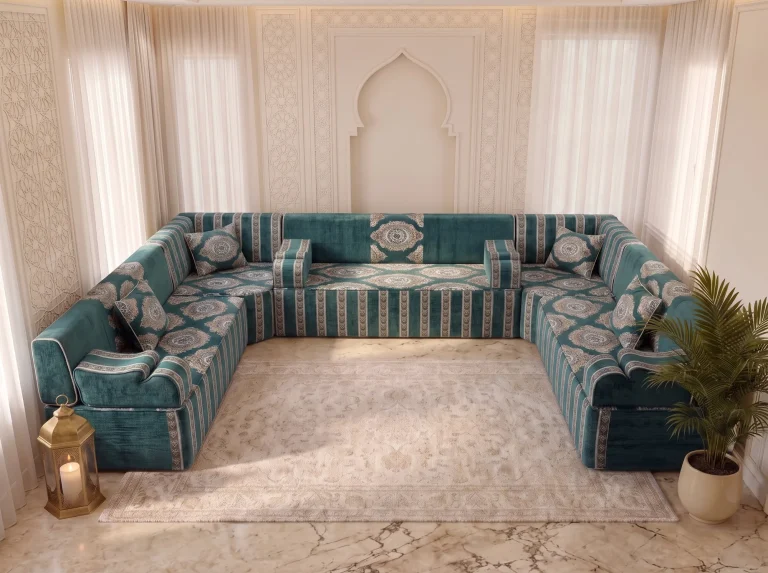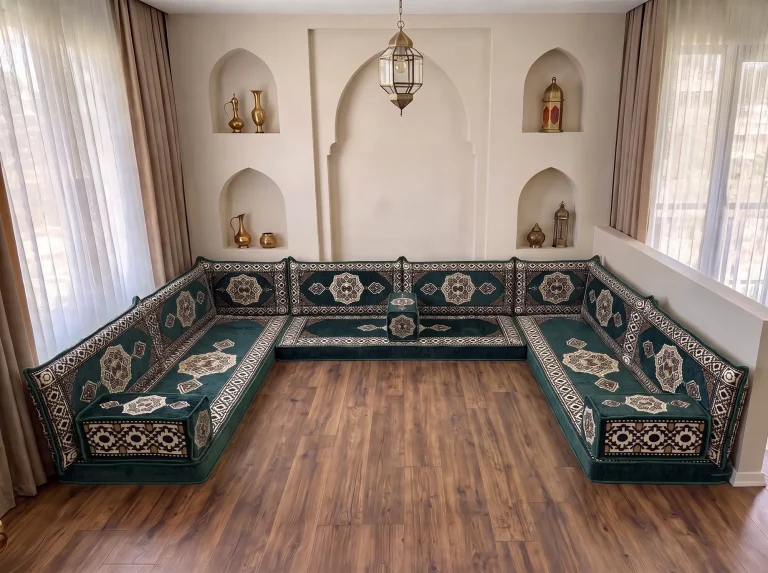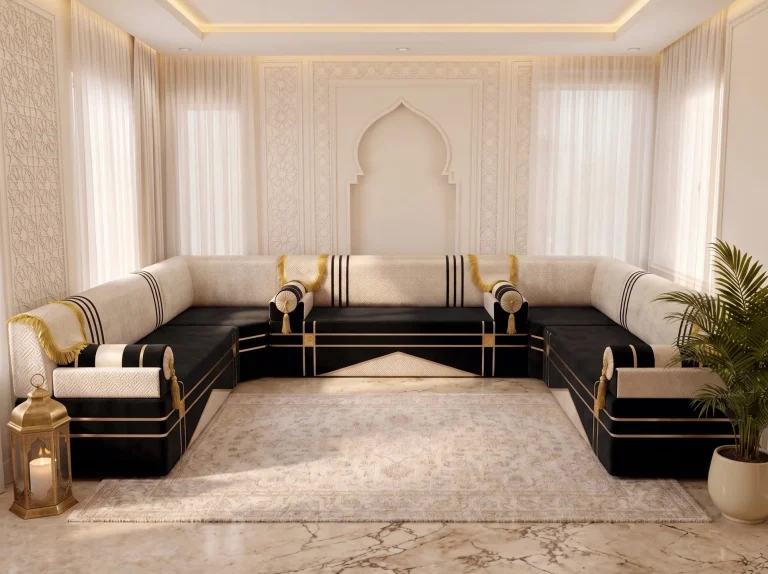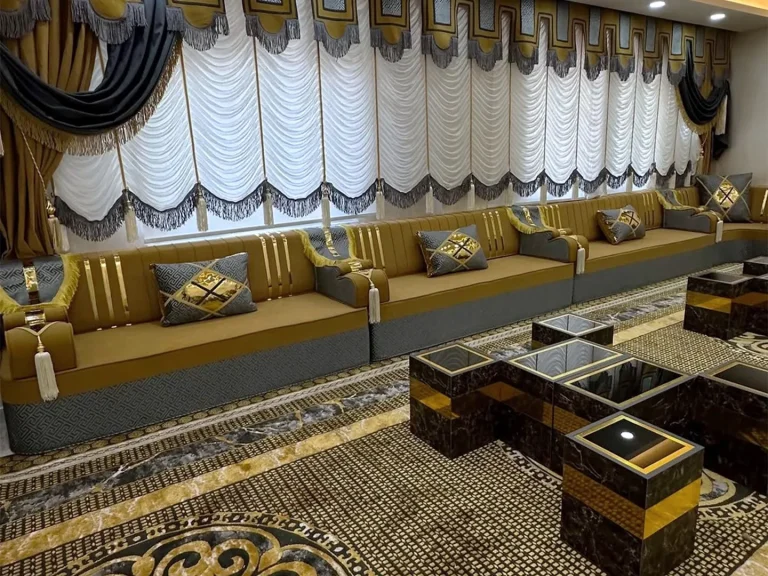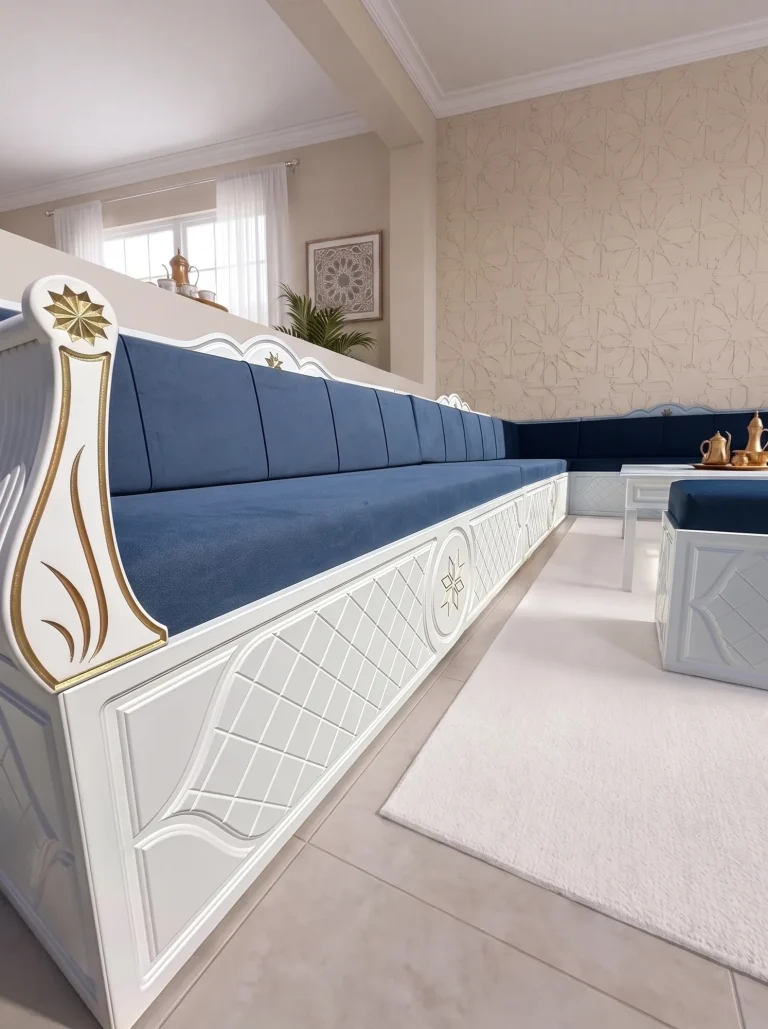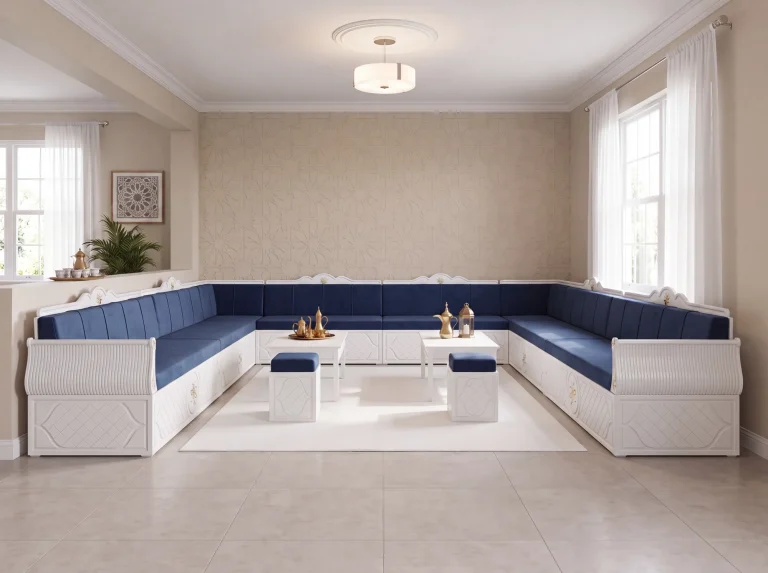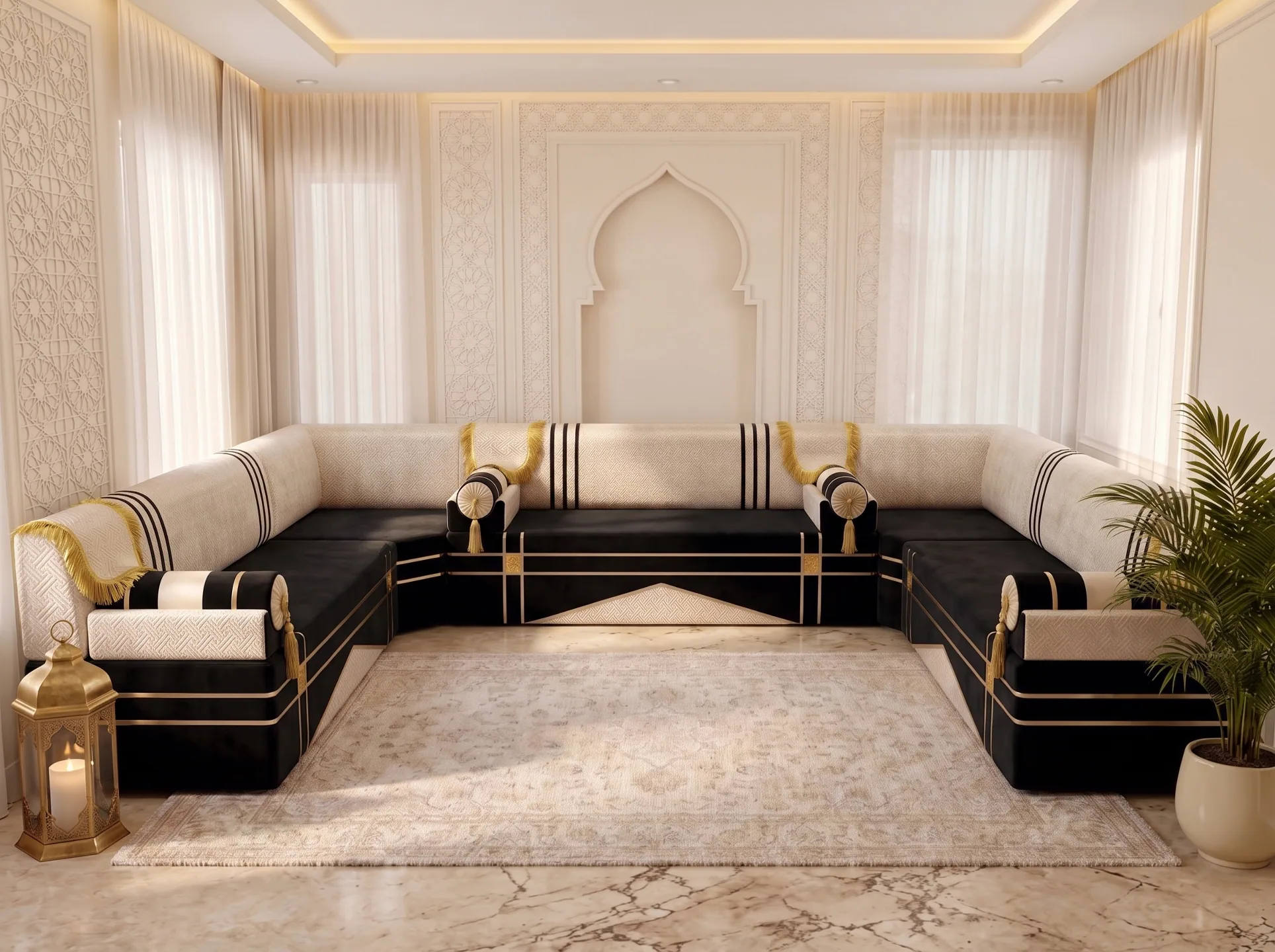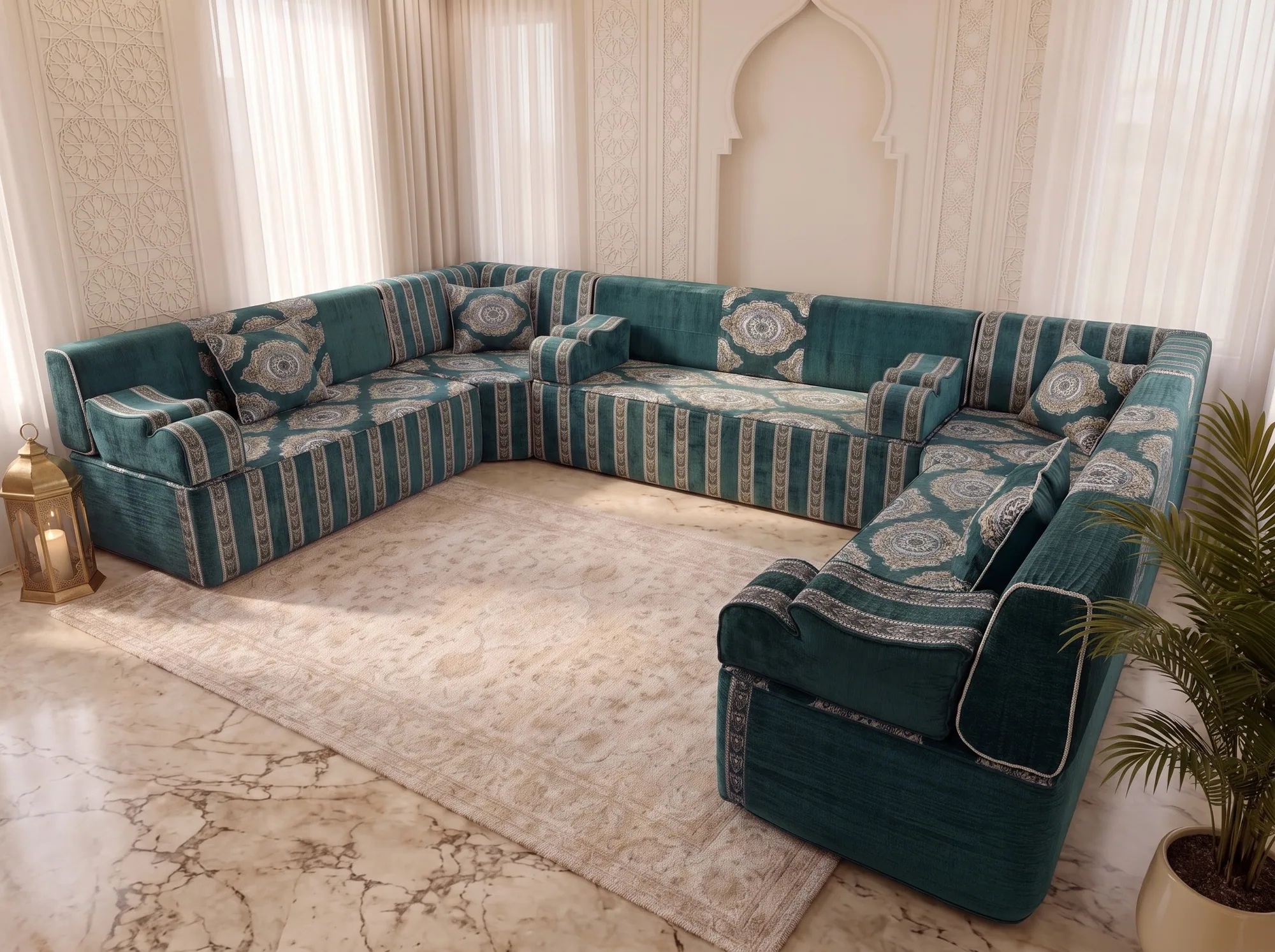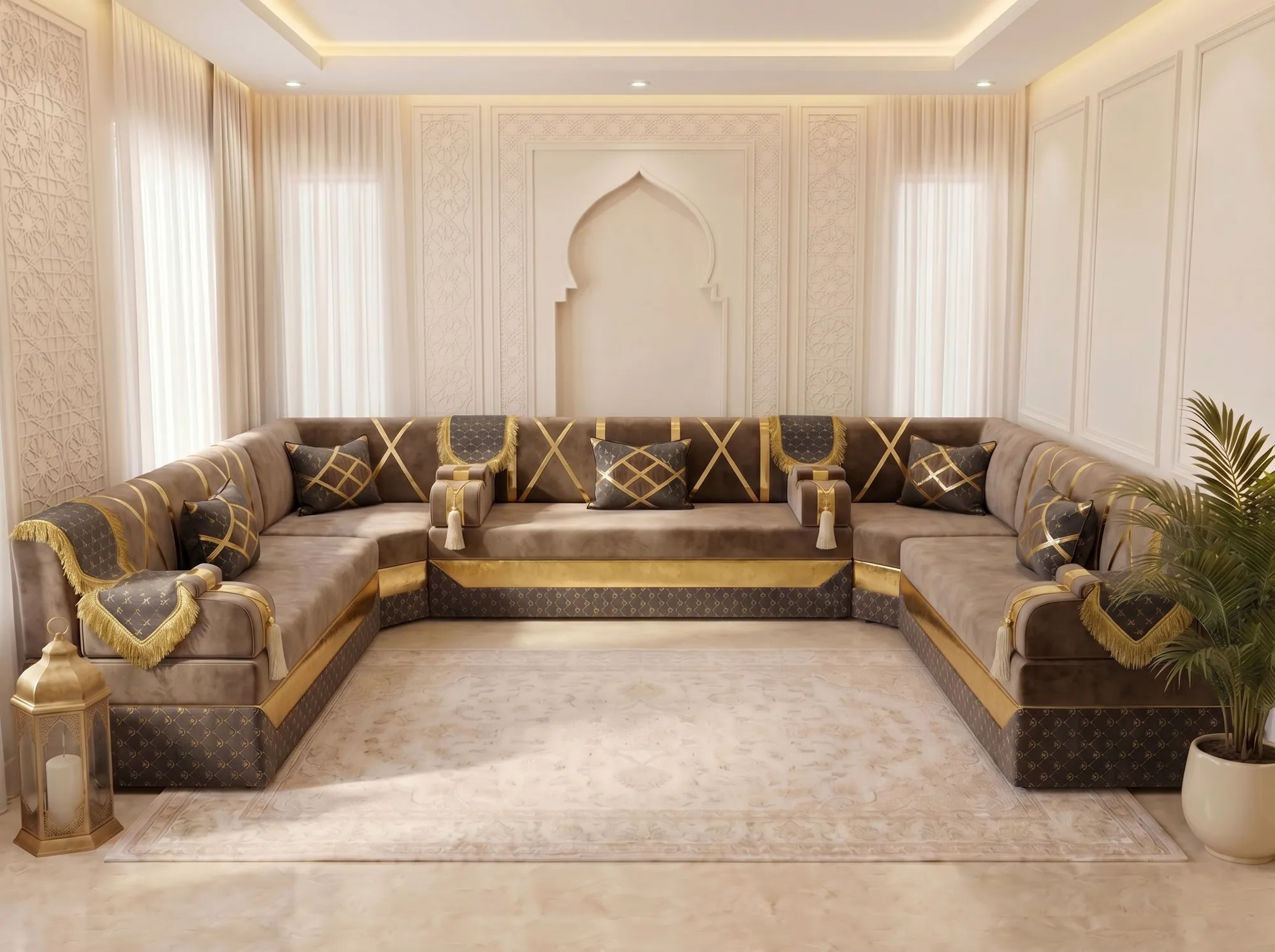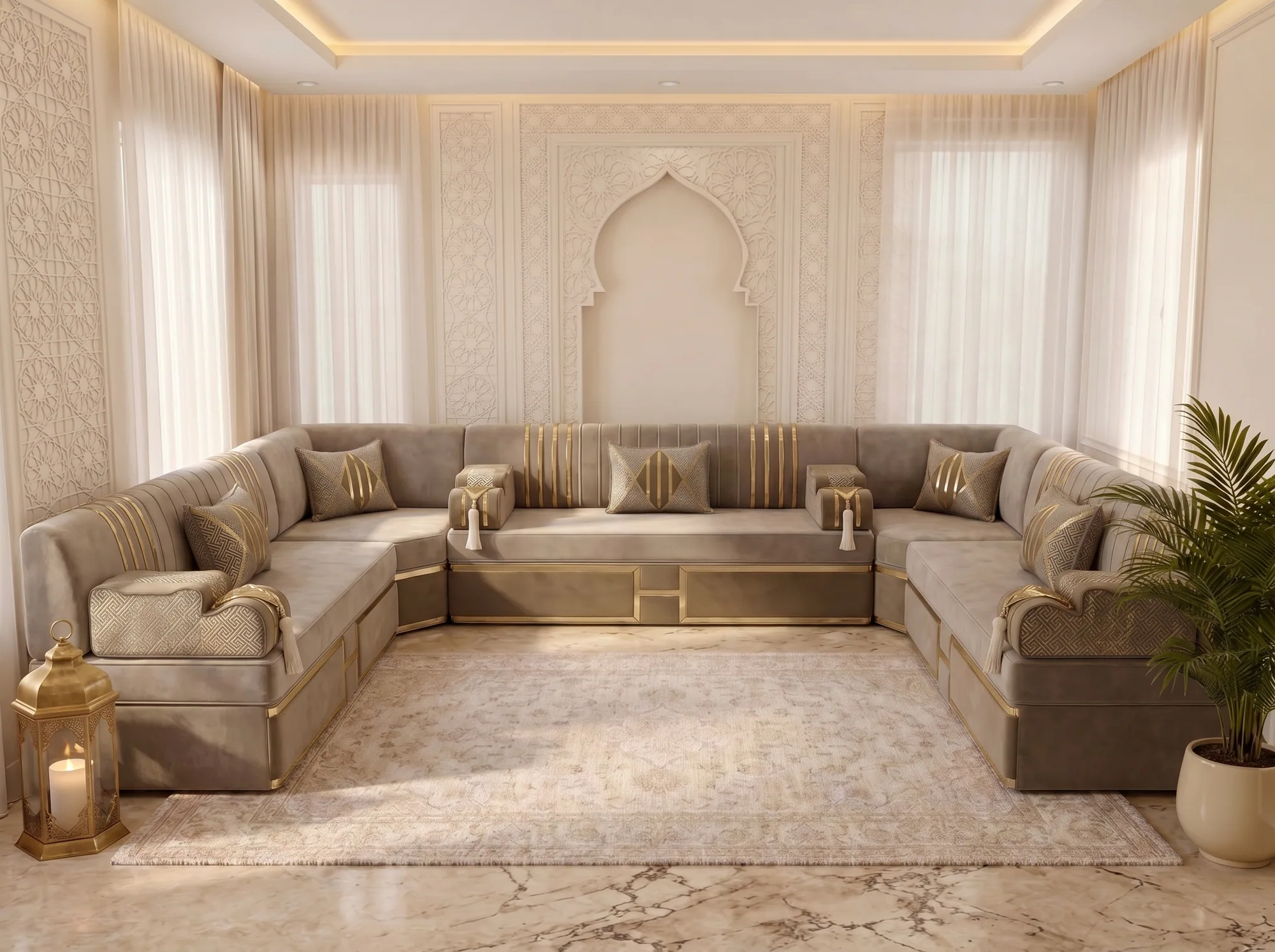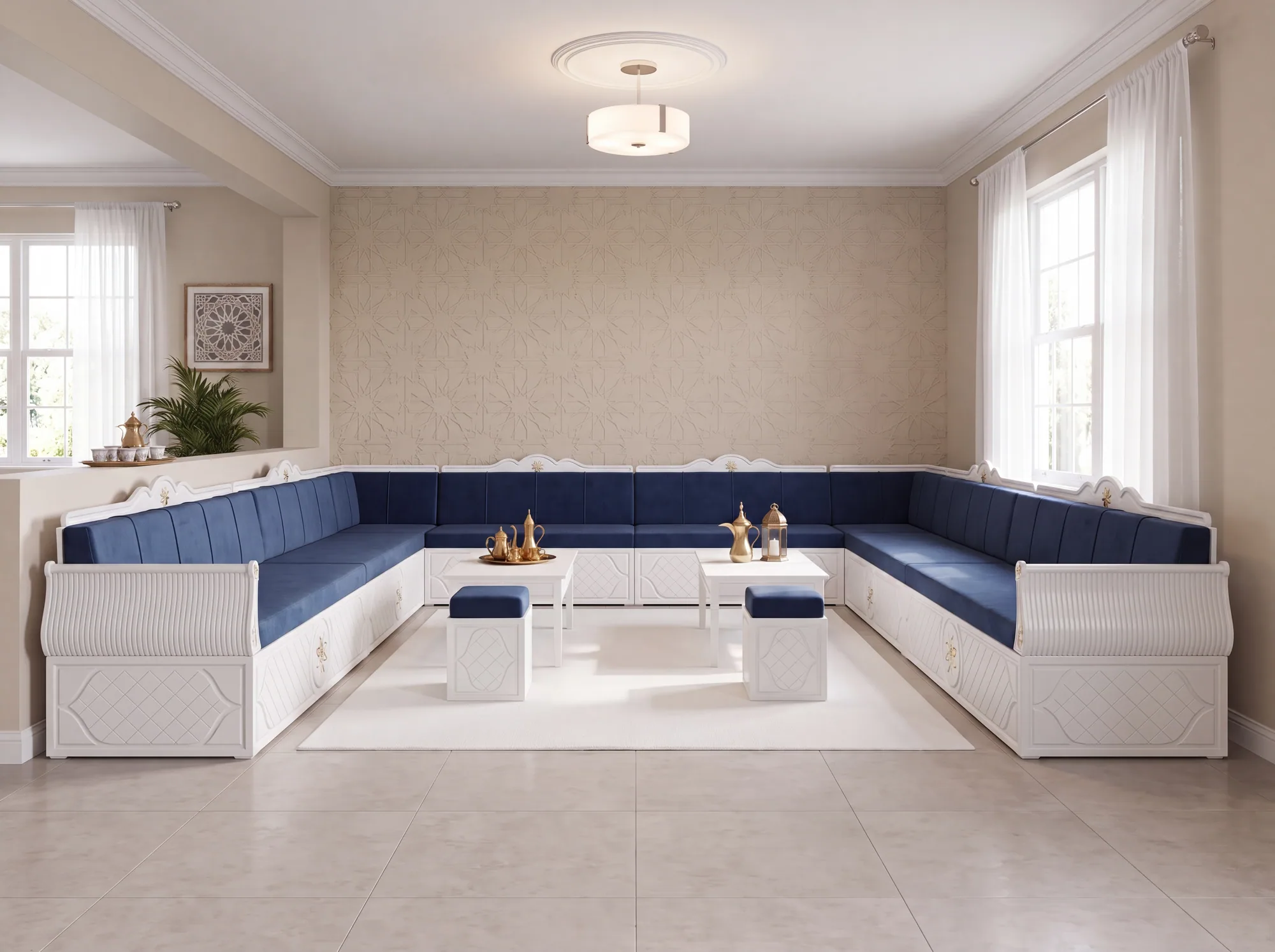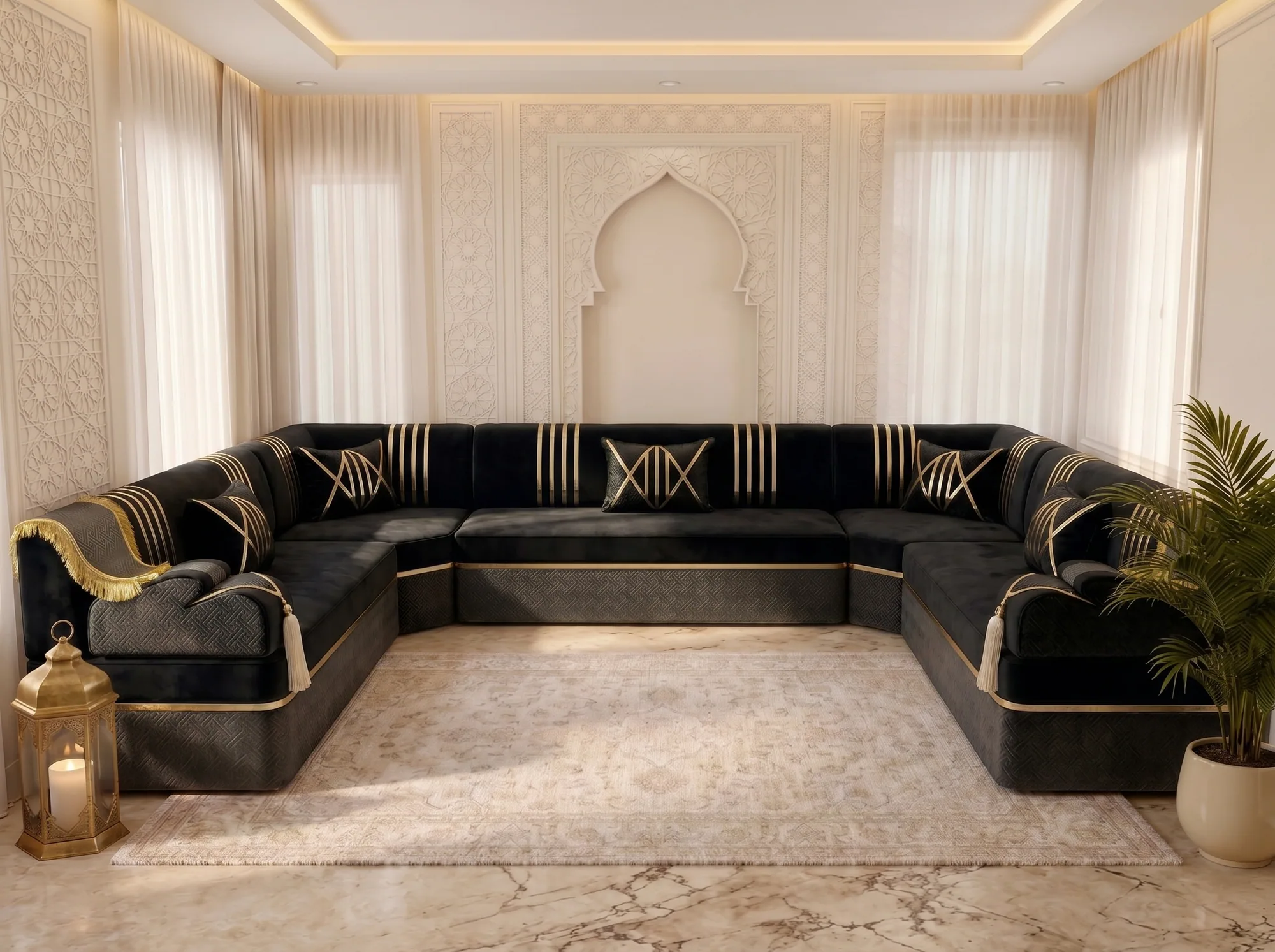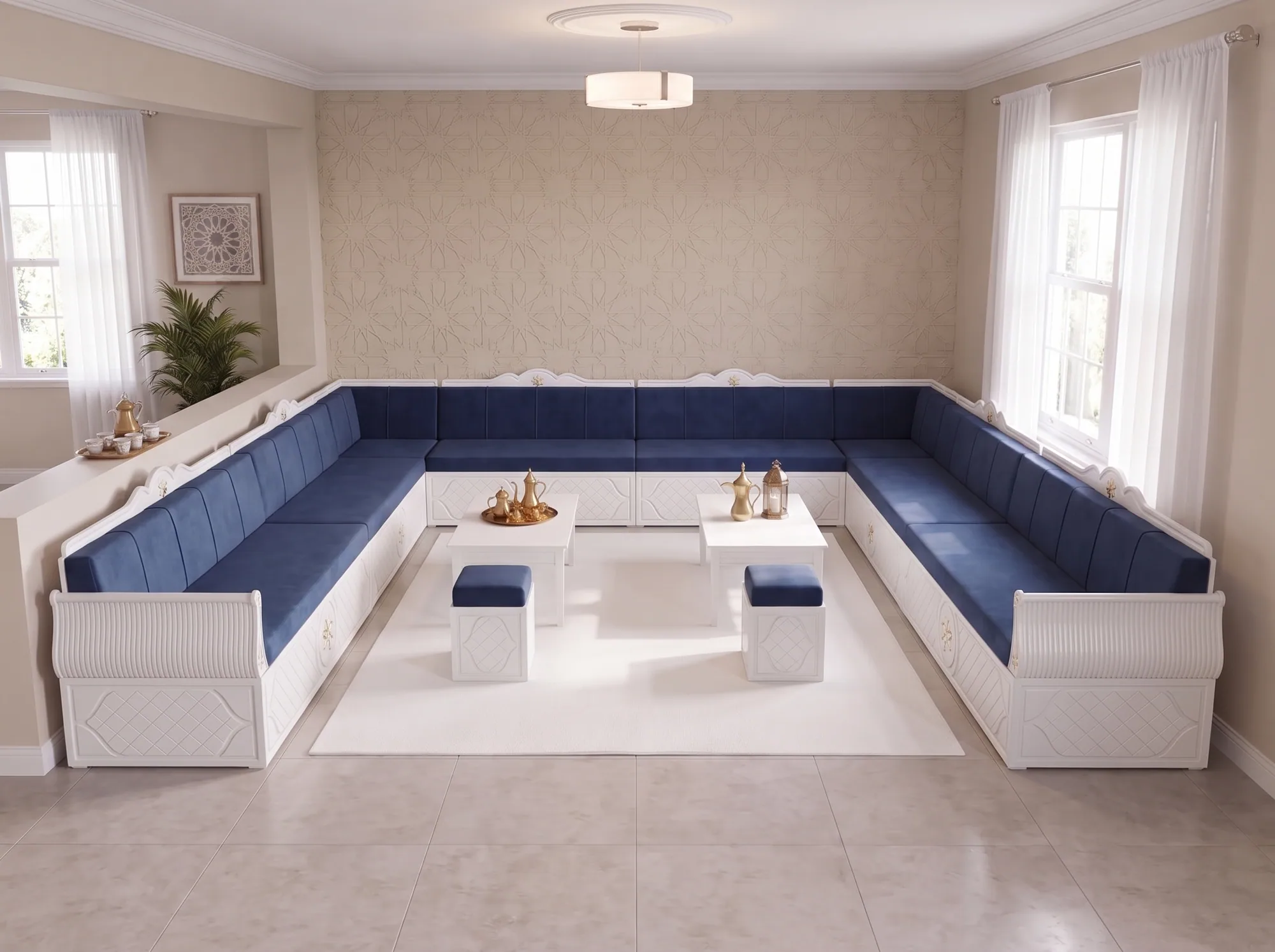
An office majlis is a reception room where visitors are received seated around the walls instead of across a desk. Formal versions use raised seats with upright backs in a U shape, with the host and principal guest at the head of the room, away from the door. Sofhu builds raised majlis sets and low floor sofas to an organisation's measurements or drawings.
- Purpose
- Receiving visitors seated, without a desk between
- Usual layout
- U shape, head of the room away from the door
- Formal option
- Raised seats on a carved wooden frame
- Informal option
- Floor sofas with back cushions and armrests
- Customisation
- Dimensions, fabric, colour, stitching, embroidery
- Maker
- Sofhu, manufacturer in Türkiye
- Shipping
- Free worldwide
On this page
In the Gulf, business often opens in a sitting room before it moves to an office. The office majlis exists for the first of those: a room where a visitor is seated, served coffee and listened to before any paper is produced. A company may keep one beside the chairman’s office. Consulates and cultural centres use one to receive delegations, and firms outside the region sometimes add one for visiting clients. This guide explains the choices that follow from protocol: how formal the seating should be, where people sit, which colours carry authority, and how to brief a designer and a maker.
Why organisations keep a majlis
A majlis says that the visitor is a guest before he is a counterpart. UNESCO describes the majlis as a cultural and social space where people gather to discuss events and issues, receive guests and exchange news, and it was inscribed on the Representative List of Intangible Cultural Heritage in 2015 on a joint file by the UAE, Saudi Arabia, Oman and Qatar. What was recognised is the practice of gathering, not a style of furniture, and that practice moved easily from the house to the workplace.
The Kuwaiti diwaniya shows how close the two have always been. It is described as a reception hall where a man receives business colleagues and male guests, attached to the house but with its own entrance from the street. A corporate reception room follows the same logic: near the entrance, separate from the working floor, and open to callers.
A majlis reception room serves several purposes at once:
- receiving clients, officials and delegations with proper hospitality
- holding conversations that are better had side by side than across a table
- hosting open hours when staff or members of the public may call on a senior figure
- giving visiting dignitaries a place to wait that is not a corridor
More on the regional customs is in the guides to the Kuwaiti diwaniya and the Saudi majlis.
How formal should an office majlis be? Raised seats and upright backs
The more formal the room, the higher and straighter the seat. Three levels cover most briefs.
| Level | Seating | Where it fits |
|---|---|---|
| State and executive | Raised seats on a carved wooden frame, upright backs, side tables between places | Chairman’s majlis, embassy reception, VIP majlis |
| Business | Raised or mid-height upholstered seating, firm and plain | Client lounge, branch reception, office guest room |
| Cultural | Floor sofas with back cushions and armrest blocks | Cultural centre, heritage room, staff majlis |
Raised seating has practical reasons behind it. Guests keep their shoes on. They wear tailored clothes that do not fold well. Some are elderly. An upright back keeps a sitter alert and makes it easy to rise when someone enters, which formal manners require often. Interior designers working in Dubai note the same shift in private villas, where raised divan seating has replaced the floor set in many modern rooms.
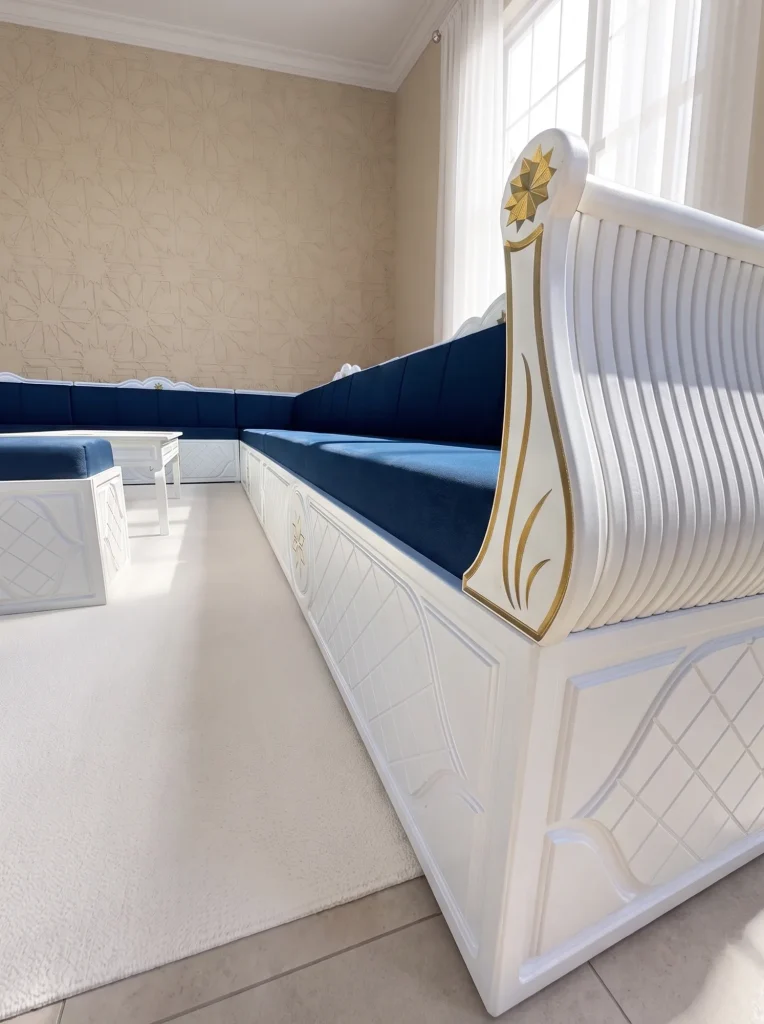
Sofhu’s Turkish majlis line is built this way: a frame of first-grade solid beech with hand-carved accents, upholstered seats and a matching carved coffee table. Its page on the Turkish majlis shows the type.
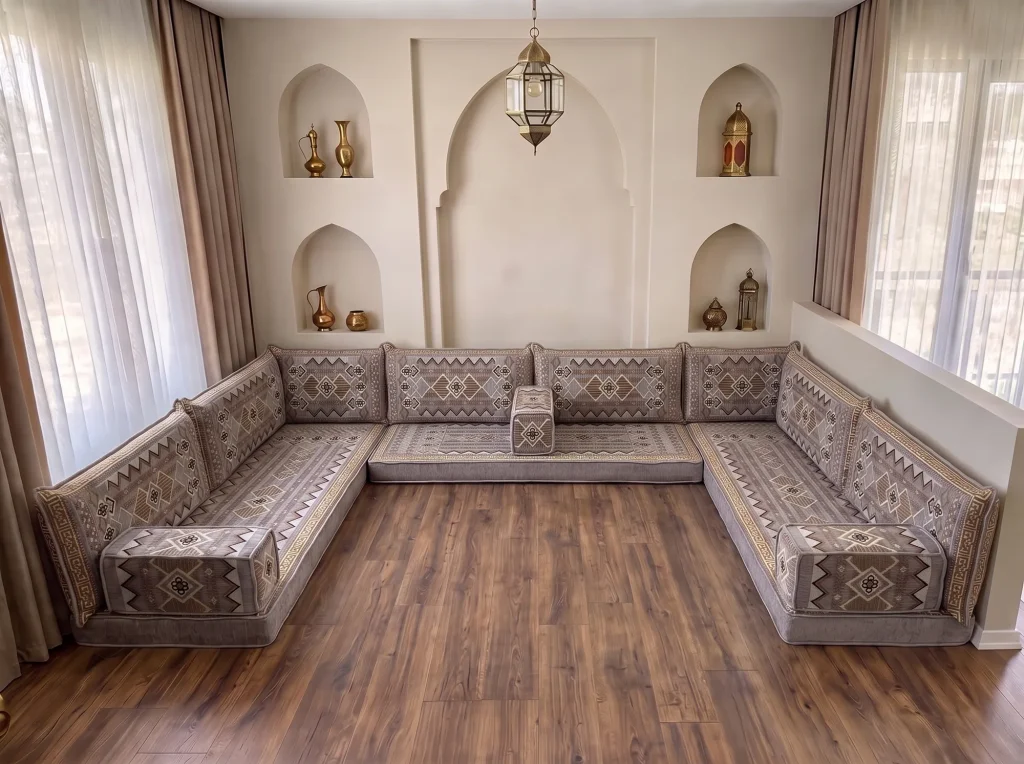
The low alternative is the Arabic floor sofa, a cushion set at floor level, which Sofhu makes alongside the raised, fully upholstered Arabic majlis. It still has a place at work. A cultural attaché’s office, a heritage company or a restaurant group may want the low seat because it is the thing being represented. In that case make it a complete set, with a firm seat, proper backrests and an armrest for every guest, and offer a few raised places as well. The majlis seat height guide compares the options.
Seating by rank and the head position
Where people sit is the part of corporate majlis design that cannot be left to the decorator.
The head of the room. A formal majlis has a head. It is normally the wall that faces the entrance or lies farthest from it. Accounts of the Kuwaiti family diwan describe a U-shaped hall with the elders seated at the head. In houses of northern Saudi Arabia the main guest’s seat is described as facing the hearth where coffee is prepared. The principle is the same: the place of honour is deep in the room, in view of the door, and away from the traffic.
Host and guest. The host sits at the head with the principal guest beside him. Others take places outward along the two side walls in rough order of seniority. Juniors and staff sit nearest the door, where they can come and go to serve.
What this means for the furniture.
- Make the head wall a continuous run with no door or column breaking it.
- Mark the centre of that run, with a pair of armrests, a slightly different back cushion or the room’s emblem above it.
- Put a side table or armrest tray between every two places so each guest has somewhere for a cup.
- Keep the two side runs equal in length where the room allows. Symmetry is read as respect for both sides of a delegation.
- Leave the centre floor open for serving. A large rug and one low table are enough.
Protocol varies by country, by ministry and by company. Where there is a protocol office, its seating plan comes first and the furniture is drawn to suit it. The manners expected of a visitor are in majlis etiquette for guests, and Sofhu’s earlier notes on hosting guests and meetings cover the host’s side.
Colours, logos and restraint
A formal room gets its authority from proportion and finish, not from decoration.
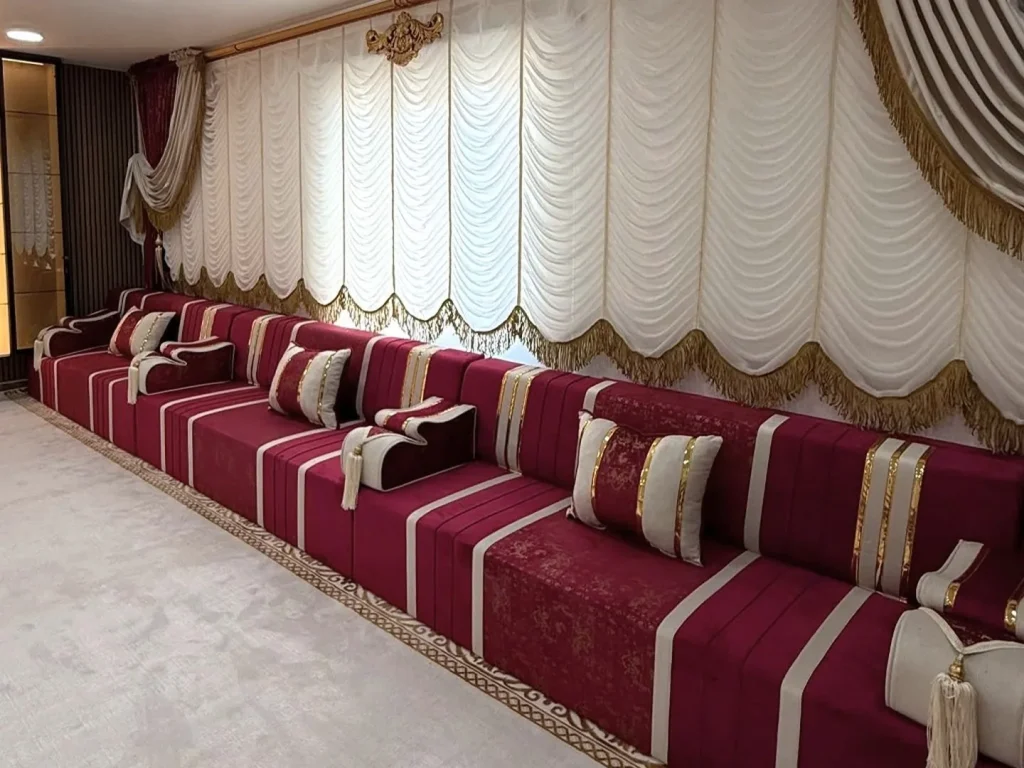
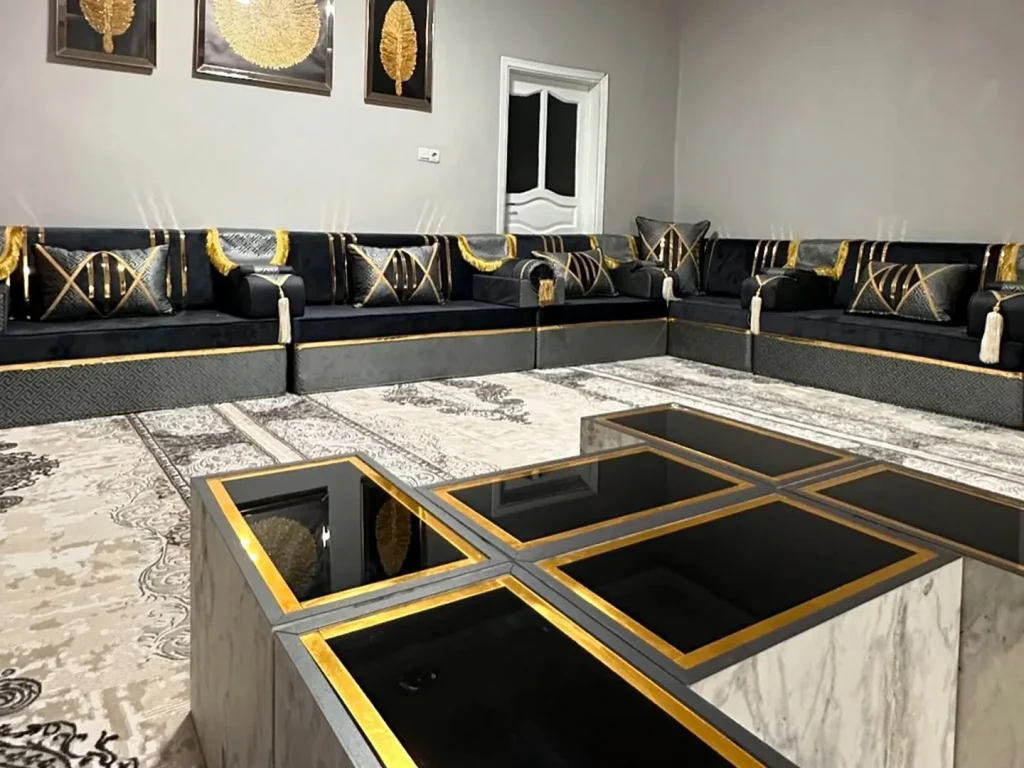
Colour. Choose one deep colour, one neutral and one metallic. Navy with white and gold. Deep green with cream and gold. Burgundy with cream. Charcoal with gold piping. These combinations read as formal without shouting, and they sit well behind people in official photographs. Ideas for the darkest palette are in black and gold majlis ideas.
Royal majlis as a style. When clients ask for a royal majlis they usually mean carved frames, velvet, tassels and gilded detail. It suits a ceremonial room. For a working reception, take one or two of those elements and leave the others. A carved end panel and plain velvet say more than every trim at once.
Logos. Use the emblem once, on the head wall or on a single cushion at the centre. Brand colours belong in the piping and the rug border. A room wallpapered in logos looks like an exhibition stand.
Fabric. Velvet gives depth of colour and Sofhu describes its velvet as durable and easy to clean. A tight woven or jacquard fabric shows less wear on seats used all day. Ask for zippered, removable covers so the room can be kept spotless between visits.
Working with an interior designer
A majlis ordered for an organisation is a project with several parties. It runs smoothly when each has what it needs.
- Fix the protocol first. How many guests are usually received, who sits at the head, where coffee is served from.
- Draw the room. A dimensioned plan showing every wall, door, column, socket and window sill height. Mark the head wall.
- Set the seat level. Raised, mid-height or floor-level, and whether any places differ.
- Choose fabric and trim with the designer’s material board in hand, and send photographs of the board.
- Agree the details: armrest spacing, tables, any embroidery, the rug.
- Confirm access. Lift size, stair width and delivery hours for the building.
Sofhu is the manufacturer. It builds each set in Türkiye to the measurements supplied, states that dimensions, fabric, colour, pattern and stitching can all be specified, and offers video calls with its designers during a project. Shipping is free worldwide. Organisations ordering for several sites can use the wholesale and project route, and hotels will find related notes on Sofhu’s page about majlis seating for hotels.
Prices and schedules are given by quote for each project. Duties or taxes may apply depending on the destination, so raise that with Sofhu and your own customs agent early. Read how a custom majlis is specified, browse the Arabic majlis range, then get a quote by measurement or send the drawings on WhatsApp.