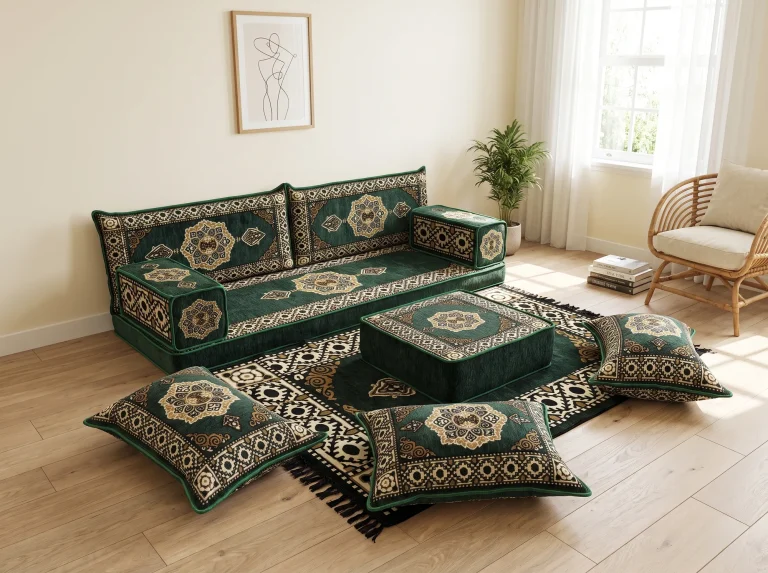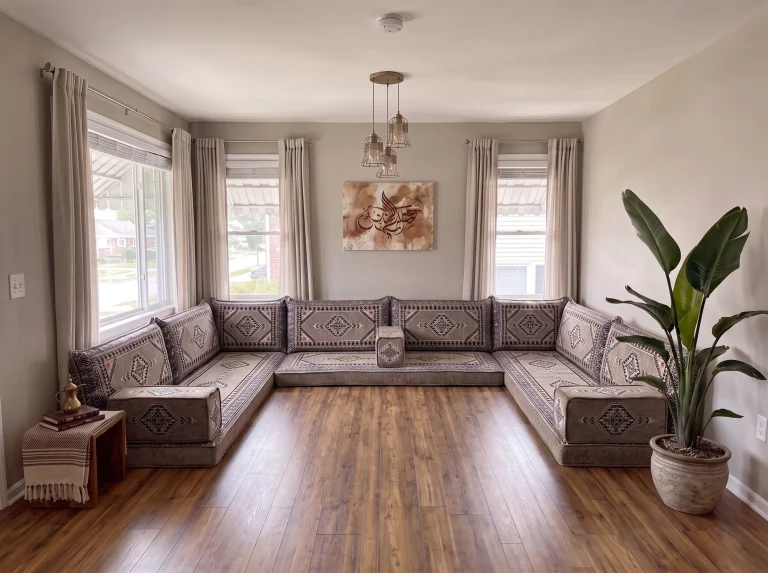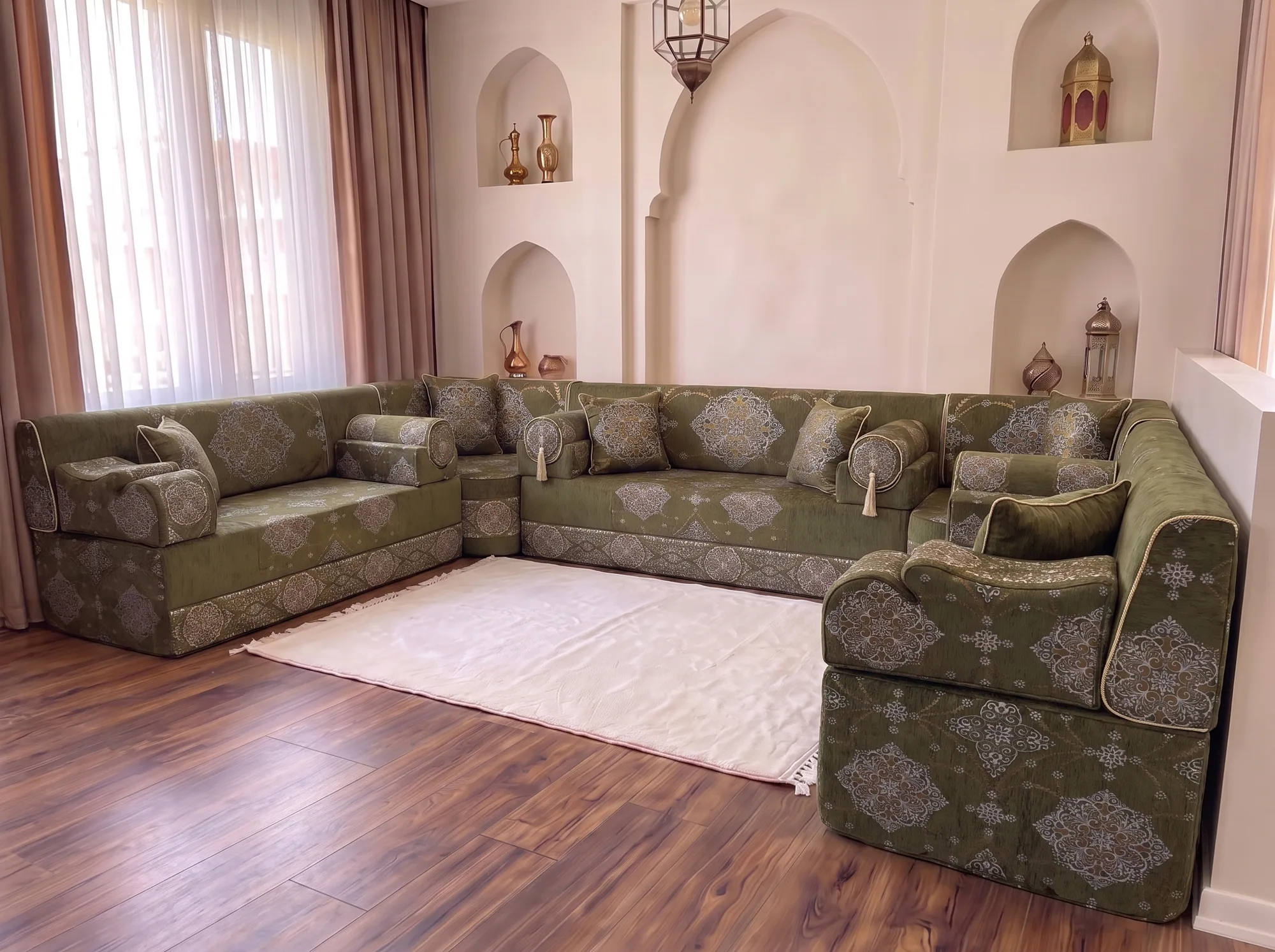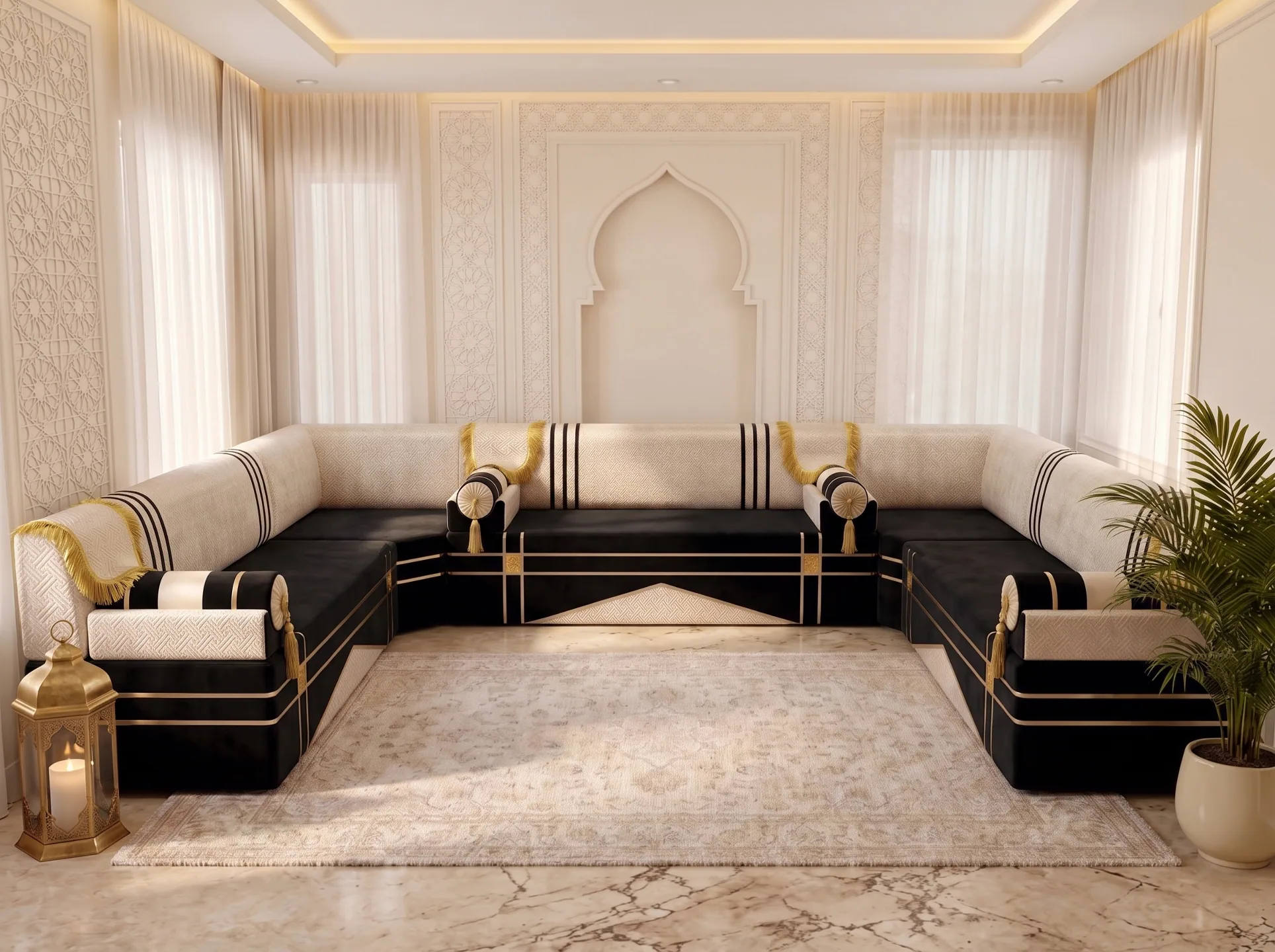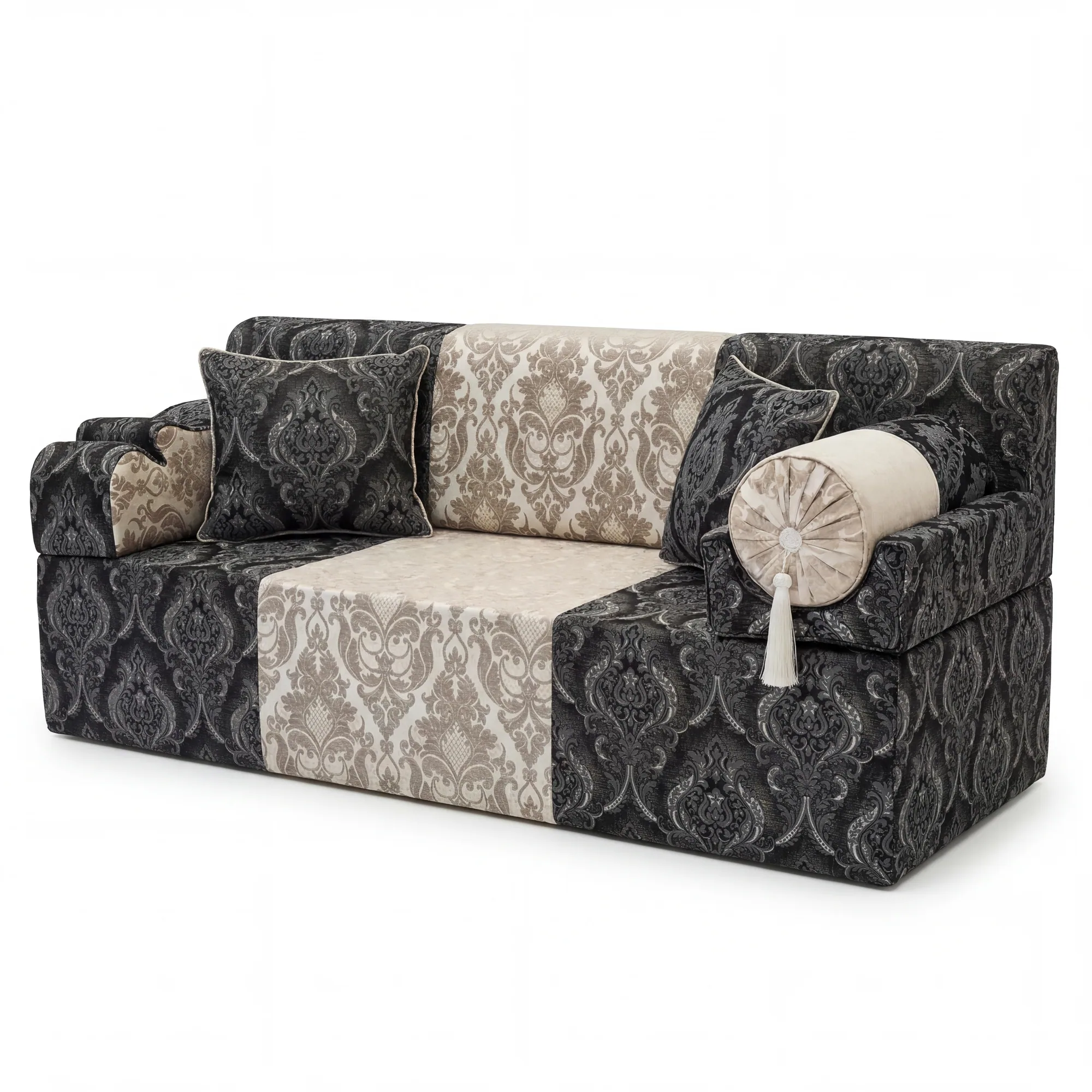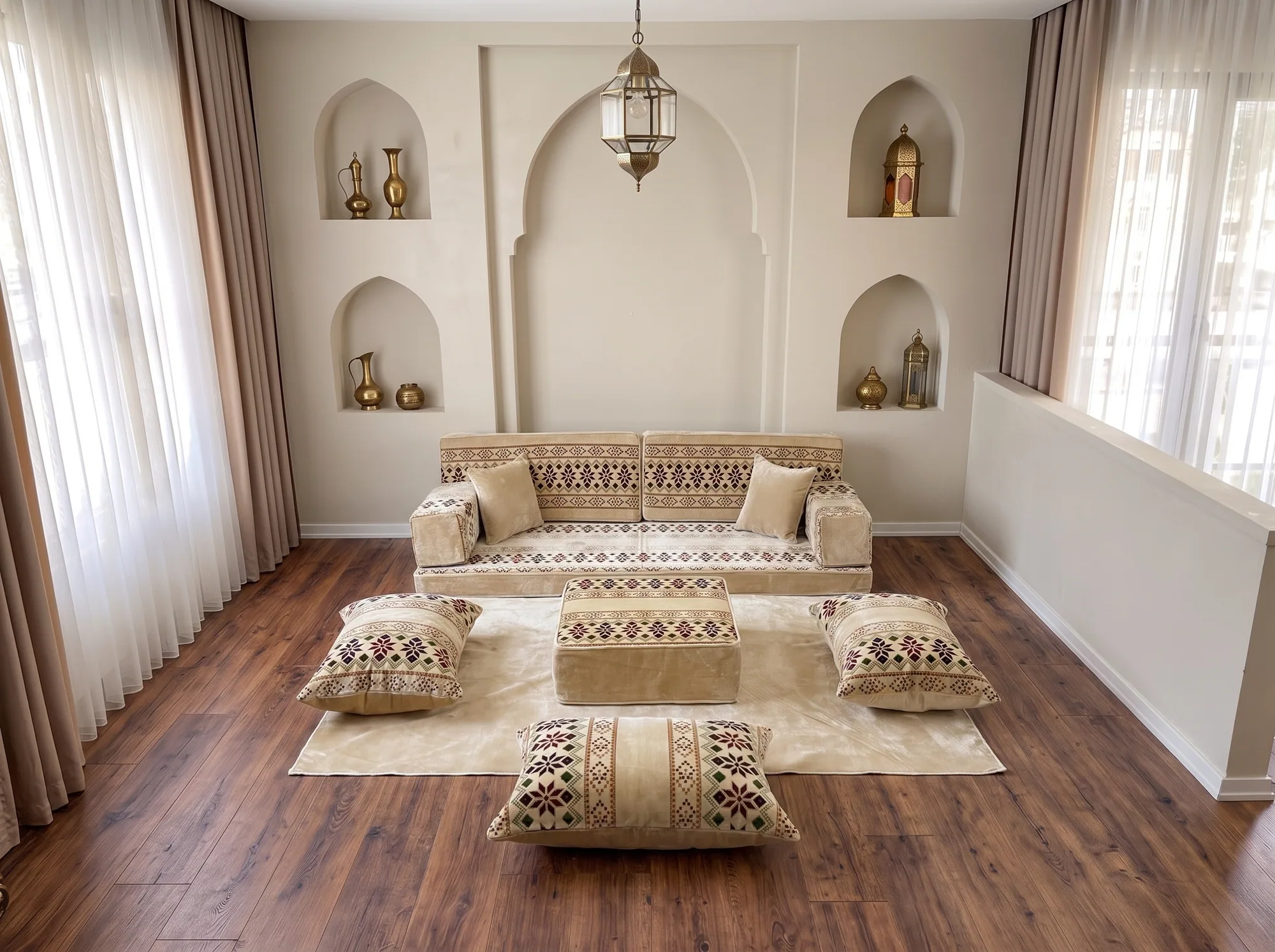
Plan hookah lounge seating as booths, not rows. As a planning figure, allow about 75 cm of seat per guest, an open side on every booth so staff can reach the pipe, and aisles that meet your local code. Choose dark, patterned covers that unzip and wash at 30 degrees. Sofhu makes each set to your floor plan with 32 kg/m³ foam.
- Seat length per guest
- About 75 cm for long sessions
- Booth shapes
- Straight run, L or U with one open side
- Aisles
- Set by your local fire and access code
- Covers
- Zipped, removable, machine wash at 30 degrees
- Foam
- 32 kg/m³ (32 DNS) high-density, no springs
- Supply
- Made to measure by Sofhu, free shipping worldwide
On this page
Which earns more in a shisha lounge: one more booth, or a wider aisle? Most owners answer that question too late, after the seating has arrived. Hookah lounge seating has to do four jobs at once. It keeps a group comfortable for an hour or more, gives staff a clear path to every pipe, survives ash and spilled tea, and comes apart for cleaning. This guide takes those jobs in order, from the size of a single booth to the rules you need to check before you sign a lease.
Plan the booth before the room
A lounge is a set of booths with aisles between them. Design one good booth, then see how many the room takes.
A good booth has three things:
- Seats that face the pipe. Guests share one hookah, so an L or U works better than a straight row.
- One open side. Staff change coals and swap bowls many times a night. They should reach the pipe from the aisle without leaning over a guest.
- A solid back. Sofhu states that its floor sofas are not freestanding and need a wall or something hard behind them. Wall booths are simple. Island booths need a half-height partition.
Sofhu makes two kinds of indoor booth seating. An Arabic floor sofa is a low set of seat mattresses, loose back cushions and armrest blocks, which is what most photos in this guide show. An Arabic majlis is raised to sofa height and built as fully upholstered units with fixed backs, for a more formal room.
Booth and module sizes
Size the booth from the number of guests, not from a catalogue module. For a quick visit, about 60 cm of seat per adult is enough. Lounge guests lean on an armrest and stay, so plan nearer 75 cm each.
| Party | Usable seat length | Booth shape |
|---|---|---|
| 2 to 3 guests | About 1.8 to 2.2 m | Straight run with an ottoman opposite |
| 4 to 5 guests | About 3 to 3.5 m | L on two sides |
| 6 to 8 guests | About 4.5 to 6 m | U on three sides |
Subtract one seat depth for each corner before you count places. The method is set out in our guide to how many people a majlis seats.
These are planning figures, not Sofhu product dimensions. Sofhu does not sell fixed modules. Each run is cut to the length you send, so a 2.9 m alcove gets a 2.9 m seat with no filler panel. That is the practical argument for a custom majlis in a commercial room: no dead corners.
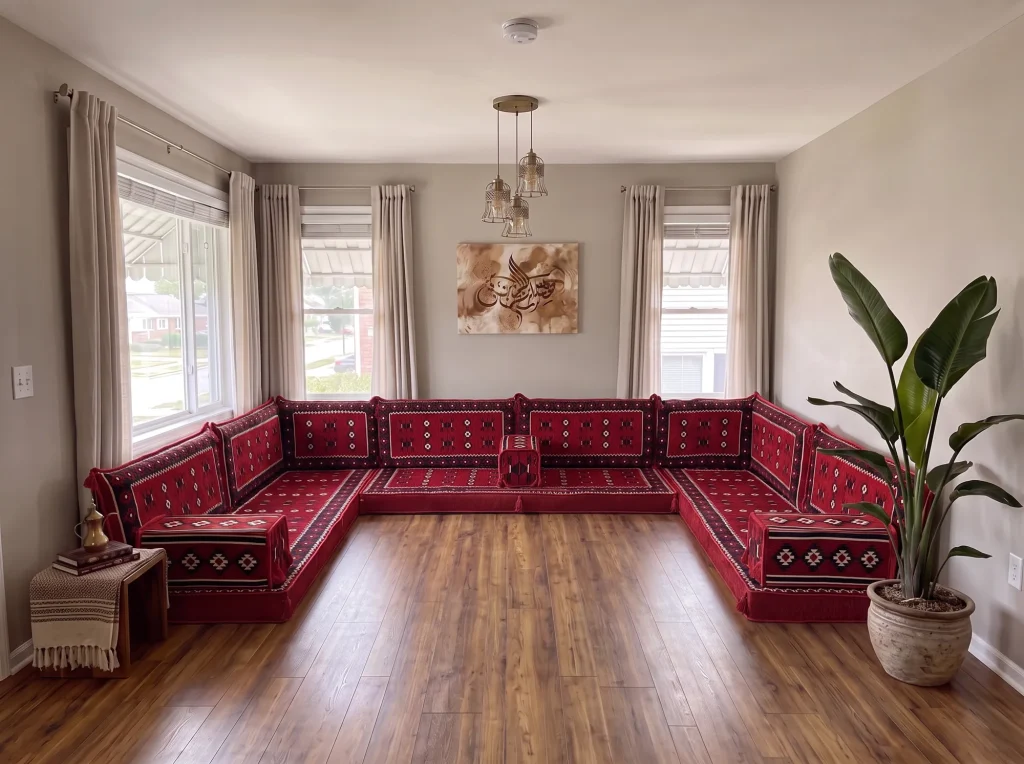
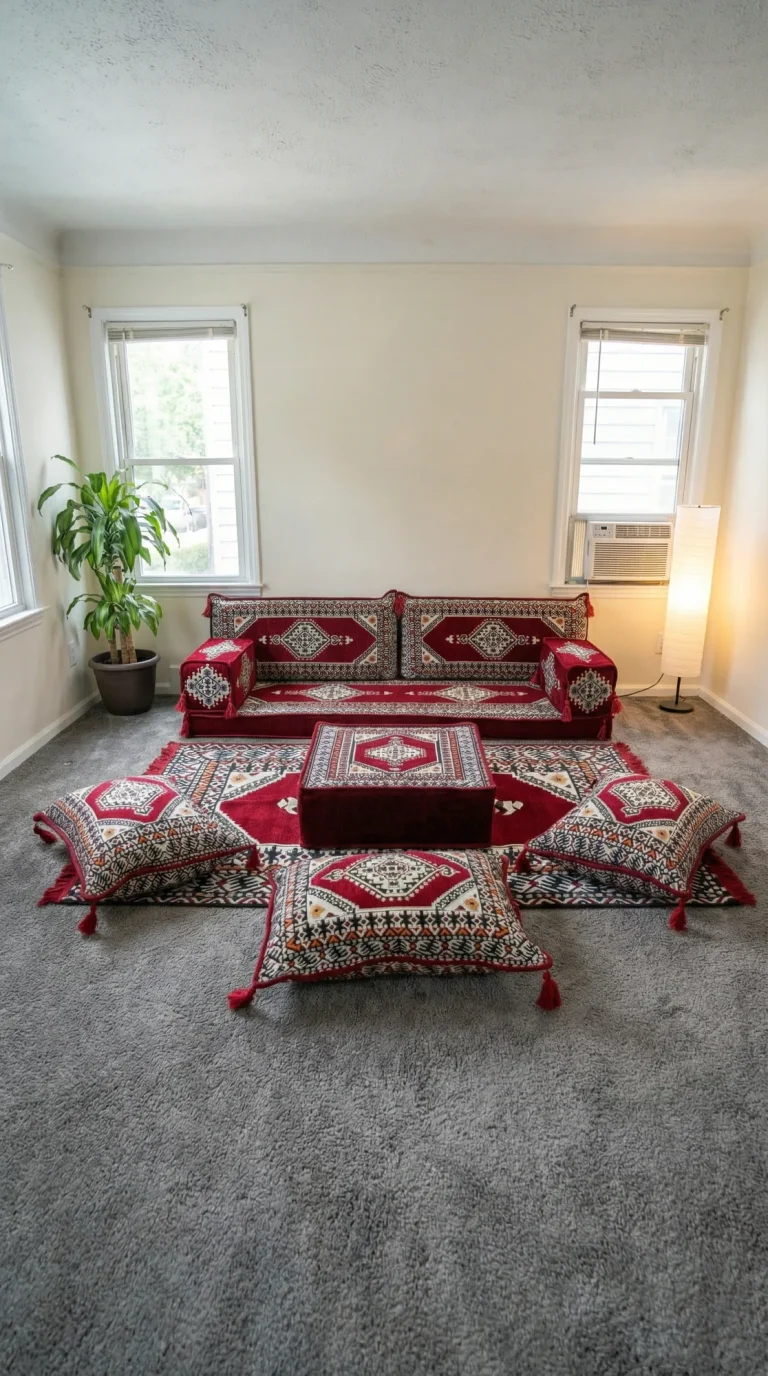
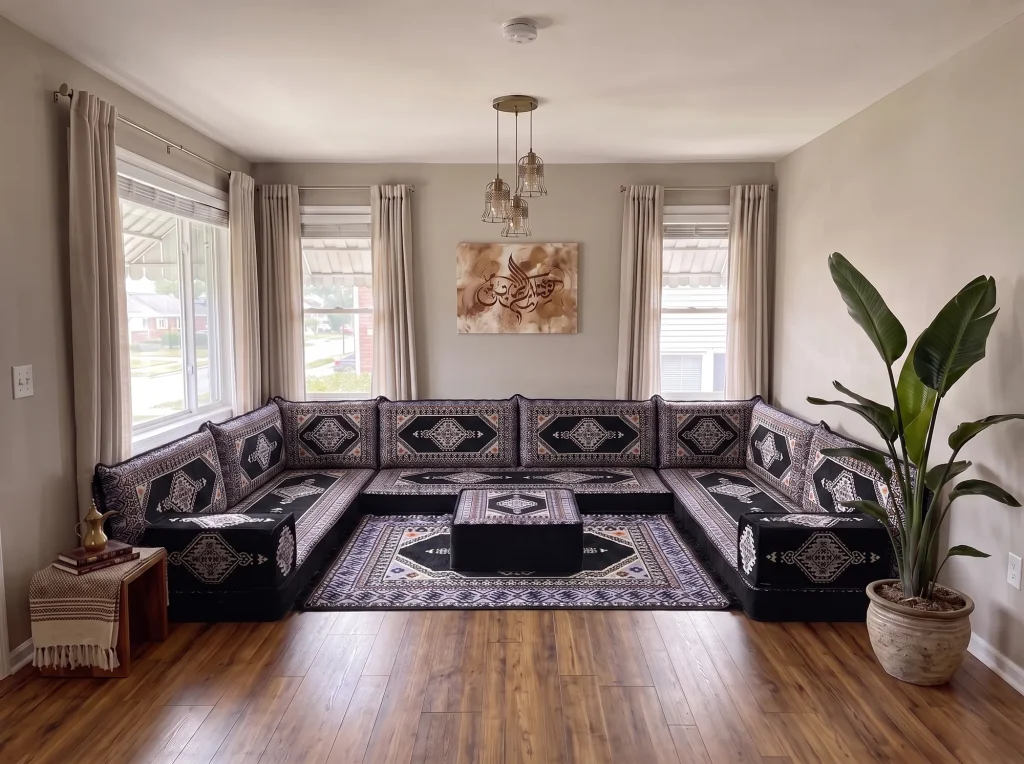
This red floor sofa in a U along three walls is the shape of a large booth. Picture the pipe where the open floor is, and the aisle across the open end.
Spacing around hookahs and tables
Put the pipe where every hose reaches and no walkway crosses it. In a U booth that is the centre of the open floor, on a low table or a tray. In an L booth it is the inside corner of the floor, away from the aisle.
Three clearances matter:
- Pipe to seat edge. Leave enough floor for a guest to stand up and step out without touching the pipe. Test it with a real pipe and a real person before you fix the layout.
- Coal route. Staff carry lit coals. Their path from the coal station to each booth should be short, straight and free of steps.
- Aisles. Your fire authority and your accessibility rules set the minimum. As a reference point, New York City and Massachusetts guidance for restaurants both use 36 inches, about 91 cm, as the minimum clear width of an accessible route. Exit routes may need more. Get the figure for your premises in writing.
A tray armrest or a small side table at each end of a booth gives glasses a home. Drinks on the floor are the main cause of spills.
Fabrics: ash, spills and smell
Choose the fabric for how it looks on a bad night. Ash smudges, sweet tea, molasses from the tobacco and the smell of smoke are the four things your covers will meet.
Ash and burns. Fine ash shows as a grey mark on plain, pale cloth. A dark ground with a busy pattern hides it until the next wash. Hot coals are a different matter. Sofhu’s own care note for velvet says to keep it away from fire and sharp objects, and no flammability rating is published for any fabric. Assume a dropped coal will mark the cover, and manage coals with trays and tongs.
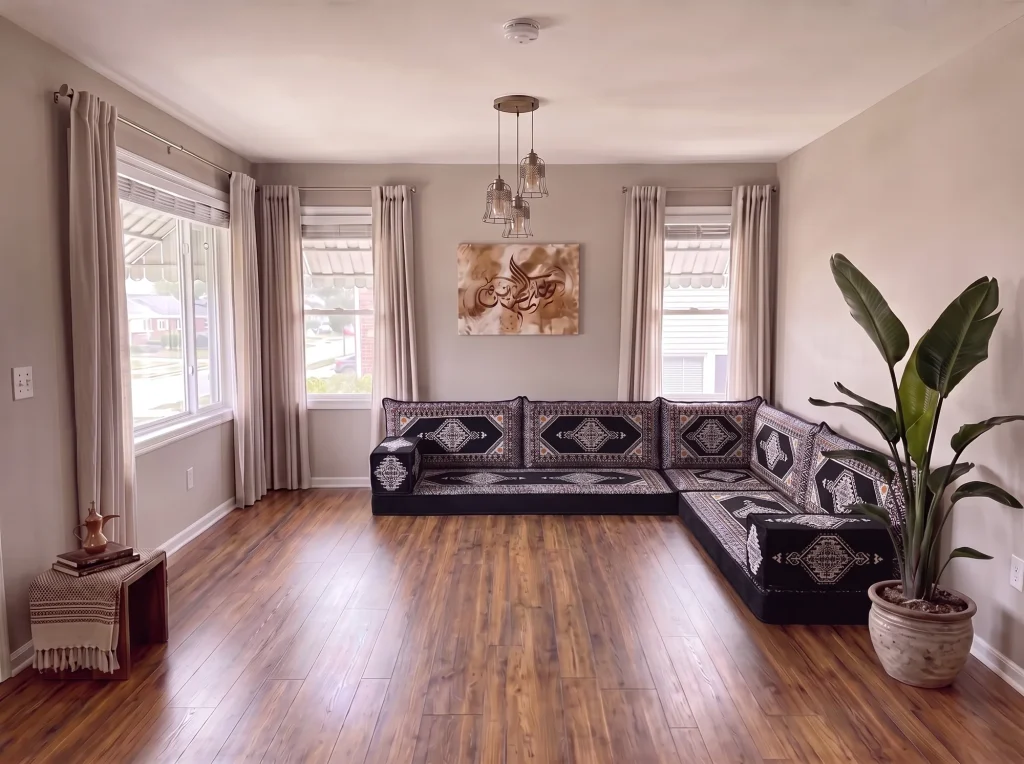
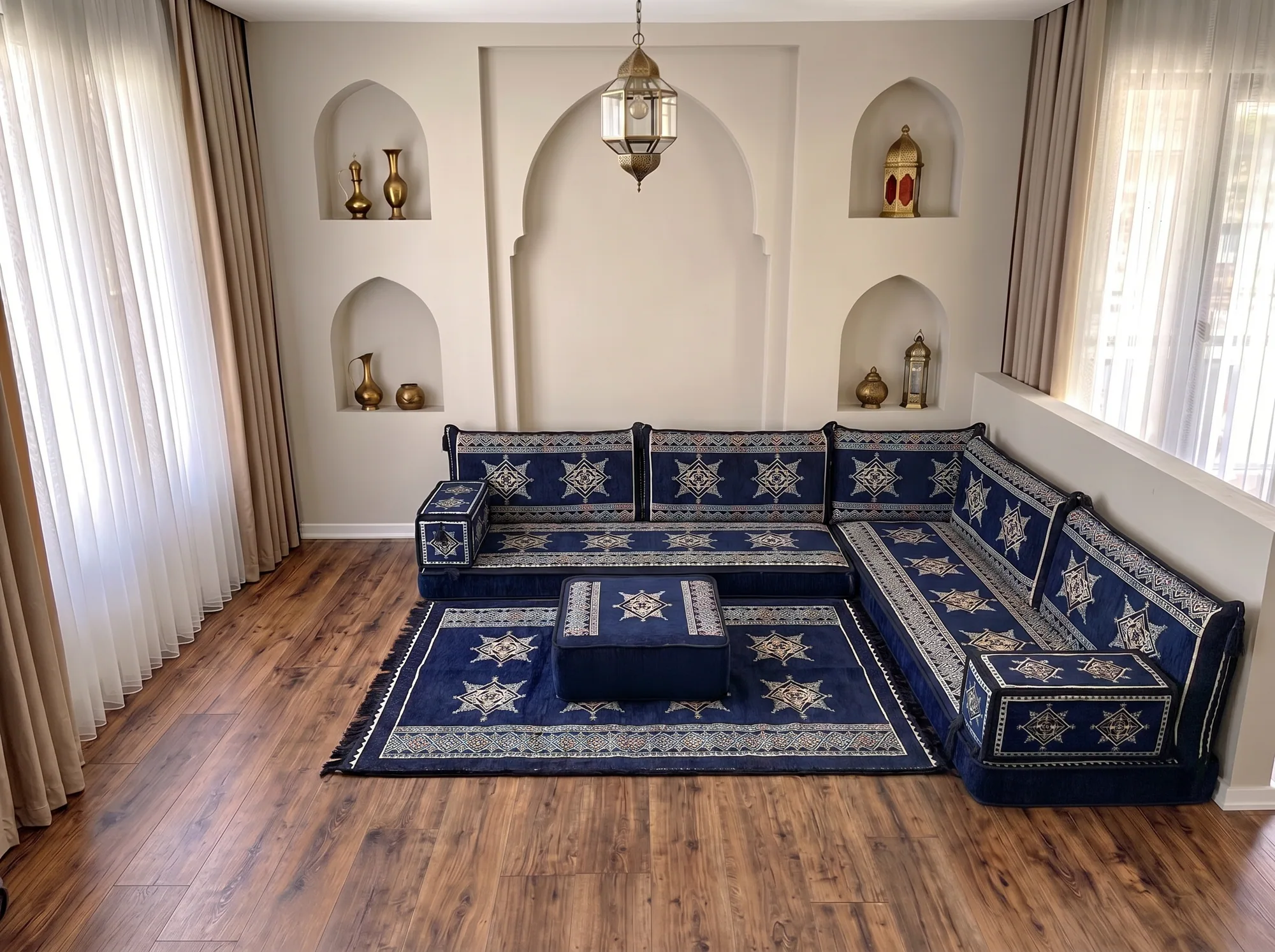
A black ground with cream diamond panels, as on this L-shaped floor sofa, is forgiving in a lounge. Marks disappear into the pattern.
Spills. Sofhu describes its velvet as durable and easy to clean, its chenille as low-shedding, and its woven series as non-wrinkling. The custom order page also lists stain-resistant fabrics as an option. Ask which of the current fabrics the team would put in a cafe, and say plainly that it is for commercial use. The fabrics page lists the series, and our comparison of velvet, linen and jacquard explains how each behaves.
Smell. Smoke settles in cloth first. Every Sofhu cover is zipped and removable, and the site gives 30 degrees as the machine wash temperature. Wash the covers, and stand the foam inserts on edge in fresh air while they are bare.
What is inside. The cushions are filled with 32 kg/m³ (32 DNS) high-density foam and contain no springs. Density is about how long the foam keeps its height, not how hard it feels. For seats that are sat on twelve hours a day, that is the number to ask any supplier for.
Spare covers and a laundry rotation
A booth with its covers in the wash earns nothing. Plan the rotation when you order, not when the first cover is stained.
- Ask for a second set of covers with the order. Sofhu does not publish a spare-cover service, so raise it in the quote. Covers cut from the same roll at the same time will match. Covers ordered a year later may not.
- Number the covers. Mark each one inside the zip with its booth and position. Night staff can then re-dress a booth without guessing.
- Rotate by traffic. The booths by the door and the window work hardest. Wash them most often and move covers between busy and quiet booths so the room ages evenly.
- Keep a log. Note each wash and each burn. After a few months you will know your own replacement cycle better than any supplier can tell you.
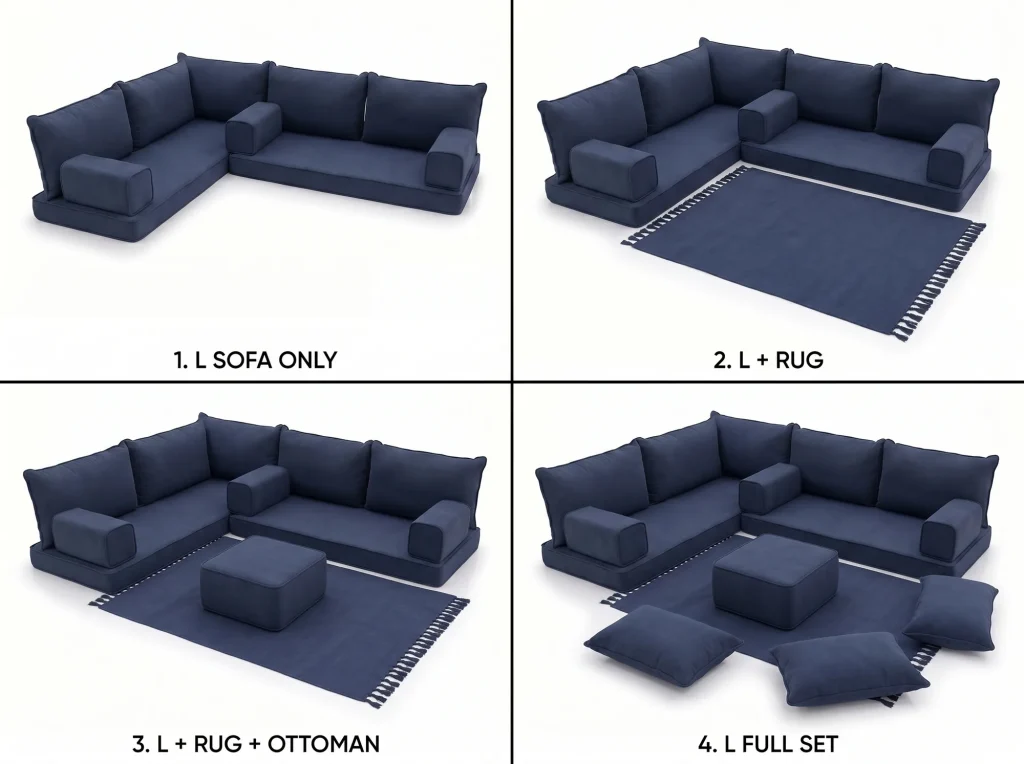
Sets are built up in layers: seating, then rug, ottoman and floor cushions. In a lounge, the ottoman and floor cushions are the pieces that move, so order them in the hardest-wearing cover.
Layouts for small and large lounges
Small lounge, one room. Line the two longest walls with L booths and keep the centre as the aisle. Avoid a booth behind the door. Four to six booths with a clear coal route will serve better than eight that staff cannot reach.
Large lounge. Use the walls for U booths and the middle for raised seating on wooden bench frames, which stand without a wall. A mix of heights also helps guests who find floor seating hard to get up from.
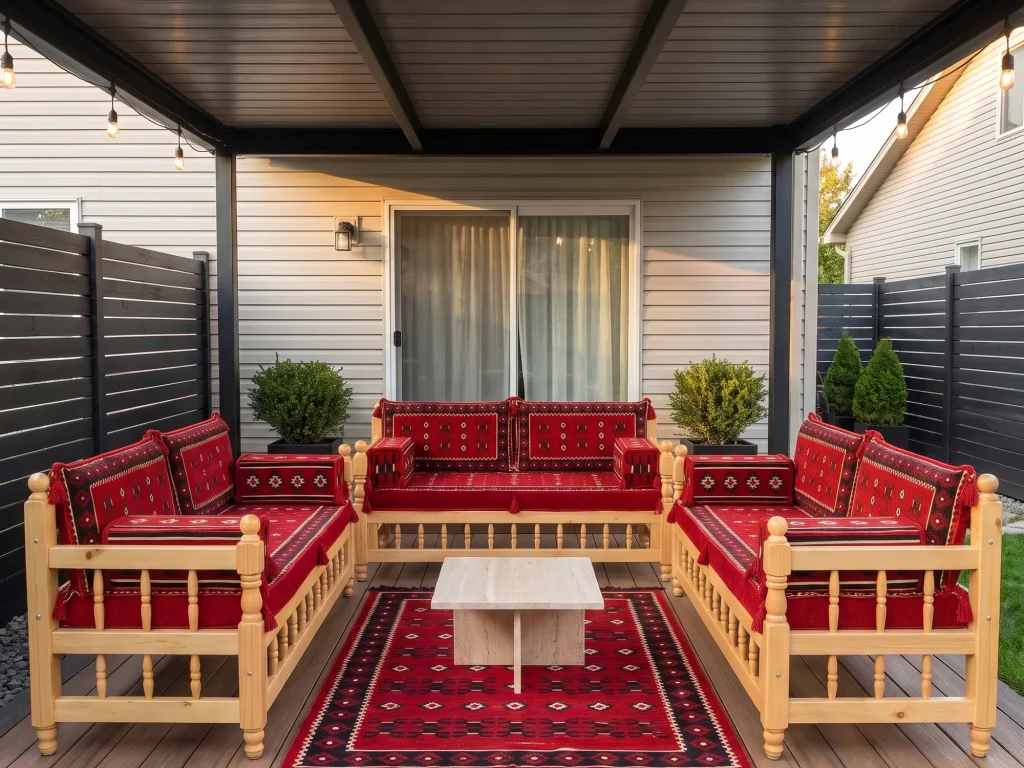
Terrace or courtyard. Sofhu makes outdoor benches with wooden frames and fabrics it describes as water-resistant and able to handle light rain. Three benches around a low table make an outdoor booth, as in the photograph below. See the outdoor majlis page for the range.
Private or event rooms. A closed U with floor cushions suits birthdays and engagement parties. The majlis for events page covers larger gatherings.
Check local fire, smoke-free and ventilation rules
The law decides more of your layout than the furniture does. Check it first.
- Where smoking is allowed. Rules differ widely. In England, for example, council guidance states that smoke-free law covers shisha with or without tobacco, and that a roofed area must have at least half its wall space permanently open before smoking is allowed there. That pushes many lounges onto terraces and into open shelters, and changes the seating you need.
- Fire safety. Ask your fire authority what it requires of upholstered seating in a licensed premises, and how wide exits and aisles must be. Then ask Sofhu what documentation it can supply for the fabric and foam you have chosen. Do not assume any standard is met.
- Ventilation. Burning charcoal produces carbon monoxide. Your local authority or a ventilation engineer should set the airflow and alarm requirements for the room.
- Planning. A new shelter or canopy may need permission.
What to send for a quote
Send a scaled floor plan or clear measurements of each wall, the positions of doors, columns and windows, the number of booths, and photographs of the room. Say whether you want floor sofas, a raised majlis, bench frames or a mix, and whether you need spare covers.
Sofhu is the manufacturer, makes every set to measure in Türkiye and ships free worldwide. Import duty or tax may apply depending on your country, so ask before ordering. Operators fitting several rooms or sites should read the wholesale majlis page. The older article on Arabic majlis for cafes and shisha cafes shows the style in use, and our guide to Yemeni coffee house seating covers a neighbouring kind of room. When the plan is ready, get a quote by measurement or message on WhatsApp.