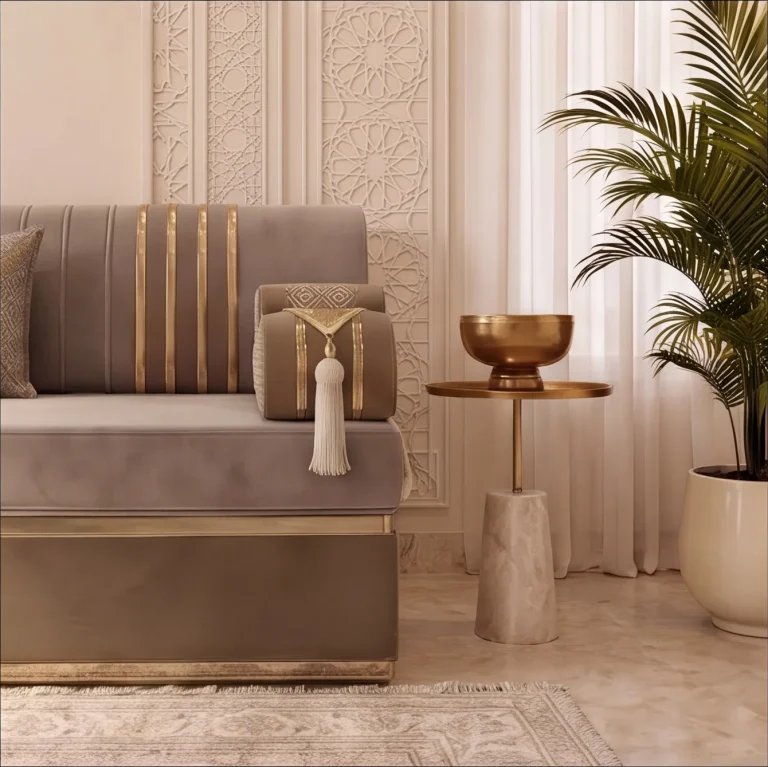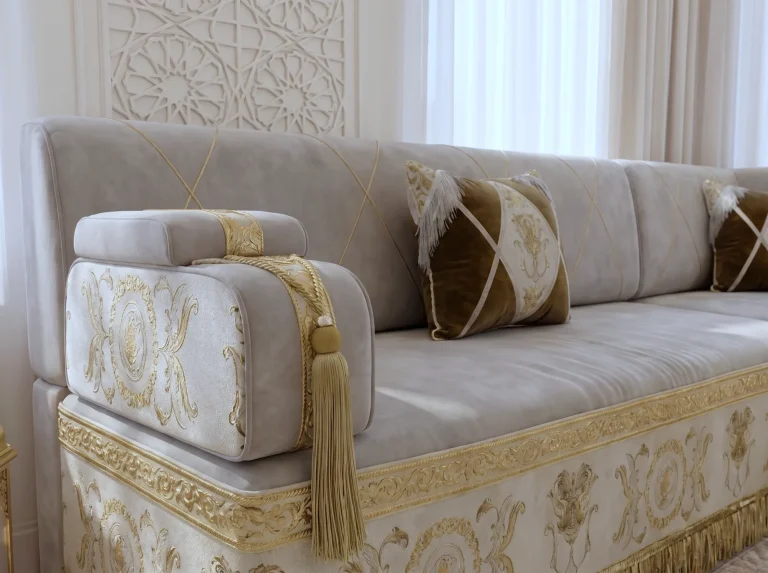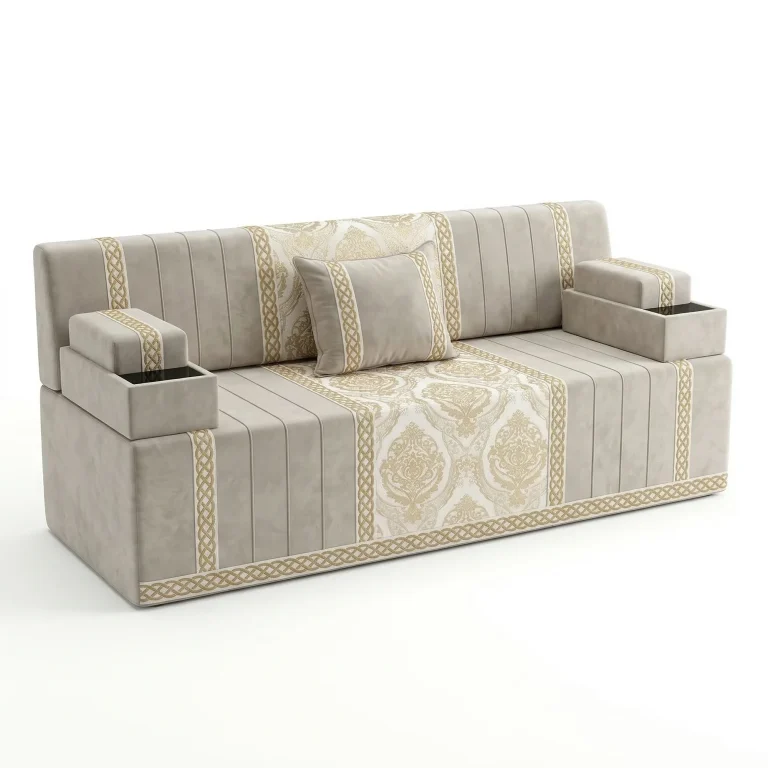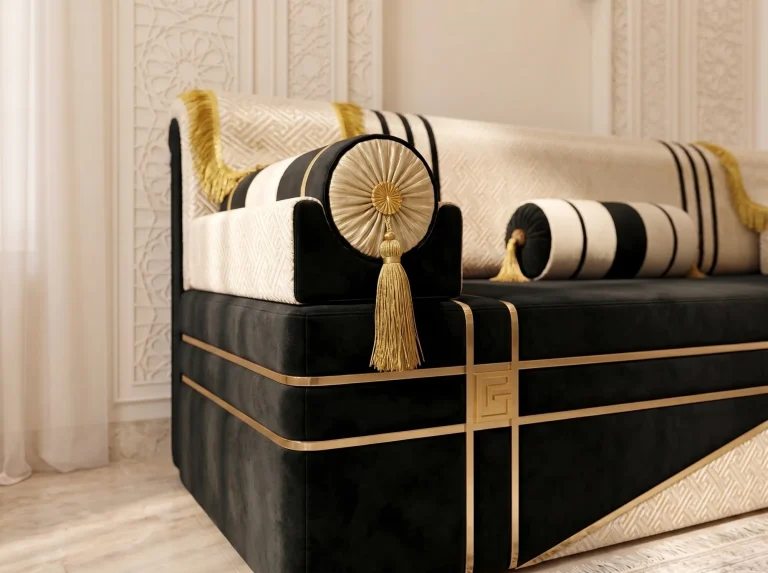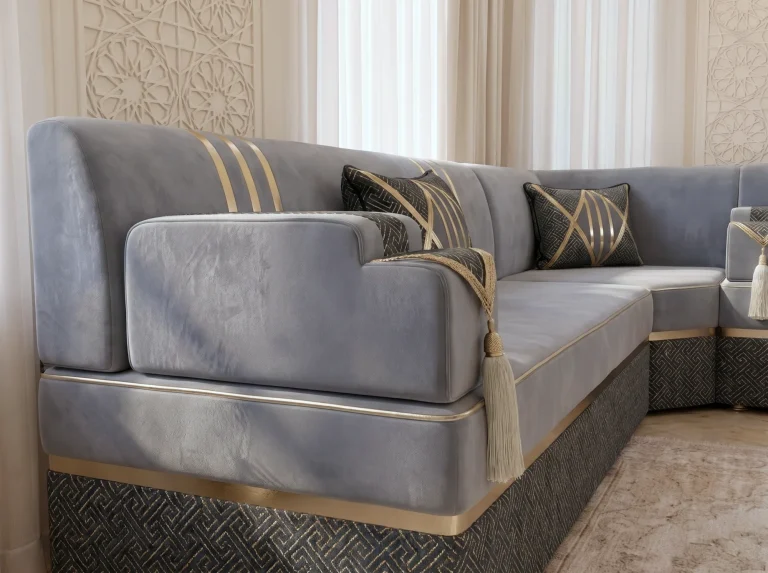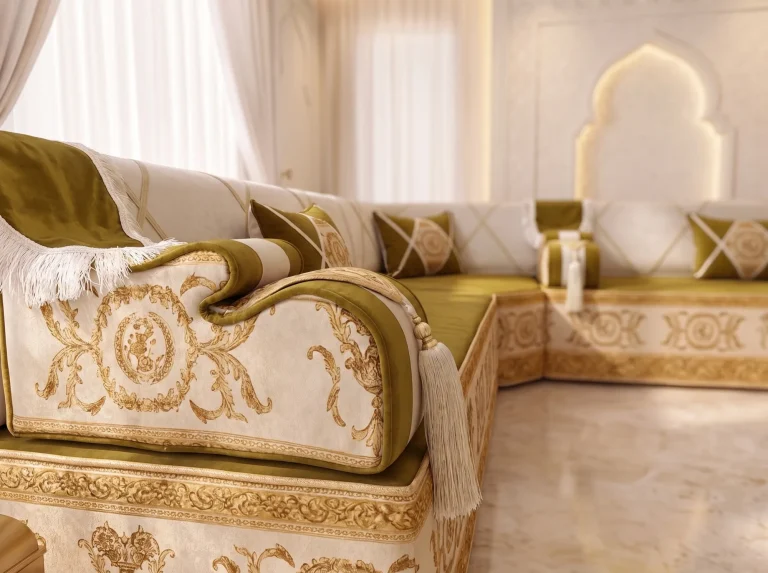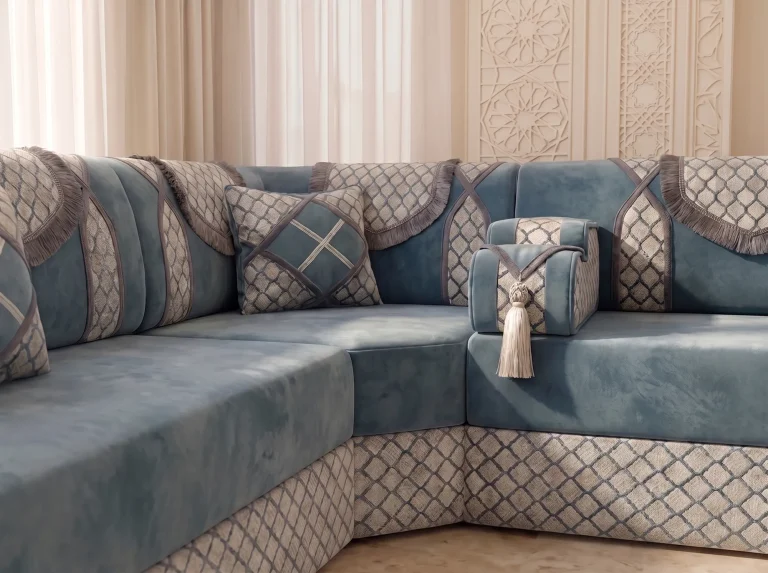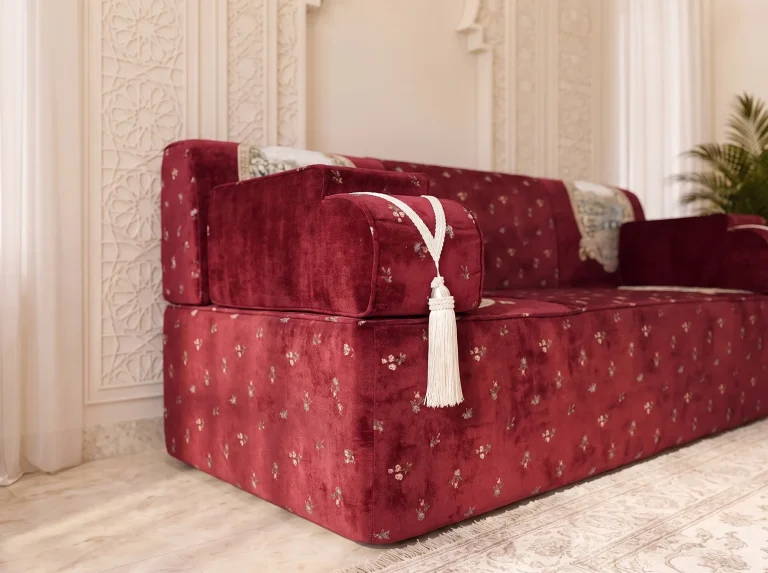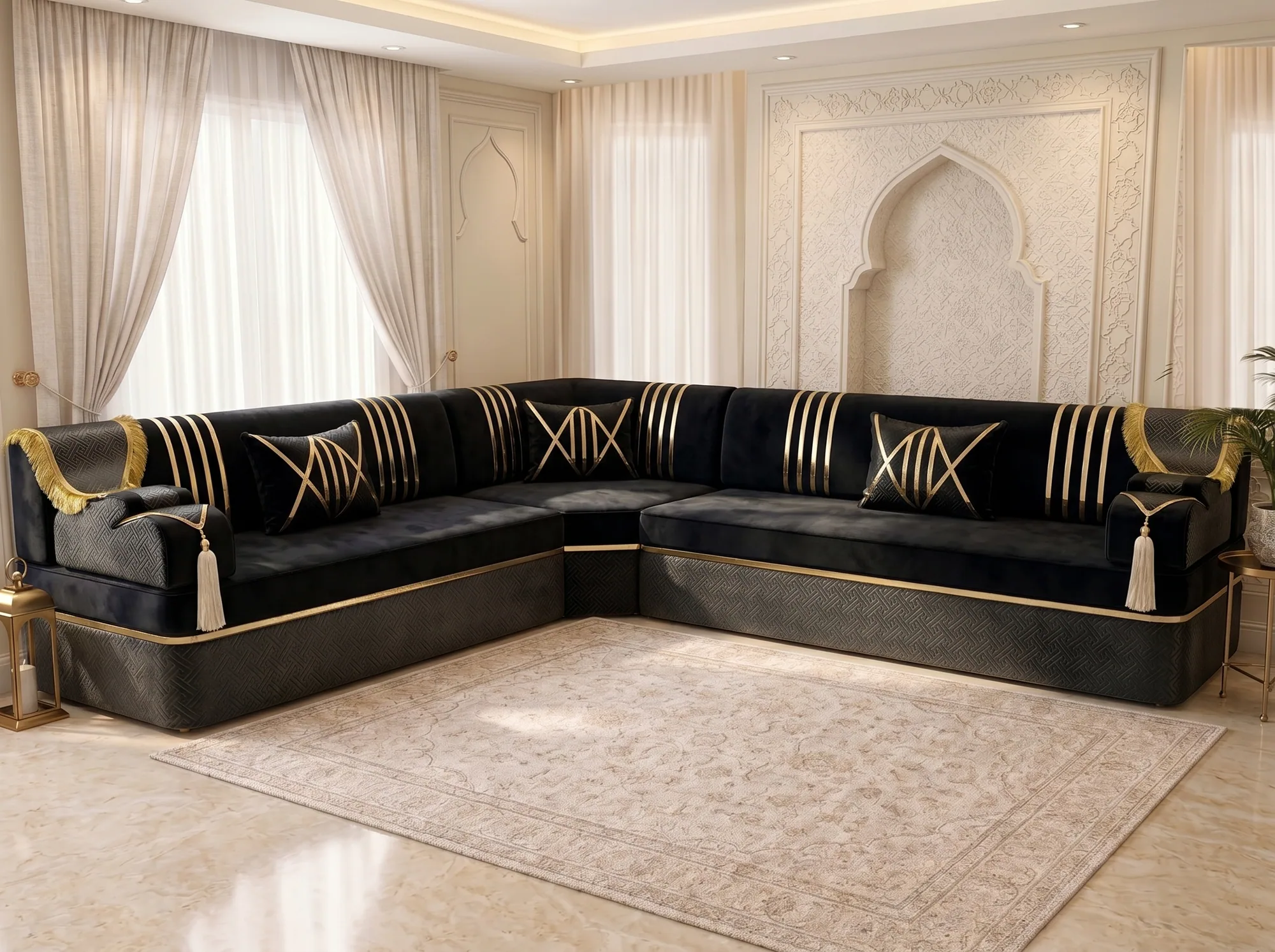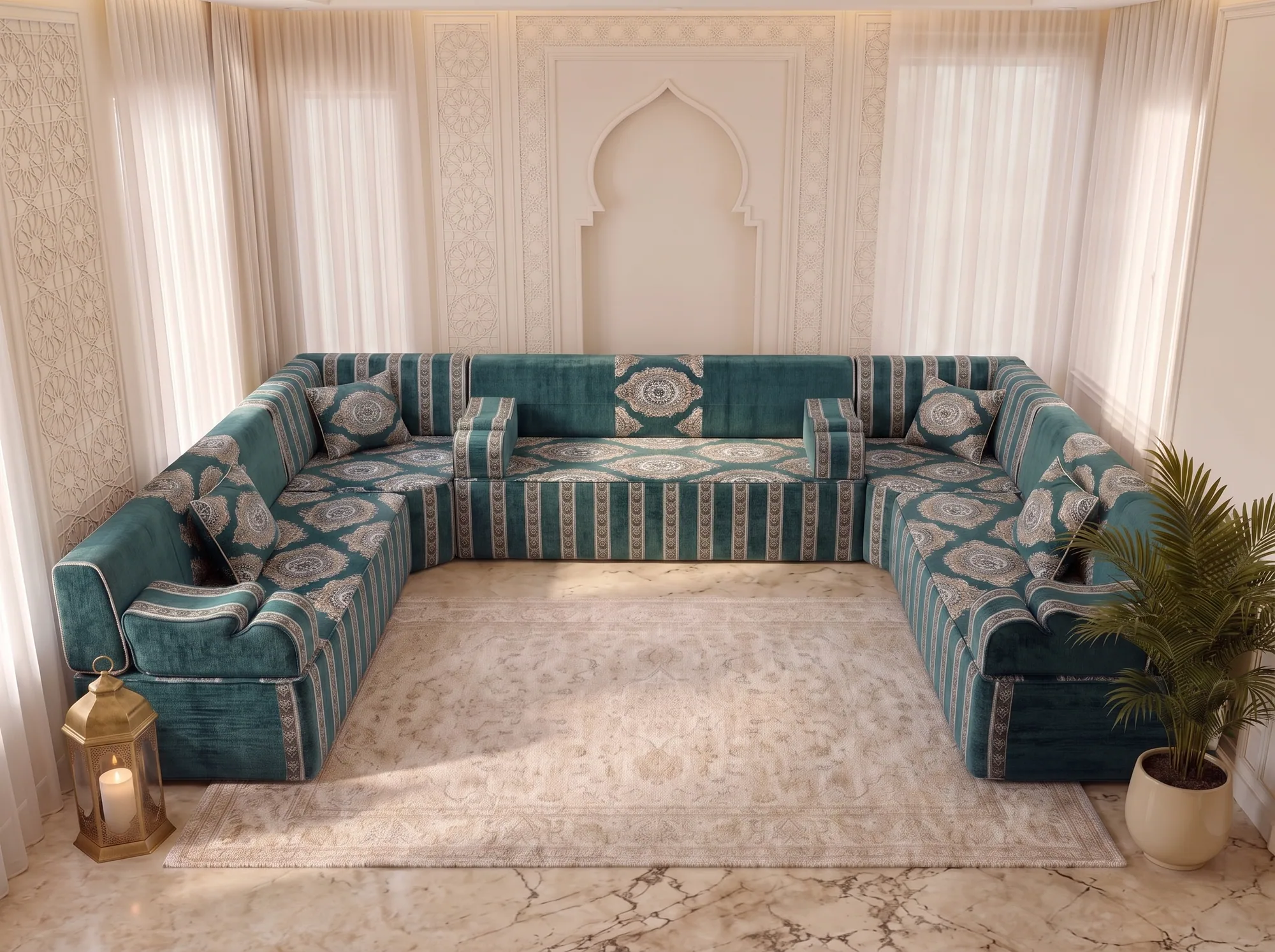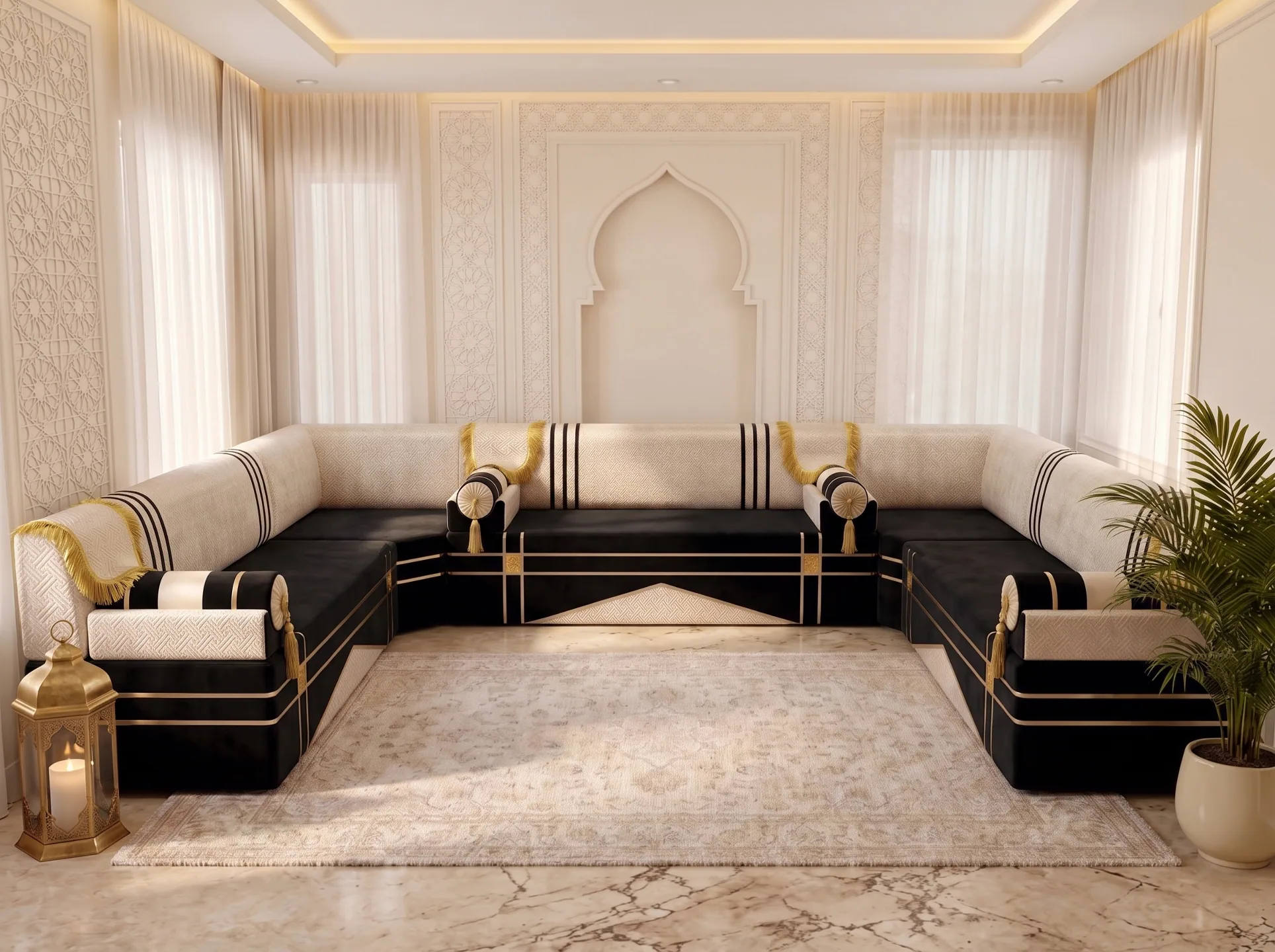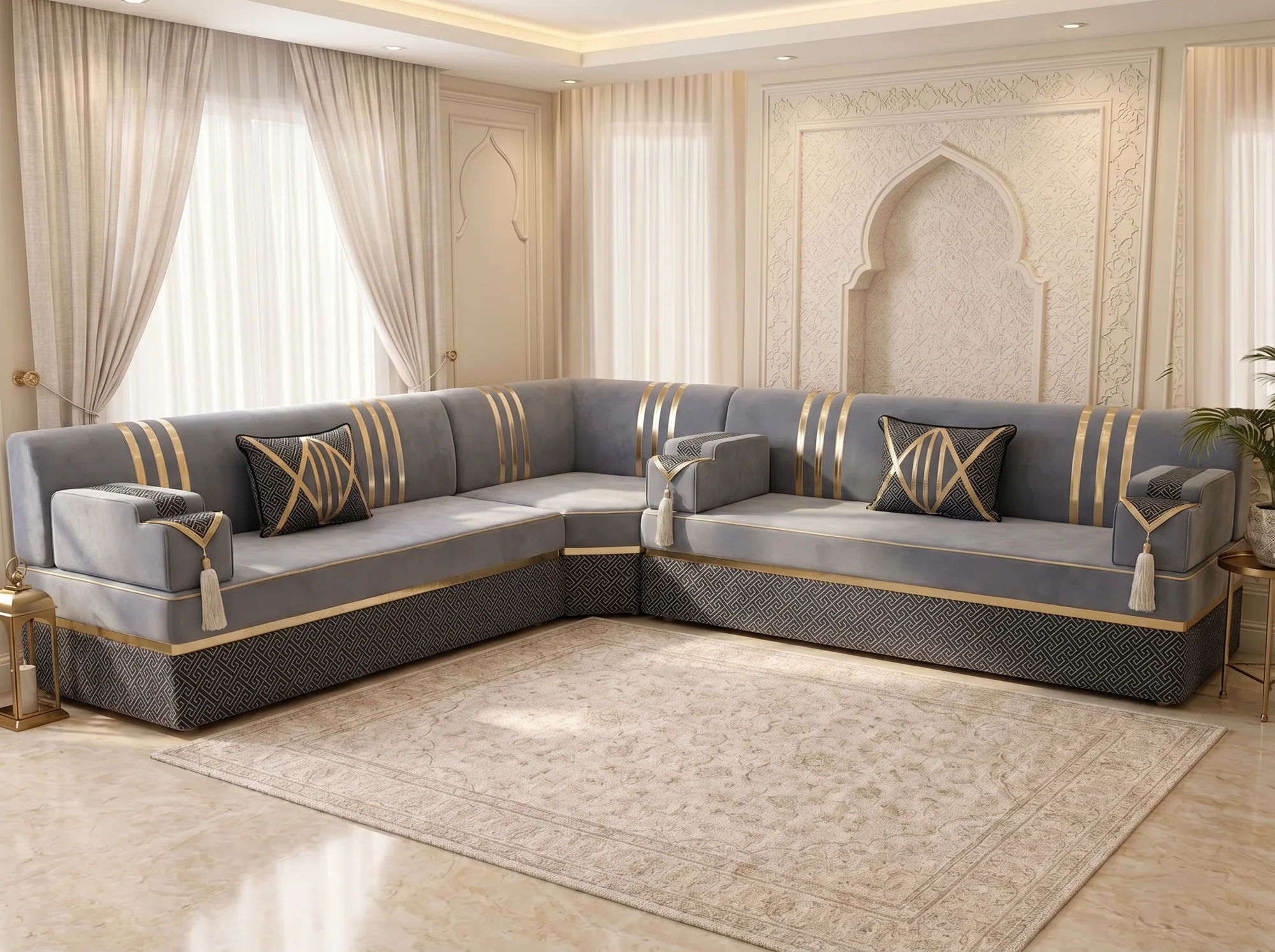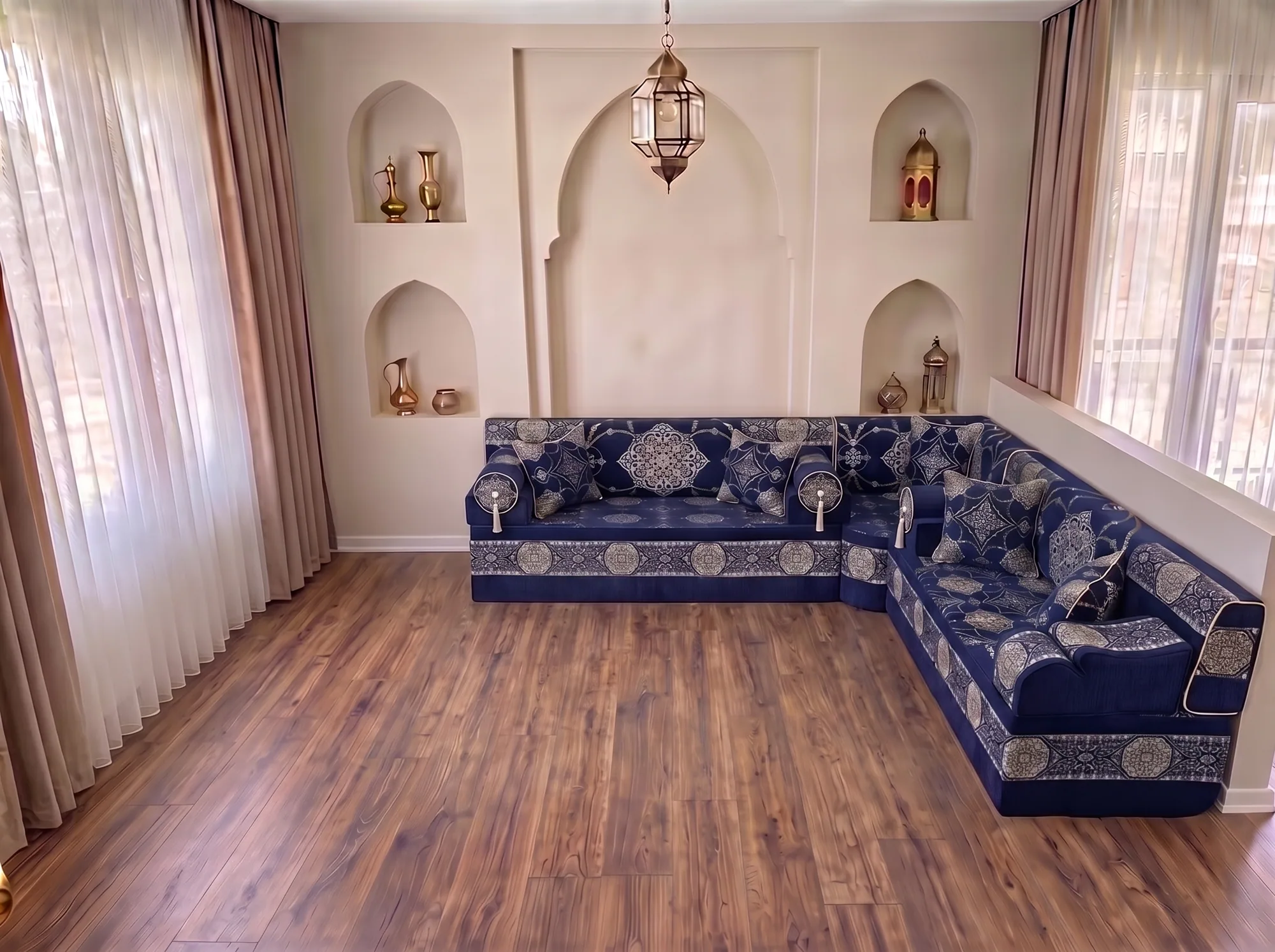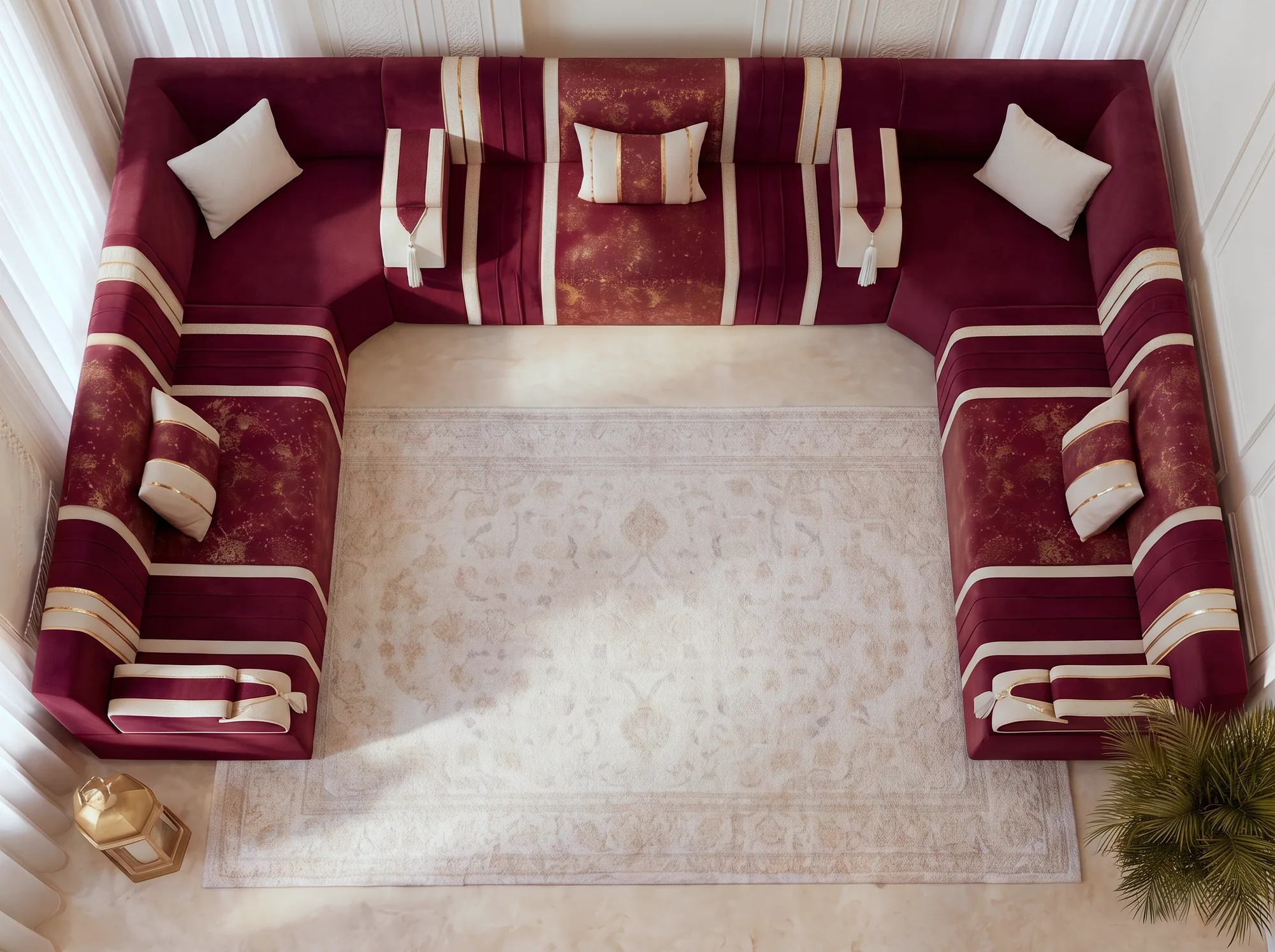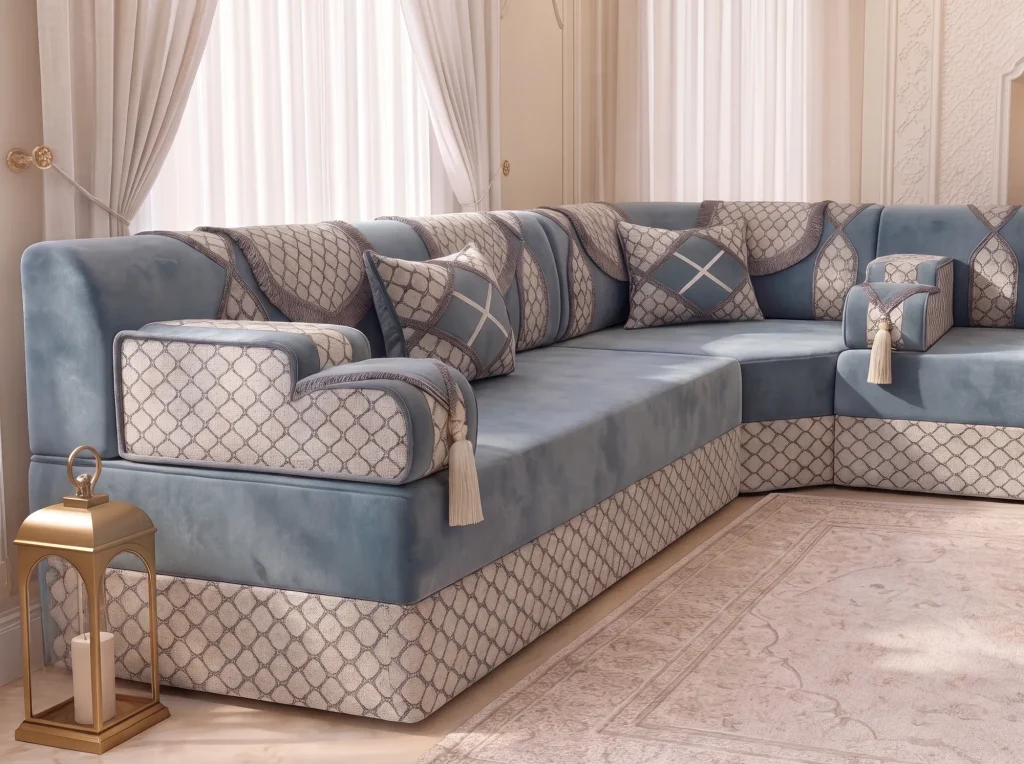
A majlis set has three core parts: the seat (farsha), the backrest (masnad) and the armrest bolster (markā). On a raised Arabic majlis the back is fixed to an upholstered base; on a low floor sofa it is a loose cushion leaning on the wall. Corner pieces, throw cushions, an ottoman and a rug complete the room. Sofhu cuts every run to your wall measurements.
- Seat mattress
- farsha (فرشة), plural farshat
- Backrest
- masnad (مسند), plural masanid
- Armrest bolster
- markā (مركى), plural marāki
- Filling
- 32 kg/m³ (32 DNS) high-density foam, no springs
- Covers
- Zippered and removable
- Sizing
- Made to measure from your wall lengths
On this page
The parts of a majlis set are few, and each has a job. A long mattress to sit on, a cushion behind your back, a bolster under your elbow. Everything else in the room, from the corner piece to the rug, is there to join those three together or to finish the space. Knowing the names saves a lot of back-and-forth when you ask for a quote, because “four of the long ones and two of the round ones” means something different to every workshop.
This guide names every piece in English and Arabic, shows where it sits, and gives example sizes so you can picture the scale.
The three core pieces at a glance
| Part | Arabic name | What it does |
|---|---|---|
| Seat mattress | farsha (فرشة) | The long foam mattress laid along the wall |
| Backrest | masnad (مسند) | Leans on the wall behind the sitter |
| Armrest bolster | markā (مركى) | Supports the elbow at row ends and between sitters |
These three words follow Gulf and Levant retail usage. An account of a traditional Najdi guest room describes it as carpeted and furnished with marāki and masānid, the plurals of the same words, so they are not shop inventions.
Regional vocabulary does move around. You may hear takya in the Gulf or madka in Yemen for a leaning cushion or armrest, and Afghan families will say toshak for the mattress and balesht for the bolster. We could not find a firm written source for the first two, so treat them as spoken usage and send a photo with your message.
Sofhu builds two products from these parts, and they are put together differently. An Arabic majlis is raised to sofa height: the seat sits on a solid upholstered base, the tall back is fixed to the unit and the arms are bolsters or tray-top blocks. An Arabic floor sofa is the low version: a seat mattress at floor level, loose back cushions, armrest blocks and usually a matching ottoman. Most of the close-ups on this page are from majlis sets.
Seat mattress: the farsha
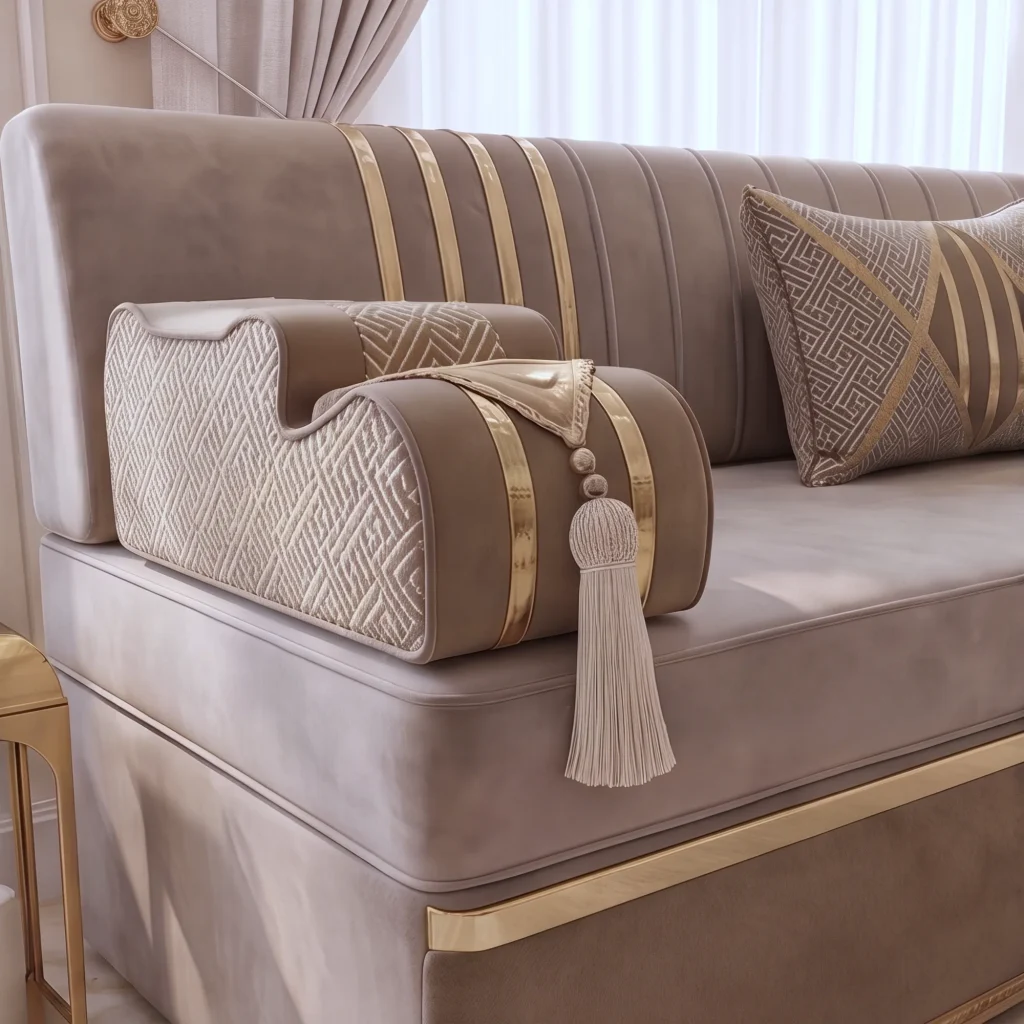
The seat is the piece that does the work. On a floor sofa it carries full body weight on a hard floor, and on a raised majlis it sits on an upholstered base. Either way its foam matters more than anything else in the set. Sofhu fills its seats with 32 kg/m³ (32 DNS) high-density foam and uses no springs. The cover closes with a zip, so it comes off for washing.
Three measurements describe a seat:
- Length, which runs along the wall. On a made-to-measure set this is cut from your wall lengths, and a long wall is divided into two or more mattresses so each can be carried and turned.
- Depth, from the wall to the front edge. It decides how far the set comes into the room.
- Thickness, which sets the seat height. Sofhu offers different thicknesses on request.
For a sense of scale only: one Jordanian classifieds listing for an Arabic jalsa set gives mattresses of 160 × 60 × 14 cm. That is one seller’s listing, not a standard and not Sofhu’s specification. For size ranges across the trade see standard majlis dimensions, and for the height question read the majlis seat height guide.
Majlis backrest: the masnad, fixed or loose
The backrest takes two forms. On a floor sofa it is a firm rectangular cushion that stands on the back edge of the seat and leans against the wall. It is a loose piece, and this is the reason floor sofas are not freestanding: without a wall or another hard surface behind them, the backrests have nothing to push against.
Loose backrests have practical advantages. They lift out when you want to use the seat as a guest bed, they can be swapped along the row so wear is shared, and each cover unzips on its own.
On a raised Arabic majlis the back is part of the upholstered unit: tall, fixed and often striped, tufted or panelled. On sets with a wooden bench or carved frame it may be built differently again. If you are choosing between a floor sofa, a majlis and a framed set, ask how the back is made on the model you like.
The same Jordanian listing gives backrests of 160 × 40 × 8 cm, matched in length to the mattress they sit on. Matching lengths is the usual arrangement, but it is not the only one. Some designs use shorter backrests with a gap for an armrest between them.
Majlis armrest: the markā and where it goes
The armrest is the piece people argue about most, because every family has a view on how many is right. A markā can be a round bolster with a rosette and tassel at each end, a square block, or a sculpted wedge.
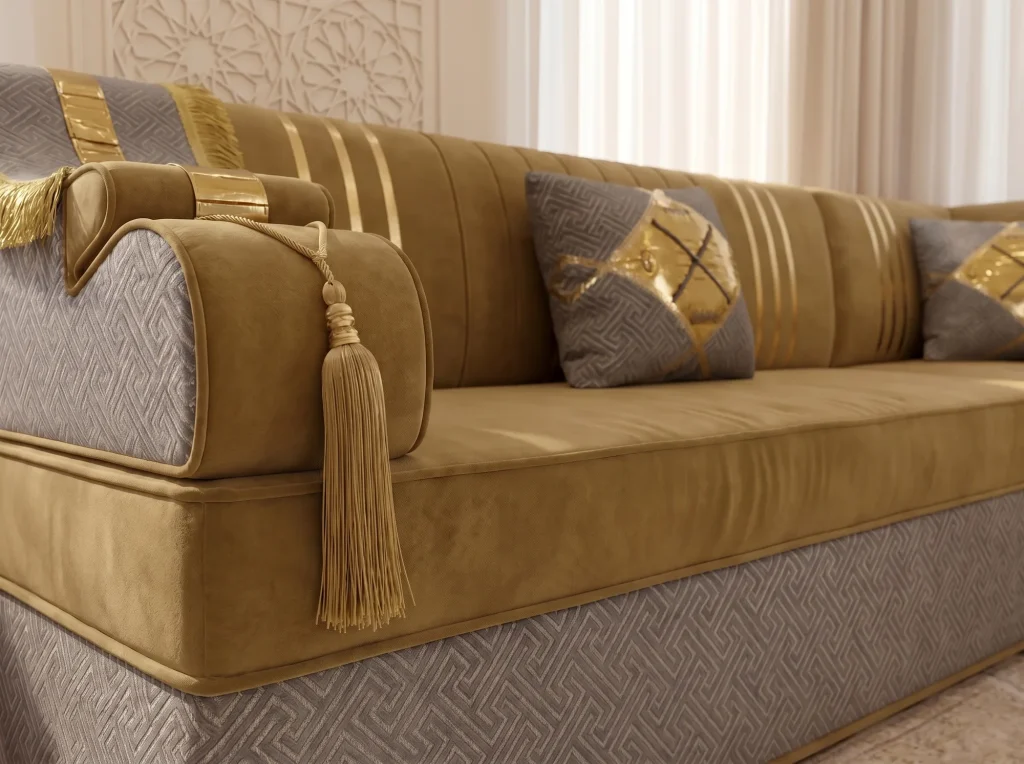
It goes in two places:
- At the open ends of a row, where it closes the seating visually and gives the last sitter something to lean on.
- Between sitters along a row, where it marks out places and gives each guest an elbow rest.
More armrests mean more comfort for each person and fewer places overall, since each one takes up seat length. A formal guest room usually has more; a family room where children lie down usually has fewer. The example listing gives armrests of 50 × 25 × 25 cm, which shows why three or four of them along a wall take a real share of the seating. The guide to how many backrests and armrests you need works through the trade-off.
Some designs replace the end bolster with a flat tray-top arm.
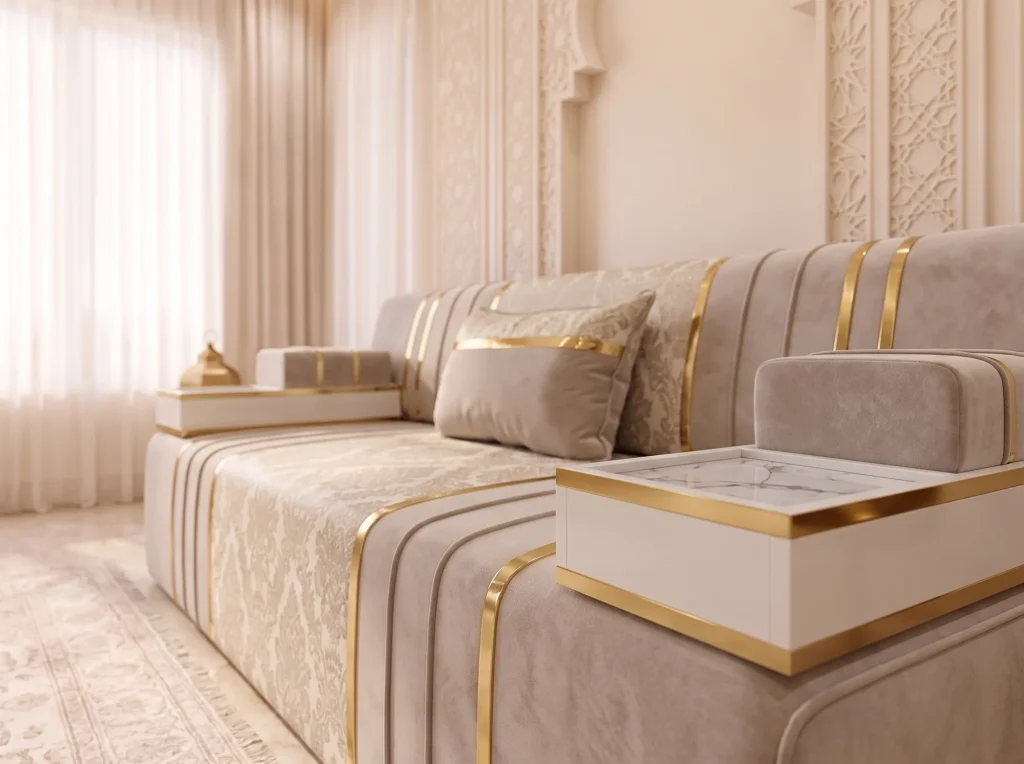
Corner pieces and end pieces
A corner is where two rows of seating meet, and there are two ways to build it. Either one mattress runs into the corner and the next butts up against its side, or a separate square corner piece fills the angle and both rows start from it. A separate corner keeps the seams symmetrical. Running one mattress through is simpler and leaves one piece fewer to line up.
Whichever you choose, the corner needs backrests on both walls. The corner seat itself is deep and comfortable for one person sitting diagonally, but it does not seat two. Layout choices are covered in the L-shape and U-shape majlis guide.
End pieces are simply the armrests or tray arms that finish a row where it stops short of a wall, at a doorway for example. Tell the workshop which ends are open and which meet a wall, because an end against a wall does not need an arm.
Throw cushions, floor cushions, ottoman and rug
Past the core pieces, a set is finished with smaller items. Sofhu’s Yemeni majlis sets are described as including pillows, armrests, a carpet or kilim, a curtain, an ottoman and wall decor alongside the seat cushions, so “what is included in a majlis set” depends on the line and on what you ask for.
- Throw cushions (mikhadda). Small square pillows that sit against the backrest. They add lower-back support and carry the accent colour or pattern.
- Floor cushions. Large flat cushions laid on the rug in front of the seating. They are extra places for children and for full-house evenings.
- Ottoman or pouf. An upholstered block in the middle of the layout. With a tray on top it is the tea table.
- Rug or kilim. It defines the sitting area and keeps the seat fronts from sliding on a hard floor.
- Curtains and wall decor. Offered with some lines so the room reads as one design.
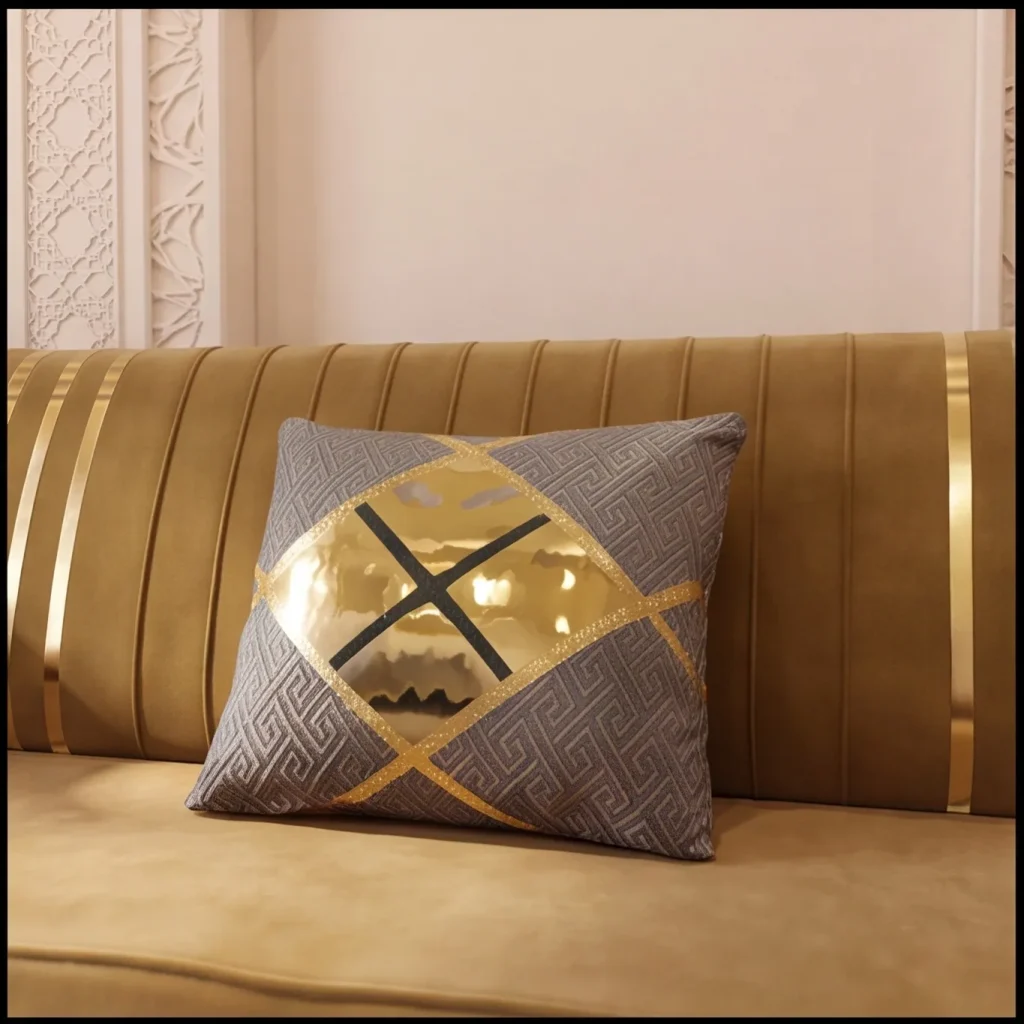
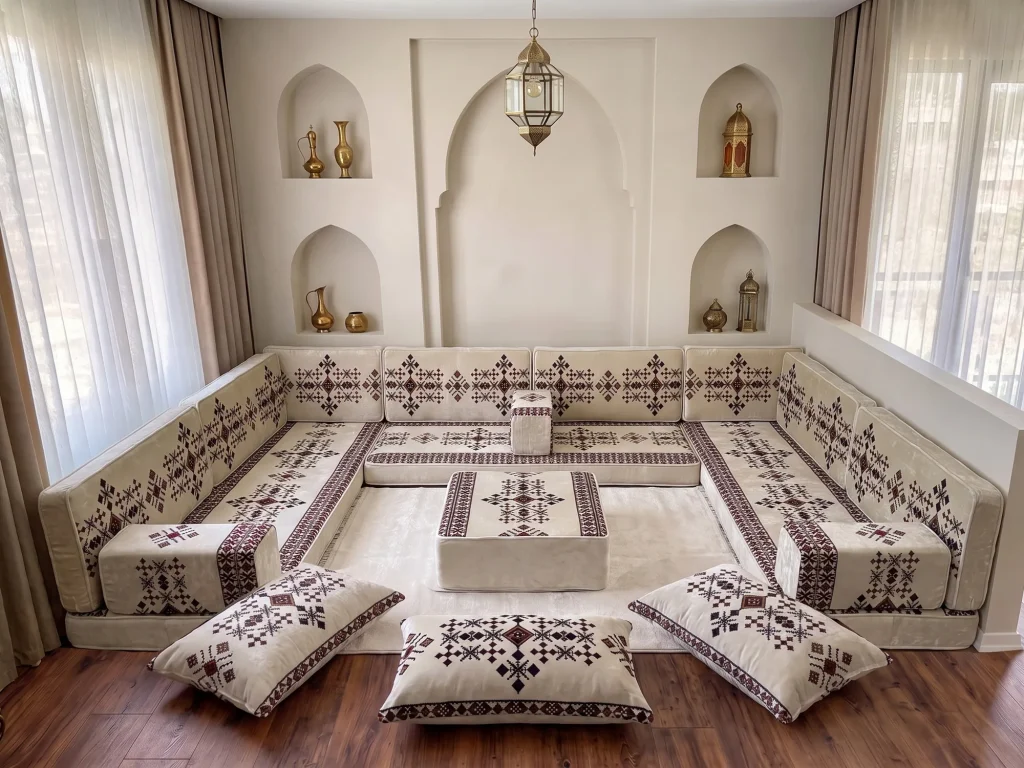
The first photograph shows a throw cushion on a mustard majlis. The second is a complete cream floor sofa set, with its ottoman, rug and floor cushions laid out in a U-shape.
How to count pieces for your room
Start from the walls, not from a piece list. Measure each wall the seating will run along, note where doors and windows fall, and decide which ends are open. From that, the workshop divides each wall into seats of a sensible length, gives each seat a backrest, and places armrests where you want them.
When you ask for a quote, it helps to state:
- the length of each wall the seating will cover, in centimetres;
- the layout you want: single row, L or U;
- roughly how many armrests you like along a wall;
- whether you want a separate corner piece;
- which extras you need: throw cushions, floor cushions, ottoman, rug, curtains.
Our step-by-step guide shows how to measure a room for a majlis. Once you have the numbers, a custom majlis is drawn around them, and the quote lists every piece by name. You can browse finished layouts on the majlis sofa sets page and read more about the Gulf-style set on the Arabic jalsa page, then get a quote by measurement or message us on WhatsApp with your wall lengths.