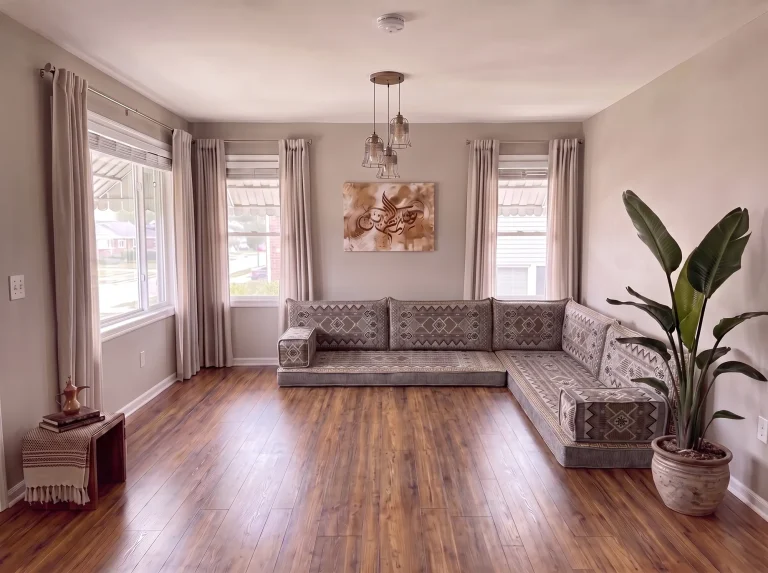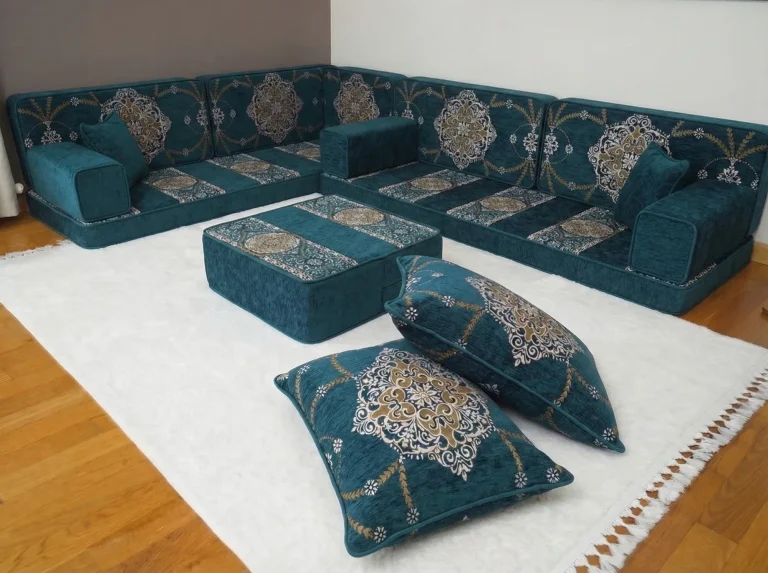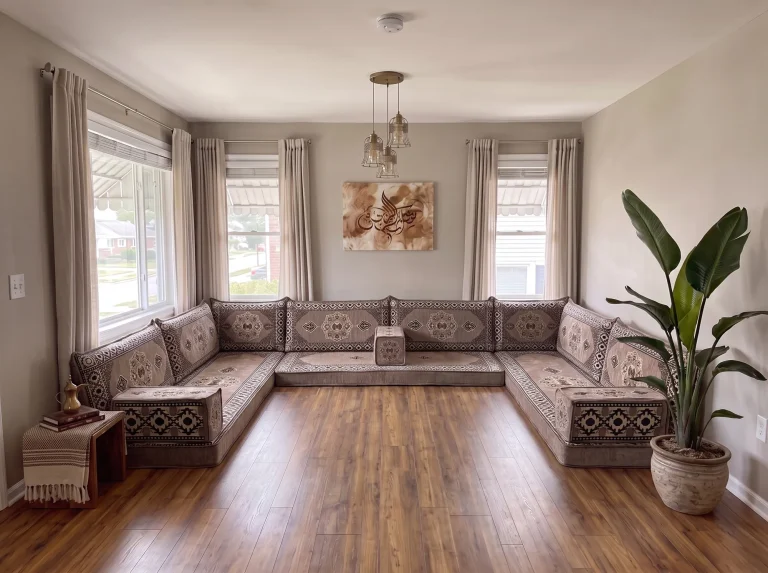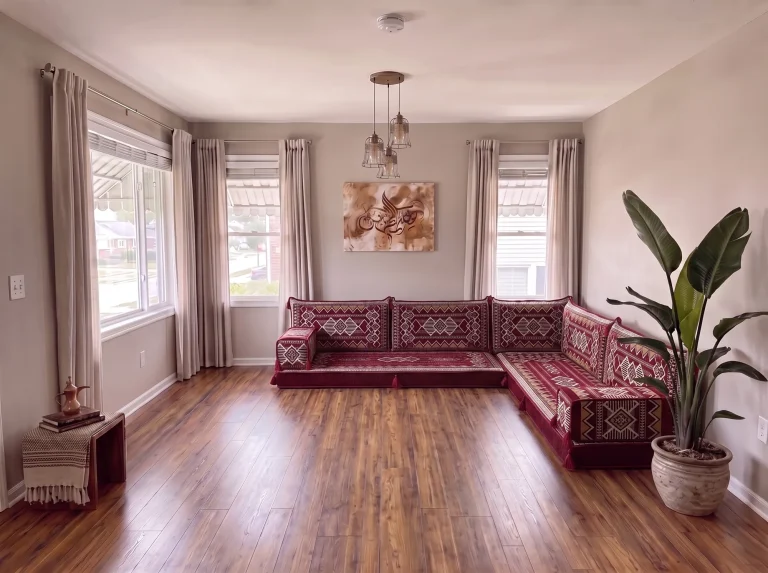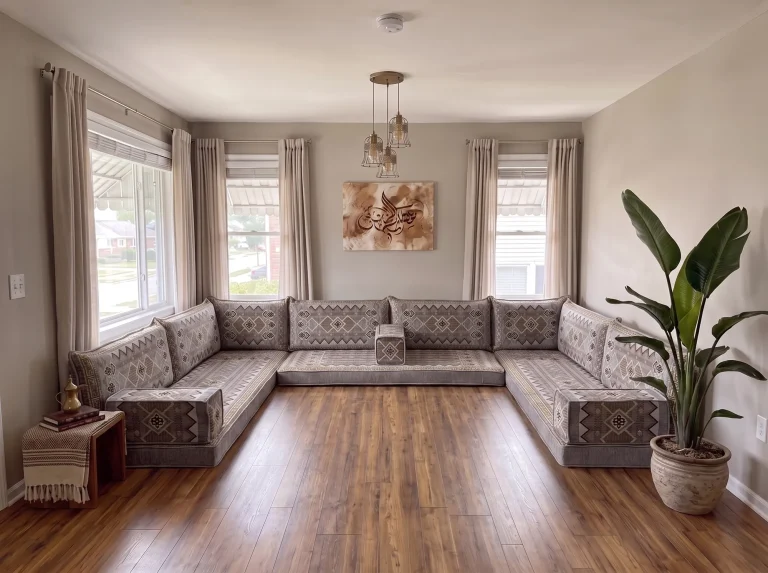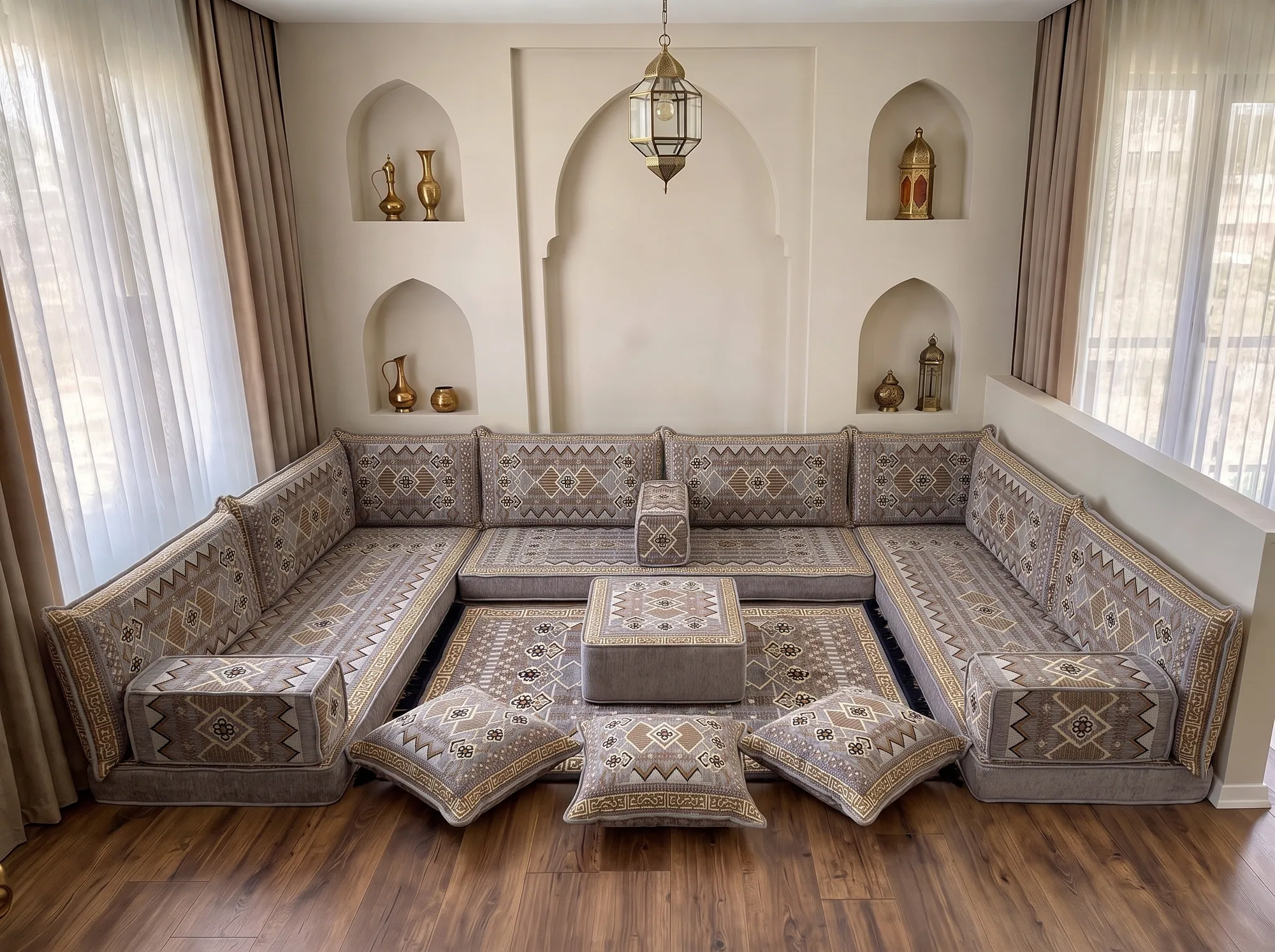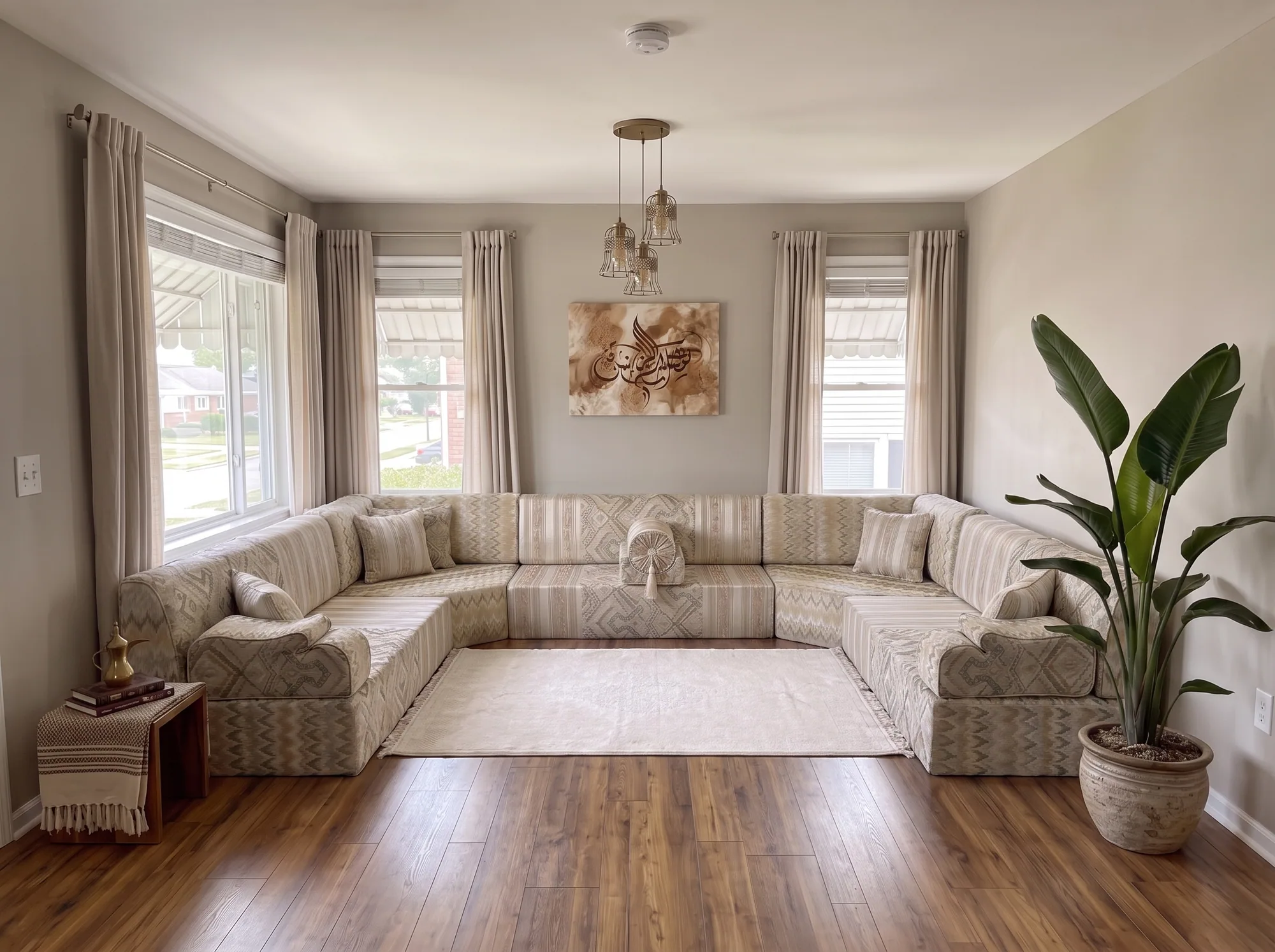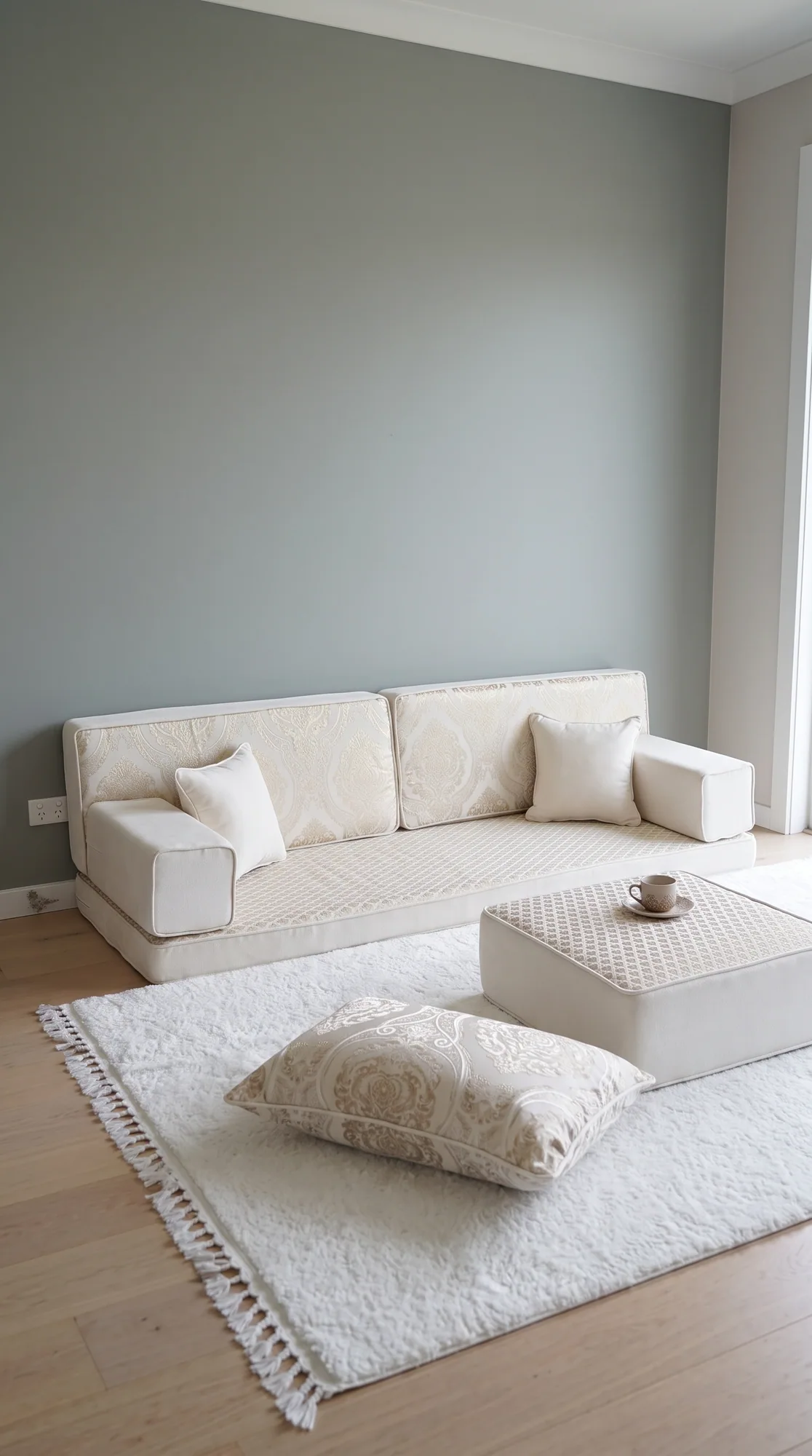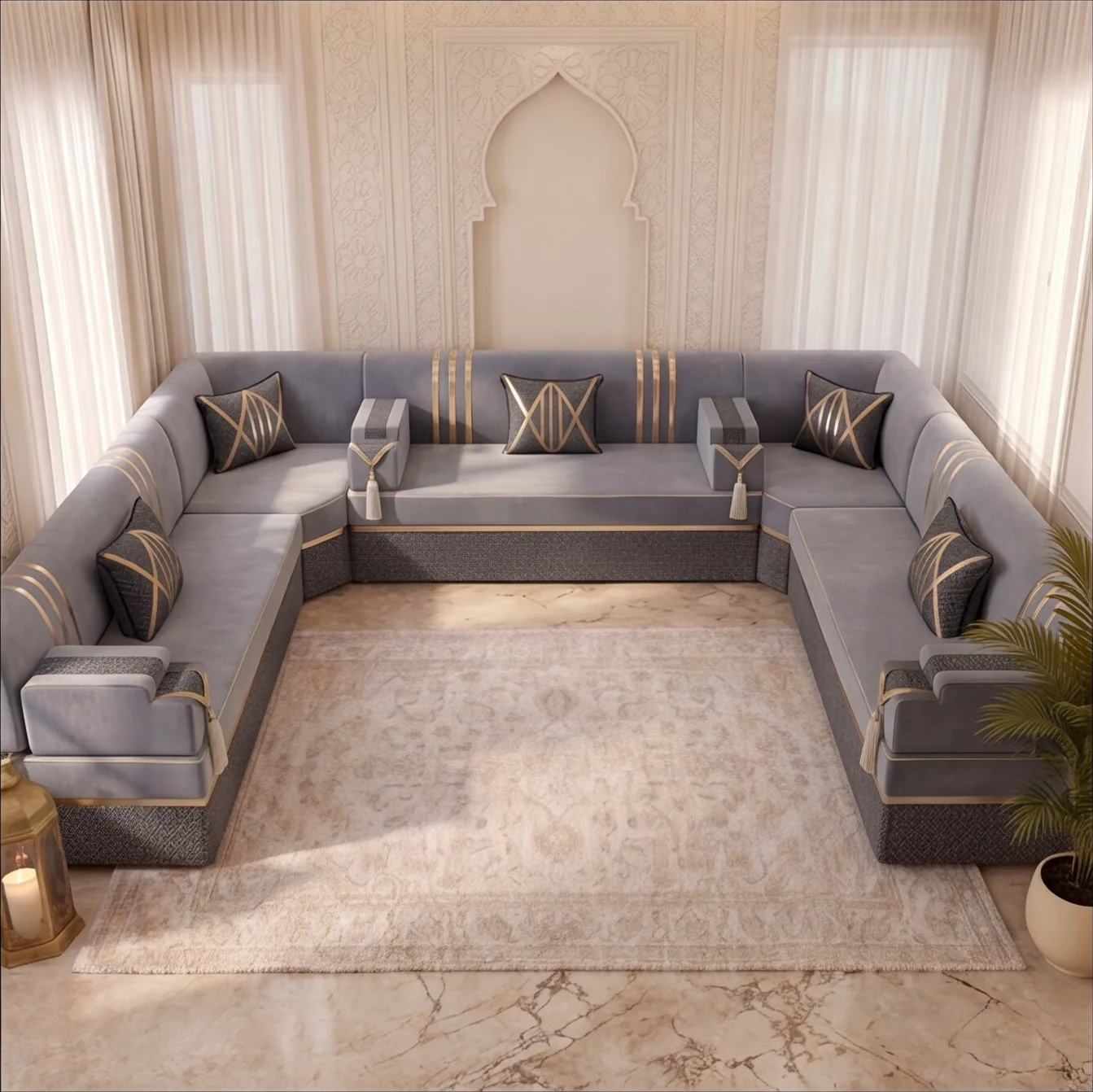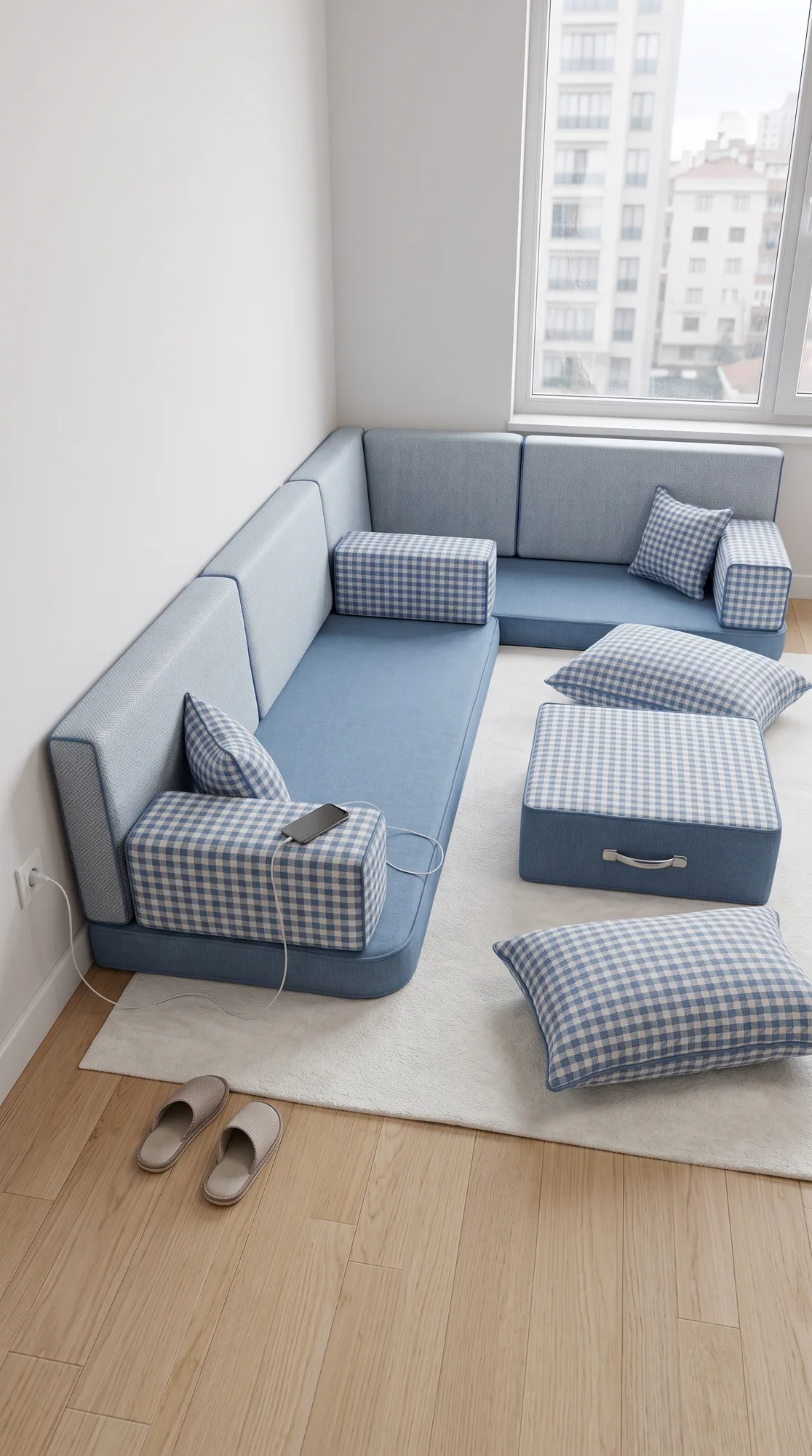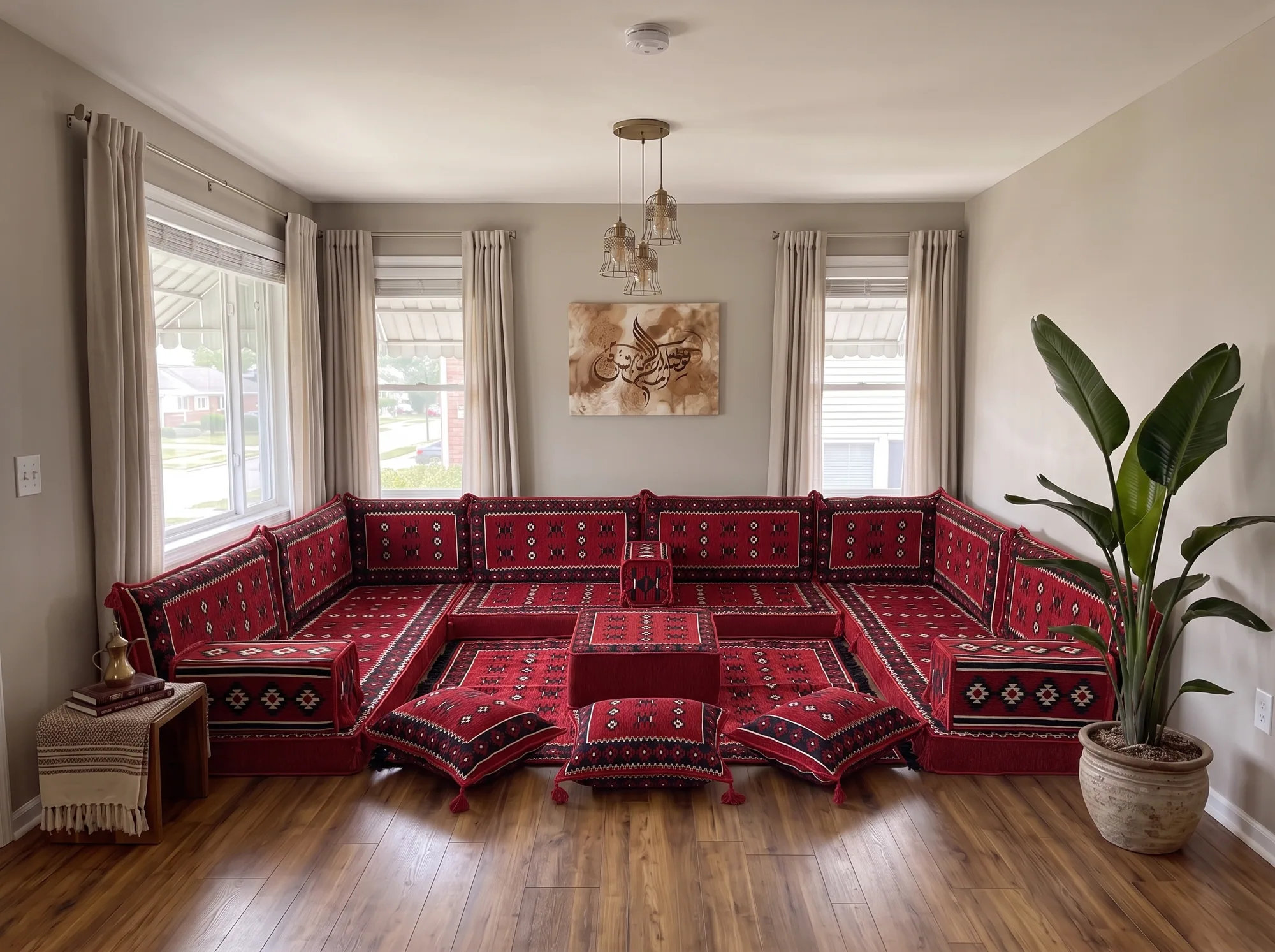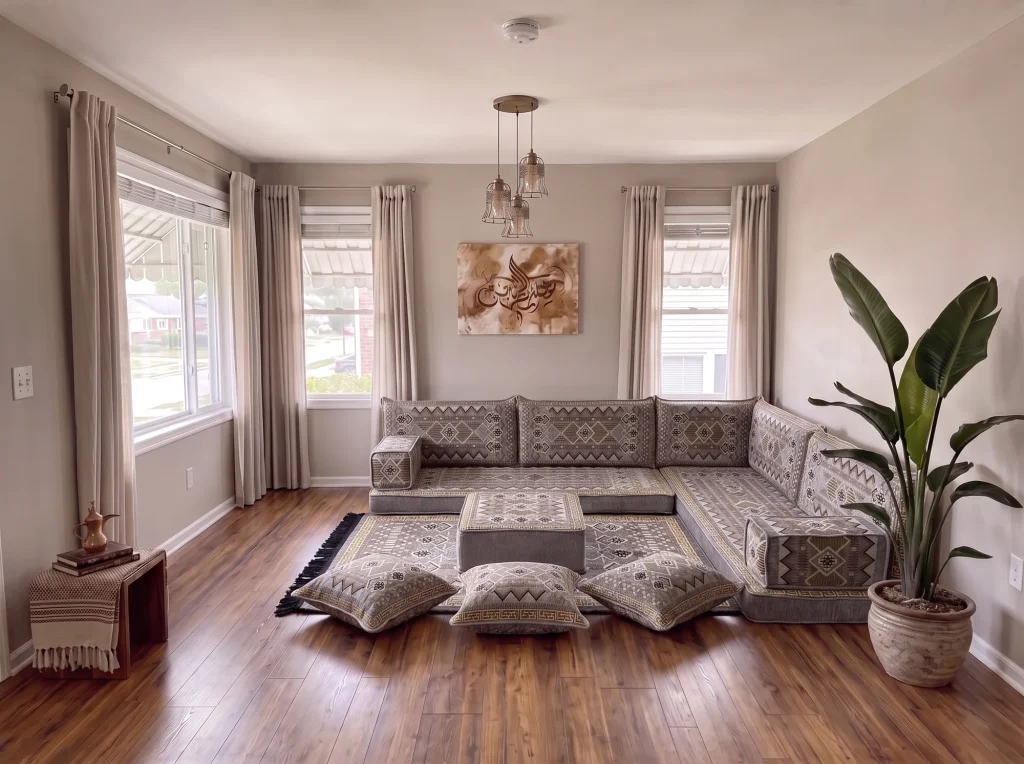
A home prayer room can hold seating as long as the floor in front of the prayer mats stays open. Put a low seat along the back or side wall, away from the qibla wall, for Quran reading and dhikr before and after prayer. Sofhu makes single-row and L-shaped floor seating to the wall lengths you send.
- Seat position
- Back or side wall, not the qibla wall
- Best layouts
- Single row or a small L
- Colours
- Quiet neutrals, soft greens and blues
- Covers
- Zippered and washable at 30°C
- Foam
- 32 kg/m³ (32 DNS), no springs
- Sizing
- Made to your wall measurements
On this page
The best prayer room ideas begin with what to leave out. A musalla at home is defined by open floor, a clear direction and quiet. Seating has a place in it, but a small one: somewhere to read Quran before fajr, to sit with tasbih after isha, to listen while a child recites. The task is to add that seat without taking a hand’s width from the place of prayer. What follows is practical layout advice from a furniture maker. It is not religious guidance, and where practice is in question your imam is the person to ask.
Keeping the prayer area clear
Plan the empty space first and the furniture second.
Work out the qibla direction in the room and mark it. The wall you face, and the floor in front of it, stay free: no seat, no shelf at head height, nothing to step around. Then count how many people will usually pray together and lay that many mats side by side. Whatever floor is left behind or beside the rows is the only space a seat may use.
Three rules keep a home musalla design honest:
- Seat behind or beside, never in front. A seat on the back wall or a side wall is out of the line of sight during prayer.
- Keep the door swing and the path to the mats open. People arrive in a hurry at prayer time.
- Do not let the seat creep. Floor seating is modular, and it is tempting to add one more piece. Fix the length of the run at the start and keep to it.
Because Sofhu’s floor sofas are not freestanding and need a wall behind them, they sit naturally at the edge of a room and leave the middle alone, which is what a prayer room needs.
A word on the two products Sofhu makes. The Arabic floor sofa is a low cushion set at floor level, and it is what most of this page describes. The Arabic majlis is raised, upholstered seating at sofa height, the better choice where someone in the house needs a higher seat.
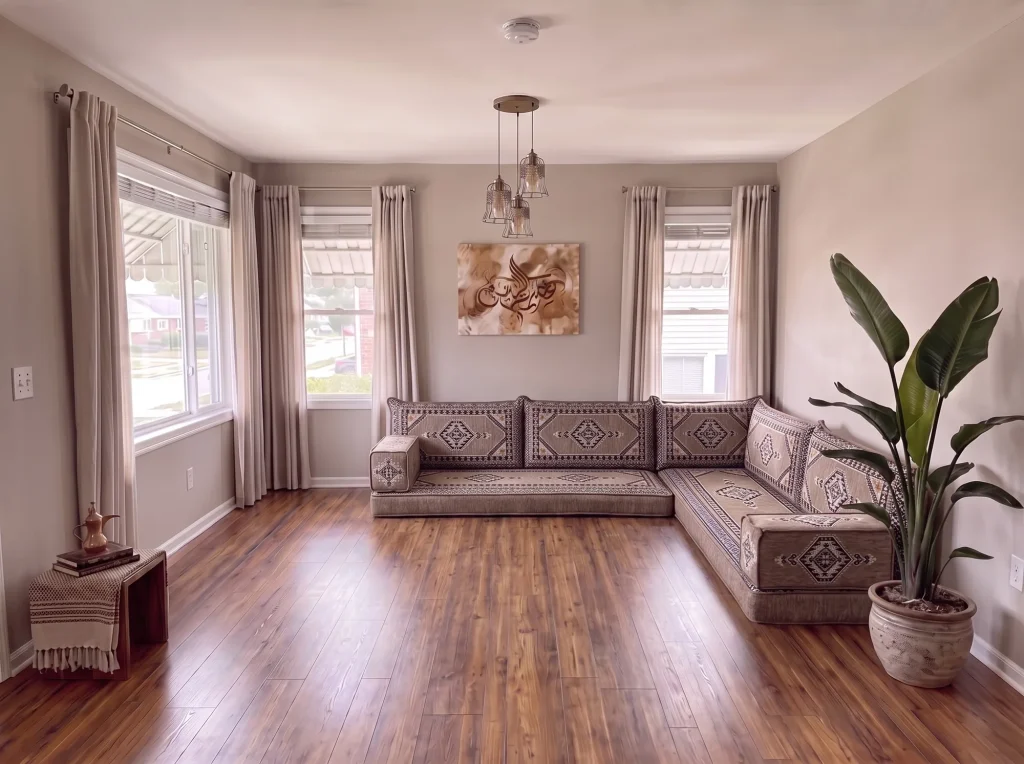
A reading and dhikr corner
A Quran reading corner needs four things within arm’s reach: a seat, a back support, a light and the book.
The seat. A single run long enough for one or two people is plenty. A firm seat keeps you upright for reading. Sofhu fills its seats with 32 kg/m³ high-density foam and describes its cushions as firm, with no springs inside, and on custom orders you can ask for a softer or firmer feel.
The back. Backrest cushions that lean on the wall let you sit for a long recitation without slumping. An armrest bolster at one end gives an elbow somewhere to rest while holding the mushaf.
The light. A reading lamp or wall light beside the seat, warm in tone and not glaring into the eyes of someone praying.
The book. A shelf or niche at seated shoulder height, so the Quran is stored above the seat and never on the floor. A folding stand (rehal) beside the seat serves the same purpose.
Where two walls meet behind the prayer rows, a small L makes a corner where a parent and child can sit at right angles over a shared page. This is the most useful form of prayer room seating in a family house.
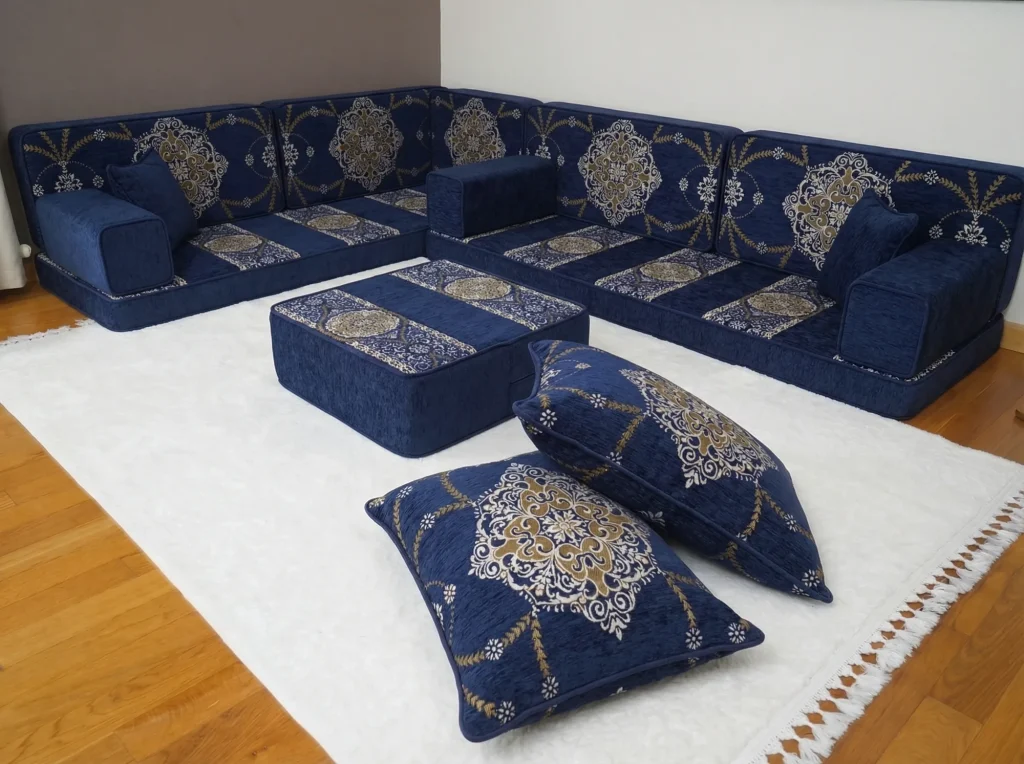
Loose floor cushions are worth adding. They give children a place during a lesson and stack in a corner afterwards.
Colours and fabrics
A prayer room should not compete for attention, so choose colour and cloth for calm.
Pale neutrals do most of the work: cream, sand, stone, soft grey, taupe. Sage green and muted blue sit well beside them. If you like the deeper traditional colours, use them in a small measure, on a bolster or a rug border, and keep the large surfaces quiet. There are worked examples in beige, cream and grey majlis ideas, and plainer silhouettes in the modern Arabic sofa range.
On pattern, many households prefer plain cloth or a small geometric repeat, and keep anything bold out of the direction of prayer. Geometric and medallion weaves are a comfortable fit. If the cushions carry a strong motif, put them on the back wall.
For fabric, think about touch and washing:
| Fabric | Suits a prayer room because | Note |
|---|---|---|
| Linen | Breathable and cool; Sofhu describes it as absorbent | Choose a mid-tone if the room is used daily |
| Woven or jacquard | Small pattern, holds its shape | Good for the back wall |
| Chenille | Soft underhand; low shedding by Sofhu’s description | Warm in winter rooms |
| Velvet | Rich and quiet in plain colours | Shows handprints until brushed |
Sofhu states that its covers are zippered, removable and machine washable at 30 degrees, which matters in a room kept as clean as this one. See its page on linen floor sofas for that option.
Storage for mats and books
Clutter is what turns a musalla back into a spare room. Give every object a home.
- Mats. A lidded basket or a low chest by the door, or a rail on the back of the door for mats that hang.
- Prayer clothes. Hooks or a narrow cupboard, out of the qibla line.
- Qurans and books. Shelves above seated head height on a side wall. Keep the top shelf for the mushaf.
- Tasbih, miswak, attar. One small tray on the shelf.
- Children’s things. A basket of their own, so small mats and first books are theirs to fetch and return.
Keep storage off the floor wherever possible. Wall shelves and hooks cost no prayer space, and floor cabinets do.
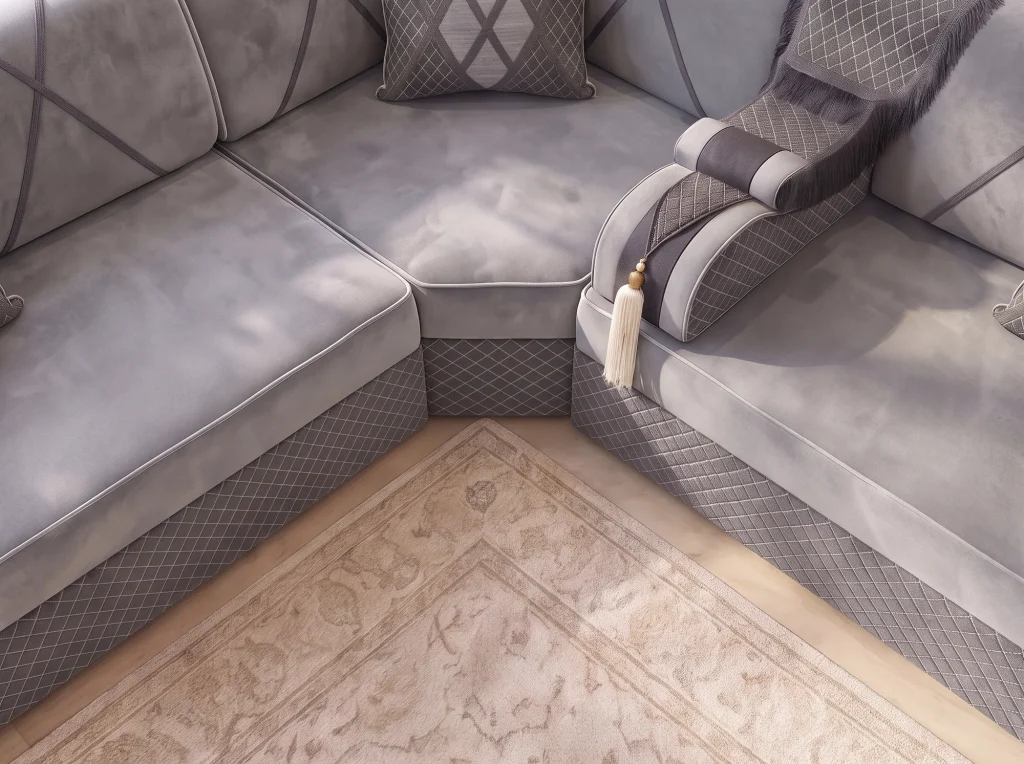
Prayer room ideas for small rooms
Three common situations, described by shape instead of size, since every room differs.
A box room given over to prayer. Mats across the room facing the qibla. A single-row seat on the wall behind them, running the full width. Shelves above the seat. This is the simplest and most restful arrangement.
A prayer corner at home in the living room. Choose the corner farthest from the television and the door. Keep a mat’s length of floor clear toward the qibla. If the living room already has a floor sofa or a majlis, let the end of one run serve as the reading seat and add a wall shelf there. A folding screen or a curtain can close the corner off at prayer time.
A wide landing or alcove. One mat, one shelf, and a short seat or a pair of floor cushions to the side. Even this is enough for a place the household recognises as set apart.
For other tight layouts, see a majlis in a small apartment. If an elder in the house prays seated, the advice in hosting elderly guests in a majlis on mixing seat heights applies here as well.
Ordering a seat for your musalla
Islamic prayer room furniture is mostly a matter of fit. Sofhu is the manufacturer and makes each set in Türkiye from the customer’s measurements, so the seat can stop exactly where your prayer rows begin. Send the length of the back or side wall, mark the qibla direction and the door on a sketch, and say how many people pray there. Shipping is free worldwide; duties or taxes may apply depending on your country, so ask before ordering.
Look through the Arabic floor sofa range, then get a quote by measurement or send your sketch on WhatsApp.