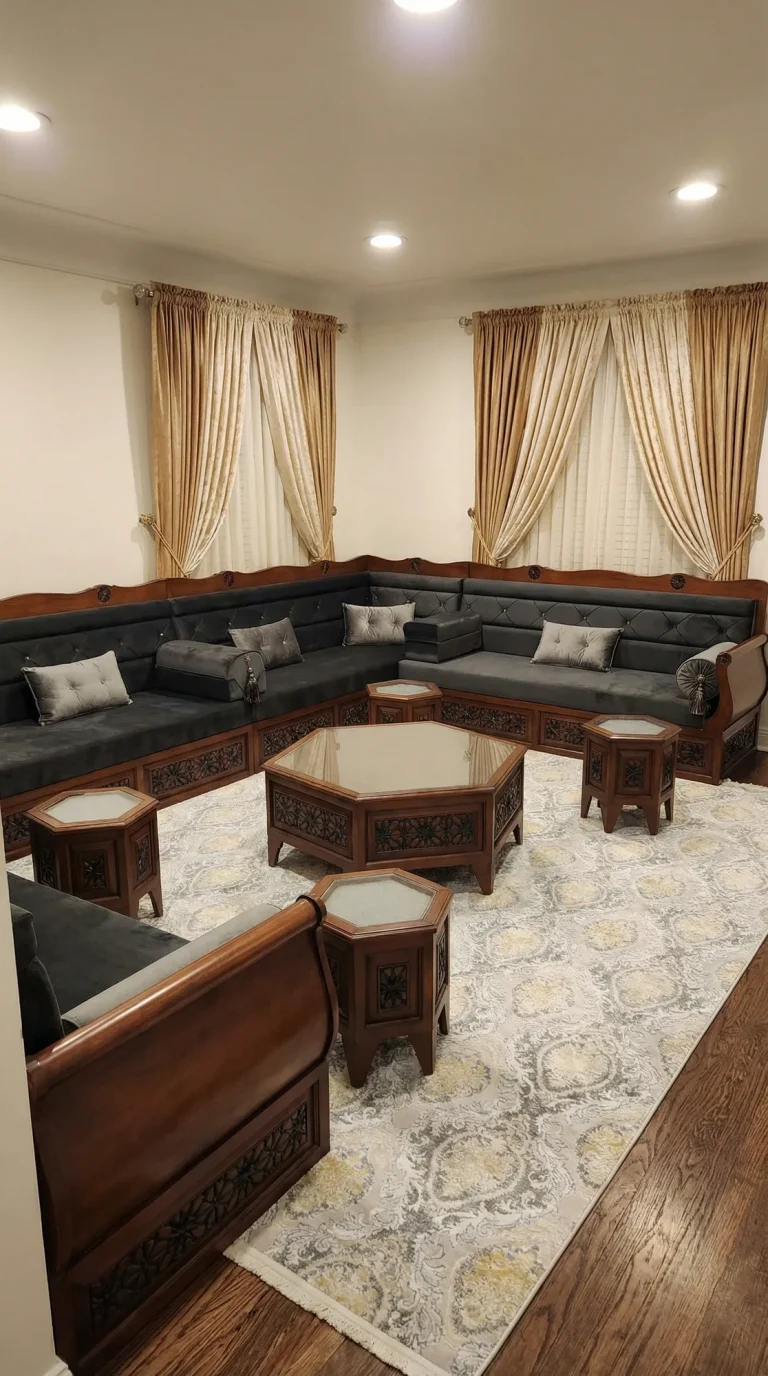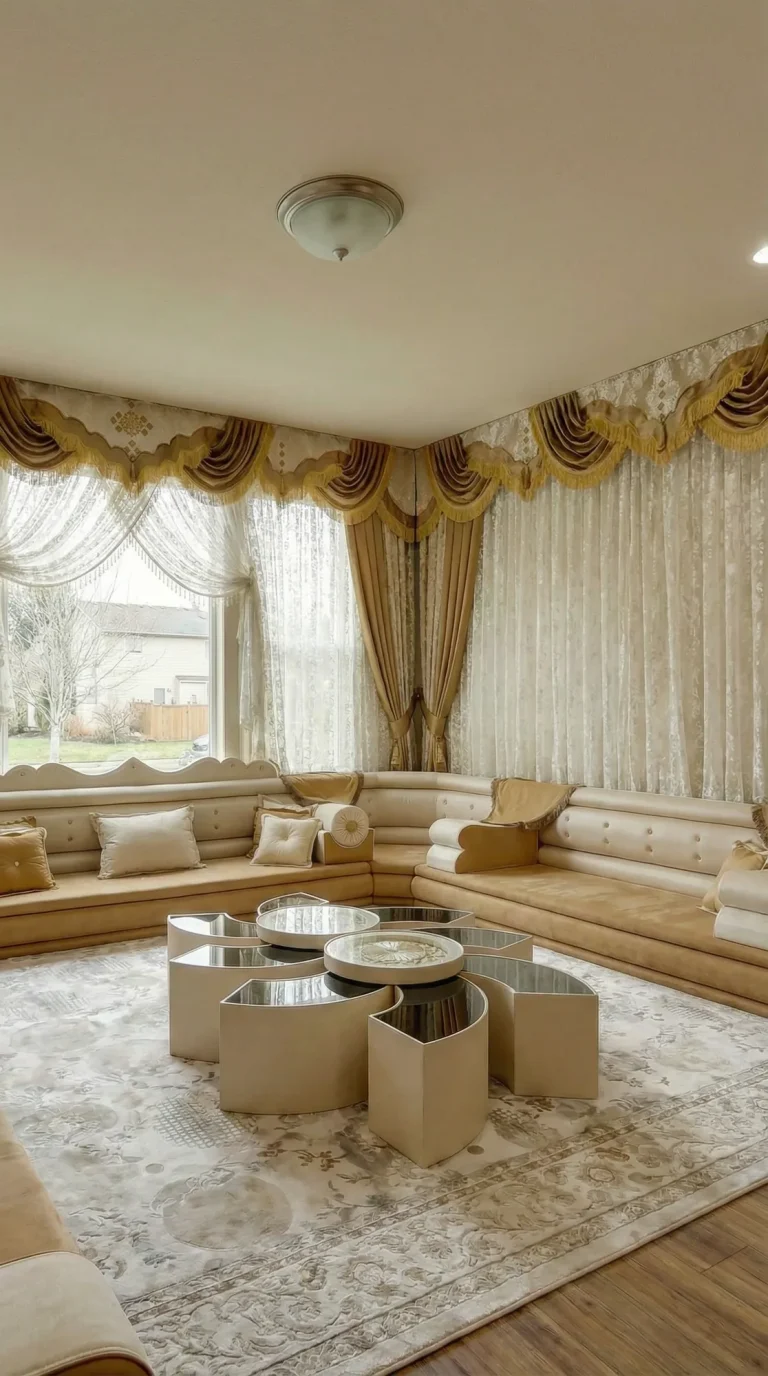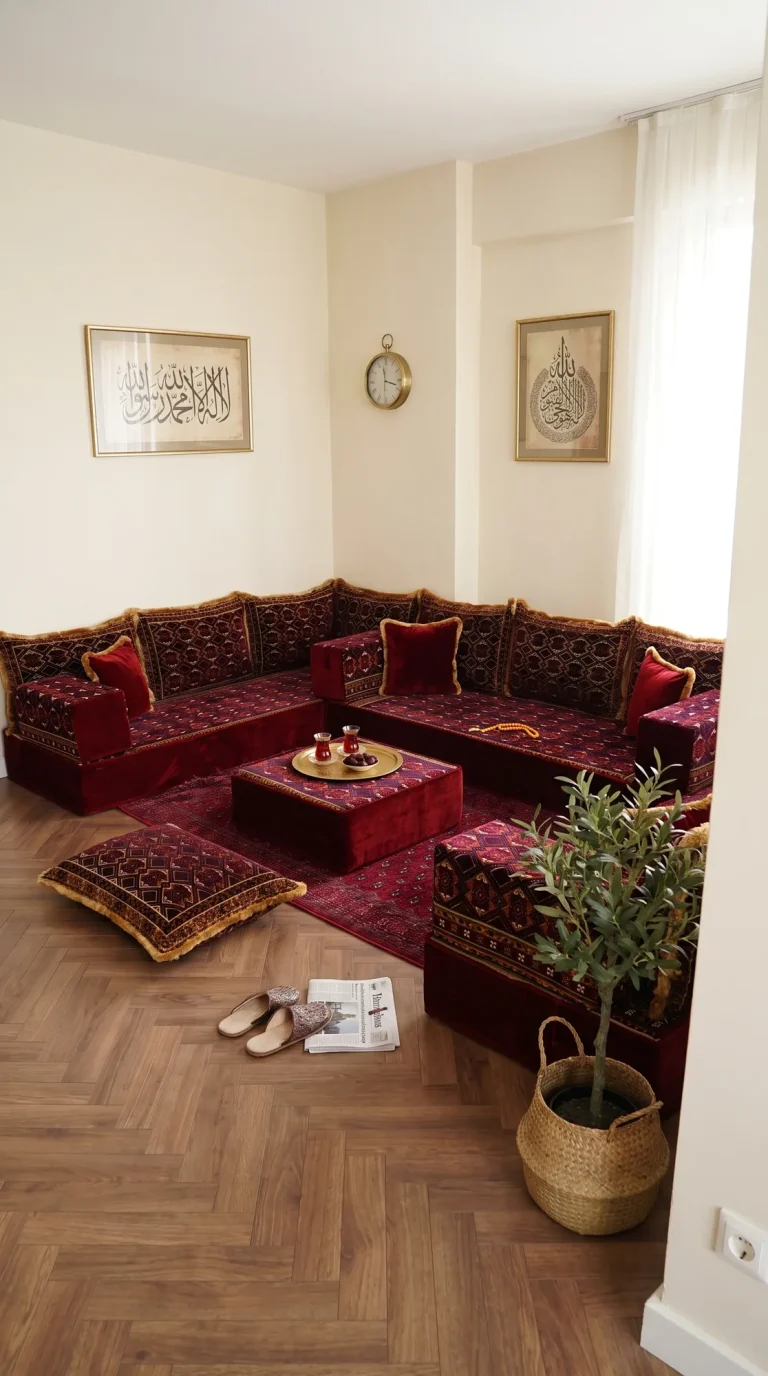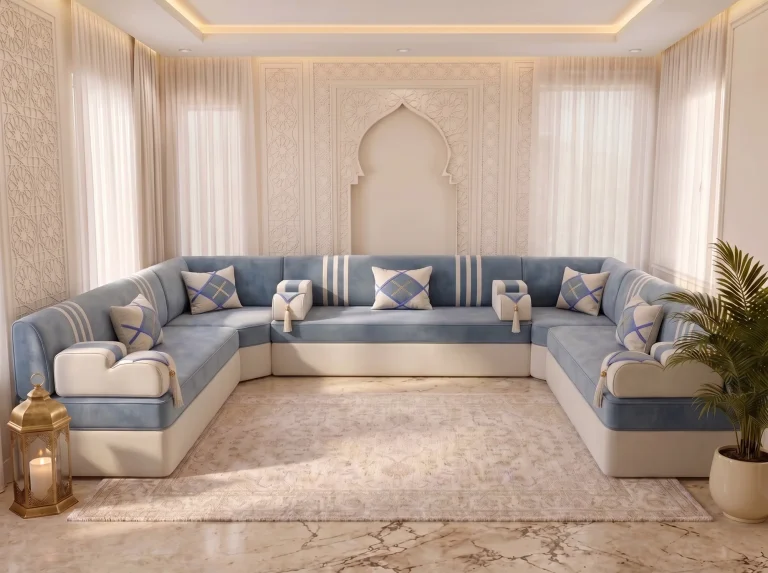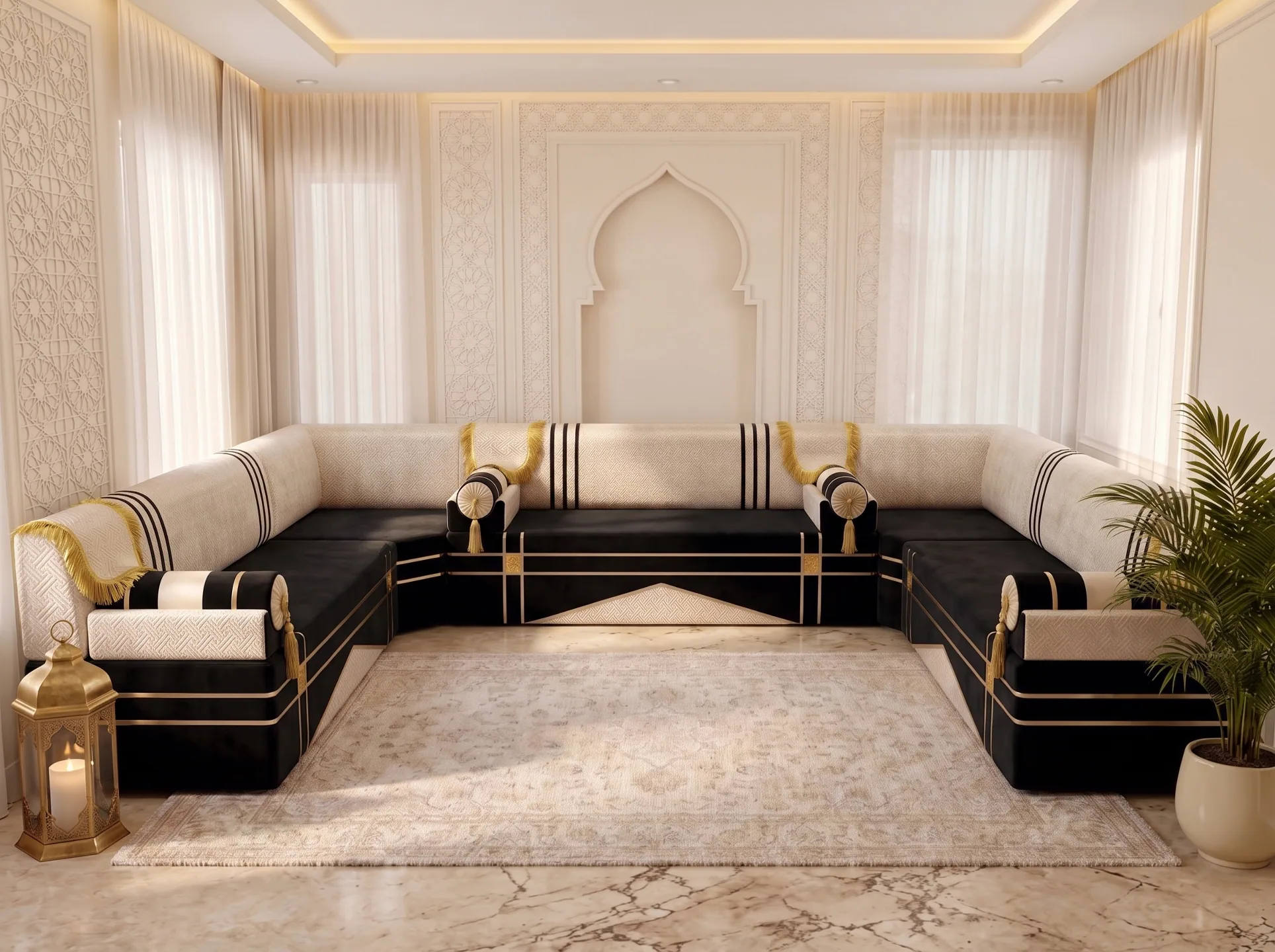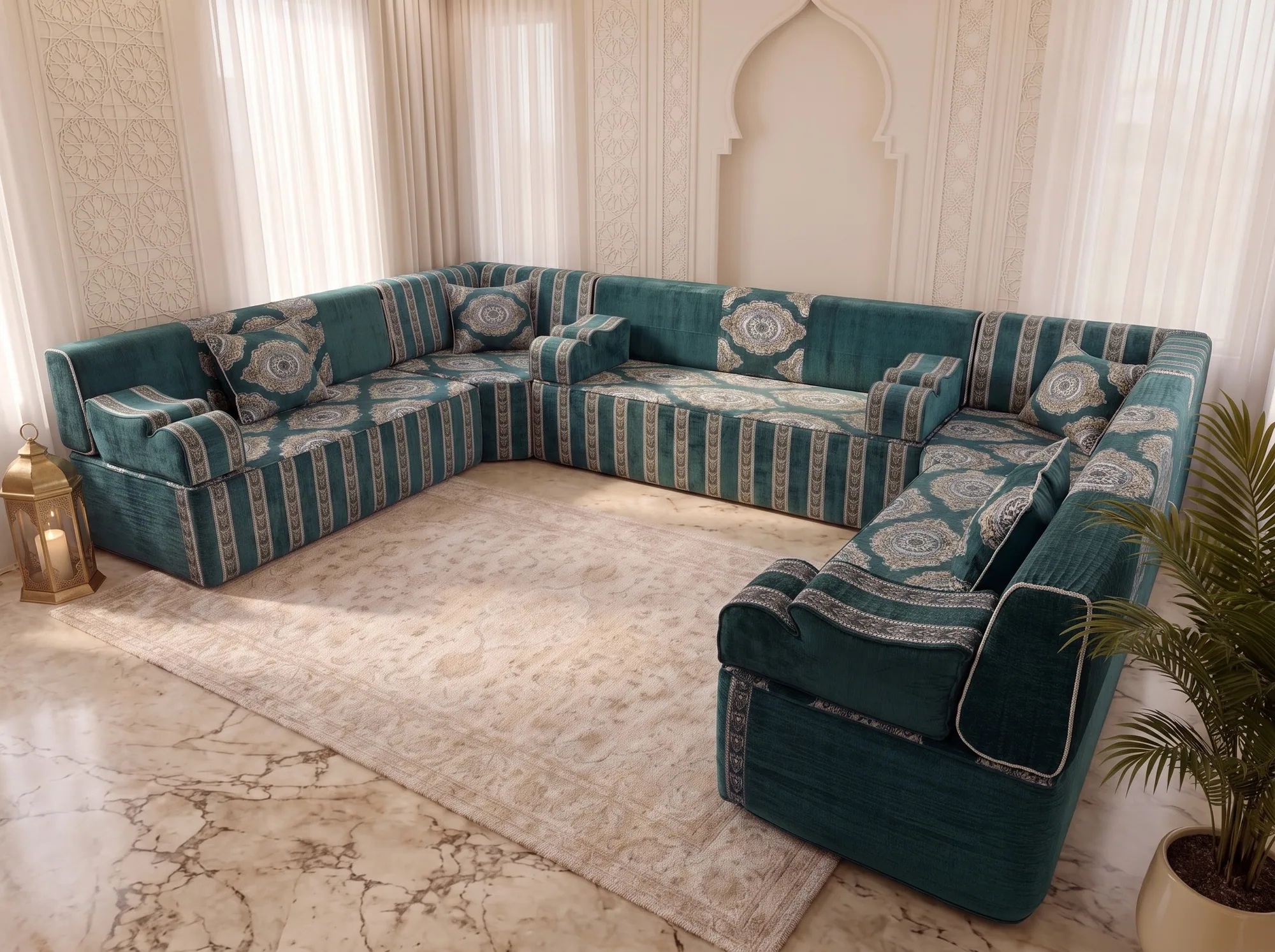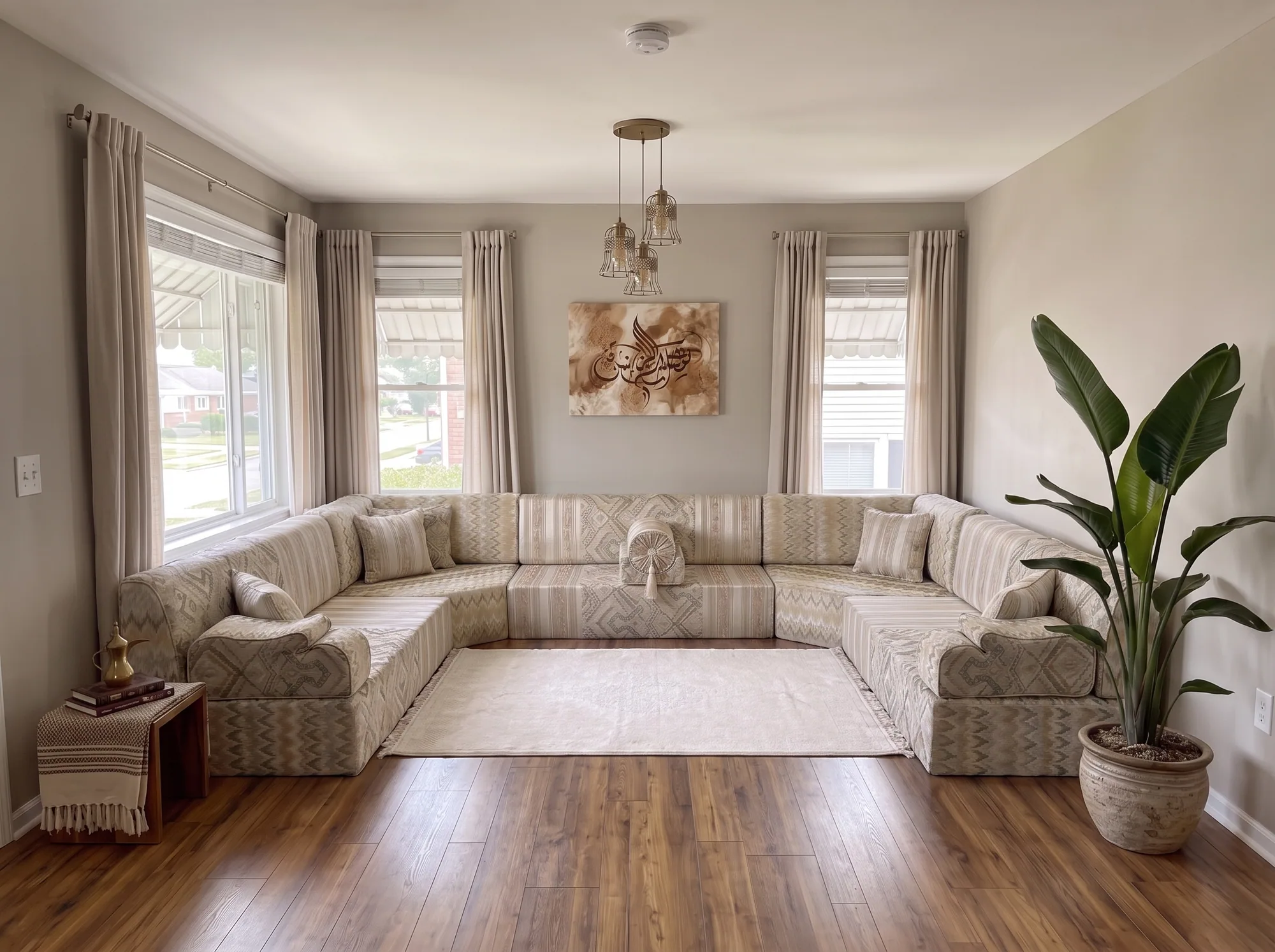
Choose majlis colours in three steps. Start from what will not change: the floor, the walls and the light. Then pick one main colour for the seats, one accent for backs and cushions, and one fine line colour for piping and tassels. Sofhu makes each set to order, so all three can be matched to your room before anything is cut.
- Method
- One main colour, one accent, one line colour
- Start from
- Floor, walls, window direction
- Rough balance
- About 60% main, 30% accent, 10% line colour
- Pattern rule
- One large pattern, one small, the rest plain
- Check before ordering
- Fabric photos in daylight and in lamp light
- Made to order
- Colour, fabric and pattern chosen per set
On this page
Which colour should the majlis be? Most people answer that question by scrolling through photos until one looks right, then find the same set looks different at home. Majlis colours behave better when you choose them in order: first the things in the room you cannot change, then one main colour, one accent and one fine line colour. This guide walks through that order, with rooms from our own work as examples.
Arabic seating is not a sofa that sits in the middle of a room. Sofhu makes two kinds: the Arabic majlis, raised to sofa height with an upholstered base, fixed backs and arm bolsters, and the Arabic floor sofa, a low seat mattress with loose back cushions and an ottoman. Either one runs along two or three walls, so its colour covers more of what you see than any other piece of furniture would. The examples below include both, and the method is the same. That is why a shade that looks modest on a single cushion can take over a whole room, and why the method matters.
Start from what will not change
The floor, the walls and the windows are your fixed points, so read them before you look at any fabric. Write down three things.
- Floor tone. Warm (oak, walnut, terracotta, beige tile) or cool (grey tile, pale laminate, marble).
- Wall colour. White, cream, grey or a painted colour. Note whether you are willing to repaint.
- Light. Which way the windows face and when the room is used. A north-facing room in a cold country has grey light most of the year. A room used mainly after sunset lives under lamps.
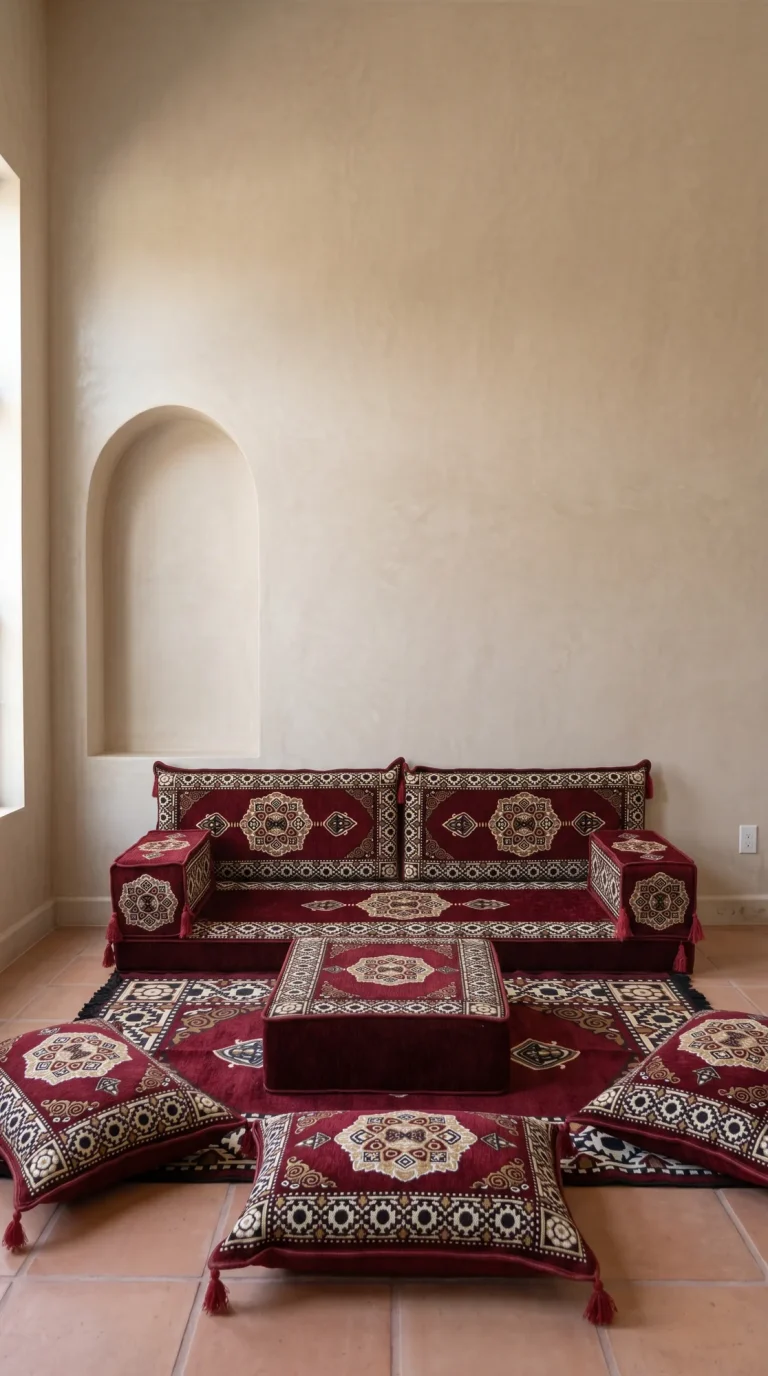
Warm floors are kind to warm colours: burgundy, terracotta, mustard, olive, cream. Cool floors suit navy, grey, teal and white. You can cross the line, and often should, but then the rug has to do the joining. A cream rug between a walnut floor and a navy set is the simplest bridge there is.
If a rug or curtains are staying, treat them as fixed too. A patterned rug has already chosen your palette for you. Pull the seat colour from the second or third strongest colour in the rug, not the strongest, so the two do not merge into one block.
Main, accent and piping: the three majlis colours
A set reads best with three colours in clearly unequal amounts. Designers often quote a rough balance of 60, 30 and 10 per cent, and it works well for majlis colour combinations because the seating has three natural layers.
| Layer | Where it goes | Share |
|---|---|---|
| Main | Seat cushions and base band | About 60% |
| Accent | Backrests, armrests, throw cushions | About 30% |
| Line | Piping, stripes, tassels, embroidery | About 10% |
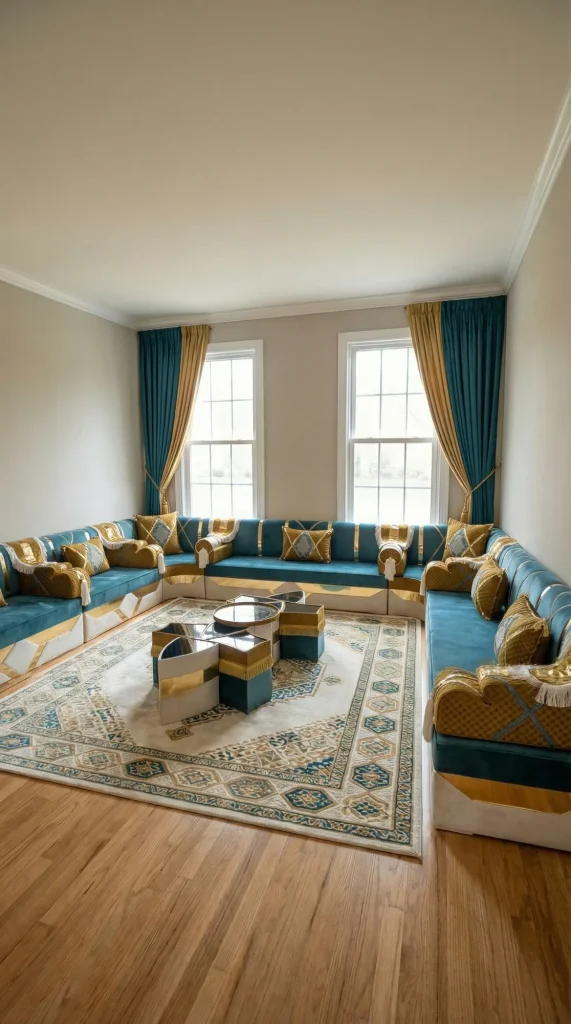
The teal majlis at the top of this page shows the layers plainly. Teal velvet is the main colour, gold quilting on the armrests is the accent, and the pale walls and rug give the eye somewhere to rest. The curtains repeat teal and gold, so nothing in the room is a stranger.
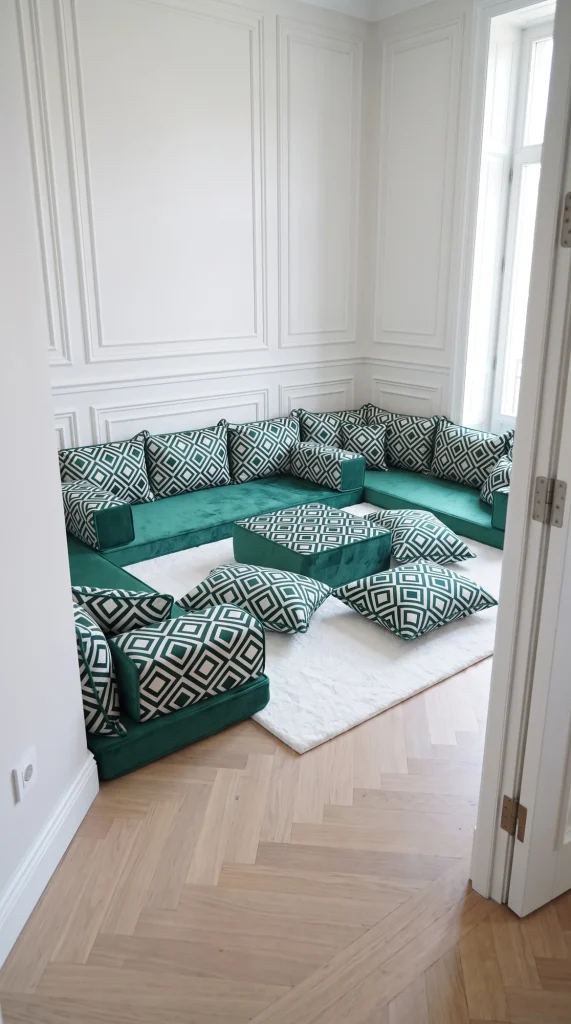
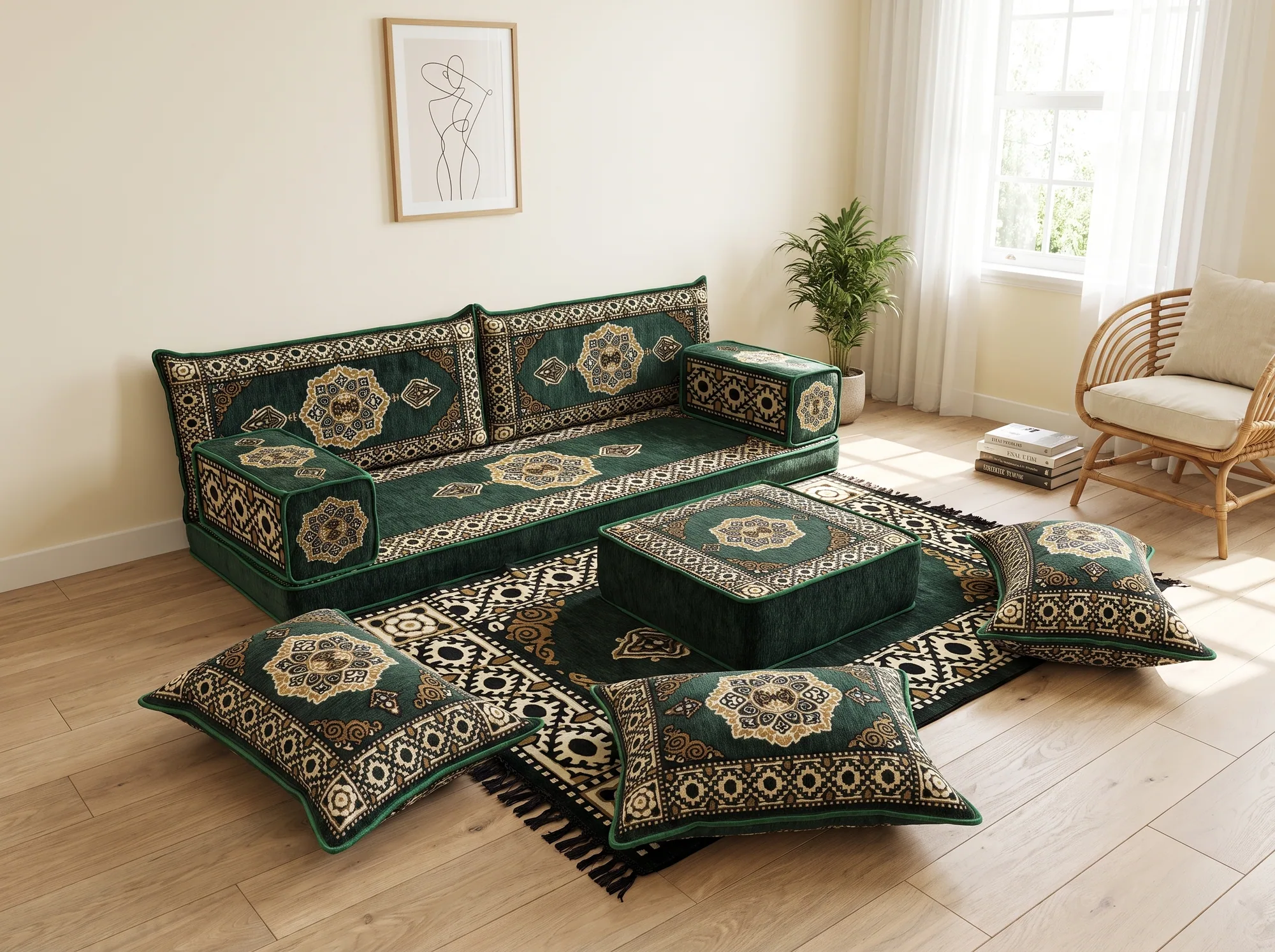
Here the same idea is done on a floor sofa with only two colours and a pattern. Emerald velvet is the main colour. The white geometric cushions are the accent, and they are placed at regular intervals so the white travels around the whole set. White panelled walls pick the accent up again.
Because each Sofhu set is made to order, the three layers do not have to come as a fixed package. You can ask for the seat in one fabric, the backs in another and the piping in a third. The page on custom majlis orders explains what can be changed, and the fabrics page lists the fabric families we work with.
Pattern scale
Pattern counts as colour, and scale matters more than motif. One large pattern, one small pattern and plain fabric for the rest is a safe rule.
A large medallion or star needs distance to be read. It suits a long wall in a big room, where guests see it from across the floor. In a small room the same motif gets cut off by people sitting on it and turns into noise. Small repeats, narrow stripes and textured plains keep their order at close range.
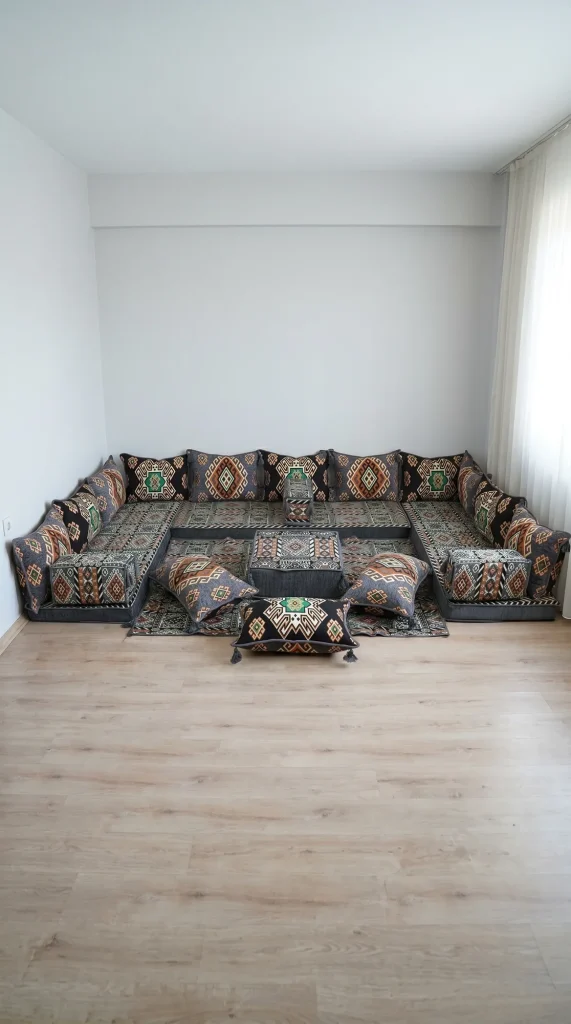
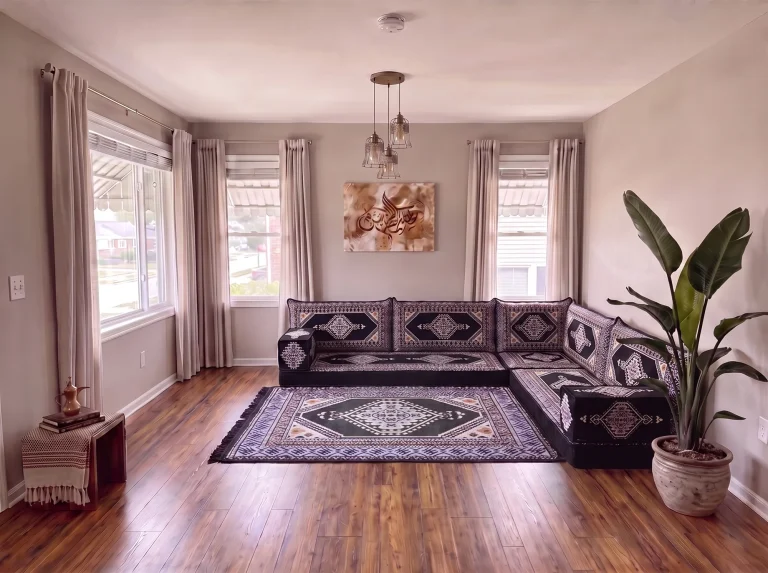
This grey kilim-pattern floor sofa in a plain white room is a good example of balance. The fabric is busy, with black, orange and green in it, so everything else was kept quiet: white walls, pale floor, no patterned curtain. The pattern is the decoration. If you want a patterned rug as well, choose a plainer seat. Our guide to majlis patterns and motifs goes through stars, Sadu bands, damask and kilim geometry one by one.
Daylight and lamp light
A fabric has at least two colours: the one you see at noon and the one you see at night. Check both before you commit.
Velvet shifts the most. Its pile reflects light in one direction and absorbs it in the other, so a navy velvet can look almost black from one side of the room and bright blue from the other. Flat weaves and linen hold a steadier colour. Chenille sits in between.
Warm lamps pull colours towards yellow. Cream turns to butter, grey turns to beige, and blue loses some strength. Cool white bulbs do the opposite and can make burgundy look purple. If the majlis is mainly an evening room, judge the fabric under the kind of bulb you use.
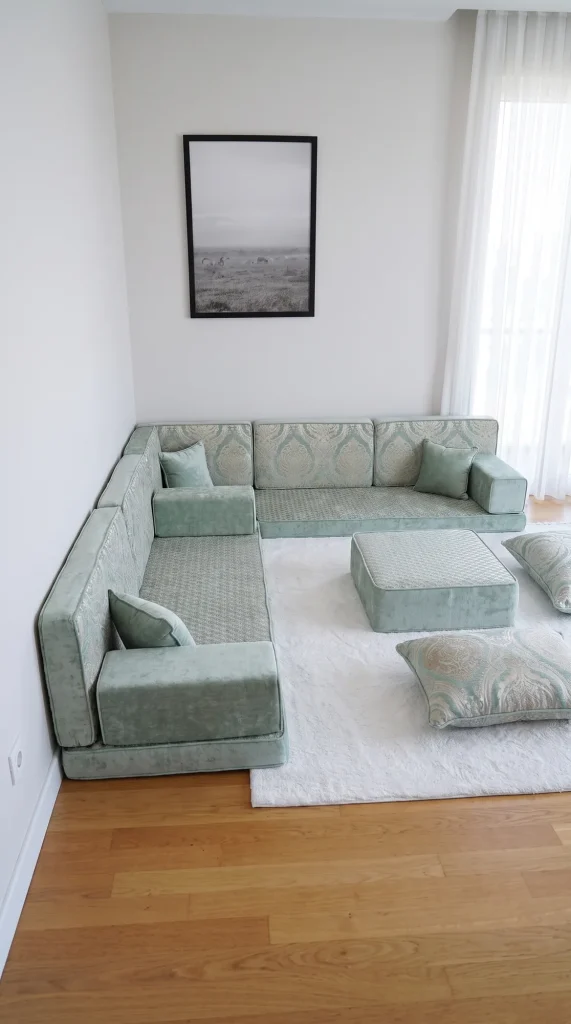
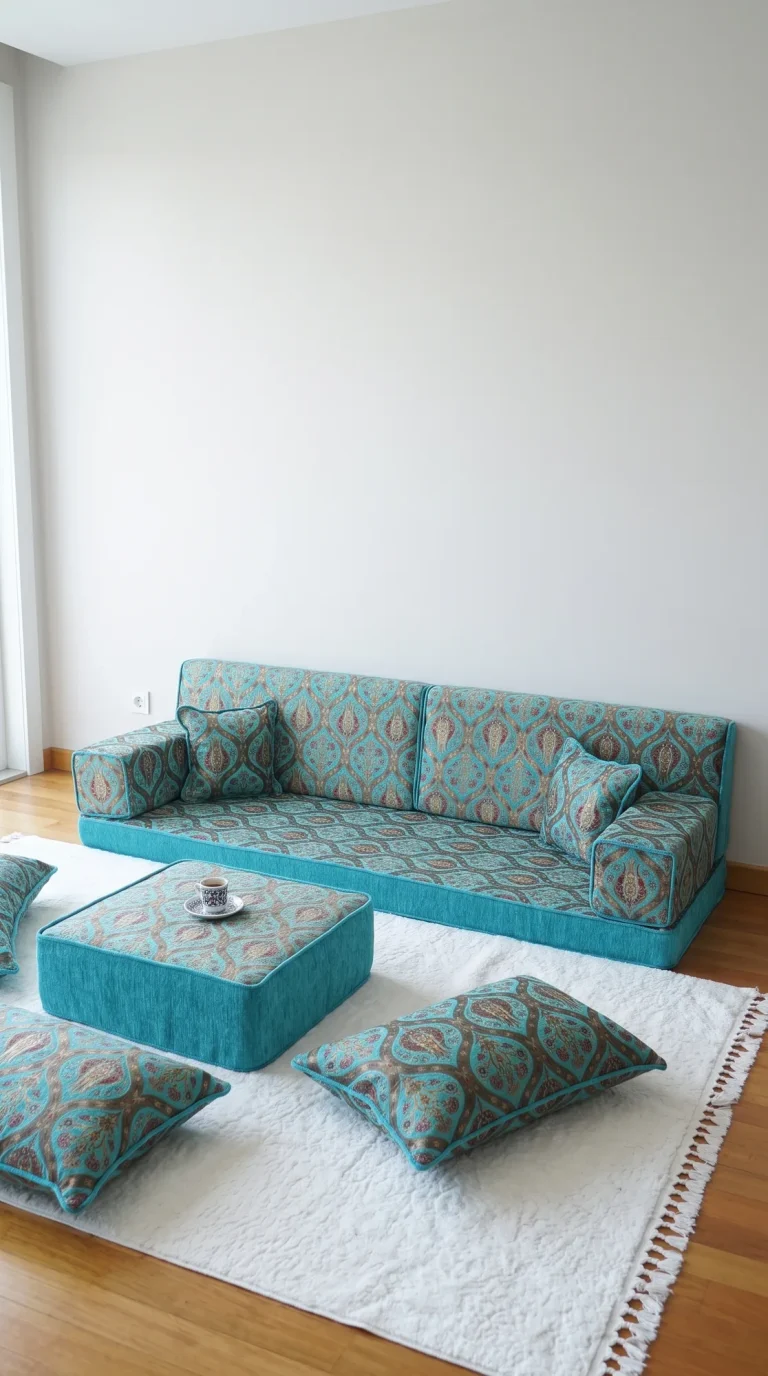
Pale colours are the most sensitive to this. The water-green velvet floor sofa above reads as a soft green in daylight beside a white rug. Under a yellow bulb it would move towards sage. When you request a quote, ask for the fabric to be photographed in daylight and under a lamp, and compare it with a photo of your own room.
Combinations that always work
Some pairings are dependable in almost any room. Each has its own guide if you want to go further.
- Navy, cream and gold. Formal without being dark. See our blue majlis ideas.
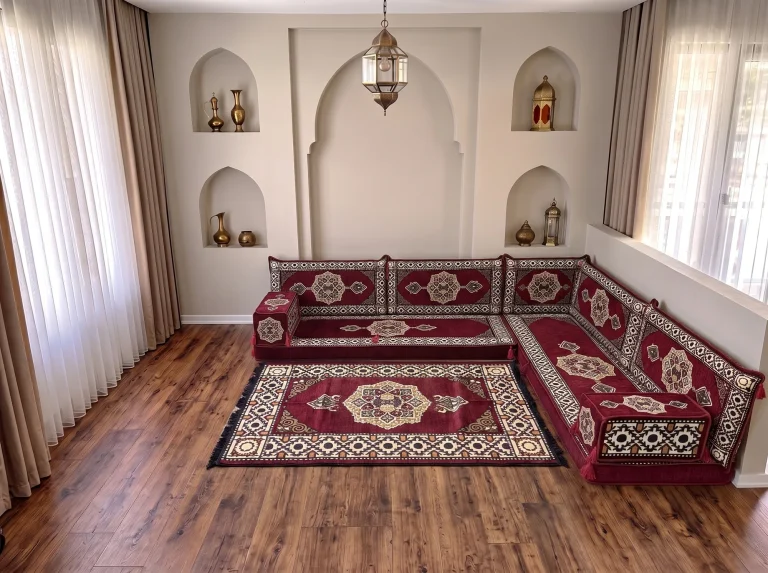
- Burgundy, cream and black. The classic guest-room palette, strong on wooden floors. See emerald green and burgundy majlis ideas.
- Emerald, white and gold. Fresh in daylight, rich at night.
- Beige, cream and a wood tone. Calm and easy to add to. See beige, cream and grey majlis ideas.
- Grey, black and one warm metal. The base of most modern Arabic sofas.
- Black, cream and gold. For a formal room with good lighting. See black and gold majlis ideas.
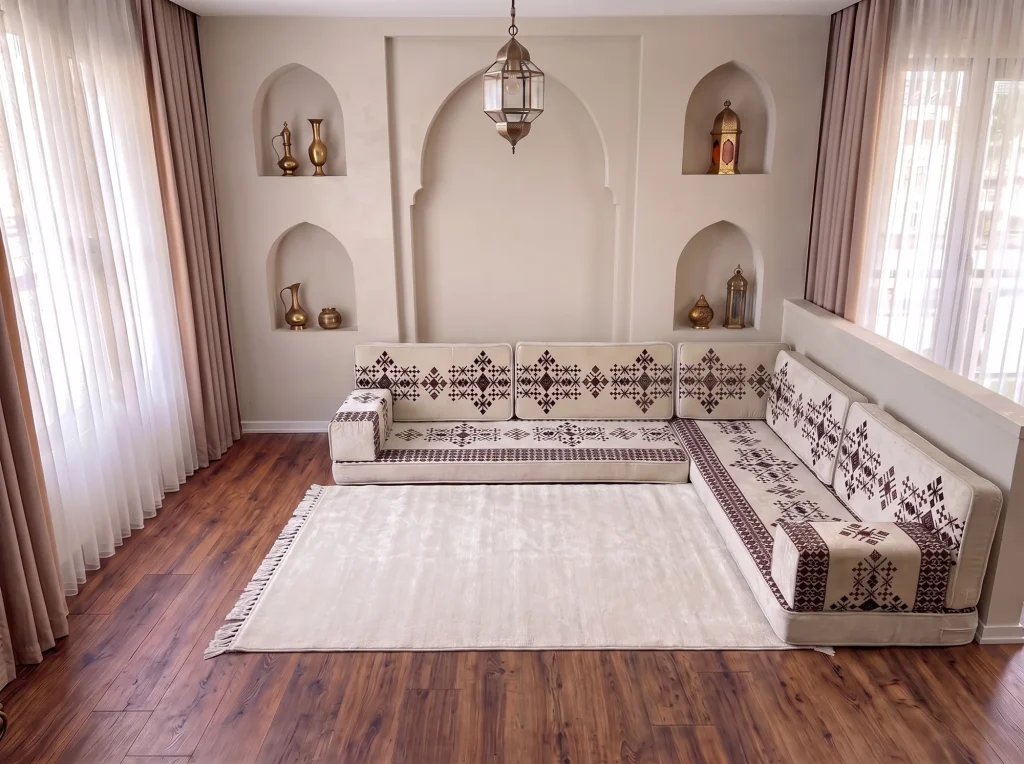
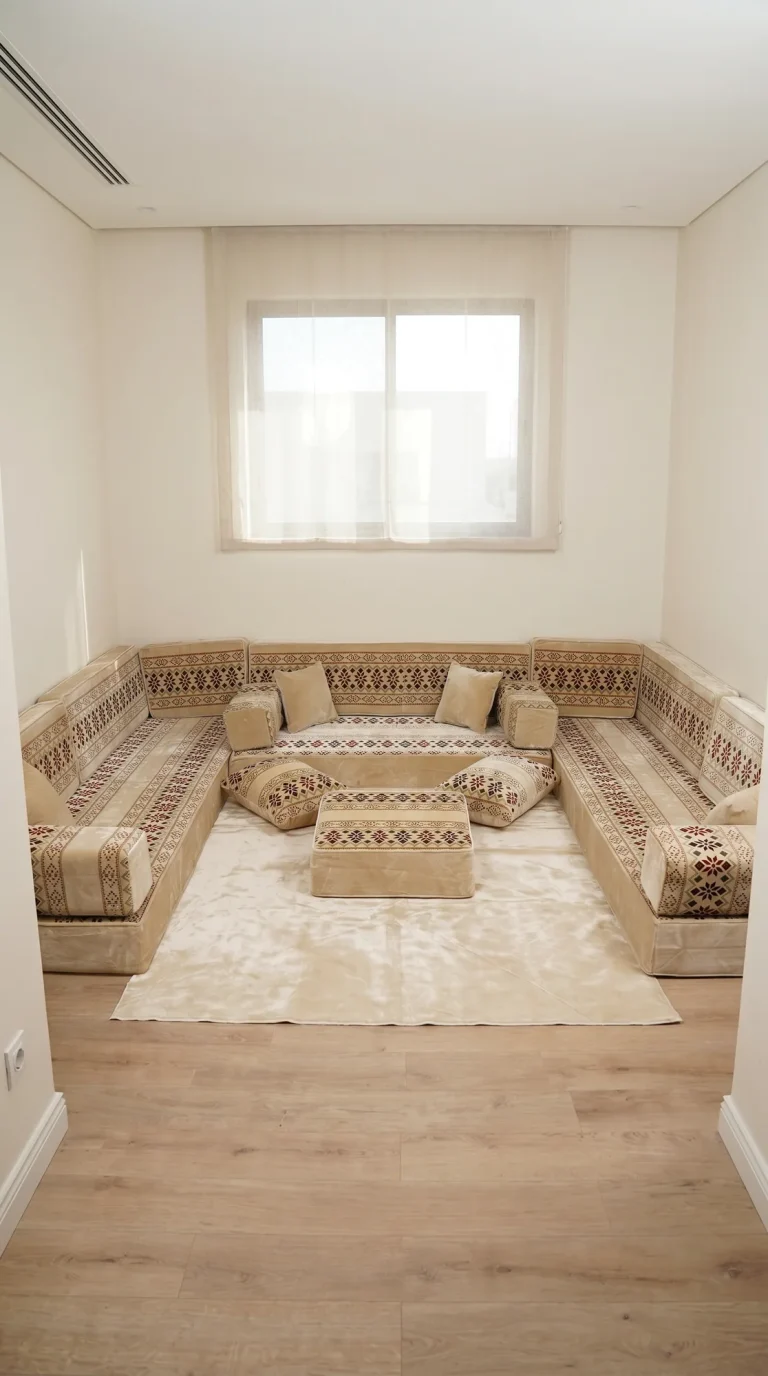
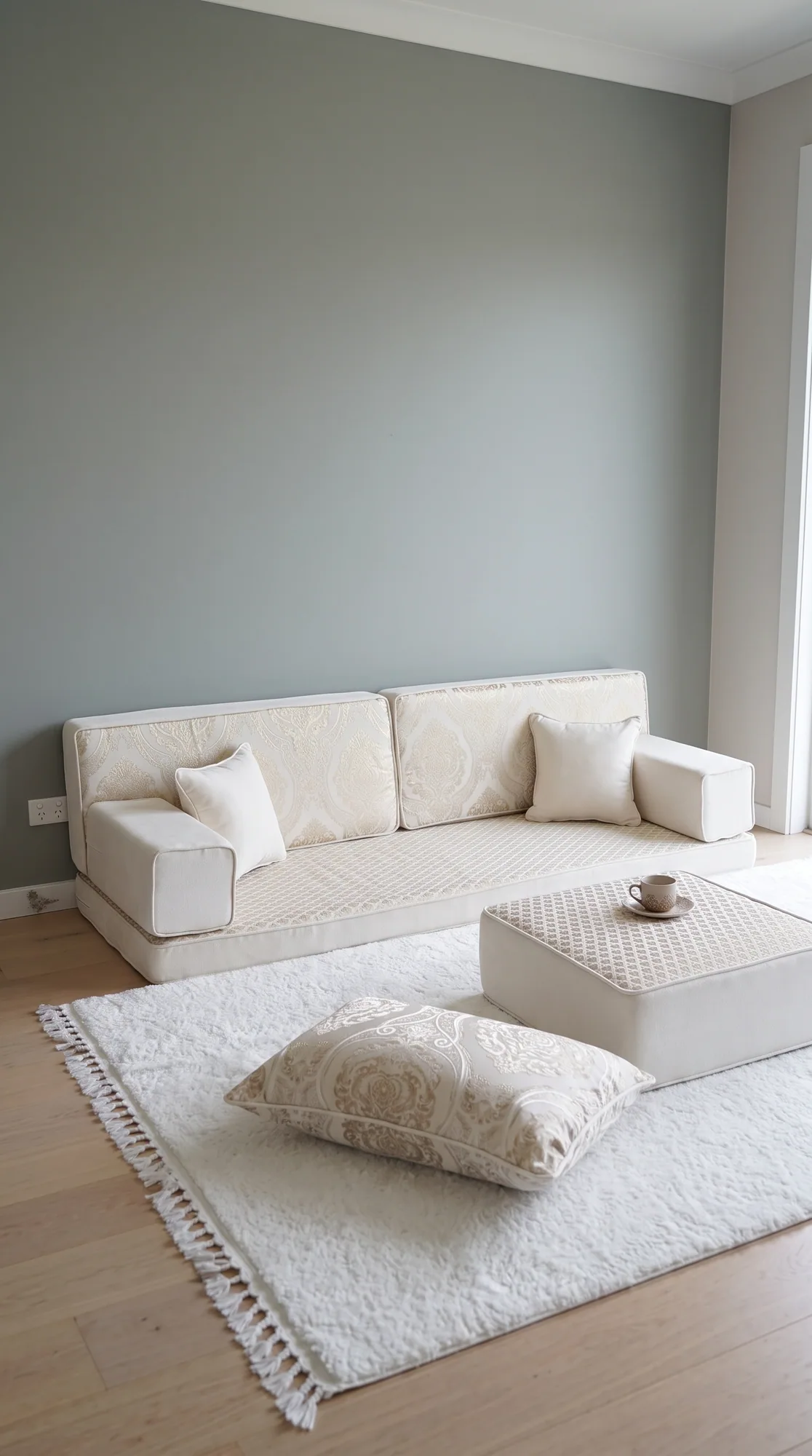
Cream with a coloured band is the gentlest of them. In this room the floor sofa is cream with burgundy and black Sadu-style bands, and the rug was left plain so the bands stand out. It keeps a traditional character while leaving the room light.
Mistakes to avoid
Most colour regrets come from a short list of errors.
- Matching the seat to the wall too closely. Beige on beige with no line colour loses the shape of the set. Add contrast piping or a darker base.
- Choosing from a screen alone. Phone screens brighten and saturate. Always ask for daylight photos beside something white.
- Ignoring the floor. A set that looked right in a photo with a marble floor may clash with orange-toned laminate.
- Too many patterns. Patterned seats, patterned rug and patterned curtains together need a very large room.
- Forgetting daily use. Pure white in a room where children eat is a cleaning job. Covers are zippered and removable, but a mid-tone or pattern forgives more between washes.
- Deciding the curtains last. They cover a lot of wall. Decide them with the set, not after it arrives.
Sending your colours with your measurements
Colour is decided at the same moment as size, because the set is cut for your room. When you write to us, send the wall lengths, two or three photos of the room in daylight, and a note of what is staying: the rug, the curtains, the wall colour. Mention any colour you already know you want and any you want to avoid.
From there the main, accent and line colours can be proposed against your own photos. Every set is filled with 32 kg/m³ high-density foam whatever the fabric, and shipping is free worldwide. To begin, use get a quote by measurement or message us on WhatsApp. For the wider picture of layouts and set types, the Arabic majlis guide is the place to start.